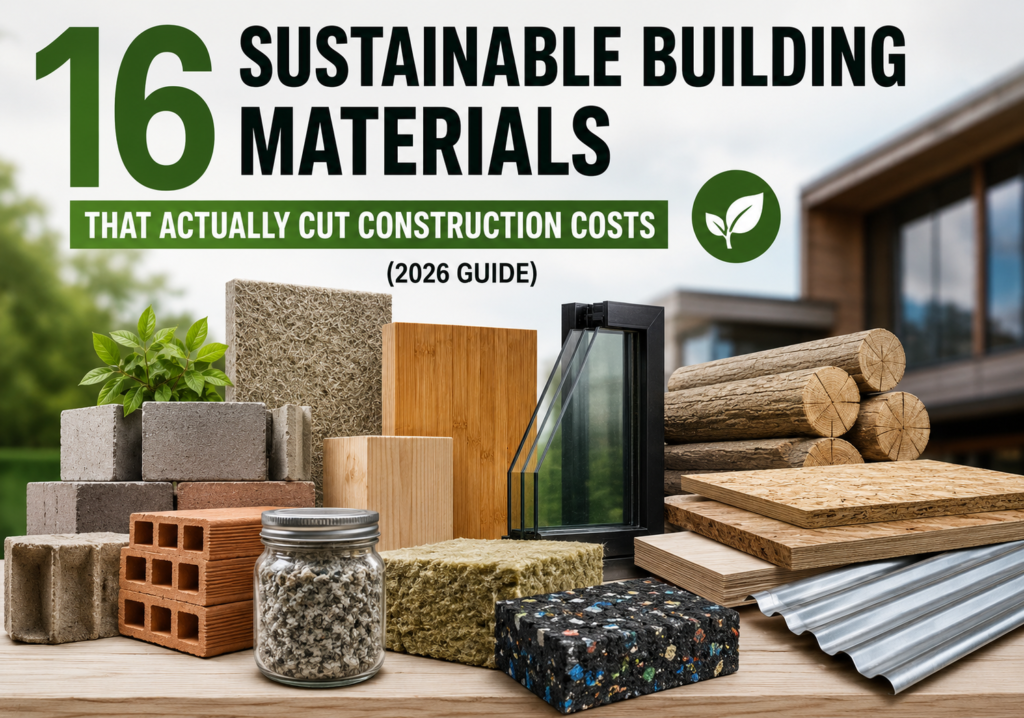
16 Sustainable Building Materials That Actually Cut Construction Costs (2026 Guide)
Sustainable building materials reduce embodied carbon, cut long-term costs, and help buildings qualify for Leadership in Energy and Environmental Design (LEED) certification. This guide covers 16 materials with actual cost-per-square-foot data, carbon scores, and workability ratings that most competitors skip entirely.
How to Choose the Right Sustainable Material
3 factors decide the right material for any project.
1. Climate zone first. Hempcrete works best in temperate climates like the UK and Pacific Northwest USA. Rammed earth and CEB perform best in hot-dry zones. Straw bale excels in continental climates with cold winters. Match thermal properties to the local climate before evaluating anything else.
2. Structural role second. CLT and recycled steel carry structural loads. Hempcrete, straw bale, and cork handle insulation only. Misassigning structural roles is the most common and most expensive mistake on first sustainable builds.
3. Budget over 30 years, not upfront. Bamboo flooring costs $2 to $4/sq ft installed and lasts 25 to 50 years with zero maintenance. Carpet costs $3 to $5/sq ft but needs full replacement every 10 to 12 years. The 30-year total cost of bamboo is 60% lower than carpet, even though the upfront prices are similar.
The Problem With Conventional Construction
Concrete alone produces 8% of global CO2 emissions. Steel manufacturing adds another 7 to 9%. Together, these two materials make construction one of the dirtiest industries on the planet.
Embodied carbon is the CO2 released before a building opens its doors. It accounts for 10% of all global energy-related CO2. Architects and contractors who ignore this number are building problems into every project they touch.
16 proven alternatives exist right now. Most cost less than concrete over a 30-year lifespan, and several actively pull carbon out of the air instead of releasing it.
How to Read Each Material Entry
Each material below includes 4 data points most competitors skip:
- Carbon Score: CO2 absorbed vs emitted (negative = carbon-absorbing)
- Cost Range: USD per square foot installed
- LEED Points: approximate contribution to LEED v4 certification
- Workability: contractor ease-of-use rating (1 = specialist only, 10 = general builder)
16 Sustainable Building Materials for 2026
1. Bamboo
Carbon Score: -5 to -8 kg CO2/kg | Cost: $2 to $4/sq ft | LEED Points: 2 to 4 | Workability: 8/10
Bamboo reaches full structural maturity in 3 to 5 years and hits 28,000 psi tensile strength, which matches mild steel. Builders use bamboo for flooring, wall panels, structural frames, and cabinetry. The entire stem gets used with zero processing waste, and any offcuts are 100% biodegradable.
Raw bamboo needs treatment against moisture and insects. Untreated bamboo in wet climates degrades within 2 to 3 years. For structural applications, always specify treated, cross-laminated bamboo.
Best for: flooring, wall cladding, light structural frames in dry climates.
2. Cross-Laminated Timber (CLT) / Mass Timber
Carbon Score: -15 to -25 kg CO2/kg | Cost: $15 to $22/sq ft | LEED Points: 3 to 6 | Workability: 6/10
CLT panels store carbon rather than releasing it. The 86.6-metre Ascent Tower in Milwaukee confirmed that a 25-storey CLT building sequesters more CO2 than construction emits. CLT also weighs 20% less than concrete at equivalent load-bearing capacity, and prefabricated panels cut on-site construction time by 25 to 30%.
Standard carpentry crews need 2 to 3 days of training before working with CLT connections. That is a small investment for a material that cuts a building’s structural carbon footprint by half.
Best for: multi-storey residential, commercial buildings, modular construction.
3. Hempcrete
Carbon Score: -110 kg CO2/tonne | Cost: $10 to $15/sq ft | LEED Points: 3 to 5 | Workability: 7/10
Hempcrete is a mixture of hemp hurds, lime, and water. During the hemp plant’s growth cycle, it absorbs 110 kg of CO2 per tonne, making hempcrete carbon-negative before a single block gets installed.
Hempcrete walls naturally maintain 45 to 55% indoor humidity without mechanical systems, cutting HVAC costs by 30 to 40% in temperate climates. Hempcrete is not load-bearing though. It works as infill insulation within a timber or steel frame, not as a structural wall material.
Best for: residential walls, insulation panels, eco-homes, passive house construction.
4. Ferrock
Carbon Score: -200 kg CO2/tonne | Cost: $8 to $12/sq ft | LEED Points: 4 to 6 | Workability: 5/10
Ferrock is produced from waste steel dust and silica. It is 5 times stronger than Portland cement and pulls CO2 from surrounding air while curing. Standard concrete releases CO2 during setting. Ferrock does the exact opposite.
Marine engineers use ferrock in seawater-exposed structures because ferrock resists saltwater corrosion better than standard concrete. Sourcing requires specialist suppliers. South Asian availability is limited to 3 to 4 importers as of 2026.
Best for: foundations, marine structures, high-strength paving, concrete replacement.
5. Rammed Earth
Carbon Score: Near zero | Cost: $12 to $18/sq ft | LEED Points: 2 to 4 | Workability: 5/10
Rammed earth walls are built by compressing layers of gravel, clay, sand, and lime into formwork at 2 to 3 tonne pressure. These walls last centuries. The oldest verified rammed earth structure in Yemen dates to the 8th century.
Soil often comes directly from the building site’s own excavation, dropping transport emissions to near zero. Walls between 300 and 600mm thick absorb daytime heat and release it overnight, cutting heating costs by 35 to 50% in continental climates.
Best for: walls in hot-dry and temperate climates, residential builds, heritage-style architecture.
6. Straw Bale
Carbon Score: -150 kg CO2/tonne | Cost: $5 to $9/sq ft | LEED Points: 2 to 4 | Workability: 6/10
Straw bale insulation achieves R-30 to R-35 values, 3 times higher than standard fiberglass batts. Dense compressed bales contain no oxygen inside the wall cavity, which makes straw bale walls genuinely fire-resistant. Standard fire tests record 90-minute ratings.
Straw bale houses built in Nebraska in the 1880s still stand today. The critical challenge is moisture. Straw bale walls need breathable lime render on both faces. Cement render traps moisture and causes rot from the inside.
Best for: residential insulation, passive solar homes, rural builds.
7. Recycled Steel
Carbon Score: 35% lower than virgin steel | Cost: $6 to $9/sq ft | LEED Points: 3 to 5 | Workability: 7/10
Recycled steel uses 75% less energy to produce than virgin steel and retains 100% of original strength through multiple recycling cycles. Construction consumes 40% of all steel produced globally. Switching to recycled stock cuts the construction sector’s steel-related emissions by 35% without changing any structural specification.
Recycled steel is available in all standard structural grades including I-beams, H-beams, hollow sections, and rebar. No specialist sourcing is needed in the UK or USA.
Best for: structural frames, bridges, roofing, prefabricated housing, skyscrapers.
8. Cork
Carbon Score: -73 kg CO2/tonne | Cost: $3 to $7/sq ft | LEED Points: 2 to 3 | Workability: 9/10
Cork harvesting never kills the tree. Bark strips regenerate every 9 to 12 years, making cork one of the few building materials that gets more sustainable with each harvest cycle.
Cork contains suberin, a natural substance that repels insects, mold, and mites without any chemical treatment. On the acoustic side, a 25mm cork panel reduces airborne sound transmission by 18 to 22 dB, which matters significantly in residential and office interiors.
Best for: flooring, wall panels, insulation, acoustic treatment, roof tiles.
9. Sheep’s Wool Insulation
Carbon Score: -1.8 kg CO2/kg | Cost: $4 to $8/sq ft | LEED Points: 2 to 3 | Workability: 9/10
Sheep’s wool absorbs and releases moisture without losing its thermal performance. Mineral wool loses R-value when wet. Sheep’s wool at 65% moisture content still maintains 90% of its insulation rating, which is a meaningful difference in humid UK and coastal climates.
Wool insulation permanently absorbs formaldehyde from indoor air and converts it into safe amino acids. Buildings insulated with sheep’s wool show 15 to 20% lower Volatile Organic Compound (VOC) levels compared to synthetic alternatives.
Best for: loft insulation, wall cavities, acoustic panels, eco-renovations.
10. Compressed Earth Blocks (CEB)
Carbon Score: Near zero | Cost: $3 to $6/sq ft | LEED Points: 2 to 4 | Workability: 7/10
CEB production needs only a hydraulic press and dry subsoil with no kiln firing and no chemical treatment required. On-site production cuts transport emissions to zero and reduces material costs by 40 to 60% compared to fired brick.
CEBs pass ASTM E119 fire tests at 4-hour ratings. Water resistance is the one known weakness. In high-rainfall zones, CEBs need a lime plaster or cement render coat.
Best for: load-bearing walls in dry climates, low-cost housing, community construction projects.
11. Recycled Plastic Lumber (RPL)
Carbon Score: Diverts 1 tonne of plastic per 500 sq ft | Cost: $4 to $8/sq ft | LEED Points: 2 to 4 | Workability: 8/10
RPL is manufactured from High-Density Polyethylene (HDPE), the plastic found in milk jugs and detergent bottles. The finished product is 100% rot-proof, needs zero staining or sealing, and never splinters. Every tonne of RPL produced keeps 1 tonne of plastic out of landfill.
RPL decking outlasts pressure-treated timber by 15 to 20 years with no maintenance at all.
Best for: decking, fencing, outdoor furniture, marine boardwalks, playground equipment.
12. Recycled Glass
Carbon Score: 30% lower than virgin glass | Cost: $5 to $10/sq ft | LEED Points: 2 to 3 | Workability: 7/10
Recycling glass uses 30% less energy than producing new glass with no loss of strength or quality. Recycled glass tiles and countertops come from discarded bottles and broken windows.
Adding glass aggregate to concrete mixes produces glass concrete, which improves compressive strength by 10 to 15% while cutting cement content by 20%. This is one of the simplest ways to reduce a concrete project’s carbon footprint without changing the structural specification.
Best for: countertops, floor tiles, wall panels, glass concrete aggregate.
13. Mycelium Composites
Carbon Score: -1.2 kg CO2/kg | Cost: $6 to $14/sq ft | LEED Points: 3 to 5 | Workability: 6/10
Mycelium is the root network of fungi. When grown on agricultural waste like corn husks or sawdust, mycelium binds that material into rigid, lightweight panels. The production process needs no heat, no synthetic glue, and no chemicals.
Dried mycelium panels are water-resistant, fire-resistant, and fully biodegradable at end of life. Ecovative Design’s mycelium insulation panels achieve R-3 to R-5 per inch, placing them in the same performance range as Expanded Polystyrene (EPS) foam. Commercial-scale mycelium production is available in the UK, USA, and Netherlands as of 2026.
Best for: insulation panels, acoustic tiles, interior wall panels.
14. Cob / CobBauge
Carbon Score: Near zero | Cost: $5 to $10/sq ft | LEED Points: 2 to 3 | Workability: 6/10
Cob combines subsoil, sand, straw, and lime into monolithic walls with near-zero embodied carbon. The oldest surviving cob house in the UK dates to the 15th century, over 600 years of real-world performance data.
CobBauge is the re-engineered version from the University of Plymouth. It uses a two-layer wall with structural outer cob and a high-insulation inner hemp-lime layer. This combination meets UK Part L building regulations for thermal performance, which traditional cob alone cannot do.
Best for: low-carbon self-builds, natural architecture, retrofit insulation in heritage buildings.
15. Fly Ash Concrete
Carbon Score: 30 to 40% lower than OPC concrete | Cost: $4 to $7/sq ft | LEED Points: 2 to 4 | Workability: 8/10
Fly ash is a byproduct of coal power plants. Adding fly ash to concrete replaces up to 50% of Ordinary Portland Cement (OPC), the highest-emission ingredient in standard concrete. Fly ash concrete achieves higher long-term compressive strength than standard concrete while cutting CO2 output by 30 to 40%.
Over 130 million tonnes of fly ash are produced in the USA alone each year. Most goes to landfill. Using fly ash in construction diverts that industrial waste while simultaneously reducing cement demand.
Best for: foundations, paving, structural concrete, road construction.
16. Plant-Based Polyurethane Rigid Foam (Bio-Foam)
Carbon Score: 20 to 25% lower than petrochemical foam | Cost: $7 to $12/sq ft | LEED Points: 2 to 4 | Workability: 7/10
Standard polyurethane foam is petrochemical-based and takes 500 or more years to decompose. Bio-foam replaces those petrochemical inputs with bamboo, hemp, and castor oil derivatives. Thermal performance matches standard foam at R-6 to R-7 per inch.
Bio-foam requires zero process change. Contractors use the same spray equipment and same application method. It slots directly into any project where petrochemical foam was previously specified.
Best for: cavity wall insulation, roofing insulation, spray-applied thermal barriers.
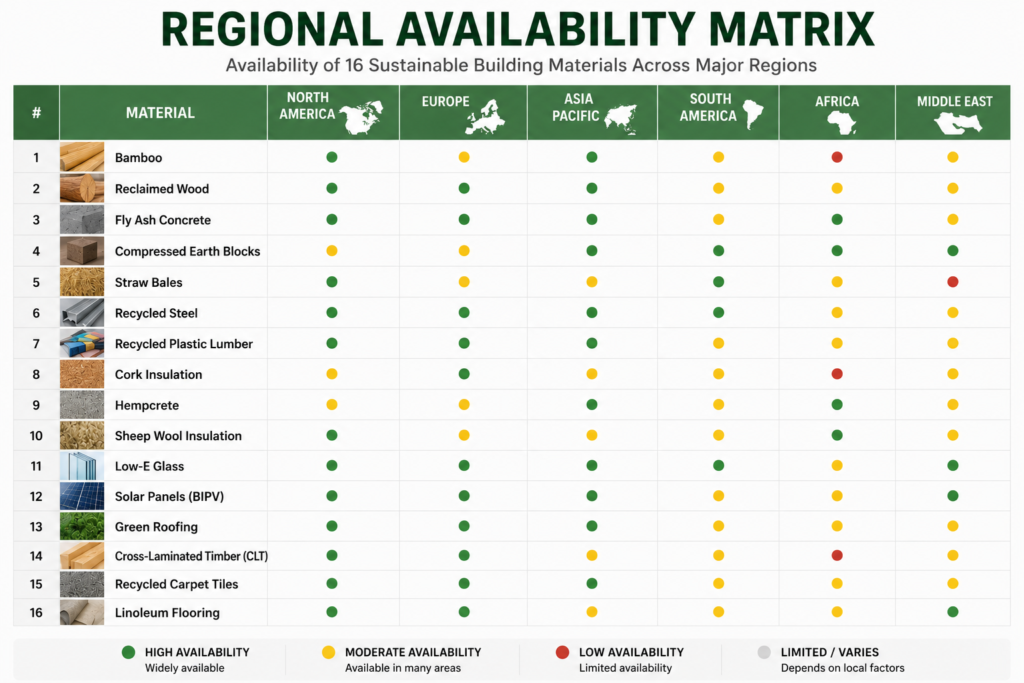
Regional Availability Matrix
| Material | UK | USA | South Asia |
| Bamboo | Imported | Wide | Native supply |
| CLT / Mass Timber | Wide | Wide | Limited |
| Hempcrete | Wide | Growing | 3 to 4 suppliers |
| Ferrock | Specialist only | Specialist only | Very limited |
| Rammed Earth | Wide | Wide | Traditional use |
| Straw Bale | Rural areas | Wide | Agricultural zones |
| Recycled Steel | Wide | Wide | Wide |
| Cork | Wide | Wide | Imported only |
| Sheep’s Wool | Native supply | Available | Limited |
| CEB | Growing | Growing | Wide |
| Recycled Plastic Lumber | Wide | Wide | Growing |
| Recycled Glass | Wide | Wide | Limited |
| Mycelium | UK suppliers | USA suppliers | Not yet commercial |
| Cob / CobBauge | Wide | Southwest USA | Traditional |
| Fly Ash Concrete | Wide | Wide | Wide |
| Bio-Foam | Growing | Growing | Imported |
Cost Comparison: All 16 Materials
| Material | Cost/sq ft (USD) | 30-Year Maintenance | Vs. Concrete |
| Bamboo | $2 to $4 | Low | 40% cheaper |
| Straw Bale | $5 to $9 | Low | 20% cheaper |
| Rammed Earth | $12 to $18 | Very Low | Similar |
| CLT / Mass Timber | $15 to $22 | Low | 10 to 15% more |
| Hempcrete | $10 to $15 | Very Low | 15% more |
| Ferrock | $8 to $12 | Very Low | Similar |
| Recycled Steel | $6 to $9 | Low | 10% cheaper |
| Cork | $3 to $7 | Very Low | 50% cheaper |
| Sheep’s Wool | $4 to $8 | Zero | 30% cheaper |
| CEB | $3 to $6 | Low | 50% cheaper |
| Recycled Plastic | $4 to $8 | Zero | 30% cheaper |
| Recycled Glass | $5 to $10 | Low | Similar |
| Mycelium | $6 to $14 | Low | 10 to 20% more |
| Cob | $5 to $10 | Low | 30% cheaper |
| Fly Ash Concrete | $4 to $7 | Low | 20% cheaper |
| Bio-Foam | $7 to $12 | Very Low | 10% more |
Standard concrete installed cost runs $8 to $12/sq ft for reference.
FAQ
Q: Which sustainable building material has the lowest carbon footprint?
Ferrock leads at -200 kg CO2/tonne. It absorbs more carbon while curing than its entire production process releases. Hempcrete ranks second at -110 kg CO2/tonne.
Q: Does sustainable construction cost more?
No. Upfront costs run 5 to 15% higher for some materials, but 30-year lifecycle costs are 20 to 40% lower. Hempcrete cuts HVAC bills by 30 to 40%. Recycled plastic lumber needs zero maintenance for 30 or more years.
Q: Which materials earn LEED certification points?
All 16 materials in this guide contribute LEED v4 points. CLT and ferrock contribute the most at 4 to 6 points each. Bamboo, recycled steel, and mycelium contribute 2 to 5 points depending on sourcing documentation.
Q: Is bamboo structurally strong enough for real buildings?
Yes. Treated, cross-laminated bamboo reaches 28,000 psi tensile strength, matching mild steel. Multi-storey bamboo buildings stand in Colombia, China, and Indonesia. Raw untreated bamboo is not suitable for structural use.
Q: What exactly is embodied carbon?
Embodied carbon is the CO2 released during material production, transport, and installation before a building opens. It accounts for 10% of all global energy-related CO2. Most efficiency conversations focus on operational energy, but embodied carbon is the larger near-term problem for new construction projects.
Q: Can sustainable materials meet standard building codes?
Yes. CLT meets International Building Code (IBC) requirements for buildings up to 18 storeys. Fly ash concrete meets all standard compressive strength grades. CobBauge meets UK Part L thermal regulations. Always confirm local code requirements with a structural engineer before specifying any new material.
Q: Which material works best in South Asia’s climate?
Rammed earth and CEB perform best because both have established local supply chains across the region. Bamboo is a strong second given its native supply. All 3 handle heat, humidity, and monsoon conditions when finished with lime render.
Q: Is mycelium insulation available for residential projects today?
Yes, in the UK and USA. Ecovative Design (USA) and Biohm (UK) both supply residential quantities at $6 to $14/sq ft installed with 4 to 8 week lead times. Mycelium is not yet commercially available in South Asia.
Conclusion
Sustainable building materials are not a passing phase. They are the direction the entire construction industry is moving toward, and the pace is picking up. Governments are tightening embodied carbon regulations. LEED and Building Research Establishment Environmental Assessment Method (BREEAM) requirements add new thresholds with every revision cycle. Contractors and architects who specify these 16 materials now stay ahead of every code update coming between 2026 and 2030.
The data removes the guesswork. Ferrock absorbs more CO2 than it emits. CLT builds 25-storey towers at lower structural weight than concrete. Hempcrete cuts HVAC bills by 30 to 40%. Recycled plastic lumber delivers 30 years of zero-maintenance performance. These results come from real built projects across the UK, USA, and Europe.
3 decisions drive every successful sustainable specification: match the material to the climate zone, confirm the structural role, and calculate the 30-year cost rather than the upfront price. Every material in this guide beats standard concrete on that 30-year number.
Construction produces 38% of global CO2. Most of that figure is set at the specification stage, before a single wall goes up. One project switching from standard concrete to CLT or hempcrete cuts embodied carbon by 30 to 70%. Multiply that across an industry and the impact becomes measurable at a national level.