How to Measure Concrete: Get the Right Amount Every Time
Ordering too little concrete stops your project cold. Ordering too much wastes hundreds of dollars. The fix is simple math — and this guide walks you through every step.
Whether you’re pouring a patio, setting fence posts, or building footings, the same 3-number formula applies. No engineering degree needed.
Table of Contents
ToggleWhat “Measuring Concrete” Actually Means
Measuring concrete means calculating cubic yards (or cubic feet) of material your project needs before you order or mix anything.
Concrete volume depends on 3 things: length, width, and depth of the area you’re filling. Get those 3 numbers right and everything else follows automatically. Most beginners measure square footage and stop there. That’s wrong — depth changes everything. A 100 sq ft patio at 4 inches thick needs completely different amounts than the same patio at 6 inches thick.
The 3 Numbers You Need Before Anything Else
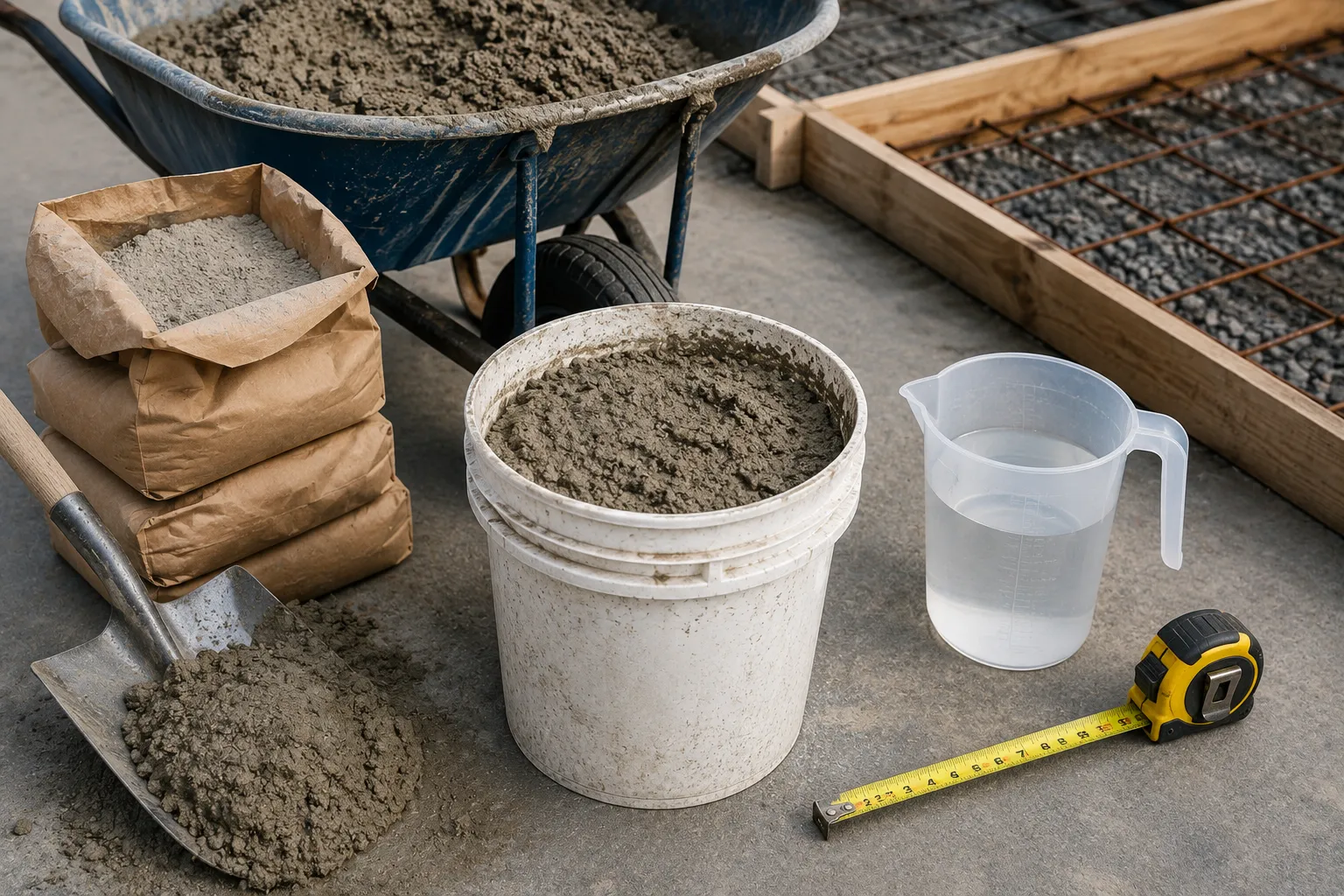
Grab a tape measure and write down: Length : longest side of your project area, in feet Width — shorter side, in feet Depth (thickness) : how deep the concrete goes, in inches Convert depth to feet before calculating. Divide inches by 12. So 4 inches becomes 0.33 ft. Six inches becomes 0.5 ft. That’s it. Three numbers, and you’re ready to calculate.
The Basic Formula (Takes 30 Seconds)
Multiply length × width × depth (in feet). That gives you cubic feet. Divide by 27 to convert to cubic yards.
- Formula: (Length × Width × Depth) ÷ 27 = Cubic Yards
- Example: 10 ft long × 10 ft wide × 0.33 ft deep (4 inches) ÷ 27 = 1.23 cubic yards
One cubic yard equals 27 cubic feet. Ready-mix suppliers sell by the yard. Bags come in 40 lb (0.30 cu ft), 60 lb (0.45 cu ft), and 80 lb (0.60 cu ft) sizes.
The magic number for 4-inch slabs: Divide total square footage by 81. That gives cubic yards directly. A 200 sq ft slab ÷ 81 = 2.47 cubic yards. Fast, accurate, field-tested.
How to Measure Concrete for a Slab
Slabs cover patios, driveways, garage floors, and walkways. Standard residential thickness is 4 inches (10 cm). Heavy vehicle traffic needs 6 inches (15 cm).
- Step 1: Measure length and width in feet.
- Step 2: Divide your thickness in inches by 12 to get feet.
- Step 3: Multiply all three numbers.
- Step 4: Divide by 27. Step 5: Add 10% for safety.
Real example — 12×20 ft driveway at 6 inches: 12 × 20 × 0.5 = 120 cu ft ÷ 27 = 4.44 cubic yards Add 10% → 4.88 cubic yards to order
For odd-shaped areas, break the shape into rectangles. Calculate each rectangle separately, then add the totals. A curved driveway that’s 16 ft wide at the top and 12 ft at the bottom averages 14 ft — use that center measurement.
How to Measure Concrete for Footings
Footings support structures — decks, walls, columns. They’re rectangular trenches filled with concrete. Use the same formula: length × width × depth ÷ 27.
- Example — 20 ft long footing, 12 inches wide, 12 inches deep: 20 × 1.0 × 1.0 = 20 cu ft ÷ 27 = 0.74 cubic yards
For multiple footings, calculate one and multiply. Four identical footings at 0.74 yards each = 2.96 yards total. Steps attached to a porch? Calculate the porch surface with the slab formula. Calculate the step sides with the footing formula. Add both numbers together.
How to Measure Concrete for Fence Posts
Round post holes need a different calculation because volume of a cylinder = π × radius² × depth.
- Simplified: For a standard 10-inch diameter hole, 3 ft deep — you need roughly 0.016 cubic yards per hole.
Practical shortcut: For post setting, use 1 bag of 50 lb (23 kg) fast-setting concrete per post for holes up to 10 inches wide and 3 ft (0.9 m) deep. For 12-inch holes at 4 ft (1.2 m) depth, use 2 bags per post. Always add one extra bag per every 10 posts — spillage and uneven holes are guaranteed.
Bags or Ready-Mix — Which One Do You Need?
- Use bags for projects under 1 cubic yard. Small patios, walkways, footings, post setting — bags make sense. You mix at your pace, no truck deadline.
- Use ready-mix for anything over 1 cubic yard. Driveways, garage floors, large slabs — mixing bags by hand is slow, inconsistent, and physically brutal. One ready-mix truck delivers the job in minutes.
- Cost comparison: 80 lb bag costs roughly $6–$8 and yields 0.60 cu ft. One cubic yard needs roughly 45 bags = $270–$360 in bags alone, plus your labor. Ready-mix runs $125–$175 per cubic yard delivered. On large jobs, ready-mix always wins on cost and quality.
Pro tip from concrete contractors: call your local ready-mix plant, give them your square footage and thickness, and they calculate the yardage for you at no charge.
The 10% Rule Every Pro Uses
Never order the exact amount you calculate. Add 10% to every order, every time.
Three reasons this matters:
Ground is never perfectly level. Low spots swallow extra concrete. Slab depth varies by half an inch across a pour — that adds up fast on large projects. Spillage happens. Concrete sticks to chutes, barrows, and tools. You lose material in transfer.
Running short mid-pour forces you to stop, order emergency concrete, and risk cold joints — weak seams where fresh concrete meets partially set concrete. Cold joints fail over time. A 20-yard order finishing with 1 yard left over is a good order. A 20-yard order running short by half a yard is an expensive mistake.
5 Measuring Mistakes That Cost You Money
- Mistake 1: Measuring in inches without converting to feet. Plugging 4 inches directly into the formula (instead of 0.33 ft) gives results 12 times too high. Always divide inches by 12 first.
- Mistake 2: Ignoring subgrade variation. Your ground isn’t perfectly flat. Measure depth at 4–5 spots and use the average, not just one measurement.
- Mistake 3: Skipping the 10% buffer. Even experienced contractors add it. One short load ruins a day’s work.
- Mistake 4: Calculating bags by weight instead of volume. A 60 lb bag and an 80 lb bag don’t produce the same volume. Check the yield on the bag label — always go by cubic feet, not pounds.
- Mistake 5: Forgetting to account for forms and rebar. Forms and reinforcement steel displace concrete volume slightly on large pours. On projects over 10 yards, factor in roughly 2–3% extra for displacement.
Pro Tips Straight from the Job Site
- Tip 1: Use the 81 rule for 4-inch slabs. Square footage ÷ 81 = cubic yards. No calculator needed on-site.
- Tip 2: Order concrete in whole yards. Ready-mix plants charge a short-load fee for orders under 3–4 yards. Combine small adjacent projects into one order when possible.
- Tip 3: Check weather before pouring. Concrete needs temperature between 50°F (10°C) and 90°F (32°C) to cure correctly. Pouring outside this range changes how much material you need and how fast it sets.
- Tip 4: Wet the subgrade before pouring. Dry soil pulls moisture from concrete, weakening it. A damp — not soaked — base improves your final slab.
- Tip 5: Write your measurements down. Contractors who calculate in their head misorder concrete twice as often. Write length, width, depth, calculated yards, and +10% buffer before calling the supplier.
FAQ
How do I calculate how much concrete I need for a 10×10 slab?
A 10×10 ft slab at standard 4-inch thickness needs 1.24 cubic yards — about 56 bags of 80 lb concrete. At 6 inches thick, you need 1.85 cubic yards (84 bags).
What is 1 cubic yard of concrete?
One cubic yard equals 27 cubic feet and weighs roughly 4,000 lb (1,814 kg). It covers 81 sq ft at 4-inch thickness.
How many 80 lb bags make 1 cubic yard?
45 bags of 80 lb concrete make 1 cubic yard. Each 80 lb bag yields 0.60 cu ft.
Should I order bags or ready-mix?
Order bags for jobs under 1 cubic yard. Order ready-mix for anything larger — it’s cheaper per yard and physically easier on big pours.
What is the standard concrete slab thickness?
Residential patios and walkways use 4 inches (10 cm). Driveways use 5–6 inches (13–15 cm). Commercial or heavy-load slabs use 6–8 inches (15–20 cm).
Why add 10% extra when ordering concrete?
Uneven ground, spillage, and slight depth variations consume the extra. Running short mid-pour creates cold joints — structural weak points that crack over time.
Can I calculate concrete in metric units?
Yes. Formula stays the same: length (m) × width (m) × depth (m) = cubic meters. One cubic meter equals 1.31 cubic yards. A 3m × 3m patio at 10 cm (0.1 m) depth = 0.9 cubic meters.
Conclusion
Wrong concrete measurement kills projects. You either run short mid-pour — creating cold joints that crack for years — or you waste hundreds of dollars on unused material.
The fix takes 5 minutes: Length × width × depth (in feet) ÷ 27 = cubic yards. Add 10%. Decide between bags or ready-mix based on whether your total crosses 1 cubic yard. That’s the entire system pros use on every job. One tape measure, three numbers, and this formula — you’ll never misorder concrete again.

Rachel Park
Rachel Park leads sustainability, roofing, and building materials content at Constructionspedia, drawing on over 10 years of commercial and residential construction experience. She holds an M.S. in Sustainable Building Systems from UC Berkeley and is a LEED AP BD+C, specializing in roofing systems, insulation, waterproofing, and energy-efficient materials. Her research-backed guides help homeowners and industry professionals make informed decisions about construction and green building.
Related Posts