What Is Modular Construction? The Complete 2026 Guide
Modular construction builds structures in a factory, ships them to a site, and assembles them in days, not months. The result? Buildings completed 30-50% faster, with 10-20% lower costs and up to 90% less material waste than traditional construction.
Most people still picture temporary site cabins when they hear “modular.” That picture is outdated. In 2026, modular buildings serve hospitals, universities, military bases, and 20-story apartment blocks. The global modular construction market hit $130 billion in 2025 and continues growing, driven by housing shortages, skilled labour gaps, and net-zero building targets.
This guide covers how modular construction works, real 2026 costs, building types, industries using it, honest disadvantages, and where the industry is heading.
How Modular Construction Works — Step by Step
Most guides skip the actual process. Here are the 4 phases every modular project follows.
Phase 1: Design & Engineering
Every modular project starts with Design for Manufacture and Assembly (DfMA) — a method that plans factory production and on-site assembly simultaneously. Engineers use Building Information Modeling (BIM) software to create 3D models, check tolerances, and catch errors before a single panel gets cut.
Standard buildings take 4–8 weeks in this phase. Complex multi-story projects take up to 12 weeks. Getting design right eliminates expensive rework later.
Phase 2: Factory Manufacturing — 60–90% of Work Happens Here
The factory builds modules while site preparation — foundations, utilities, groundwork — runs in parallel. This overlap cuts total project time by 30–50%.
Inside the factory, workers install:
- Structural frames in steel, wood, or concrete
- Electrical wiring and plumbing systems
- Heating, ventilation, and air conditioning (HVAC)
- Interior finishes, flooring, and fixtures
- Windows and exterior cladding
Quality control (QC) checks run at every production stage. Independent inspectors test structural integrity, fire resistance, and energy performance before modules leave the facility.
Phase 3: Transport & On-Site Assembly
Completed modules travel by flatbed truck to the site. A crane lifts each module onto the prepared foundation. Workers connect units using inter-module connections — bolted steel joints that tie the structure together permanently.
On-site assembly takes 3–10 days for smaller buildings. A 5-story structure takes 4–6 weeks to stack, connect, and weatherproof.
Phase 4: Inspection & Handover
Local building inspectors verify the completed structure against all applicable codes. Modular buildings meet or exceed the same building codes as site-built structures — including accessibility, fire safety, and energy efficiency standards.
2 Types of Modular Construction Explained
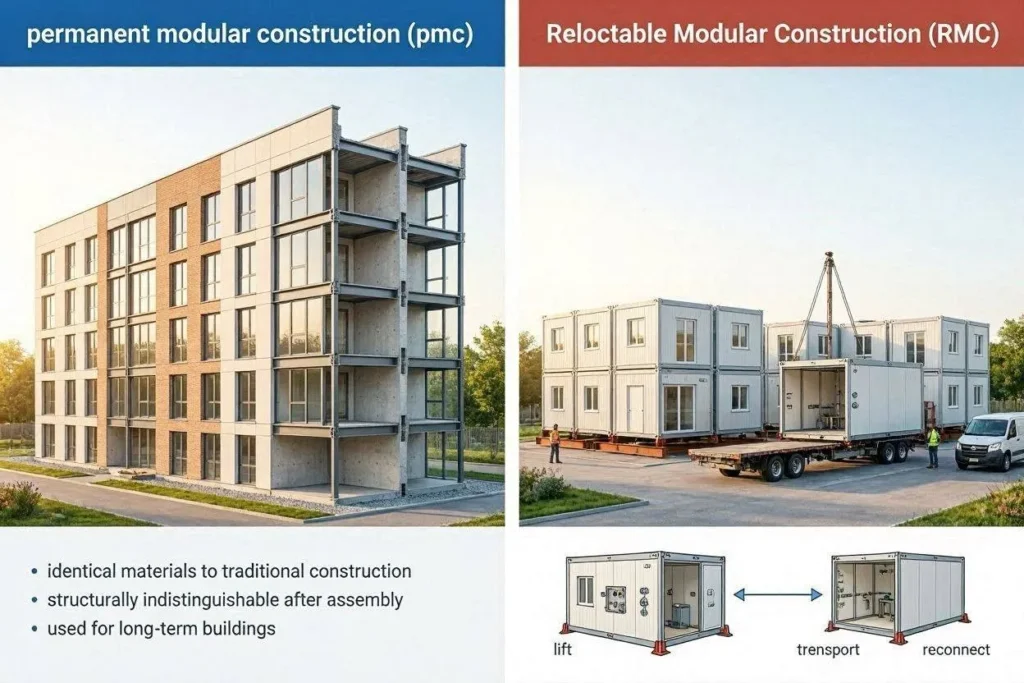
Permanent Modular Construction (PMC)
PMC buildings stay in one location permanently. Engineers design PMC structures using steel, wood, and concrete — identical materials to traditional construction. Once assembled, a PMC building is structurally and visually indistinguishable from a conventionally built one.
PMC projects include:
- Multi-story apartment buildings up to 20+ storeys
- School classrooms and full campuses
- Hospitals, medical clinics, and diagnostic centres
- Hotels and student accommodation
- Office complexes exceeding 100,000 sq ft
Relocatable Buildings (RB)
Relocatable buildings are designed to move. Each module is a self-contained unit with electrical, plumbing, and HVAC pre-installed. When requirements change, the building disconnects at its mate lines, lifts off the foundation, and transports to a new site.
Common RB uses include:
- Temporary school classrooms
- Construction site offices
- Military forward-operating bases
- Disaster relief shelters
- Pop-up medical and retail units
Modular Construction vs Traditional Construction — 6 Key Differences
The biggest advantage modular has over traditional construction is simultaneous building. The factory manufactures modules while the site is being prepared. Traditional construction does these steps one after the other — adding months to every project.
| Factor | Modular Construction | Traditional Construction |
| Build Time | 30–50% faster | Standard sequential timeline |
| Weather Impact | Zero — built indoors | Delays common |
| Quality Control | Factory QC at every stage | Variable, site-dependent |
| Material Waste | Up to 90% less | High — offcuts, packaging |
| Cost | 10–20% lower on average | Higher labour and time costs |
| Flexibility | Relocatable and expandable | Permanent, difficult to change |
7 Proven Benefits of Modular Construction

1. Speed — 30–50% faster completion: Site work and factory manufacturing run at the same time. A building that takes 18 months traditionally completes in 9–12 months with modular.
2. Cost savings — 10–20% lower total project cost: Reduced labour hours, bulk material purchasing, and zero weather delays cut costs significantly. Faster occupancy means faster return on investment (ROI).
3. Superior quality control: Factory environments allow precision manufacturing impossible on open construction sites. Every module passes independent inspection before leaving the facility.
4. Up to 90% less material waste: Factories control inventory precisely. Off-cuts get recycled within the facility. The UK’s WRAP organisation estimates modular construction reduces material waste by up to 90% compared to traditional builds.
5. Safer construction process: Moving 60–90% of construction indoors reduces worker exposure to falls, equipment accidents, and hazardous weather. Fewer workers on-site means lower liability and fewer injuries.
6. Genuine sustainability: Less waste, tighter construction tolerances, and better thermal insulation via Structural Insulated Panels (SIPs) make modular buildings inherently greener. Modules disassemble and repurpose — reducing demand for raw materials on future projects.
7. Flexibility and reusability Modular buildings expand, contract, and relocate. A healthcare clinic built today becomes a school annex tomorrow. No other construction method offers this level of long-term adaptability.
Ready to Start Your Modular Project?
Get a free consultation and cost estimate from our team. We match your requirements to the right modular solution — permanent or relocatable. [Get a Free Quote →]
How Much Does Modular Construction Cost in 2026?
No competitor gives real numbers. Here is an honest cost breakdown.
Cost by Building Type
| Building Type | Modular Cost (per sq ft) | Traditional Cost (per sq ft) |
| Office building | $95–$155 | $115–$185 |
| School / classroom | $85–$135 | $105–$165 |
| Healthcare clinic | $125–$210 | $155–$260 |
| Workforce housing | $75–$115 | $95–$145 |
| Retail unit | $80–$125 | $100–$155 |
5 Factors That Affect Modular Construction Cost
- 1. Building size: Larger projects cost less per sq ft. Economies of scale apply strongly in modular manufacturing.
- 2. Material specification: Steel frame costs more than wood frame. Both meet the same structural standards.
- 3. Transport distance: Moving modules more than 500 miles (800 km) adds 5–10% to total project cost.
- 4. Level of customisation: Standard floor plans cost less than fully bespoke designs. Most manufacturers offer 200+ ready-to-build plans.
- 5. Site conditions: Complex foundations or remote locations increase on-site preparation costs regardless of build method.
Industries That Use Modular Construction in 2026
Healthcare: Hospitals use PMC for new wards, diagnostic suites, and MRI buildings. Modular builds faster with less disruption to existing patients and staff. A modular medical clinic installs in 6–10 weeks versus 12–18 months traditionally.
Education: Schools expand with modular classrooms in weeks, not months. Full modular campuses now serve thousands of students across the US, UK, and Australia. Catholic University’s 124-bed modular student housing complex completed in under 6 months.
Military and Government: Armed forces use relocatable modular buildings for barracks, forward operating bases, and training facilities. Rapid deployment is non-negotiable — modular delivers.
Hospitality: Hotels from budget to luxury now use volumetric modular construction. Bathroom pods manufactured off-site cut hotel build times by 40%. IHG, Marriott, and CitizenM have all used modular for new properties.
Remote and Resource Industries: Mining camps, oil fields, and remote research stations depend on modular construction. Building on-site in these locations is impractical and expensive. Modular solves both problems.
Retail: Quick-service restaurants and bank branches use modular units to open new locations in 6–10 weeks rather than 6–9 months. McDonald’s and Starbucks both operate modular-built locations across North America.
4 Disadvantages of Modular Construction
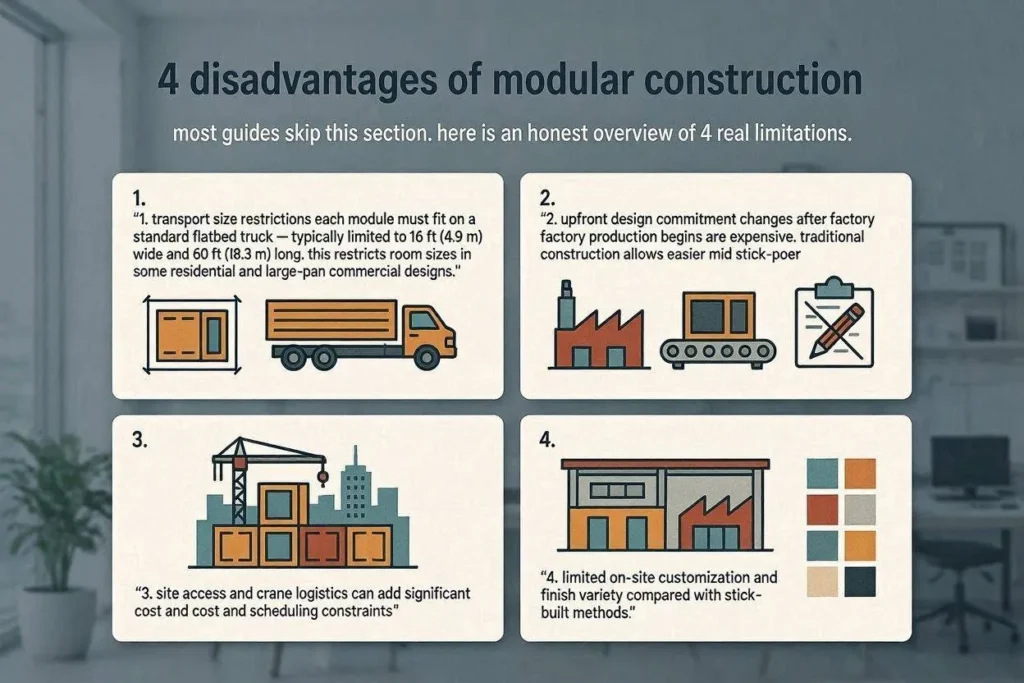
Most guides skip this section. Here is an honest overview of 4 real limitations.
1. Transport size restrictions Each module must fit on a standard flatbed truck — typically limited to 16 ft (4.9 m) wide and 60 ft (18.3 m) long. This restricts room sizes in some residential and large-span commercial designs.
2. Upfront design commitment Changes after factory production begins are expensive. Traditional construction allows easier mid-project adjustments. Modular requires precise, fully resolved decisions before manufacturing starts.
3. Limited contractor availability Fewer builders specialise in modular construction compared to traditional methods. In smaller markets, finding experienced modular contractors takes time and affects project timelines.
4. Financing and insurance complexity Some lenders and insurers treat modular buildings differently from site-built structures. Commercial loans and mortgages for modular projects can require additional documentation. This gap is closing in 2026 as modular adoption grows — but it remains a friction point for first-time buyers.
Do Modular Buildings Meet Building Codes?
Yes. Modular buildings meet or exceed the same building codes as site-built structures in every regulated market.
- United States — International Building Code (IBC) compliance. The MBI maintains a state-by-state code resource database covering all 50 states.
- United Kingdom — Building Regulations Parts A through R apply in full.
- Australia — National Construction Code (NCC) 2026 edition governs all modular builds.
Permanent modular buildings carry the same certifications as conventional structures — fire safety, structural load ratings, energy performance, and ADA accessibility. Independent third-party inspection occurs at the factory before any module leaves — an additional quality layer traditional construction does not have.
The Future of Modular Construction — 2026 Trends
No competitor covers this. The modular industry is moving fast across 5 fronts.
1. Robotics in factory manufacturing Automated welding, panel cutting, and module assembly now operate in leading facilities. Autovol’s Idaho plant uses robotics to produce 500–600 modules per year. Aerofilm Systems deploys air-caster transport technology that moves completed modules across factory floors without forklifts or cranes.
2. AI-assisted design AI tools generate DfMA-optimised floor plans in hours. Design errors that previously caused costly factory rework get caught in the digital model before production begins.
3. Net-zero modular buildings Factory precision creates tighter building envelopes than site construction achieves. In 2026, modular construction is the preferred delivery method for net-zero energy buildings — structures that produce as much energy as they consume annually.
4. Housing crisis response The US, UK, and Australia face severe housing shortages. Modular construction builds affordable housing 40–50% faster than traditional methods. The UK government allocated £1.5 billion to modular housing programmes in 2025. The US Department of Housing is funding 14 modular pilot projects in 2026.
5. Mass timber modular Cross-laminated timber (CLT) combined with modular construction cuts embodied carbon by up to 60% compared to steel or concrete. Timber modular buildings now reach 10+ storeys across Europe and North America — combining low carbon with fast delivery.
Conclusion
Modular construction is not a shortcut. It is a smarter build method, factory-controlled, code-compliant, and proven across healthcare, education, military, and residential sectors worldwide.
The numbers speak for themselves. 30–50% faster. 10–20% cheaper. 90% less waste. Buildings lasting 50–100 years, meeting the same codes as any site-built structure.
In 2026, with construction costs rising and housing demand outpacing supply, modular is no longer an alternative method, it is the practical one. If you are planning a build, compare modular costs against traditional quotes. The difference will make the decision for you.
Frequently Asked Questions

Related Posts