What does a concrete cost calculator estimate?
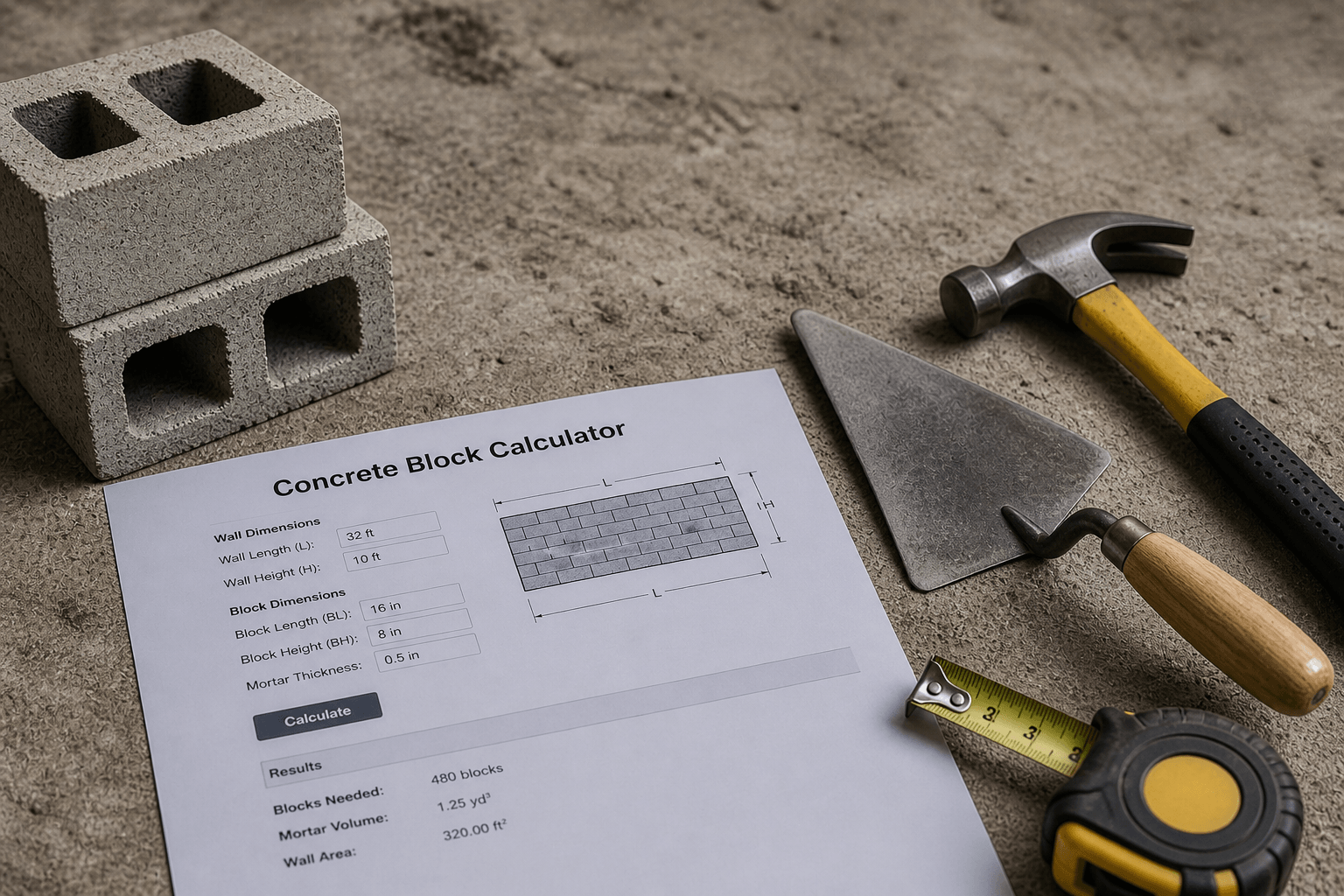
A concrete cost calculator estimates total project cost by adding 4 components: material cost (per cubic yard), delivery and short-load fees, admixture surcharges, and labor and finishing. Most online calculators only show material cost — this calculator includes all 4 components so your budget reflects the actual invoice, not just the concrete price.
The most common budgeting mistake on concrete projects is planning only for the per-yard price. A 3-yard residential pour at $152/yd looks like a $456 material cost. Add a short-load fee ($150), Saturday delivery ($100), pump truck ($275), and finishing labor ($1,200) and the real project cost is $2,181 — 4.8x the material price alone.
How to use this calculator — 5 steps
- 1Enter project dimensions — length and width in feet, thickness in inches. The calculator converts thickness to feet and calculates cubic yards automatically.
- 2Select concrete strength (PSI) — 3,000 PSI is correct for most residential slabs, patios, and walkways. Use 3,500–4,000 PSI for driveways and garage floors. Each 500 PSI step adds roughly $8–$15 per cubic yard.
- 3Select your US region — concrete prices vary 25–35% between Southeast and West Coast. The regional base price adjusts your per-yard cost before PSI premium is applied.
- 4Check additional cost items — pump truck, weekend delivery, fiber reinforcement, integral color, air entrainment, and winter surcharge are all priced separately. Check only what applies to your project.
- 5Select labor type and finish — leave as "No labor" for DIY projects. For professional installation, basic flatwork runs $6–$8/sq ft, stamped concrete runs $12–$16/sq ft.
2026 ready-mix concrete prices by region
Ready-mix concrete costs $125–$175 per cubic yard delivered for standard 3,000 PSI mix in 2026, with the national average at approximately $150–$155/yd. Regional variation is driven by proximity to cement plants, aggregate quarries, and local labor markets.
| Region | States | Base price/yd (3,000 PSI) | 4,000 PSI | Notes |
|---|---|---|---|---|
| Southeast | FL, GA, AL, SC, MS | $125–$140 | $140–$158 | Lowest in US — abundant aggregate |
| Midwest | OH, IN, IL, MI, WI | $135–$150 | $150–$168 | Near national average |
| South Central | TX, OK, AR, LA | $135–$150 | $150–$165 | Texas urban markets higher |
| Mountain West | CO, UT, AZ, NV, NM | $140–$158 | $155–$175 | Transport distance adds cost |
| Mid-Atlantic | PA, MD, VA, NC, DC | $150–$168 | $165–$185 | Urban markets 10–15% higher |
| New England | NY, MA, CT, NJ, RI | $160–$180 | $175–$200 | Highest labor costs in US |
| West Coast | CA, WA, OR | $165–$200 | $180–$220 | Highest overall — fuel + labor |
*Prices last verified May 2026. Urban areas within each region run 10–20% above these averages. Always get 3 local quotes before ordering.
Concrete pricing by PSI strength
Every 500 PSI increase in concrete strength adds \$8–\$15 per cubic yard because higher PSI requires more Portland cement per batch — cement is the most expensive ingredient in the mix.
| PSI rating | Premium over base (per yd) | Best application | Mix ratio (cement:sand:aggregate) |
|---|---|---|---|
| 2,500 PSI | Base price | Sidewalks, non-structural fill | 1:3:5 |
| 3,000 PSI | +$8/yd | Standard residential slabs, patios | 1:2:4 |
| 3,500 PSI | +$15/yd | Driveways, garage floors | 1:2:3.5 |
| 4,000 PSI | +$22/yd | Commercial slabs, structural work | 1:1.5:3 |
| 5,000 PSI | +$35/yd | High-rise columns, bridges, industrial | 1:1:2 |
| 6,000+ PSI | +$55/yd+ | Precast structural elements, HPC | Engineered mix design |
Hidden fees most estimates miss
The base price per cubic yard is only part of the total cost. These 6 fees appear on nearly every concrete invoice but are excluded from most online calculator estimates.
Short-load fee
Short-load fees apply to any order under 8–10 cubic yards because the plant loses money running a partially loaded truck. The fee ranges from $15–$25 per cubic yard under the truck's minimum load — a 3-yard order on a 10-yard minimum costs $15–$25 × 7 = $105–$175 extra. Ordering 10+ yards eliminates this fee entirely.
Saturday and weekend delivery surcharge
Weekend delivery adds $75–$125 flat regardless of order size. Most ready-mix plants charge overtime rates for Saturday pours. Sunday delivery is unavailable at many plants. Schedule weekday pours whenever project timelines allow.
Pump truck rental
A pump truck costs $200–$350 for the first 4 hours plus $75–$125 per additional hour. Pump trucks are necessary when the mixer cannot back within 10–15 feet of the pour location — on hillside lots, through narrow gates, or over soft ground. Budget pump truck rental whenever a direct chute pour is uncertain.
Admixture surcharges
Each admixture adds $5–$25 per cubic yard to the base price. Common admixtures and their 2026 pricing: air entrainment (+$5/yd), fiber reinforcement (+$8/yd), integral color (+$15–$25/yd depending on pigment), water reducer/superplasticizer (+$10/yd), accelerator (+$8/yd), retarder (+$6/yd).
Winter heating surcharge
Heated concrete in cold weather costs $15–$25 per cubic yard extra. Plants heat the mix water and aggregate to maintain workability when air temperature drops below 40°F (4°C). This surcharge protects the concrete during placement but adds meaningful cost to winter projects.
Delivery distance fee
Ready-mix plants charge $2–$4 per mile beyond their standard delivery radius, typically 10–15 miles. A site 25 miles from the plant on a 10-mile radius pays $2–$4 × 15 = $30–$60 per load extra. Always ask the plant for their exact radius and per-mile rate when getting quotes.
Ready-mix vs bagged concrete: cost comparison
Bagged concrete from a hardware store costs $5.50–$6.50 per 80 lb bag, which equates to $248–$293 per cubic yard — significantly more expensive than ready-mix per cubic yard for large orders. The crossover point is approximately 1 cubic yard (27 bags of 80 lb mix).
| Volume | Bags needed (80 lb) | Bag cost (at $6/bag) | Ready-mix cost (at $152/yd) | Cheaper option |
|---|---|---|---|---|
| 0.5 cu yd | 14 bags | $84 | $152 + short-load fee | Bags |
| 1.0 cu yd | 27 bags | $162 | $152 + short-load fee | Bags (marginal) |
| 2.0 cu yd | 54 bags | $324 | $304 + short-load fee | Ready-mix |
| 3.0 cu yd | 81 bags | $486 | $456 + short-load fee | Ready-mix |
| 5.0 cu yd | 135 bags | $810 | $760 (no short-load) | Ready-mix |
| 10.0 cu yd | 270 bags | $1,620 | $1,520 (full truck) | Ready-mix |
Rule of thumb: Use bagged concrete for projects under 1 cubic yard. Use ready-mix for anything over 1.5 cubic yards — the savings on material cost offset the minimum delivery fee, and ready-mix quality is far more consistent than hand-mixed bags.
Labor and finishing costs by project type
Labor adds $6–$16 per square foot to the material cost and is the largest single variable in total concrete project cost. Labor rates include forming, pouring, spreading, finishing, and curing — but not site prep or demo of existing concrete.
| Project type | Labor (per sq ft) | Finishing (per sq ft) | Total installed (per sq ft) |
|---|---|---|---|
| Basic sidewalk / walkway | $5–$7 | Broom — included | $7–$12 |
| Residential patio slab | $6–$8 | Broom — included | $8–$14 |
| Driveway (standard) | $6–$8 | Broom — included | $9–$15 |
| Garage floor | $7–$9 | Steel trowel — included | $10–$16 |
| Stamped concrete patio | $10–$14 | +$4–$6/sq ft | $18–$28 |
| Polished concrete floor | $8–$12 | +$2–$4/sq ft | $14–$22 |
| Foundation wall | $9–$14 | N/A | $14–$22 |
3 worked cost examples
Example 1 — Standard 20×20 ft patio (4 inches thick, Southeast US)
Volume: 20 × 20 × (4/12) = 133.3 cu ft ÷ 27 = 4.94 cu yd
Add 10% waste: 4.94 × 1.10 = 5.43 cu yd → order 5.5 cu yd
Material (3,000 PSI, Southeast at $130/yd + $8 PSI premium): 5.5 × $138 = $759
Short-load fee (5.5 yd under 10 yd minimum): (10 − 5.5) × $18 = $81
Labor (standard flatwork at $7/sq ft): 400 sq ft × $7 = $2,800
Total estimate: $3,640 | $9.10/sq ft all-in
Example 2 — 60 ft driveway (20 ft wide × 5 in thick, Midwest, weekday)
Volume: 60 × 20 × (5/12) = 500 cu ft ÷ 27 = 18.52 cu yd
Add 10% waste: 18.52 × 1.10 = 20.37 cu yd → order 21 cu yd
Material (3,500 PSI, Midwest at $140 + $15): 21 × $155 = $3,255
No short-load fee — over 10 yd minimum: $0
Air entrainment (+$5/yd): 21 × $5 = $105
Labor (driveway flatwork at $7/sq ft): 1,200 sq ft × $7 = $8,400
Total estimate: $11,760 | $9.80/sq ft all-in
Example 3 — Stamped concrete patio (16×24 ft, 4 in thick, West Coast, with pump)
Volume: 16 × 24 × (4/12) = 128 cu ft ÷ 27 = 4.74 cu yd
Add 10% waste: 4.74 × 1.10 = 5.21 cu yd → order 5.5 cu yd
Material (3,000 PSI, West Coast at $175 + $8): 5.5 × $183 = $1,007
Short-load fee: (10 − 5.5) × $20 = $90
Integral color (+$20/yd): 5.5 × $20 = $110
Pump truck: $275
Labor + stamped finish ($14/sq ft): 384 sq ft × $14 = $5,376
Total estimate: $6,858 | $17.86/sq ft all-in
5 concrete budgeting mistakes
Budgeting only for material cost. Material is typically 25–40% of total installed cost. Labor, delivery fees, forming, and site prep make up the remaining 60–75%. A $500 material estimate that ignores labor becomes a $2,000+ project invoice.
Not accounting for short-load fees on small pours. A 3-yard pour at $150/yd looks like a $450 material cost. A short-load fee of $18/yd on the 7-yard shortfall adds $126 to that invoice — a 28% increase that most homeowners don't anticipate until the bill arrives.
Ordering the exact calculated volume without a waste factor. Running short mid-pour creates a cold joint — a structural weakness where old concrete partially cures before new concrete is placed. Cold joints never achieve full bond strength. Always order 10% over the calculated volume.
Scheduling a pour on Saturday without budgeting the surcharge. Weekend delivery surcharges of $75–$125 are standard across US ready-mix suppliers. On a small residential pour, this adds 10–25% to the material cost. Weekday scheduling eliminates this fee completely.
Using the cheapest PSI for structural applications. 2,500 PSI concrete costs $10–$15/yd less than 3,500 PSI but fails to meet ACI 318 minimum requirements for structural elements. A driveways poured with 2,500 PSI instead of the required 3,500 PSI cracks under vehicle loads within 3–5 years. The $50–$80 saved on a 5-yard pour costs $3,000–$8,000 to replace.