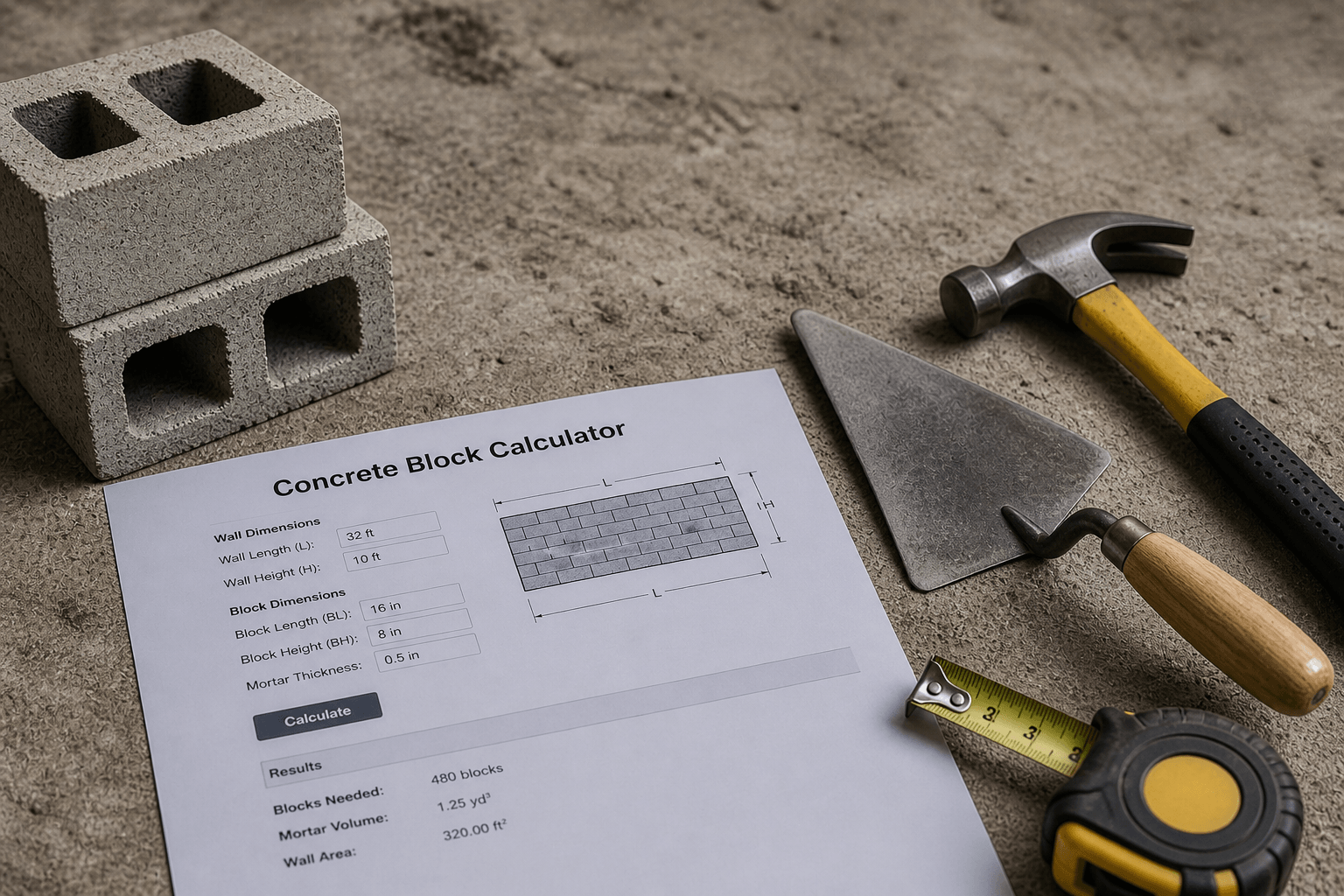
What is a concrete weight calculator?
A concrete weight calculator estimates the total weight of a concrete pour using one formula: Weight = Volume × Density. Standard concrete has a density of 150 lbs per cubic foot (2,400 kg/m³), so a 1 cubic yard pour weighs 150 × 27 = 4,050 lbs (1,837 kg). The density changes with concrete type — lightweight mixes drop to 110–145 lbs/cu ft, high-density mixes reach 200+ lbs/cu ft.
Concrete weight matters in 4 real situations: structural load calculations for foundations and slabs, truck payload and axle weight compliance before delivery, pump truck positioning on job sites, and load-bearing capacity checks for existing floors before a concrete overlay. Getting the number wrong in any of these situations causes safety problems or project delays.
Safety warning: One cubic yard of standard concrete weighs approximately 4,050 lbs (1.84 metric tons). Never haul wet concrete in a trailer or pickup truck without verifying the vehicle's legally rated payload capacity. Exceeding payload limits voids insurance, fails roadside inspections, and risks axle failure.
How to use this calculator — 3 input modes
- 1Slab / footing tab: Enter length and width in feet, thickness in inches. Use this for driveways, patios, floors, footings, and any rectangular pour.
- 2Column / cylinder tab: Enter diameter in inches and height in feet. Use this for round columns, pier footings, post holes, and cylindrical structures.
- 3Known volume tab: Enter a volume in cubic yards, cubic feet, or cubic meters if you already have the volume from another calculator or a mix design document.
Select your concrete type from the dropdown in all 3 tabs. Standard / normal concrete is correct for 90% of residential and commercial projects. Use reinforced, lightweight, or high-density only when your mix design specifies a different density.
The formula
Weight (lbs) = Volume (cu ft) × Density (lbs/cu ft)
Volume — slab (cu ft) = Length (ft) × Width (ft) × Thickness (ft)
Volume — cylinder (cu ft) = π × (Radius in ft)² × Height (ft)
Convert cu ft to cu yd: ÷ 27
Convert cu ft to m³: ÷ 35.315
Convert lbs to kg: × 0.4536
Convert lbs to short tons: ÷ 2,000
Source: ACI 318-19 §19.2.1.1 — normal-weight concrete density 145–160 lbs/cu ft (2,320–2,560 kg/m³)
Concrete density by type — 2026 reference table
Concrete density varies by aggregate type, mix design, and water content. Use this table to match the right density to your project before calculating weight.
| Concrete type | Density (lbs/cu ft) | Density (kg/m³) | Weight per cu yd (lbs) | Weight per cu yd (kg) | Common use |
|---|---|---|---|---|---|
| Standard / normal | 150 | 2,400 | 4,050 | 1,837 | Slabs, foundations, walls |
| Reinforced (with rebar) | 156 | 2,500 | 4,212 | 1,910 | Structural beams, columns |
| Lightweight | 145 | 2,320 | 3,915 | 1,776 | Roof decks, floor toppings |
| Extra-lightweight | 110 | 1,760 | 2,970 | 1,347 | Insulating concrete, blocks |
| Air-entrained | 140 | 2,240 | 3,780 | 1,715 | Exterior slabs, driveways (cold climates) |
| High-density | 200+ | 3,200+ | 5,400+ | 2,449+ | Radiation shielding, nuclear structures |
| Asphalt concrete | 140 | 2,243 | 3,781 | 1,715 | Roads, parking lots |
*Density values per ACI 318-19 §19.2.1.1 and §19.2.2.1. Wet concrete weighs 3–5% more than cured concrete — use cured density for structural load calculations.
Wet vs dry concrete weight — why it matters
Wet (fresh) concrete weighs 3–5% more than cured (hardened) concrete because it still contains mix water that evaporates during curing. A 4,050 lb/cu yd wet pour loses approximately 120–200 lbs per cubic yard as it cures over 28 days.
Use wet weight for: pump truck capacity, temporary shoring load limits during placement, and construction equipment load ratings on fresh pours.
Use cured (dry) weight for: permanent structural load calculations, dead load design in structural engineering, and long-term foundation bearing pressure calculations.
| State | Standard concrete (lbs/cu ft) | Standard concrete (kg/m³) | Per cu yd (lbs) |
|---|---|---|---|
| Wet / fresh | 155–158 | 2,480–2,530 | 4,185–4,266 |
| Cured / dry | 148–152 | 2,370–2,430 | 3,996–4,104 |
| Design value (ACI 318) | 150 | 2,400 | 4,050 |
3 worked examples
Example 1 — Residential driveway slab (20 ft × 12 ft × 4 in thick)
Thickness in feet: 4 in ÷ 12 = 0.333 ft
Volume: 20 × 12 × 0.333 = 80 cu ft
Convert to cu yd: 80 ÷ 27 = 2.96 cu yd
Weight (standard, 150 lbs/cu ft): 80 × 150 = 12,000 lbs
Weight in kg: 12,000 × 0.4536 = 5,443 kg
Weight in US tons: 12,000 ÷ 2,000 = 6.0 short tons
Practical note: A 3 cu yd residential driveway pour fits in one standard ready-mix truck (10 cu yd capacity). However, verify your driveway access can handle the truck's gross vehicle weight — a fully loaded 10 cu yd mixer weighs 66,000–70,000 lbs (30–32 metric tons). Soft ground or old pavement may not support this.
Example 2 — Round column footing (12-inch diameter × 3 ft deep)
Radius: 12 in ÷ 2 = 6 in = 0.5 ft
Volume: π × (0.5)² × 3 = 3.1416 × 0.25 × 3 = 2.356 cu ft
Weight (reinforced, 156 lbs/cu ft): 2.356 × 156 = 368 lbs (167 kg)
Volume in cu yd: 2.356 ÷ 27 = 0.087 cu yd
At 0.087 cu yd, this footing is mixed on-site from bags. One 80 lb bag of Quikrete yields 0.60 cu ft. You need 2.356 ÷ 0.60 = 4 bags (3.93 rounded up).
Example 3 — Basement floor slab (30 ft × 24 ft × 5 in thick)
Thickness: 5 in ÷ 12 = 0.417 ft
Volume: 30 × 24 × 0.417 = 300 cu ft
Convert to cu yd: 300 ÷ 27 = 11.11 cu yd
Weight (standard): 300 × 150 = 45,000 lbs
Weight in metric tons: 45,000 × 0.4536 ÷ 1,000 = 20.4 metric tons
Ready-mix trucks needed: 11.11 ÷ 10 = 2 trucks (order 12 cu yd with 8% waste)
Concrete weight per square foot by thickness
Weight per square foot depends entirely on slab thickness. Use this table for quick load estimates without calculating volume manually.
| Thickness | lbs per sq ft | kg per m² | Common application |
|---|---|---|---|
| 2 inches (51 mm) | 25 | 122 | Concrete overlay, topping slab |
| 3 inches (76 mm) | 37.5 | 183 | Walkways, light-duty paths |
| 4 inches (102 mm) | 50 | 244 | Standard residential slab, patio |
| 5 inches (127 mm) | 62.5 | 305 | Residential driveway (cars) |
| 6 inches (152 mm) | 75 | 366 | Driveway (trucks), garage floor |
| 8 inches (203 mm) | 100 | 488 | Heavy-duty industrial floor |
| 10 inches (254 mm) | 125 | 610 | Foundation walls, loading dock |
| 12 inches (305 mm) | 150 | 732 | Structural transfer slab |
*Based on standard concrete density of 150 lbs/cu ft (2,400 kg/m³).
Truck payload limits and concrete delivery
A fully loaded standard ready-mix truck carries 10 cubic yards of concrete and weighs 66,000–70,000 lbs (30–32 metric tons) gross. Understanding these limits prevents overloading access roads, damaging driveways, and failing DOT weigh-station inspections.
| Load | Volume (cu yd) | Concrete weight (lbs) | Truck GVW est. (lbs) | Notes |
|---|---|---|---|---|
| Empty drum | 0 | 0 | ~26,000 | Tare weight of truck |
| Half load | 5 | 20,250 | ~46,250 | Easier on soft driveways |
| ¾ load | 7.5 | 30,375 | ~56,375 | Common residential delivery |
| Full load | 10 | 40,500 | ~66,500 | Maximum legal in most states |
Access road check: Standard residential driveways are designed for 8,000–10,000 lb passenger vehicles. A fully loaded mixer at 66,000+ lbs will crack most residential driveways. Request a half-load delivery or use a concrete pump truck to keep the mixer on the street and pump concrete to the pour location.
Concrete weight for structural load calculations
Structural engineers use 150 lbs per cubic foot (2,400 kg/m³) as the standard dead load value for plain concrete, and 150–160 lbs/cu ft for reinforced concrete per ASCE 7-22 Table C3.1-1a. This value represents the design weight — not the wet weight during placement.
Dead load per floor area (psf)
Dead load in pounds per square foot (psf) tells structural engineers how much load a concrete slab places on the beams and columns beneath it. To find psf: multiply slab thickness in feet by 150 lbs/cu ft.
Dead load (psf) = Thickness (ft) × 150 lbs/cu ft
4-inch slab: 0.333 × 150 = 50 psf
6-inch slab: 0.500 × 150 = 75 psf
8-inch slab: 0.667 × 150 = 100 psf
A typical residential floor carries 40–50 psf live load (people, furniture) plus the slab dead load. Add the two to get total floor load for beam and column design.
4 common concrete weight mistakes
Using the wrong density for the concrete type. Lightweight concrete at 110 lbs/cu ft weighs 27% less than standard at 150 lbs/cu ft. Using standard density for a lightweight roof deck slab overstates the load by 27% — safe but wasteful. Using lightweight density for a standard slab understates load by the same amount — a structural safety problem.
Confusing wet and dry density for structural calculations. Use cured density (150 lbs/cu ft standard) for all permanent dead load calculations. Using wet density (155+ lbs/cu ft) overstates long-term structural load — a minor error for residential projects but significant in multi-story buildings.
Not converting thickness from inches to feet before calculating volume. A 4-inch slab is 0.333 ft thick — not 4 ft. Using 4 instead of 0.333 overstates volume by 12x and produces a weight estimate of 360,000 lbs instead of 30,000 lbs for a 500 sq ft slab. Always divide inch thickness by 12 before multiplying.
Ignoring rebar weight in reinforced concrete structures. A standard #4 rebar weighs 0.668 lbs/ft. A 10×10 ft slab with rebar on 12-inch centers (100 linear feet each direction = 200 ft total) adds 200 × 0.668 = 134 lbs to the slab weight. On large structural pours with heavy reinforcement, rebar adds 3–8% to the calculated concrete weight.