Concrete Mix Ratio Calculator | Get Perfect Mix Free
Getting the concrete mix ratio wrong wastes money and weakens the structure. One extra bucket of water, one short bag of cement — the slab cracks in two years. This concrete mix ratio calculator tells you the exact quantity of cement (in bags and kg), sand (in cubic meters), and aggregate (in cubic meters) for any project — foundation, slab, column, or driveway — before you buy a single bag. Enter your dimensions. Pick your grade. Get your material list instantly.
What Is a Concrete Mix Ratio?
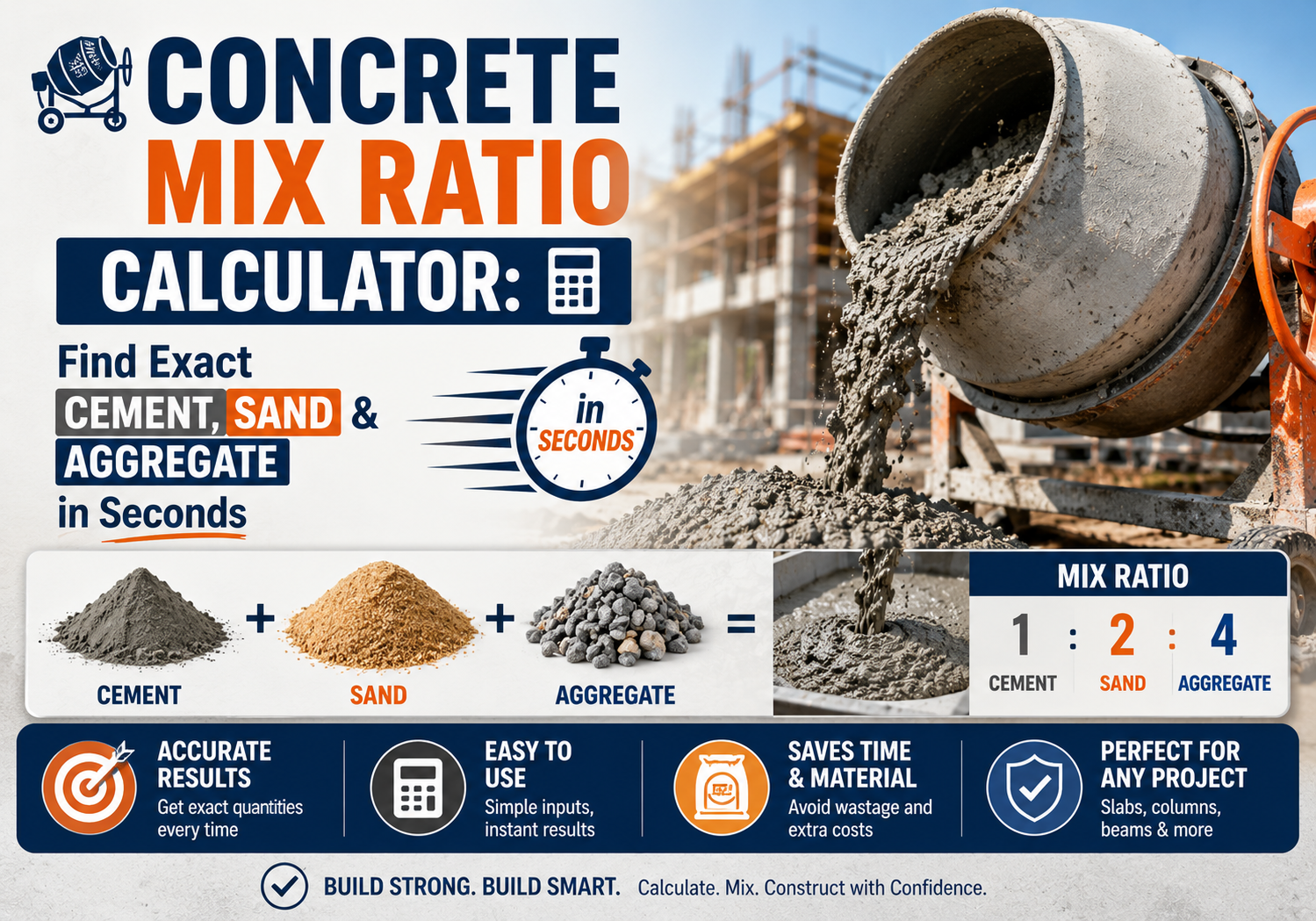
A concrete mix ratio is the fixed proportion of cement, sand, and coarse aggregate combined to produce concrete of a specific strength. The ratio is written as cement:sand:aggregate — for example, 1:2:4 means 1 part cement, 2 parts sand, and 4 parts aggregate by volume.
This proportion controls 3 things directly:
- Compressive strength — how much load the concrete holds before cracking
- Workability — how easy the mix is to pour and finish
- Durability — how long the concrete lasts under weather and load
Change the ratio, and you change all three. Use M10 for a driveway base — fine. Use M10 for a column — structural failure risk.
Concrete Grade Chart: M5 to M25
The “M” in M20 stands for Mix. The number is the compressive strength in MPa (megapascal) after 28 days of curing. Below is the full nominal mix chart covering M5 through M25.
| Grade | Mix Ratio (Cement:Sand:Aggregate) | Strength (MPa) | Strength (PSI) |
| M5 | 1:5:10 | 5 MPa | 725 PSI |
| M7.5 | 1:4:8 | 7.5 MPa | 1,087 PSI |
| M10 | 1:3:6 | 10 MPa | 1,450 PSI |
| M15 | 1:2:4 | 15 MPa | 2,175 PSI |
| M20 | 1:1.5:3 | 20 MPa | 2,900 PSI |
| M25 | 1:1:2 | 25 MPa | 3,625 PSI |
For grades above M25 — such as M30, M35, M40 — a design mix is required. A civil engineer calculates the exact proportions through lab tests because nominal ratios no longer deliver reliable strength at that level.
How to Calculate Concrete Mix Ratio (Step-by-Step)
Take a real example: a slab that is 5m long × 3m wide × 0.15m thick using M20 grade (1:1.5:3).
Step 1: Find the Wet Volume
Wet volume = Length × Width × Height Wet volume = 5 × 3 × 0.15 = 2.25 m³. This is the volume of the finished concrete structure.
Step 2: Convert to Dry Volume (×1.54)
Dry ingredients — cement, sand, aggregate — occupy 54% more space before mixing because of air gaps between particles. Once water is added, the mix compacts and shrinks. Dry volume = 2.25 × 1.54 = 3.465 m³
Step 3: Split Volume by Ratio Parts
For M20 ratio 1:1.5:3, total parts = 1 + 1.5 + 3 = 5.5 parts
| Material | Formula | Volume |
| Cement | (1 ÷ 5.5) × 3.465 | 0.63 m³ |
| Sand | (1.5 ÷ 5.5) × 3.465 | 0.945 m³ |
| Aggregate | (3 ÷ 5.5) × 3.465 | 1.89 m³ |
Step 4: Convert to kg and Bags
Cement:
- Density of cement = 1,440 kg/m³
- 0.63 × 1,440 = 907 kg
- In 50 kg bags = 907 ÷ 50 = 18.14 bags → round to 19 bags
- In 94 lb bags (USA) = 907 ÷ 42.6 = 21.3 bags → round to 22 bags
Sand:
- Bulk density = 1,600 kg/m³
- 0.945 × 1,600 = 1,512 kg (0.945 m³)
Aggregate:
- Bulk density = 1,500 kg/m³
- 1.89 × 1,500 = 2,835 kg (1.89 m³)
Which Concrete Grade for Which Project?
This is the question every builder searches for — and no top competitor answers it clearly. Here is a direct project-to-grade guide:
| Project Type | Recommended Grade | Minimum Strength |
| Path, garden walkway, leveling layer | M10 | 10 MPa / 1,450 PSI |
| Floor screed, non-structural slab | M15 | 15 MPa / 2,175 PSI |
| House slab, driveway, compound floor | M20 | 20 MPa / 2,900 PSI |
| Beam, column, staircase, roof slab | M25 | 25 MPa / 3,625 PSI |
| Bridge deck, industrial structure | M30+ (design mix) | 30+ MPa |
| Retaining wall, water tank | M20–M25 | 20–25 MPa |
| Patio or outdoor seating area | M15–M20 | 15–20 MPa |
If a structural engineer has specified a grade — follow that. Never downgrade to save money on a load-bearing element.
Water to Cement Ratio by Grade
Water controls concrete strength more than any other variable. Too much water = weak, brittle concrete. Too little = unworkable mix that develops voids. The water-cement (W/C) ratio is measured by weight, not volume.
| Grade | Max W/C Ratio | Water per 50 kg Cement Bag |
| M10 | 0.60 | 30 liters (7.9 gallons) |
| M15 | 0.55 | 27.5 liters (7.3 gallons) |
| M20 | 0.50 | 25 liters (6.6 gallons) |
| M25 | 0.45 | 22.5 liters (5.9 gallons) |
Higher grades need less water because a dense, low-water mix produces tighter cement hydration — which means higher compressive strength. Reducing the W/C ratio from 0.60 to 0.45 increases 28-day strength by roughly 30–35%. Never add extra water to make mixing easier. Use a plasticizer admixture instead — it improves workability without touching the W/C ratio.
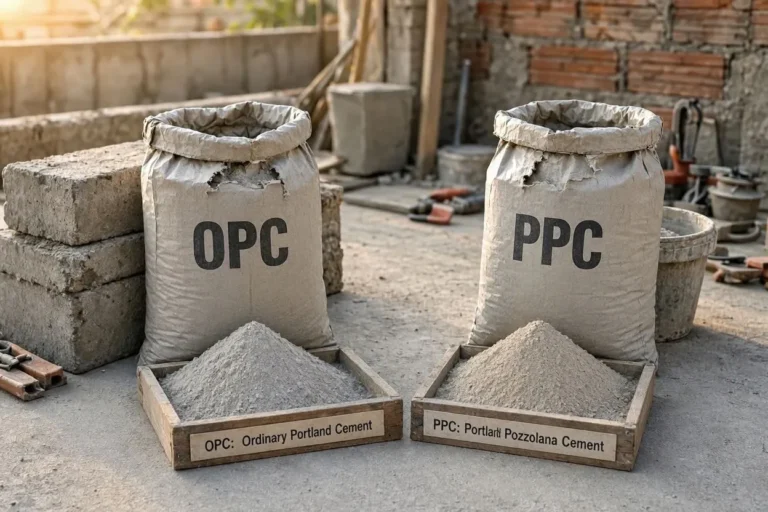
OPC 43 vs OPC 53 – Which Cement to Use?
Most online calculators only say “Portland cement.” In Pakistan, India, and Bangladesh, cement comes in 2 standard grades — OPC 43 and OPC 53 — and the choice changes your bag count.
OPC 43 Grade:
- 28-day strength: 43 MPa
- Suitable for M10, M15, M20
- Sets slower — better workability in hot weather
- Standard choice for residential construction
OPC 53 Grade:
- 28-day strength: 53 MPa
- Suitable for M25 and above
- Gains strength faster — reduces curing time
- Better for beams, columns, precast elements
For a standard house slab (M20), OPC 43 is sufficient and costs less. For a column taking heavy floor loads, OPC 53 gives a 15–20% strength advantage at the same mix ratio. Switching cement grade without adjusting the mix ratio is a common site mistake — the numbers in your calculation stay the same, but the actual strength margin changes.
How Weather Affects Your Concrete Mix

No competitor covers this — and it matters especially in South Asian summers and winters.
Hot Weather (above 35°C / 95°F): Cement hydration accelerates. The mix stiffens faster, reduces working time from 90 minutes to under 45 minutes, and increases the risk of plastic shrinkage cracks on the surface.
3 adjustments for hot weather:
- Mix in early morning or evening when temperature is below 30°C (86°F)
- Pre-wet sand and aggregate to reduce heat absorption
- Reduce W/C ratio by 0.02–0.03 and use a retarder admixture to extend setting time
Cold Weather (below 5°C / 41°F): Cement hydration slows sharply. Below 0°C (32°F), water in the mix freezes before full hydration — this destroys strength permanently.
3 adjustments for cold weather:
- Use warm mixing water (40–50°C / 104–122°F)
- Cover the poured concrete with hessian or polythene sheets for minimum 48 hours
- Add an accelerator admixture (calcium chloride-based) to speed up early strength gain
Rain During Pouring: Never pour concrete during active rainfall. Rain increases the effective W/C ratio unpredictably — even 15 minutes of rain on fresh concrete can reduce 28-day strength by 10–15%.
4 Mistakes That Ruin Your Concrete Mix
1. Adding water by eye, not by measurement: Site workers add water until the mix “looks right.” This is the single biggest cause of weak concrete. Always measure water by bucket — never guess.
2. Using wet sand without adjustment: Wet sand already contains 5–8% water by weight. Using the same water quantity with wet sand pushes the W/C ratio above the limit. Always measure sand moisture or reduce mixing water by 10–15% when sand is visibly wet.
3. Skipping the dry volume factor (1.54): Calculating cement and sand based on wet volume gives 35–40% less material than needed. The pour falls short. Every material calculation must use dry volume = wet volume × 1.54.
4. Curing too short: Concrete reaches only 65% of its design strength at 7 days. Full 28-day strength needs consistent moisture — cover with wet hessian or cure compound for minimum 14 days on slabs, 21 days on columns. Stopping curing at 3 days cuts final strength by up to 25%.
Estimated Material Cost by Grade (per 1 m³)
No competitor shows cost estimates. This table uses average market rates — adjust based on your local prices.
| Grade | Cement Bags (50kg) | Sand (m³) | Aggregate (m³) | Approx. Material Cost* |
| M10 | 4.4 bags | 0.46 m³ | 0.92 m³ | PKR 3,800 / USD 14 |
| M15 | 6.3 bags | 0.46 m³ | 0.92 m³ | PKR 5,200 / USD 19 |
| M20 | 8.2 bags | 0.42 m³ | 0.84 m³ | PKR 6,800 / USD 24 |
| M25 | 11.1 bags | 0.37 m³ | 0.73 m³ | PKR 8,900 / USD 32 |
*Based on 1 m³ wet volume. Cement at PKR 650/bag, sand PKR 900/m³, aggregate PKR 1,100/m³. Prices vary by region and supplier.
Use the Calculator Now – Get Your Material List in 10 Seconds
Stop estimating. Stop guessing bags. Enter your slab or column dimensions above, pick your concrete grade, and the calculator gives you:
- Cement quantity in bags (50 kg and 94 lb)
- Sand in cubic meters and kg
- Aggregate in cubic meters and kg
- Water in liters
- Estimated cost in your local currency
Frequently Asked Questions

Related Posts