How Long Does Concrete Take to Cure? Full Timeline, Factors & Methods
If you’re asking how long the concrete cure takes, the short answer is 28 days for full design strength, though the slab reaches roughly 70% of that strength within 7 days and is safe for light foot traffic after 24 to 48 hours. Full curing means the concrete has developed the compressive strength (measured in pounds per square inch, or PSI, or megapascals, or MPa) that engineers designed the mix to reach. A standard residential mix rated for 3,000 PSI (20.7 MPa) hits that number at the 28-day mark under normal conditions, not sooner.
Contractors, homeowners, and DIY pourers all wrestle with the same question once the pour is done, because “used” means different things at different stages. Walking on a new driveway is different from parking a truck on it, and parking a truck is different from building a wall on top of it. Get the timing wrong and you can crack a slab that should have lasted decades. It happens more than people think.
The Standard Concrete Curing Timeline
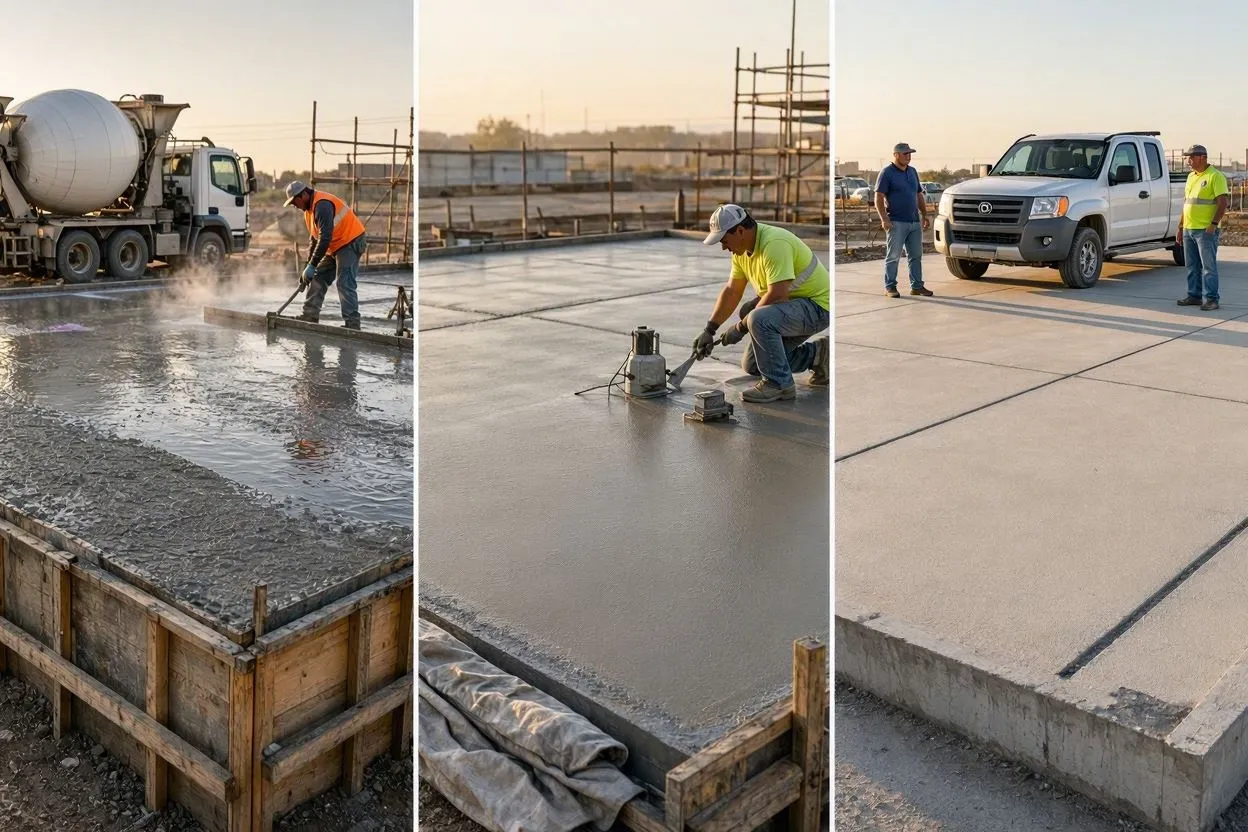
Concrete doesn’t cure all at once. It moves through three phases, and each one determines what kind of load the surface can handle.
24 to 48 Hours: Initial Set
The slab feels firm and light foot traffic is safe, but a loaded wheelbarrow or a dropped toolbox can still leave a mark; the concrete has often reached less than 30% of its final strength here. Forms can typically come off once this stage is reached, and finishing work like edging or stamping should already be done. Skip moisture protection now and you risk plastic shrinkage cracking before real strength has built.
7 Days: Partial Strength (the “70 in 7” Rule)
A typical 4,000 PSI (27.6 MPa) mix sits near 2,800 PSI (19.3 MPa) by day 7. That’s enough for a passenger vehicle, roughly 3,500 lbs, on a residential driveway, but not enough for a delivery truck. This is also when light framing can resume on a foundation, since the footing can support wall loads even before it’s fully cured.
28 Days: Full Strength
This is the industry-standard benchmark used in building codes and structural calculations across the U.S. Heavy trucks, structural loads, and permanent equipment should all wait for it. Hydration doesn’t stop here, though. It keeps going for months at a much slower rate, and testing shows concrete can measure roughly 10 to 15% stronger at 90 days than at 28. That’s why dams and bridge piers are sometimes specified at 56- or 90-day strength instead of the usual 28.
Curing vs. Drying: What’s the Difference?
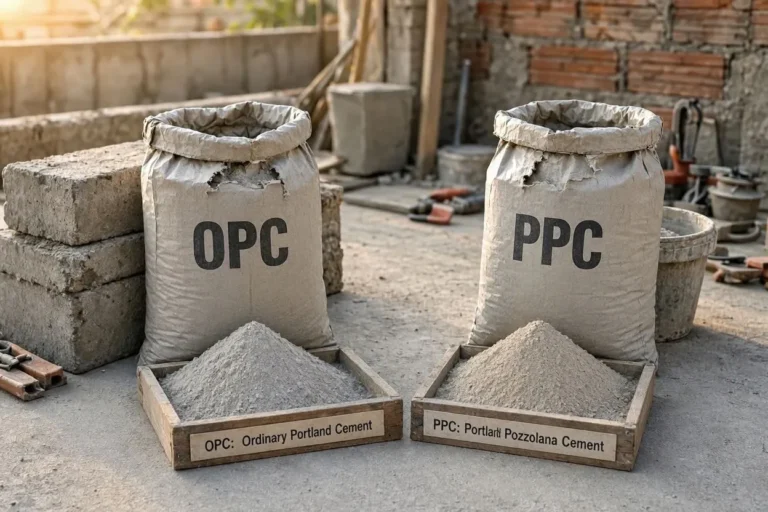
Confusing these two is probably the most common mistake on a jobsite, and it’s an easy one to make. Drying is moisture leaving the surface through evaporation. Curing is hydration: the chemical reaction between Portland cement and water that produces calcium silicate hydrate, or C-S-H, the crystal structure responsible for concrete’s strength.
A slab can look dry within hours of finishing while still being far from cured underneath. Lose surface moisture too fast and hydration gets cut short before the C-S-H crystals finish forming, leaving a weaker, crack-prone slab. That’s why marine structures and bridge footings can cure while fully submerged in water, often better than a surface slab left to air-dry unprotected. Keeping concrete wet doesn’t slow curing down. It’s what lets curing finish properly.
Why 28 Days? The Science Behind the Standard
The American Concrete Institute (ACI) set 28 days as the standard testing age decades ago, mainly because it gives engineers a consistent number to compare across mix designs without waiting years for hydration to fully complete. A test cylinder, typically 6×12 inches or 4×8 inches, gets crushed under increasing pressure until it fractures, and that PSI reading becomes the reference point for the whole project.
It’s a testing checkpoint, not a hard ceiling: precast manufacturers often strip forms and ship products well before 28 days once early cylinder breaks confirm the needed strength, sometimes in as little as 24 hours with a high-early-strength mix.
What Affects Concrete’s Curing Time
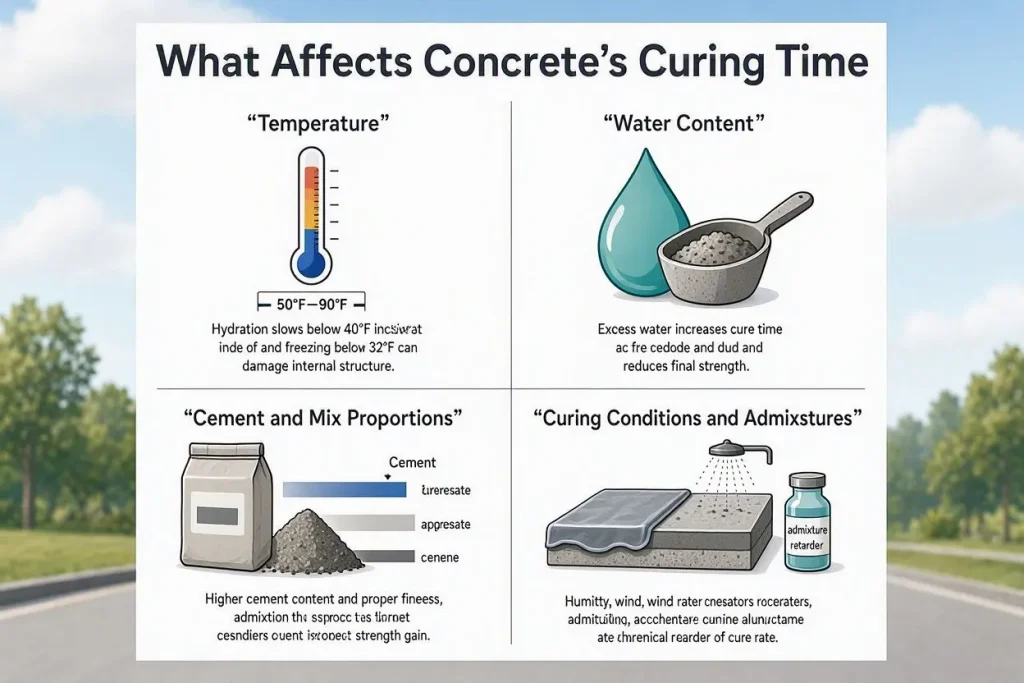
Four variables can speed up or slow down concrete’s cure time, and getting any one of them wrong can cost days of strength.
Temperature
Concrete cures fastest between 50°F and 90°F (10°C–32°C). Below 40°F, hydration nearly stops. Below 32°F, water in the mix can freeze before the reaction completes and permanently damage the internal structure. Contractors following ACI 306, the Cold Weather Concreting standard, typically keep fresh concrete above 50°F for at least the first three days, using insulating blankets, heated enclosures, or accelerating admixtures to hold that range. Above 90°F, surface evaporation can outpace internal hydration; ACI 305 (Hot Weather Concreting) recommends pouring in early morning, using chilled mixing water, and misting the surface every 30–60 minutes once conditions push evaporation rates high enough to threaten surface strength.
Moisture and Humidity
High humidity slows surface evaporation and supports better curing; hot, dry, or windy conditions can pull moisture out of fresh concrete before hydration finishes, which is why contractors often mist a slab every 30–60 minutes during the first day in tough drying conditions.
Mix Design
A lower water-to-cement ratio produces stronger, slower-curing concrete, while accelerators can push a mix to usable strength within hours. Fly ash and slag cement, two common supplementary materials, generally extend the curing window compared to straight Portland cement, but they also tend to produce a denser, more durable final product.
Slab Thickness
Thicker slabs cure less evenly because hydration has to work through more material. A standard 4-inch residential slab follows the typical 28-day timeline closely; an 8-inch commercial floor or 12-inch foundation footing retains more internal heat, which can speed strength gain in the core while raising the risk of thermal cracking if the surface cools faster than the interior.
Curing Time by Project Type
Driveways
Allow foot traffic after 24 to 48 hours, passenger vehicles after 7 days, and full loads, including trucks, after 28 days. Skipping the 28-day mark for anything heavier than a car raises the odds of surface cracking within the first year.
Patios
Allow walking after 24–48 hours and support furniture after roughly 7 days, reaching full strength at 28 days. Because patios sit fully exposed to sun and weather, moisture retention during the first week matters even more than on a shaded slab.
Foundations
Typically support framing work after 7 days and reach full structural strength at 28 days. Most contractors won’t proceed with heavy load-bearing work, steel beams, upper floors, until the 28-day mark, even though light framing can start much earlier.
Sidewalks and Slabs
Reach initial set at 24–48 hours, 70% strength at 7 days, and full cure at 28 days, the same baseline as driveways and patios. Larger commercial slabs often add moisture blankets, curing compounds, or extended wet-curing depending on thickness and exposure.
How to Cure Concrete Properly
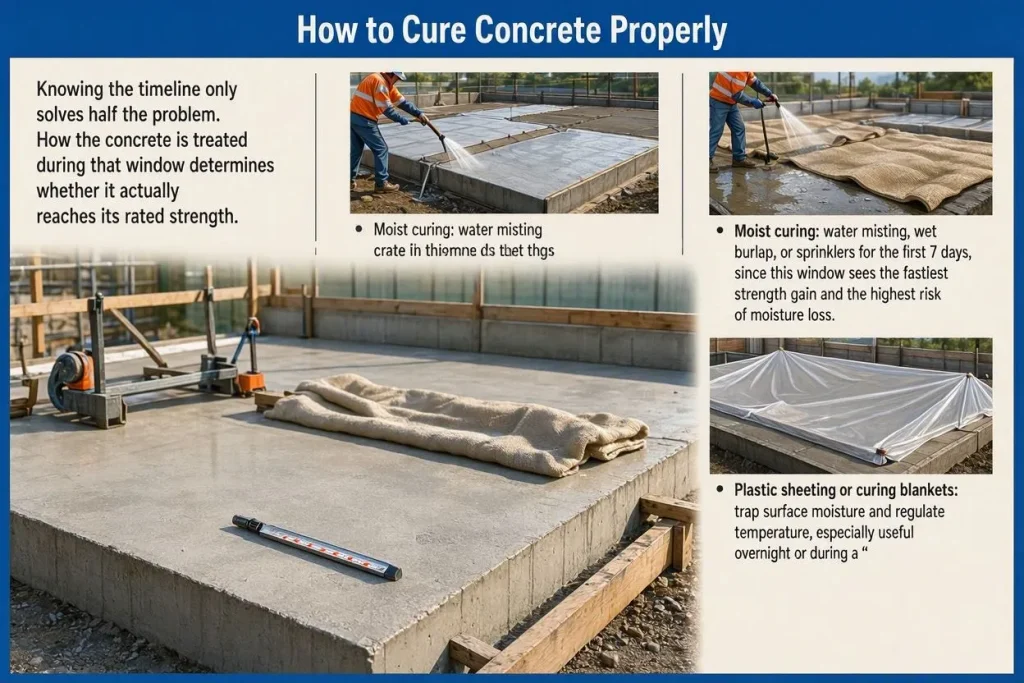
Knowing the timeline only solves half the problem. How the concrete is treated during that window determines whether it actually reaches its rated strength.
- Moist curing: water misting, wet burlap, or sprinklers for the first 7 days, since this window sees the fastest strength gain and the highest risk of moisture loss.
- Plastic sheeting or curing blankets: trap surface moisture and regulate temperature, especially useful overnight or during a sudden weather shift.
- Curing compounds: spray-applied membranes that seal in moisture right after finishing, common on large commercial slabs; products meeting ASTM C309 are the industry baseline.
- Water curing (ponding or flooding): building temporary berms and flooding the enclosed area is generally considered the most effective method. Moist-curing for the first 7 days can meaningfully outperform concrete left to cure in open air.
- Maturity method: embedded temperature sensors track the time-temperature relationship inside the slab, giving a real-time strength estimate instead of waiting on a scheduled cylinder break. It’s increasingly common on commercial jobs where schedule pressure makes the full 28-day wait costly.
What Happens If Concrete Cures Too Fast or Too Slow
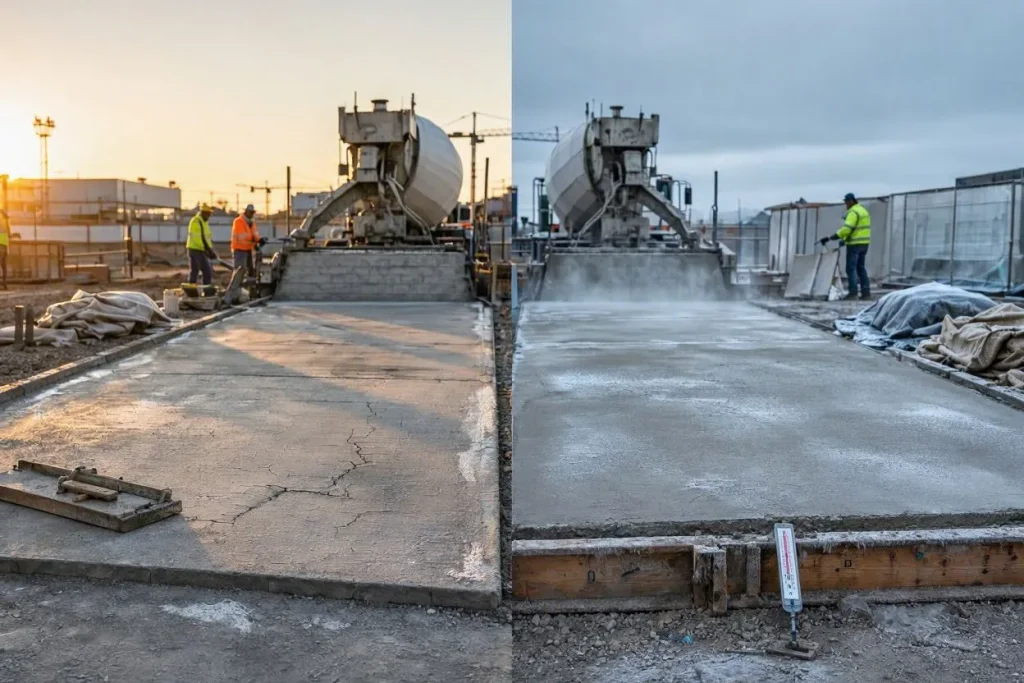
Concrete that cures too fast loses moisture before hydration completes, producing a weaker, more brittle slab prone to surface cracking and dusting. Concrete that cures too slowly, typically from cold temperatures, delays strength gain and risks freeze damage if the mix hasn’t reached roughly 500 PSI (3.4 MPa) before a hard freeze hits. Both problems trace back to the same root cause: a mismatch between the concrete’s moisture needs and the environment it’s curing in.
Hairline shrinkage cracks are common and rarely structural, but wide cracks, pattern cracking, or a chalky, dusting surface signal that hydration was interrupted. A cold joint, a visible seam where one batch set before the next was placed against it, is another defect tied directly to poor timing on multi-pour projects. It creates a permanent weak point where the two pours meet.
Conclusion
The 24-hour, 7-day, and 28-day markers are the backbone of every concrete project, from a backyard patio to a commercial loading dock. Understanding that timeline, and giving the slab proper moisture and temperature control through it, is what separates a pour that lasts decades from one that cracks within its first year.
FAQs

Related Posts