How to Cut Concrete: 6 Methods, Tools, and Safety Steps
To cut concrete, mark the line with chalk, fit a diamond blade to a circular saw or angle grinder, wet the surface to control dust, and cut in shallow passes of half an inch (1.3 cm) or less until you reach full depth. Slabs thicker than 7 inches (17.8 cm) need a walk-behind saw instead of a handheld tool. If the concrete has rebar inside, swap to a blade rated for reinforced material before you touch the surface. Every method calls for a respirator, hearing protection, and safety glasses, no exceptions.
Why People Cut Concrete
Most homeowners cut concrete to fix a problem, not to start a new project from scratch. Shrinkage cracks form as a slab dries, and cutting a control joint ahead of time stops that cracking from spreading in random directions. Buried pipes and wiring sometimes need access years after the pour, forcing a cut straight through an existing patio or driveway. A family that outgrows a small patio might cut back the edges to widen it, and someone installing a new fence post or pergola footing often needs a clean opening in the slab. Whatever the reason, cutting a section out costs far less than tearing out the whole surface.
Tools and Blades You Need Before You Start
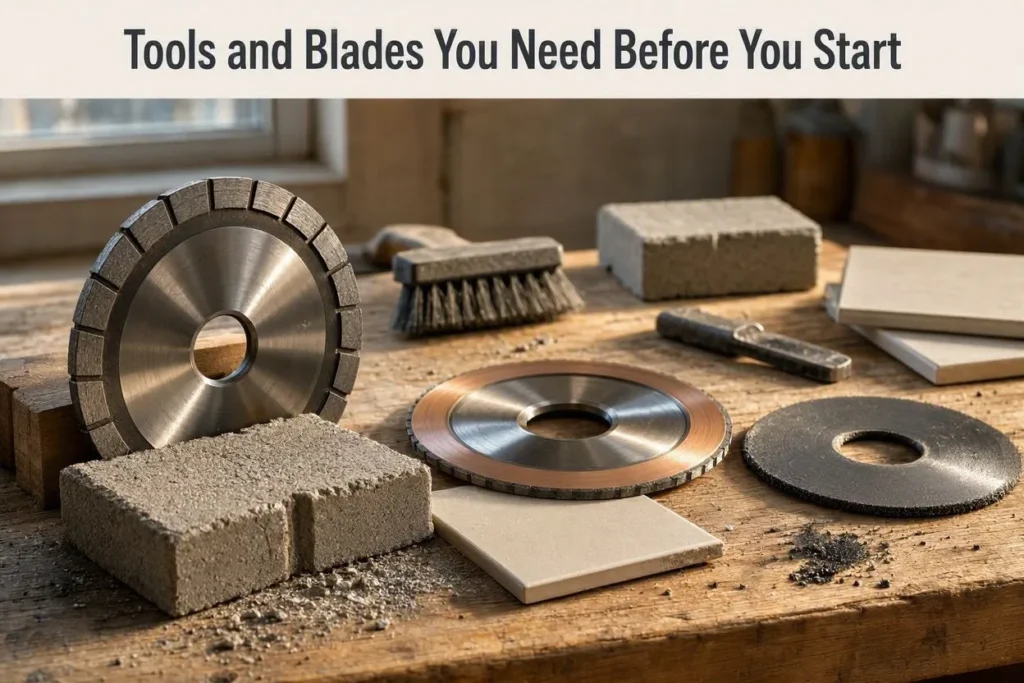
A diamond blade is the only blade that holds up to concrete’s abrasiveness, and everything else wears down within minutes. Standard abrasive blades work for a single small cut, but they glaze over and lose their edge fast on anything larger than a paver. Diamond blades come in two types: segmented blades for fast, rough cuts on hard aggregate, and continuous-rim blades for smoother edges on tile or thin masonry. Match the blade’s arbor size to your saw before buying one, since a 7-inch (17.8 cm) blade won’t fit a saw built for a 4.5-inch (11.4 cm) arbor. Check the blade’s maximum RPM rating against your tool’s spindle speed too. A blade rated below your saw’s output can shatter mid-cut.
Beyond the blade, gather a chalk line, a straight-edge guide board, a garden hose or spray bottle, and full PPE (personal protective equipment) before starting any project.
Materials and Supplies Checklist
A complete concrete-cutting kit includes a diamond blade, a saw, dust control equipment, and marking supplies, all sourced from a hardware store or equipment rental counter. Gather these building materials and supplies before the job starts, not partway through it:
- Diamond blade (segmented or continuous-rim, arbor size matched to the saw)
- Circular saw, angle grinder, or walk-behind saw rated for masonry
- Chalk line and marking chalk
- Straight-edge guide board (1-inch scrap lumber works)
- Garden hose, spray bottle, or wet-saw water attachment
- HEPA-rated shop vacuum for dry cutting
- NIOSH-approved respirator
- Safety glasses and hearing protection
- Work gloves and knee pads
- Plastic sheeting for dust containment
- Sledgehammer and masonry chisel for finishing cuts
- GFCI-protected extension cord
6 Methods for Cutting Concrete
Method 1: Hammer and Chisel
A hammer and chisel work best for small pavers and cuts under 2 inches (5 cm) thick, where power tools would be overkill. This method costs almost nothing since most households already own both tools. Start by scoring a line across the surface with light taps, then strike the chisel harder at the center once the groove is deep enough to guide a clean break. The edges won’t come out perfectly straight, so this method suits rough cuts, not finished ones. A gardener splitting a cracked stepping stone into two usable halves is a typical use case.
Method 2: Scoring Knife
A scoring knife is the right tool for cement backer board and other thin sheet materials, not full-depth slabs. These knives cost under $10 (about €9) and cut by scoring a groove repeatedly until the board snaps clean along the line. Run the blade along a straight edge five to ten times, then push down on one side to break it. Tile installers reach for this tool constantly when prepping bathroom subfloors, since a full saw would be excessive for quarter-inch sheet material.
Method 3: Circular Saw
A circular saw fitted with a diamond blade handles pavers, blocks, walls, and the top inch of a slab before switching to a sledgehammer. Set the blade depth no deeper than half the blade’s diameter for the first pass, then guide the saw along the chalk line with both hands. If you’re cutting dry, spray the line with water every few passes to keep dust down and the blade cool.
Method 4: Angle Grinder
An angle grinder cuts concrete almost as well as a circular saw, though it moves slower and produces less straight lines. Fit it with the same type of diamond blade used on a circular saw, and expect to make several passes on anything over an inch thick. Contractors keep one in the truck as a backup tool for tight corners a circular saw can’t reach.
Method 5: Walk-Behind Saw
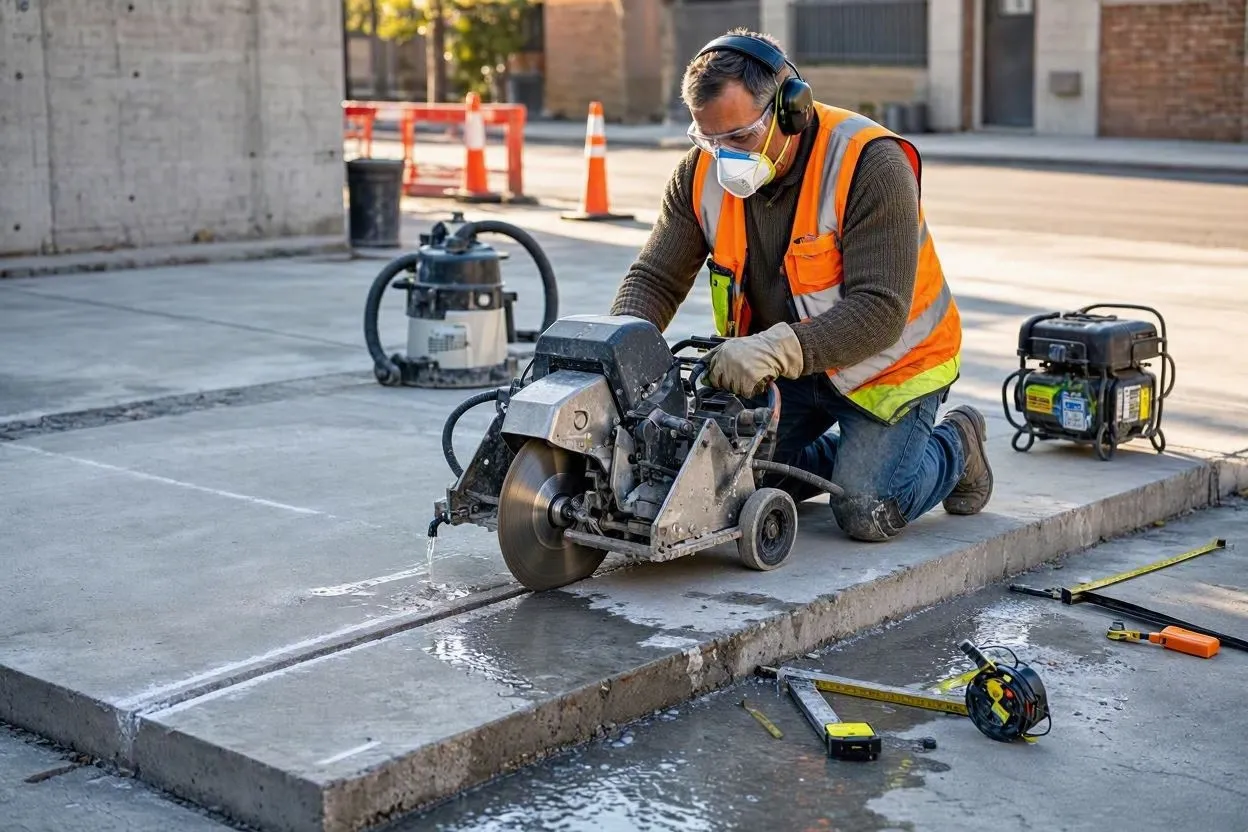
A walk-behind saw is built for slabs 7 inches (17.8 cm) or thicker, where a handheld tool would take hours and still cut unevenly. These saws run on gas or electric power and carry blades up to 20 inches (50.8 cm) across. Lower the blade in stages rather than plunging to full depth on the first pass, since a single deep cut strains the motor and risks binding the blade. A commercial parking lot resurfacing crew relies on this saw daily to cut expansion joints across dozens of yards of concrete.
Method 6: Trencher
A trencher digs deep, narrow channels through concrete pavement for utility lines, and no other tool matches its speed at that job. Wheel trenchers outperform chain trenchers on rocky or reinforced ground. Utility crews laying fiber-optic cable under a sidewalk typically choose a wheel trencher over any handheld alternative, since the trench needs to run continuous for hundreds of feet.
How to Cut Concrete Step by Step
To cut concrete correctly, follow six steps in order: mark the line, prep the area, set up dust control, make a guide cut, deepen the cut in passes, then finish the break. Each step builds on the one before it, so skipping ahead usually means redoing work later.
Step 1: Mark the cutting line. Measure from a fixed reference point and draw a thick chalk line along the intended cut. Snap the line twice if the surface is textured, since a faint mark disappears once water hits it.
Step 2: Prep the work area. Cover nearby doors, vents, and windows with plastic sheeting, since dust travels farther than most people expect. Clear loose debris and furniture from a 10-foot radius around the cut.
Step 3: Set up dust control. Connect a garden hose or wet-saw attachment for a steady trickle of water along the line, or attach a HEPA vacuum to the saw’s dust port if you’re cutting dry.
Step 4: Make a shallow guide cut. Set the blade depth to no more than half an inch (1.3 cm) and guide the saw along a straight-edge board rather than freehand. A wobble at this stage throws off the entire line.
Step 5: Deepen the cut in passes. Add roughly half an inch of depth with each additional pass until you’re within an inch of full thickness. Let the saw cool between passes if it starts to bog down.
Step 6: Finish the break. For slabs you can’t cut all the way through, finish the last section with a sledgehammer or masonry chisel along the scored line.
Wet Cutting vs. Dry Cutting
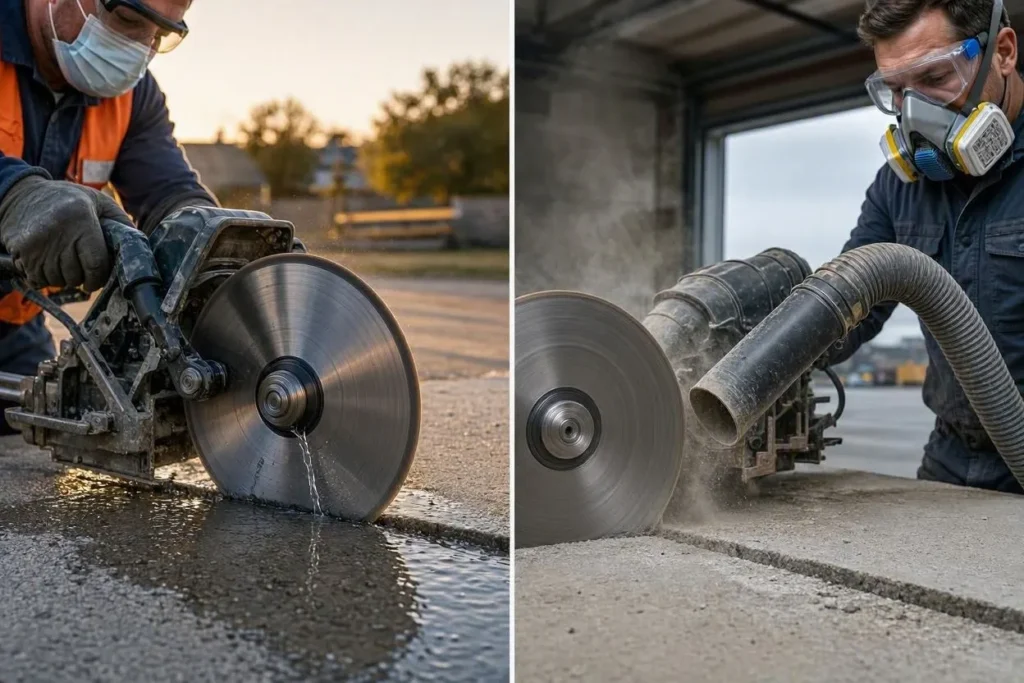
Wet cutting suppresses dust and cools the blade, while dry cutting saves setup time but demands stronger respiratory protection. A trickle of water along the cut line keeps silica particles from becoming airborne and extends blade life by reducing friction heat. If running water isn’t practical, such as an indoor job or a spot without a hose bib nearby, dry cutting works fine as long as you pair it with a HEPA-rated dust extraction vacuum and a properly fitted respirator. Most rental companies stock both wet-cutting circular saws and dry-cutting models, so ask which one matches your job site before renting.
How to Cut Concrete With Rebar Inside
Yes, you can cut through rebar-reinforced concrete, but only with a blade specifically rated for reinforced material. Standard diamond blades made for plain concrete dull fast or snap when they hit steel rebar mid-cut. Look for a blade labeled “reinforced concrete” or “combination blade,” since these use a different diamond segment bond designed to handle both concrete and steel in the same pass. Slow your feed rate by roughly half once you feel the blade contact metal, and never force the saw through resistance. A driveway with wire mesh reinforcement, common in slabs poured after the 1990s, almost always needs this blade type even for a routine repair cut.
When to Cut Concrete After Pouring It
Fresh concrete should be cut within 6 to 18 hours after pouring, and never later than 24 hours. Cutting too early causes raveling, where aggregate pieces dislodge and leave a torn, weak edge instead of a clean line. Waiting too long risks random cracking before the saw ever reaches the surface, since concrete starts generating internal stress as it cures. Temperature affects this window directly: concrete poured on a 90°F (32°C) day cures faster and needs cutting closer to the 6-hour mark, while a cool 50°F (10°C) pour can wait closer to 18 hours. A contractor pouring a driveway on a summer afternoon typically schedules the joint-cutting crew for early the next morning to stay inside that window.
Safety Precautions and OSHA Silica Rules
Concrete dust contains crystalline silica, a substance the Occupational Safety and Health Administration (OSHA) links to lung disease after repeated exposure. OSHA’s silica standard sets a permissible exposure limit and requires employers on qualifying job sites to use engineering controls like water suppression or vacuum dust collection. For any home project, wear a NIOSH-approved respirator rated for silica dust, not a basic paper dust mask, since paper masks don’t filter particles small enough to matter. Add safety glasses, hearing protection, gloves, and knee pads for ground-level cuts to that list. Plug power tools into a ground-fault circuit interrupter (GFCI) outlet whenever you’re working with water nearby, since wet conditions raise the risk of shock.
Cutting Concrete Indoors
Indoor concrete cutting needs active ventilation, not just an open window, because dust and exhaust fumes concentrate quickly in enclosed spaces. Set up a box fan blowing outward through a window to pull airborne particles out of the room while you work. Gas-powered saws should stay outdoors entirely, since carbon monoxide builds up fast in a garage or basement. A homeowner cutting a doorway into a basement slab, for example, should run an electric wet saw with a shop vac attached directly to the dust port rather than a gas model.
Cost to Cut Concrete
Cutting concrete yourself costs $50 to $150 (about €46 to €138) for a day’s tool rental and blade, while hiring a professional runs $4 to $15 per linear foot depending on slab thickness and region. A basic circular saw with a diamond blade rents for around $40 to $60 per day at most equipment rental counters, and the blade itself adds another $20 to $50 depending on quality. Walk-behind saws cost more to rent, often $150 to $300 per day, but they’re rarely needed for a single driveway repair. Professionals charge more per foot for slabs over 6 inches (15.2 cm) thick or for cuts through rebar, since those jobs take longer and wear blades out faster. A 20-foot control joint cut across a residential driveway typically lands in the $80 to $300 range when hired out.
Control Joints vs. Expansion Joints
Control joints manage where concrete cracks as it shrinks, while expansion joints give the slab room to move without cracking at all. A control joint is a shallow groove cut into the top third of a slab, guiding natural shrinkage cracks to form in a straight, hidden line instead of a random spot. An expansion joint runs the full depth of the slab and gets filled with a flexible material, letting neighboring sections shift slightly during temperature swings without pushing against each other. Driveways typically need control joints every 8 to 12 feet (2.4 to 3.7 m), while expansion joints go wherever a slab meets a fixed structure, such as a garage foundation or a sidewalk against a building.
When to Call a Professional
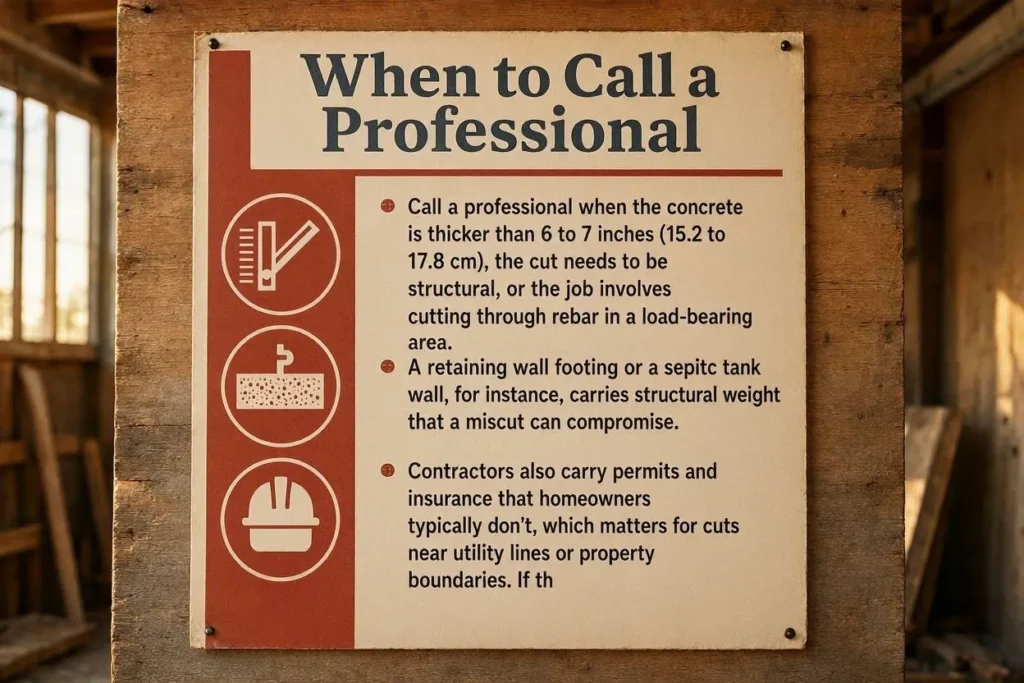
Call a professional when the concrete is thicker than 6 to 7 inches (15.2 to 17.8 cm), the cut needs to be structural, or the job involves cutting through rebar in a load-bearing area. A retaining wall footing or a septic tank wall, for instance, carries structural weight that a miscut can compromise. Contractors also carry permits and insurance that homeowners typically don’t, which matters for cuts near utility lines or property boundaries. If the project involves tying new concrete into an existing structure with rebar, as with a root cellar entrance cut into a foundation wall, a structural engineer should review the plan before any saw touches the surface.
Conclusion
Cutting concrete comes down to matching the right blade and saw to the slab in front of you, then respecting depth, dust, and curing time along the way. A half-inch pass with a diamond blade, a wet line to keep silica dust down, and a sledgehammer finish for the last stubborn inch cover most driveway and patio repairs without a contractor. Save the walk-behind saw and the professional call for slabs over 7 inches thick or any cut running through structural rebar.
FAQs

Related Posts