Pavers vs Concrete: Cost, Durability, and Which One Wins in 2026
Pavers cost more to install, but they last longer and cost less to fix when something goes wrong. Concrete is cheaper on day one and more likely to crack once winter starts freezing and thawing the ground underneath it. The right choice depends on budget, climate, and how long you plan to stay in the house. A patio in Phoenix, Arizona faces different stress than a driveway in Minneapolis, Minnesota, and that difference changes the math. This guide breaks down cost by project type, durability by climate zone, and maintenance schedules for both materials, so the decision comes down to your numbers instead of a sales pitch.
What Is the Real Difference Between Pavers and Concrete?
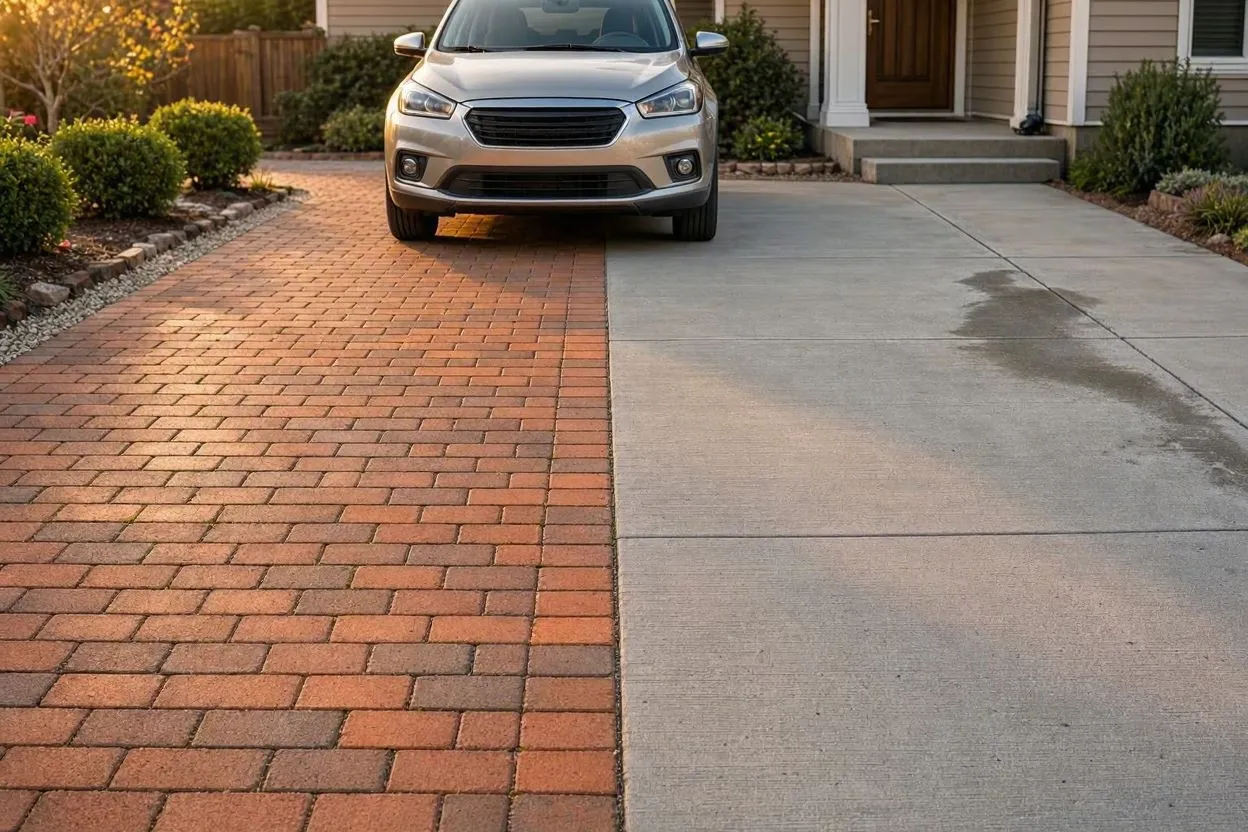
Pavers are individual units set on a compacted base. Concrete is a single slab, poured and left to cure into one solid piece. That structural gap drives almost everything else in this comparison, from how each material handles stress to how it gets repaired.
| Material | Composition | Structural Behavior | Repair Method |
| Concrete pavers | Dry, tamped concrete mix pressed into molds | Thousands of small joints let each unit move independently | Crew lifts and resets the single damaged unit |
| Brick pavers | Fired clay units, set individually | Same joint-based movement as concrete pavers | Crew lifts and resets the single damaged unit |
| Porcelain pavers | Clay-based, kiln-fired at high temperatures (denser and less porous) | Same joint-based movement as concrete pavers | Crew lifts and resets the single damaged unit |
| Poured concrete | Wet mix leveled on-site, cured over several days | One rigid slab with no joints, so it absorbs stress all at once | Visible patch, or a full repour to fully match color |
| Stamped concrete | Poured concrete pressed with a textured mold before curing | Still one continuous slab, with the same cracking weakness as plain concrete | Same as poured concrete |
Stamped concrete deserves a separate mention, since three of the top-ranking guides on this topic use it interchangeably with plain concrete. It costs more than plain gray concrete but shares concrete’s core weakness: it’s one continuous slab, so it cracks the same way plain concrete does.
How Much Do Pavers Cost Compared to Concrete?
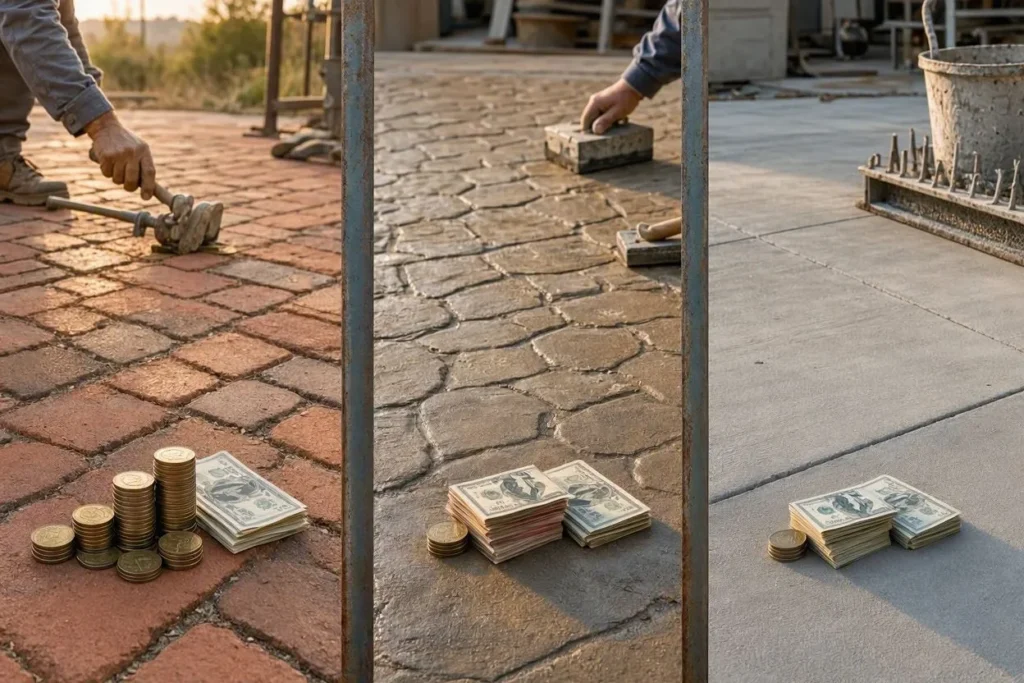
Pavers run $10 to $30 per square foot ($108 to $323 per square meter) installed, while poured concrete runs $6 to $15 per square foot ($65 to $161 per square meter). Stamped concrete sits between the two, at $15 to $22 per square foot ($161 to $237 per square meter). Costs shift by project type, so a single blended number hides more than it reveals.
| Project Type | Pavers (per sq ft / m²) | Poured Concrete (per sq ft / m²) |
| Patio | $10-$30 / $108-$323 | $6-$15 / $65-$161 |
| Driveway | $25-$35 / $269-$377 | $6-$12 / $65-$129 |
| Walkway | $35-$60 / $377-$646 | $8-$15 / $86-$161 |
Labor accounts for most of the price gap. A concrete crew can pour and finish a 500-square-foot (46-square-meter) patio in a day or two, then let it cure for about a week before full use. Paver installation on the same footprint takes longer, since it involves excavating 6 to 9 inches (15 to 23 cm) of soil, laying and compacting a gravel base, screeding a sand layer, and setting each unit by hand.
For homeowners weighing pavers vs concrete on price alone, concrete wins on day one. Over a 20-year span, though, the cost gap narrows. Concrete typically needs resealing every 2 to 3 years at $0.50 to $1.50 per square foot ($5.40 to $16 per square meter), and a single major crack repair can cost hundreds of dollars without ever matching the original color. Pavers need occasional resanding and resealing too, but a damaged section gets fixed for the cost of a few replacement units and an hour of labor.
Which Material Lasts Longer, Pavers or Concrete?
In a freeze-thaw climate, pavers generally outlast poured concrete. In a dry, stable climate, concrete can hold up just as well. A concrete patio in Phoenix, where temperatures rarely dip below freezing, might go decades without a crack. That same slab poured in Cincinnati, Ohio or Idaho Falls, Idaho faces repeated freezing and thawing every winter, and each cycle pushes moisture into hairline gaps and expands them.
Ohio’s soil compounds the problem. High clay content in the ground swells when wet and shrinks when dry, and that movement transfers straight into a rigid concrete slab. Landscape architect Michael Boeck of Werbrich Custom Outdoor Living put it bluntly: there’s no clean way to repair a crack or level a slab once it starts moving. Pavers handle that same soil movement differently, since their joints allow individual units to shift slightly without breaking the surface. Some paver systems can also withstand close to four times the load pressure of a standard concrete slab, according to figures reported by regional contractors, which matters for driveways carrying trucks or RVs.
Expect a well-installed concrete patio to last 25 to 30 years before major repairs, and a paver patio to last 30 to 50 years with periodic releveling. A poor base is the most common failure point for both materials, so the compaction step during installation matters as much as the material choice itself.
How Do Pavers and Concrete Compare for Maintenance and Repairs?
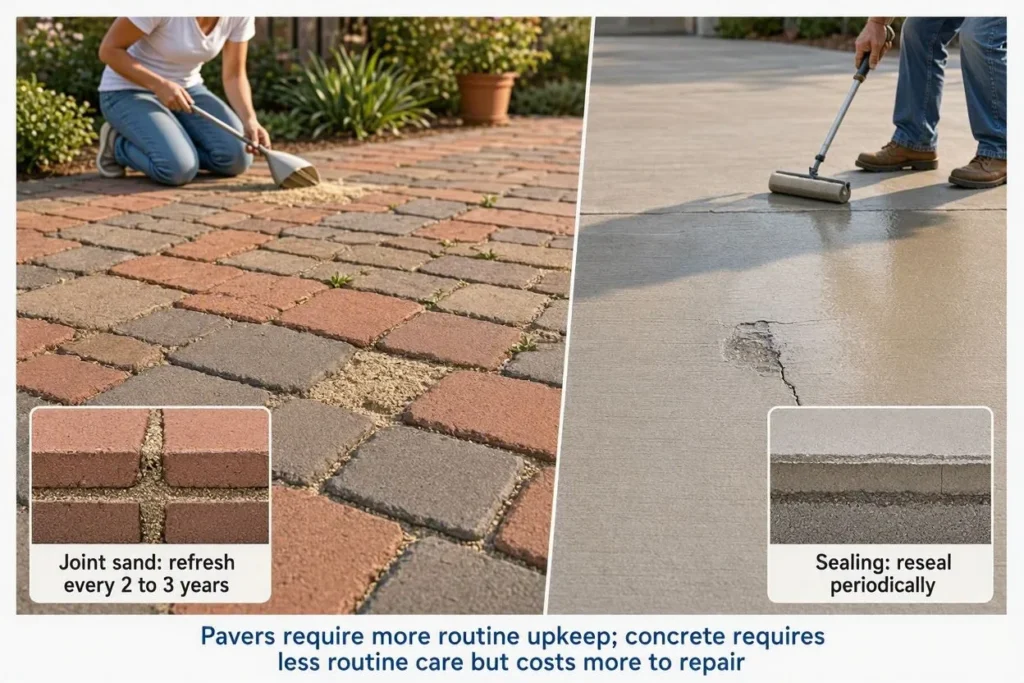
Pavers ask for more routine upkeep. Concrete asks for less, but when it does need work, that work costs more. Here’s how the maintenance actually breaks down:
- Joint sand (pavers): Once the polymeric sand between joints wears down, weeds start moving in. Refresh it every 2 to 3 years and that’s not an issue. Loose traditional sand washes out even faster and needs replacing more often.
- Sealing (concrete): Reseal every 2 to 3 years. Skip it, and the surface starts flaking, a problem contractors call spalling.
- Efflorescence: Both materials can develop this white, chalky mineral deposit as moisture works its way out of them. It’s more common on concrete, and a mild acid wash usually clears it up.
- Color: Stained concrete can lose up to half its color within 5 years of direct sun, according to figures from Cincinnati-area contractors. Paver color runs through the entire unit, not just the surface, so it holds up longer, especially on south-facing patios and driveways that bake in full sun most of the day.
Are Pavers or Concrete Safer for Pool Decks and Walkways?
Pavers typically offer better slip resistance and stay cooler underfoot than plain or stamped concrete. Textured paver surfaces, especially porcelain pavers, are manufactured with slip ratings tested for wet conditions, which makes them a common pick for pool decks. Stamped concrete can turn slick when wet, particularly on smooth or polished finishes, so many installers add a slip-resistant additive to the sealer as a workaround.
Surface temperature is the other safety factor. Lighter-colored pavers reflect more heat than dark concrete, so bare feet stay more comfortable on a 95°F (35°C) afternoon. Darker materials of either type absorb more heat and can reach uncomfortable surface temperatures in direct sun, so color choice matters as much as material choice for anyone barefoot near a pool.
Which Option Offers Better Design Flexibility?
Pavers win on design range: color, shape, and pattern combinations that concrete simply can’t match with a single uniform pour. A paver patio can mix herringbone, running bond, or basket-weave patterns, and individual units come in brick, natural stone, concrete, or porcelain finishes. That range lets a homeowner match a traditional brick home or build a sharp, modern layout with large-format porcelain pavers.
Concrete’s design options have expanded past plain gray. Stamping presses a texture into the surface that mimics stone, brick, or wood grain, and staining adds color either during the pour or after curing. Both techniques narrow the visual gap with pavers, but a stamped slab is still one continuous surface, so it can’t replicate the depth or shadow lines that individual paver joints create. Anyone deciding between pavers vs concrete for a highly custom design will generally get more flexibility from pavers, while anyone who wants a clean, minimalist surface may prefer concrete’s uniformity.
Is Pavers or Concrete Better for the Environment?
Permeable pavers beat standard poured concrete on stormwater runoff. The joints in a permeable system are wider and packed with gravel or specialized aggregate, so rain filters straight through the surface and back into the ground instead of racing off toward a storm drain. That matters most in cities running combined sewer systems, where a heavy storm can push runoff past what the treatment plant can handle.
Once cured, concrete is basically impermeable. Water just runs across it toward whatever drain or low point it can find. Concrete also soaks up heat and radiates it back out, part of why dense, heavily paved neighborhoods run hotter in summer, a pattern researchers have tracked for decades. Standard concrete pavers without permeable joints share that same problem, so the environmental edge really comes down to which paver system you pick, not pavers versus concrete as a blanket rule.
Do Pavers or Concrete Increase Home Resale Value?
Buyers tend to see pavers as a premium upgrade. Concrete reads as standard and functional, nothing more. A well-maintained paver patio or driveway signals a finished, upgraded property, and that perception can influence a buyer’s first impression before they even step inside. Concrete still adds functional value, since a cracked or absent patio counts against a listing, but it rarely commands the same buyer interest as a custom paver layout.
Real estate agents in freeze-thaw regions often point to durability as the resale argument: a buyer touring a home in February wants to see a patio that survived winter without visible cracks. That single visual check can matter more to a buyer than the underlying material cost, which is part of why pavers show up more often in high-end renovation listings across the Midwest and Northeast.
How Long Does Installation Take for Pavers vs Concrete?
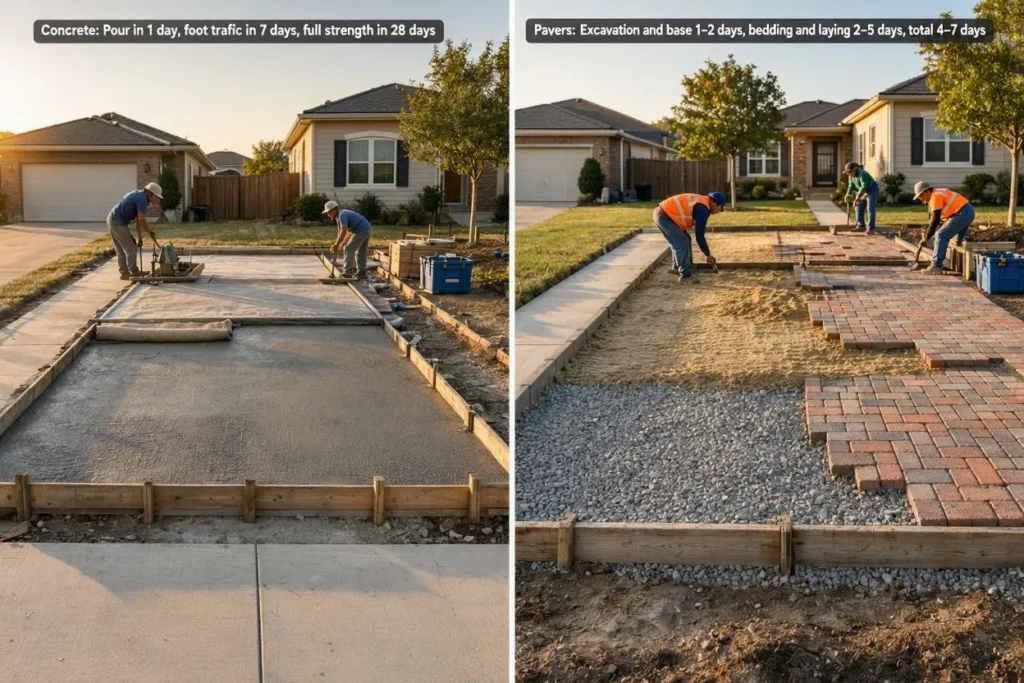
Concrete installs faster: usually 2 to 4 days including cure time, against 4 to 7 days for an average paver project. Concrete goes down in a single pour after the forms are set, then needs about a week before it can handle regular foot traffic and closer to a month before it reaches full strength.
Paver installation has more steps. Crews excavate the site, add and compact a gravel base, screed a bedding layer of sand, then set each unit by hand before compacting the finished surface and sweeping in joint sand. A 500-square-foot (46-square-meter) patio with a skilled crew typically takes 4 to 5 days, while a larger driveway can stretch past a week depending on access and site conditions. But pavers make up for the slower install with immediate usability: there’s no wet concrete waiting to cure, so people can walk on the surface the same day it goes down.
Which Should You Choose: Pavers or Concrete?
Choose pavers if you live in a freeze-thaw climate, want design flexibility, or plan to stay in the home long term, and choose concrete if you want the lowest upfront cost and a faster installation timeline. Homeowners in stable, dry climates with a tighter budget often get years of solid performance from plain or stamped concrete. Homeowners in the Midwest, Northeast, or Mountain West, where soil movement and winter cycles are a yearly reality, tend to get better long-term value from pavers despite the higher starting price.
Project type matters too. Skip the debate for a low-traffic walkway; the cost gap barely matters there. A driveway is different. It’s carrying real weight every day, and that’s exactly where pavers’ load capacity pays off. Anyone still weighing pavers vs concrete for a specific project should get quotes for both, since local labor rates and material availability can shift the numbers by region.
Conclusion
Pavers vs concrete comes down to three numbers: upfront cost, repair cost, and climate risk. Concrete wins the first number, pavers usually win the second and third in any region with real winters. A homeowner in Phoenix can lean on concrete’s lower price with little downside. A homeowner in Cincinnati or Idaho Falls is buying into a cycle of cracks and resealing unless the budget stretches to pavers from the start. Get quotes for both, check the base preparation the contractor plans to use, and match the material to the ground it’s going on top of.
FAQs

Related Posts