Concrete Stamp Patterns: The Complete Guide to Every Style
Choosing a concrete stamp pattern comes down to three questions: what do you want it to look like, where’s the surface going, and what’s your budget per square foot? Answer those first and the pattern choice narrows itself down fast. This guide covers the patterns homeowners and contractors reach for most, what each one costs, and how to pick one that still looks right on your house in fifteen years.
What Are Concrete Stamp Patterns?
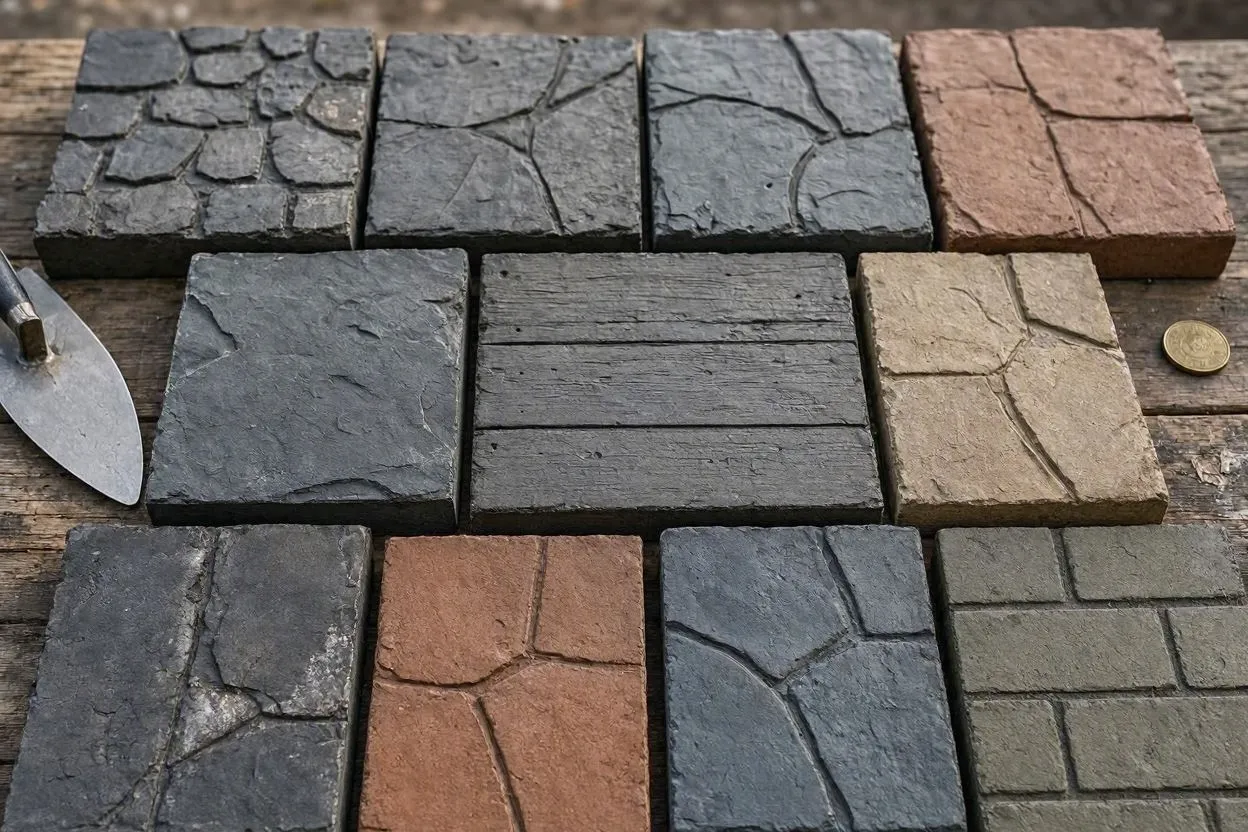
Concrete stamp patterns are textures and shapes pressed into wet concrete using rigid or flexible polyurethane mats, called stamps. Crews lay the stamps onto freshly poured concrete before it cures, then tamp them down to leave an imprint that mimics natural stone, brick, cobblestone, or wood. Once the concrete hardens, the surface keeps that texture for good.
The technique is older than most people assume. Ancient Roman builders used basic stamping methods on structures like the Pantheon. Modern polyurethane stamps didn’t show up until the mid-20th century, when contractors started casting mats directly from real stone and wood, which gave them sharper, more realistic detail than the old metal “cookie cutter” tools ever could.
Today, concrete stamp patterns fall into five broad categories: stone, brick, tile, slate, and wood. The category you pick affects everything downstream, including which colors work, how much labor the job takes, and how the surface holds up in rain or around a pool.
The Most Popular Concrete Stamp Patterns
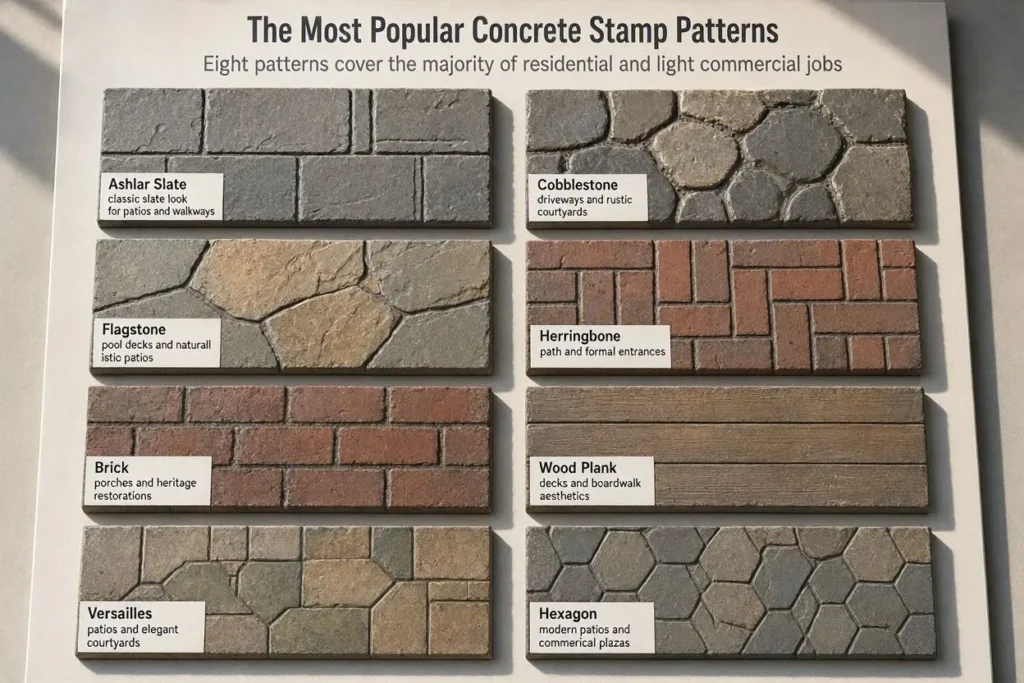
Eight patterns cover the overwhelming majority of residential and light commercial jobs. Here’s what each one looks like and where it works best.
Ashlar Slate
Ashlar slate is the single most requested pattern among stamped concrete contractors. It’s not hard to see why: the design uses rectangular “stones” of varying sizes, staggered in a non-repeating layout, that replicate cut slate without the visible grout lines of an actual paver installation. The irregular staggering also hides control joints better than any other pattern on this list, which matters a lot on larger slabs where joints are unavoidable.
Ashlar slate works with nearly any architectural style, from colonial to contemporary. Popular color pairings include desert tan with a dark walnut release, and dove gray with a charcoal release.
Random Flagstone
Random flagstone uses irregular, sharp-edged shapes to copy the look of natural quarried stone. Where ashlar slate feels structured, flagstone feels organic. There’s no repeating unit, so no two sections of a flagstone patio look identical, and the pattern flows naturally around curves. That makes it a favorite for patios with landscaped or rounded edges.
Homeowners chasing an estate-patio look tend to land on flagstone over ashlar. Autumn brown with a charcoal release and buff with a dark walnut release are two combinations contractors reach for often.
Running Bond Brick
Running bond is the classic brick layout: uniform rectangles offset by half a brick length in each successive row. It’s the same bond pattern used in real brickwork, and stamped concrete replicates it at roughly half the material and labor cost of laying actual brick pavers.
Running bond suits colonial and traditional homes especially well. It’s also a common choice for walkways leading up to brick-front houses, where the concrete needs to visually match the home’s exterior.
Herringbone Brick
Herringbone arranges brick-shaped sections at 45- or 90-degree angles in a zigzag layout. It reads as more formal and more labor-intensive than running bond, and it genuinely is: the angled sections need precise alignment, so herringbone simply takes longer to stamp correctly.
The interlocking angles aren’t just decorative, either. Herringbone shows up in actual road construction because the interlocking geometry resists shifting under load. That’s part of why it holds up so well on driveways and entryways that see regular vehicle or foot traffic.
Cobblestone
Cobblestone brings old-world European charm through small, rounded stone shapes set in a tight, repeating pattern. It’s one of the more forgiving patterns to stamp, since minor imperfections in the tooling blend into the already-textured look rather than standing out.
Cobblestone shows up most often as a driveway pattern, a walkway edge, or a border band framing a larger field pattern like ashlar slate or flagstone.
Wood Plank
Wood plank stamped concrete has grown fast over the past several years, especially for pool decks and covered patios. The stamps are cast directly from real wood boards, capturing grain lines and board-to-board variation that give the surface genuine texture instead of a flat, painted look.
The appeal is durability without the maintenance headache: no rot, no splinters, no annual staining the way a real wood deck demands. Wood plank pairs well with cedar or driftwood gray coloring and a whitewashed light release for a farmhouse look.
European Fan
A European fan, sometimes called a Euro fan or fan cobblestone, arranges small stone or brick units in a radiating, semicircular fan shape. It’s a heavier-texture pattern with fractured, split-edge joints that read as old-world and formal.
This pattern turns up most on driveways and larger patios, especially near an entryway, where a decorative focal point benefits from more visual movement than a straight running bond gives you.
Seamless Texture Skins
These aren’t a pattern in the geometric sense. They’re flexible mats that add stone-like texture across the entire slab without creating repeating grout lines or joints. The result looks closer to a single continuous slab of natural rock than a laid paving material.
This finish works particularly well for modern and minimalist homes, where the goal is subtle texture rather than a bold, repeating design.
How to Match a Pattern to Your Home’s Style
Modern homes generally do best with one pattern and one color, kept simple. A large-format ashlar slate in a cool gray tone, or a seamless texture skin, fits clean, minimalist exteriors without competing with the architecture.
Traditional and colonial homes pair naturally with brick and cobblestone patterns, since those textures echo materials already present on the house, like brick facades or stone foundations. Running bond and herringbone brick both work here.
Old-world and Mediterranean-style homes lean toward European fan, cobblestone, and slate patterns in warm earth tones. Rustic and farmhouse-style properties tend to favor wood plank or random flagstone, both of which read as more organic and less manufactured than a geometric brick layout.
The rule contractors repeat most often: match the pattern to your home’s existing materials first, then to whatever’s trending that year. A pattern that clashes with your siding or brick will look wrong no matter how popular it is.
Concrete Stamp Patterns by Project Type
Patios
Patios have the most design freedom of any surface, since they don’t carry vehicle loads. Ashlar slate and random flagstone dominate here, often paired with a contrasting border band in cobblestone or a soldier-course brick edge.
Driveways
Driveways need heavier-duty concrete mix and base preparation than patios because of the vehicle weight involved. Ashlar slate and cobblestone are the two most common driveway patterns. Lighter colors are usually the better call too, since dark colors show tire marks and oil stains more visibly than light tones do.
Pool Decks
Pool decks come with two extra requirements patios don’t have: the surface needs to stay cool underfoot in direct sun, and it needs enough texture to grip when wet. Light-colored bases reflect heat instead of absorbing it, and textured patterns like slate, flagstone, or wood plank provide natural traction. Wood plank in particular has become a leading pool deck choice because it doesn’t heat up underfoot the way darker stone patterns do.
Walkways and Steps
Matching the walkway pattern and color to the adjoining patio or driveway creates a continuous look from the street to the backyard. On steps, using a different pattern for the riser than the tread (a cobblestone riser under an ashlar slate tread, say) creates a layered, more finished appearance than one pattern throughout.
Color and Concrete Stamp Patterns
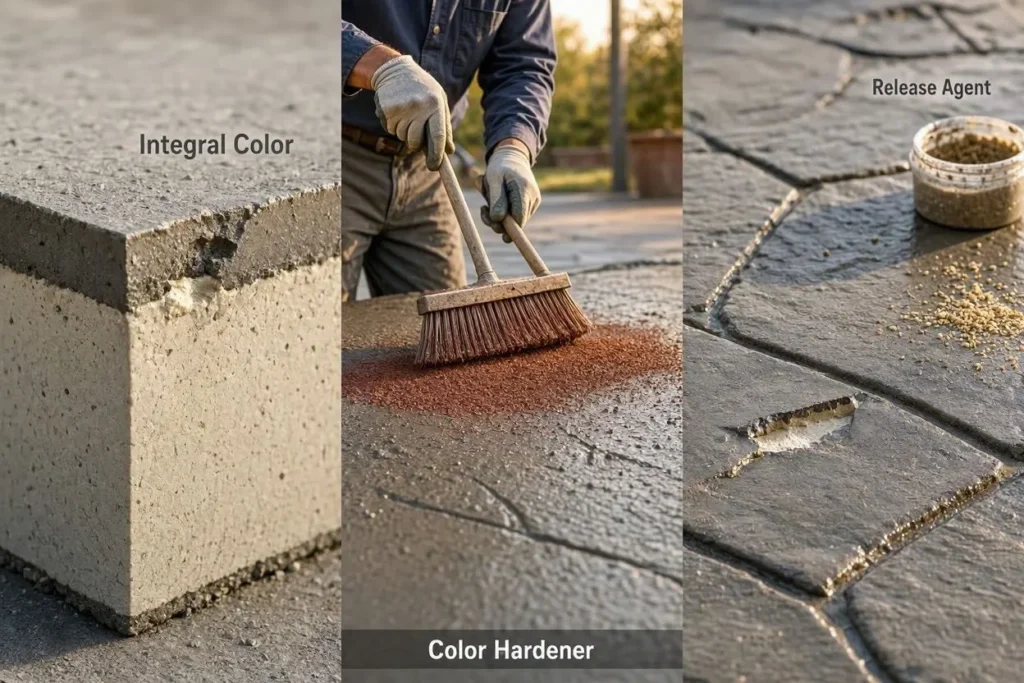
Color is what separates a stamped patio that looks like real stone from one that looks like painted concrete, and three components produce it together.
Integral color gets mixed into the concrete before pouring and becomes the base color running through the entire slab. If the surface ever chips, the color underneath matches, since it isn’t just a surface treatment.
Color hardener gets broadcast onto the surface before stamping. It’s optional, it adds cost, and it produces a richer, more vibrant surface color than integral color alone while also strengthening the top layer of the slab.
The release agent goes down right before stamping to keep the stamp mats from sticking to the wet concrete. Beyond that practical job, it also creates the antiquing effect that makes stamped concrete look like real stone: darker color settles into the joints and low spots, adding depth a flat, single-tone surface can’t achieve. Skipping the release color is the single most common reason a stamped patio ends up looking flat and artificial.
One color rule holds across nearly every project: pick a shade slightly darker than what you actually want. Freshly sealed concrete looks richer and darker than it will after a year of sun exposure, so a color that looks just right the day it’s poured often looks washed out twelve months later.
Combining Patterns, Borders, and Accents
The most distinctive projects rarely use just one pattern. A two-pattern patio might use ashlar slate as the main field with a random flagstone border band framing it. Border stamps, whether a straight soldier course or a cobblestone accent band, break up a large single-pattern surface and give it a finished, professional edge.
Multi-texture installations take more skill and materials than single-pattern jobs, since they usually require multiple pours or careful timing to keep the transition between textures clean. The payoff is a surface that reads as custom instead of off-the-shelf.
Some contractors also mix stamped concrete with real materials: a stamped patio paired with a natural stone cap on a seat wall, or a stamped surface transitioning into a paver walkway. Combinations like these add visual depth that a single material can’t replicate on its own.
Concrete Stamp Pattern Cost
Concrete stamp patterns installed typically run $10 to $20 per square foot, though the exact number depends on the pattern and how much coloring work goes into it.
Running bond brick tends to sit at the lower end, around $10 to $16 per square foot, since the geometry is straightforward to stamp. Ashlar slate runs $12 to $18 per square foot for a standard installation. Herringbone brick costs more, typically $12 to $18 per square foot too, because the angled layout takes longer to lay correctly.
Beyond the pattern itself, color hardener, multiple release colors, and border accents all add to the total. A single-color, single-pattern patio sits at the affordable end of the range; a multi-pattern design with color hardener and a contrasting border can push toward the top of it, or past it.
Contractors who buy their own stamp tools face a separate cost structure: individual stamp mats run roughly $95 to $200 each, and a full pattern set can run anywhere from $95 up to $1,695 depending on the pattern and set size. Many concrete contractors budget several thousand dollars a year just to maintain and expand their pattern inventory.
Slip Resistance and Commercial Requirements
Yes, stamped concrete can meet slip-resistance requirements for both residential and commercial use, but pattern and finish choice matter. Textured patterns like slate, flagstone, and heavy cobblestone create natural grip, while smoother seamless skins offer less traction when wet. Guidance commonly referenced under the Americans with Disabilities Act (ADA) calls for a static coefficient of friction of at least 0.6 on level walking surfaces, and sealers should include a slip-resistant additive on pool decks and commercial walkways specifically.
Commercial and municipal projects also need to account for detectable warning stamps, the truncated-dome texture required at curb ramps and crosswalks under ADA accessibility rules. This is a narrow, code-driven category separate from decorative pattern selection, and it’s worth flagging to a contractor early if the project touches any public right-of-way.
Maintenance and Longevity
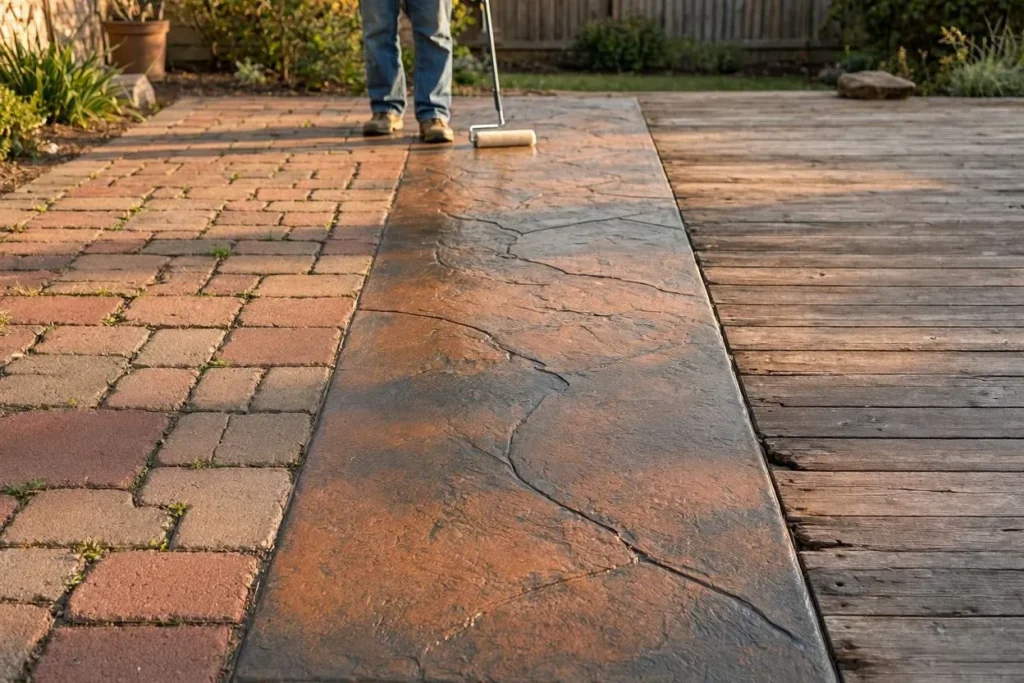
A properly installed and sealed stamped concrete surface holds its pattern and color for decades with minimal upkeep. Most contractors recommend resealing every two to three years to protect against fading, moisture penetration, and surface wear. Between reseals, routine care is limited to sweeping and an occasional hose-down or pressure wash.
Compared to pavers, which shift and settle over time and let weeds grow between joints, or wood decking, which needs annual staining and is vulnerable to rot, stamped concrete needs noticeably less ongoing maintenance once it’s sealed correctly the first time.
Conclusion
The right concrete stamp pattern comes down to three things: your home’s existing materials, the surface’s actual job (patio, driveway, pool deck, or walkway), and a color plan that includes a real release color, not just a base tone. Ashlar slate and random flagstone cover most stone-look projects, running bond and herringbone brick handle traditional homes, and wood plank has become the default for pool decks that need to stay cool and slip-resistant. Budget $10 to $20 per square foot as a baseline, add more for multi-pattern designs or heavier color work, and reseal every two to three years to keep it looking sharp for decades.
FAQs

Related Posts