What Is Fly Ash Concrete? Benefits, Uses & Mix Ratios
Coal plants have been shutting down across the country, yet the byproduct they leave behind still shapes how America pours concrete. Fly ash concrete swaps a portion of portland cement for that leftover ash, and the result holds up in everything from driveways to dam foundations. A Wisconsin bridge deck poured with this mix hit 6,000 psi by 90 days, well past what a standard cement blend delivers on its own. Here’s what fly ash actually is, how it changes a concrete mix, and where it makes the most sense to use.
What Is Fly Ash Concrete?
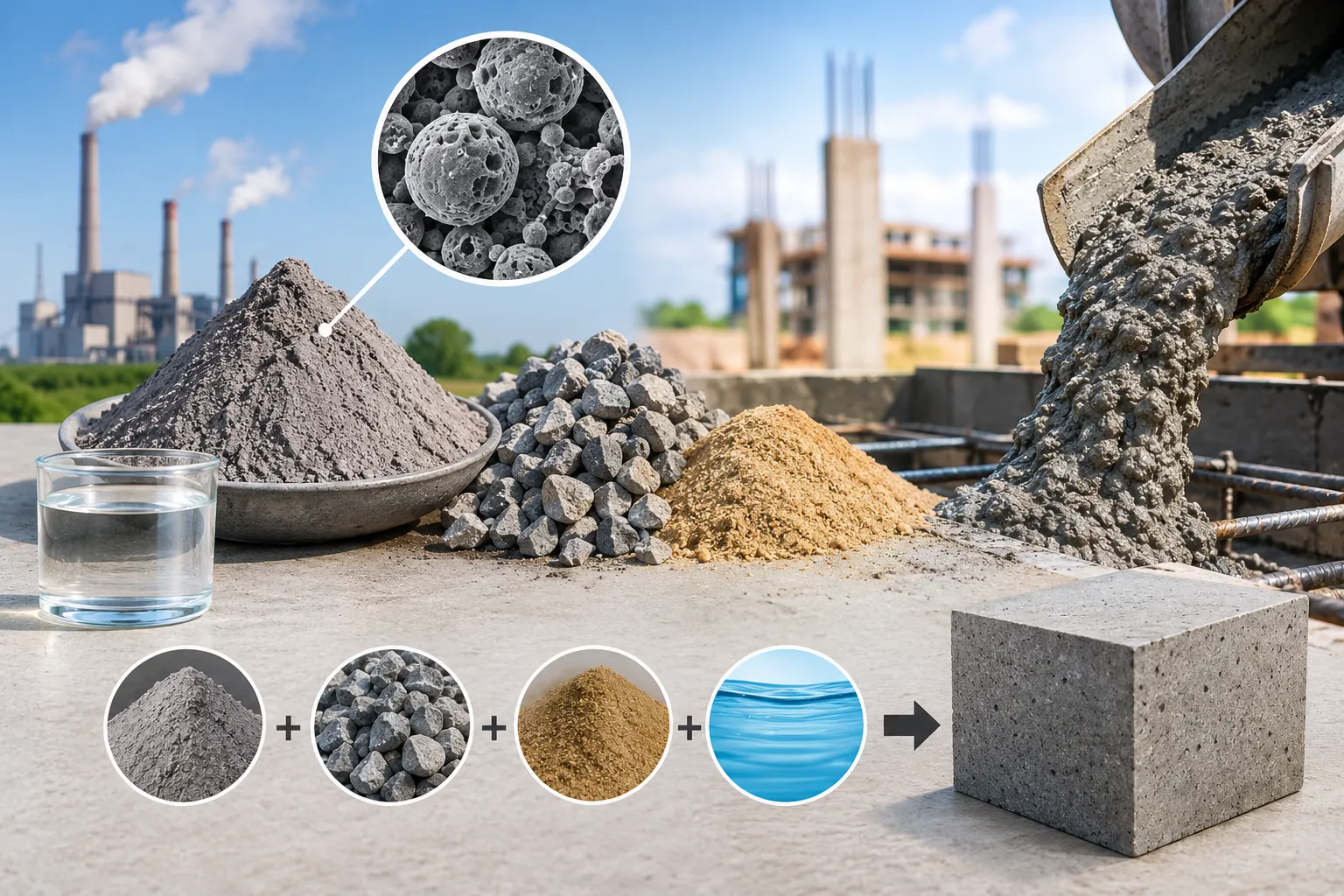
Fly ash concrete is portland cement concrete in which 15% to 30% of the cement gets replaced with fly ash, a fine powder left over from burning coal at power plants. Engineers call it a supplementary cementitious material, or SCM, because it reacts chemically with water and calcium hydroxide to form the same binding compounds that give concrete its strength. Ready-mix producers have used this substitution since the 1930s, and highway departments across the U.S. now specify it routinely on interstate paving jobs. A typical residential driveway pour might use a 20% fly ash mix; high-volume applications in dams and foundations sometimes push that figure to 50% or higher.
Contractors reach for fly ash concrete for two main reasons: it costs less, and it cuts the greenhouse gas emissions tied to cement production. Cement manufacturing accounts for roughly 8% of global CO2 emissions, so every ton of fly ash that replaces a ton of cement is a ton of that footprint gone.
What Is Fly Ash Made Of?
Fine, glassy particles of silicon dioxide, aluminum oxide, iron oxide, and calcium oxide, captured from the exhaust gas of coal-fired power plants, that’s fly ash in a nutshell. Picture something finer than flour: these particles run 10 to 100 microns across, about the width of a human hair, sometimes thinner. Before any of it reaches the smokestack, electrostatic precipitators and fabric filter baghouses grab it, so almost none escapes into the air.
What’s actually in the ash comes down to which coal went into the furnace. Bituminous coal, common in the eastern United States, produces ash rich in silica and alumina. Sub-bituminous coal, mined heavily in Wyoming’s Powder River Basin, yields ash with much higher calcium content. That calcium difference is what drives the entire classification system covered next.
How Does Fly Ash Get Into Concrete?
It enters during batching, where it’s measured by weight and blended with portland cement, aggregate, and water before mixing even starts. Fly ash gets its own silo on-site, kept apart from the cement silo. The two powders can look nearly identical, but they don’t handle the same way, so mixing them up isn’t really an option. Batch plants dose to within about 1% of the target weight, load after load, which is a tighter tolerance than most people would guess.
Once mixed, fly ash particles fill the microscopic gaps between cement grains. This packing effect reduces the water needed for a workable mix, which lowers the water-to-cement ratio and improves the finished concrete’s density. Curing slows down as a direct result, because fly ash reacts more gradually than portland cement does. That slower reaction is also exactly what drives the long-term strength gains covered in the next section.
Class C vs. Class F Fly Ash: What’s the Difference?
Class C fly ash contains more than 20% calcium oxide and sets faster. Class F contains less than 10% calcium oxide, cures more slowly, and resists chemical attack better. ASTM defines both classes under specification ASTM C618, and AASHTO mirrors that standard under AASHTO M 295.
| Property | Class C | Class F |
| Source coal | Sub-bituminous, lignite | Bituminous, anthracite |
| Calcium oxide (CaO) content | Above 20% | Below 10% |
| Self-cementing | Yes | No |
| Sulfate resistance | Lower | Higher |
| Typical replacement rate | 15%–25% | 20%–35% |
| Common regions of origin | Western U.S. (Wyoming, Montana) | Eastern and Midwest U.S. |
Engineers pick Class F for marine structures and sulfate-heavy soils because of that superior chemical resistance. Class C tends to win out in cold climates, where faster strength gain keeps a construction schedule moving.
What Are the Benefits of Fly Ash Concrete?
Four benefits show up consistently: greater long-term strength, better workability, a smaller carbon footprint, and lower material costs. Each one traces back to the chemistry above, not to marketing copy.
Increased Long-Term Strength
Fly ash concrete usually comes in weaker than standard concrete at 7 days, then catches up and surpasses it somewhere between 56 and 90 days of curing. On a Wisconsin Department of Transportation bridge deck project, a fly ash mix hit a 28-day compressive strength of 4,200 psi and kept climbing past 6,000 psi (41 MPa) by day 90. That delayed but higher ceiling comes from the pozzolanic reaction, which keeps consuming free lime in the mix long after portland cement hydration has already slowed down.
Improved Workability
Crews report easier pumping and smoother finishing once fly ash replaces 20% or more of the cement. The spherical shape of fly ash particles acts almost like tiny ball bearings inside the wet mix, cutting down on internal friction. Finishers on flatwork jobs, warehouse floors and airport runways especially, consistently note fewer surface voids and a smoother trowel finish next to a straight portland cement mix.
Lower Carbon Footprint
Swap one ton of portland cement for one ton of fly ash and you keep roughly 0.9 tons of CO2 out of the atmosphere, since fly ash needs no extra kiln firing or limestone calcination. Projects chasing LEED (Leadership in Energy and Environmental Design) certification can earn credits toward the Materials and Resources category just by documenting fly ash content in structural concrete, which makes it one of the more straightforward wins in low-carbon, green concrete design. New York State’s Buy Clean Concrete guidance, in effect for state contracts over $1 million since 2025, now requires exactly this kind of emissions disclosure.
Cost Savings
Fly ash typically runs 20% to 40% cheaper per ton than portland cement, depending on regional supply. A producer batching 1,000 cubic yards a month at a 25% fly ash replacement rate can save several thousand dollars a month on raw materials alone. Those savings shrink during regional supply shortages, though, a wrinkle covered further down.
What Are the Disadvantages of Fly Ash Concrete?
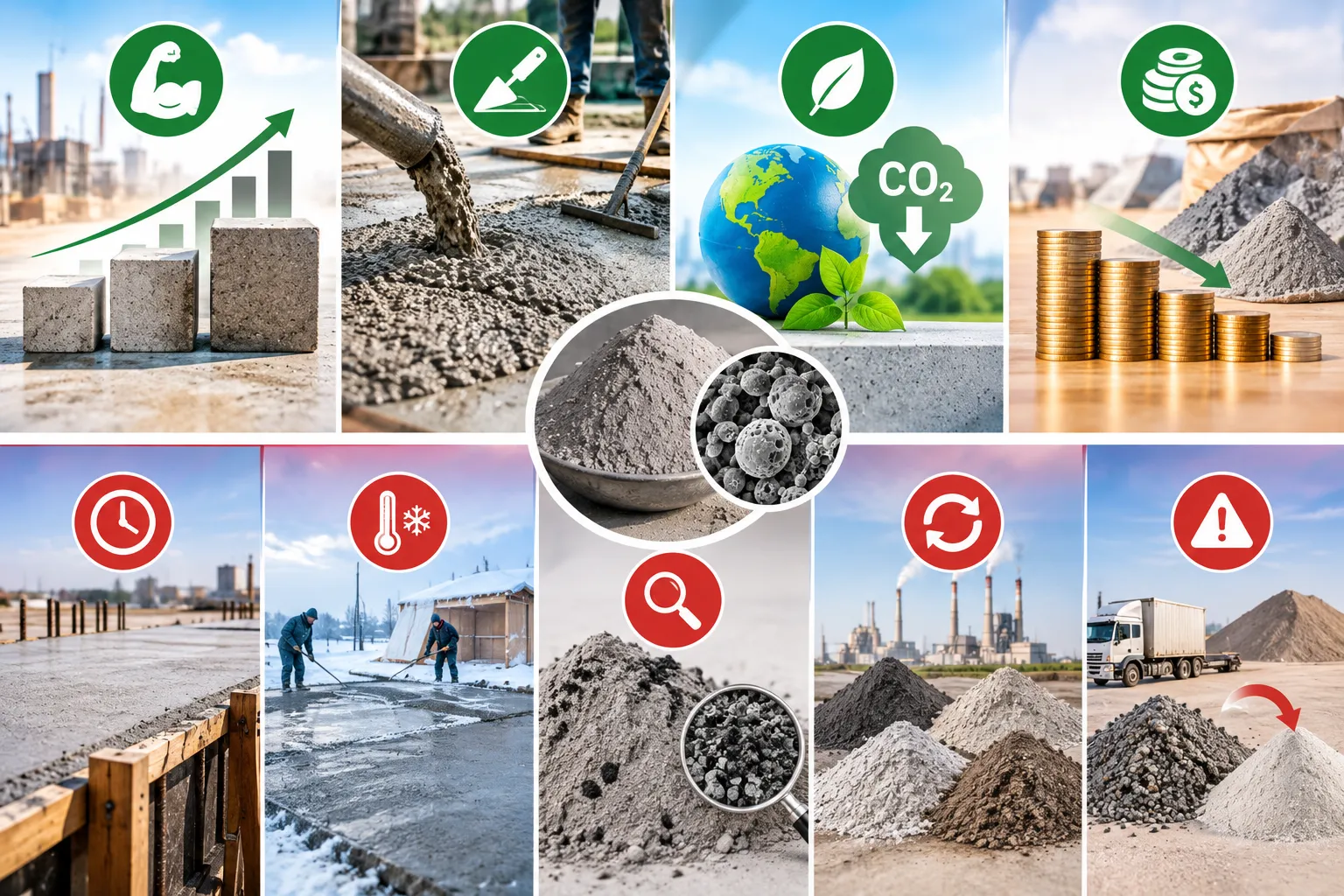
Slower early strength gain, cold-weather sensitivity, and inconsistent quality between ash sources: those are the real drawbacks. None of them rule fly ash out. Each just demands a mix-design adjustment.
- Slower initial set: Fly ash concrete gains strength more gradually over the first 3 to 7 days, which can delay form removal on time-sensitive jobs.
- Cold-weather sensitivity: Below 50°F (10°C), curing drags on, and crews sometimes need heated enclosures or accelerating admixtures just to keep the pour on schedule.
- Variable carbon content: A high loss on ignition (LOI) reading means unburned carbon is still sitting in the mix, and that carbon messes with air entrainment, which chips away at freeze-thaw durability.
- Source inconsistency: Switch coal suppliers and the ash chemistry shifts with it, so producers can’t just trust last month’s test results. Every new shipment gets retested against ASTM C618 limits.
- Supply volatility: When regional shortages hit (more on that below), producers sometimes scramble for last-minute substitutes like slag cement or silica fume.
What Is the Ideal Fly Ash Concrete Mix Ratio?
For general structural work, 15% to 25% cement replacement by weight is the sweet spot. High-volume mixes push that to 40% or higher for mass concrete pours. A standard residential mix might land at 20% fly ash, 80% portland cement, a water-to-cementitious-material ratio near 0.45, with standard aggregate proportions rounding it out.
High-volume fly ash (HVFA) concrete takes the substitution even further, using 50% or more fly ash by weight of total cementitious material. The U.S. Army Corps of Engineers has used HVFA mixes above 50% replacement in dam construction since the 1980s, where the slow, low-heat curing profile actually helps by preventing thermal cracking in massive pours. Residential contractors rarely need ratios that aggressive. A 15% to 25% range covers driveways, sidewalks, and foundation work without giving up early-strength timelines.
Where Is Fly Ash Concrete Used?
Highway pavements, bridge decks, dams, sidewalks, and precast concrete products see the most fly ash use, and each application leans on a different piece of what the material offers.
- Highway pavements: State DOTs specify fly ash in portland cement concrete (PCC) pavement to extend service life and cut down on cracking from deicing salt exposure.
- Bridge decks: Reduced permeability is the draw here. It slows chloride penetration, which means less rebar corrosion over decades of service, a real factor on a structure that’s expensive to inspect and harder still to repair.
- Dams and mass concrete: The bigger the pour, the more heat builds up while it cures, and that heat is what cracks it. Fly ash’s slower heat generation keeps massive pours from cracking under their own curing temperature.
- Sidewalks and driveways: For most residential and municipal jobs, a 15% to 25% fly ash mix is plenty, delivering a smoother finish at a lower price than straight portland cement.
- Precast products: Pipe, block, and panel manufacturers lean on fly ash because it keeps concrete workable through hours of repetitive, high-volume casting.
- Self-consolidating concrete (SCC): SCC has to flow into formwork and fill every gap under its own weight, no vibration allowed, and fly ash’s fine, spherical particles are what make that possible. It’s a big reason SCC mix designs for congested rebar sections or architectural concrete lean on fly ash in the powder content.
How Much Does Fly Ash Concrete Cost?
Expect fly ash concrete to run $5 to $15 less per cubic yard than standard portland cement concrete, though the exact discount depends on local fly ash availability. Standard ready-mix concrete costs $150 to $200 a cubic yard in most U.S. markets as of 2026, while a fly ash blend at 20% replacement often lands $10 to $20 below that. Prices swing by region: producers near active coal plants in the Midwest see the steepest discounts, while contractors on the West Coast sometimes pay a premium if local ash supply has tightened.
Is Fly Ash Concrete Safe?
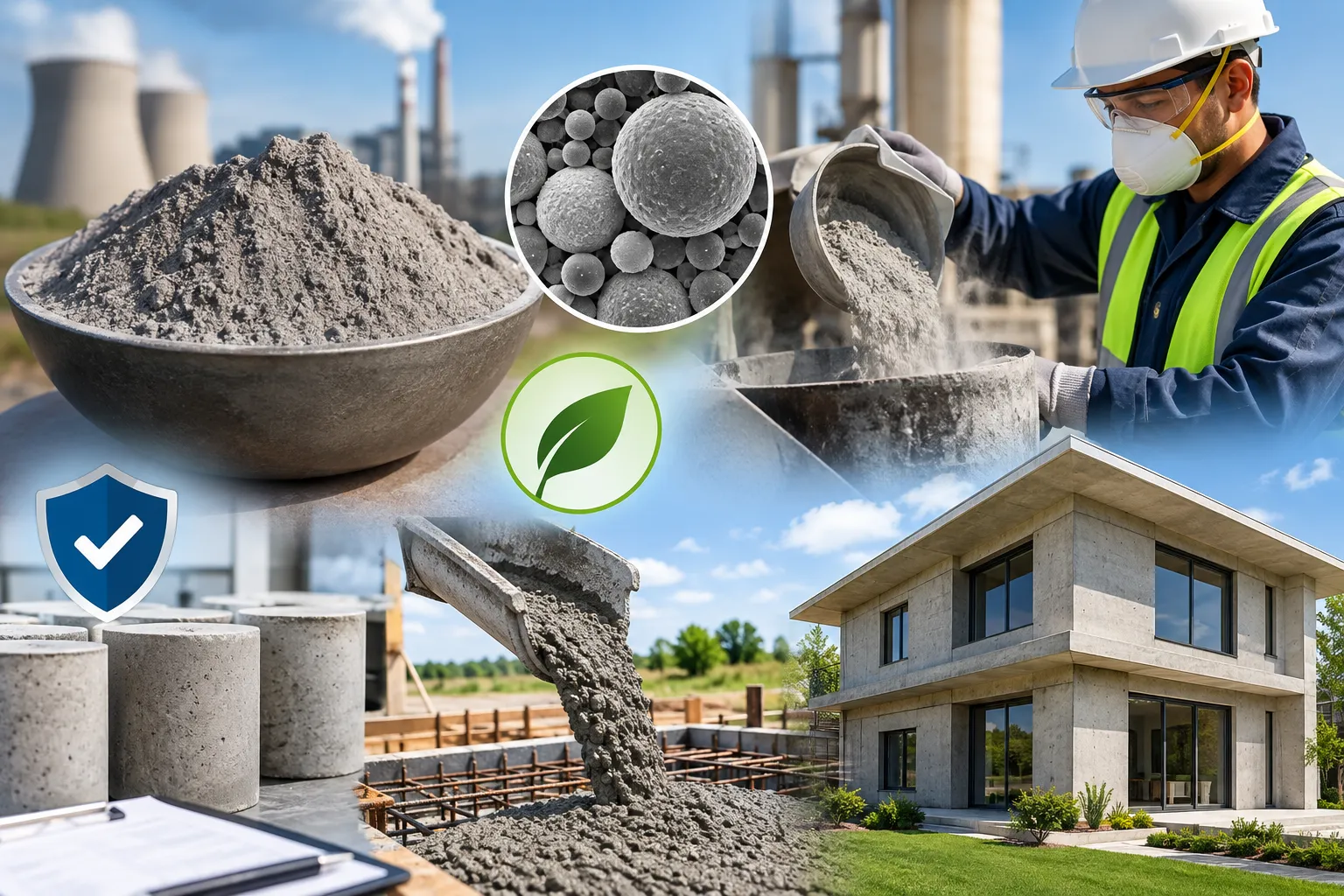
Yes, when the fly ash meets ASTM C618 quality limits for loss on ignition, moisture content, and heavy metal levels, it’s safe for structural and residential use. The EPA classified coal combustion residuals, fly ash included, as non-hazardous solid waste under Subtitle D of the Resource Conservation and Recovery Act (RCRA) back in 2015. Encapsulated uses, fly ash bound inside cured concrete, pose minimal exposure risk because the material is chemically locked into the hardened matrix rather than sitting loose. Workers handling raw, unmixed fly ash should still wear respiratory protection, since airborne particulate exposure during batching carries the same silica-related risks as handling raw cement powder.
Fly Ash Concrete vs. Regular Concrete: Key Differences
Curing speed, long-term strength, workability, and environmental impact are where fly ash concrete and regular concrete part ways, even though fly ash matches or beats regular concrete on final durability.
| Property | Regular Concrete | Fly Ash Concrete |
| Early strength (7 days) | Higher | Lower |
| Sulfate resistance | Standard | Improved (Class F) |
| CO2 emissions per ton of binder | Higher | 15%–30% lower |
| Material cost per cubic yard | Higher | $5–$15 lower |
| Cold-weather performance | Standard | Requires adjustment |
What Standards Govern Fly Ash Concrete?
ASTM C618, AASHTO M 295, and American Concrete Institute guidance documents like ACI 232.2R govern fly ash concrete in the United States. ASTM C618 sets the chemical and physical limits for fly ash used as a mineral admixture: silica-alumina-iron oxide content, loss on ignition, fineness, water requirement, all of it. AASHTO M 295 mirrors those limits for state transportation department specs, keeping federal highway projects and local paving contracts on the same page.
ACI 232.2R, from the American Concrete Institute, gives engineers mix-design guidance for specifying fly ash replacement rates on structural projects. ACI 232.3-14 goes further still, covering high-volume fly ash concrete specifically for structural applications above the standard 25% replacement threshold.
Is Fly Ash Still Available for Concrete Production?
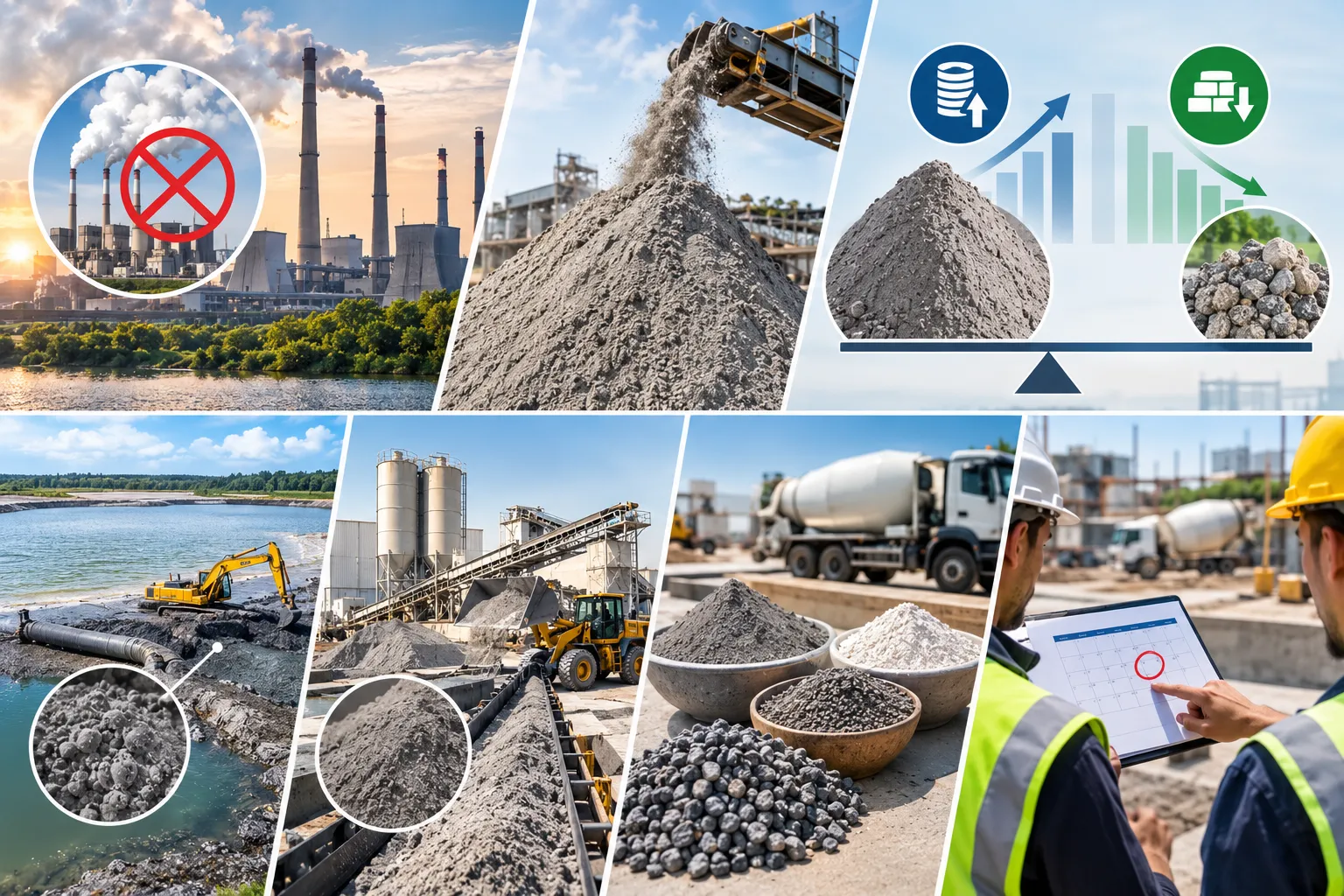
Yes, but supply has tightened significantly as coal-fired power plants shut down across the country. Twenty-three coal-fired units at fifteen power plants went offline in 2025 alone, seventeen fully retired and six converted to natural gas. FHWA research projects U.S. demand for fly ash will top 35 million tons a year by 2030, while total SCM availability, fly ash included, is expected to reach only 14 million tons a year over that same stretch. That gap is worth sitting with for a second: it’s more than 20 million tons a year of shortfall, and it isn’t closing on its own.
Producers have responded by harvesting fly ash from older storage ponds and landfills, a process that needs extra processing to meet ASTM C618 limits. Some ready-mix suppliers have started blending in slag cement or natural pozzolans as partial substitutes when local fly ash inventory runs low, and a handful are experimenting with cement kiln dust and other recycled industrial byproducts to stretch supply further. Contractors specifying fly ash concrete for 2026 projects should confirm supply with their batch plant early in the bidding process. Lead times that used to be days have stretched into weeks in several regions.
Conclusion
Fly ash concrete solves two problems at once. It cuts the carbon footprint of a construction project, and it produces a denser, more durable final product than portland cement alone can manage. Highway departments, bridge engineers, and residential contractors have leaned on this material for nearly a century, and current ASTM and AASHTO standards give every project team a clear framework for specifying it right. The one variable worth watching going forward is supply. With fifteen coal plants retiring units in 2025 and projected U.S. demand outpacing availability by more than 20 million tons a year by 2030, sourcing fly ash early in a project’s planning phase has become just as important as designing the mix ratio itself.
FAQs

Related Posts