How Long Do Roofs Last? Life Span by Material and Climate
Asphalt shingle roofs last 15 to 30 years, while metal, clay tile, concrete tile, and slate roofs last 40 to 150 years. Asphalt sits on more than 80% of US homes, so the first range is the one most owners live with. Where a roof lands inside it comes down to attic ventilation and local weather far more than the number printed on the shingle bundle. The question “how long do roofs last” has a second, more useful answer, too. It’s about how long yours will last.
How Long Do Roofs Last on Average?
The average American roof lasts about 20 to 30 years, because asphalt shingles cover most houses. The International Association of Certified Home Inspectors (InterNACHI) publishes roof life expectancy figures that home inspectors use nationwide, rating 3-tab asphalt shingles at 20 years and architectural shingles at 30. Those numbers carry a condition. They assume routine maintenance and normal wear, not extreme weather or neglect.
Real roof lifespan drifts from the chart. One Mid-Atlantic contractor puts the average across its replacements at 20 to 25 years, and has pulled 12-year-old and 32-year-old roofs of the same shingle off houses two doors apart. Ventilation and install quality explain most of that spread.
Life Span of a Roof by Material
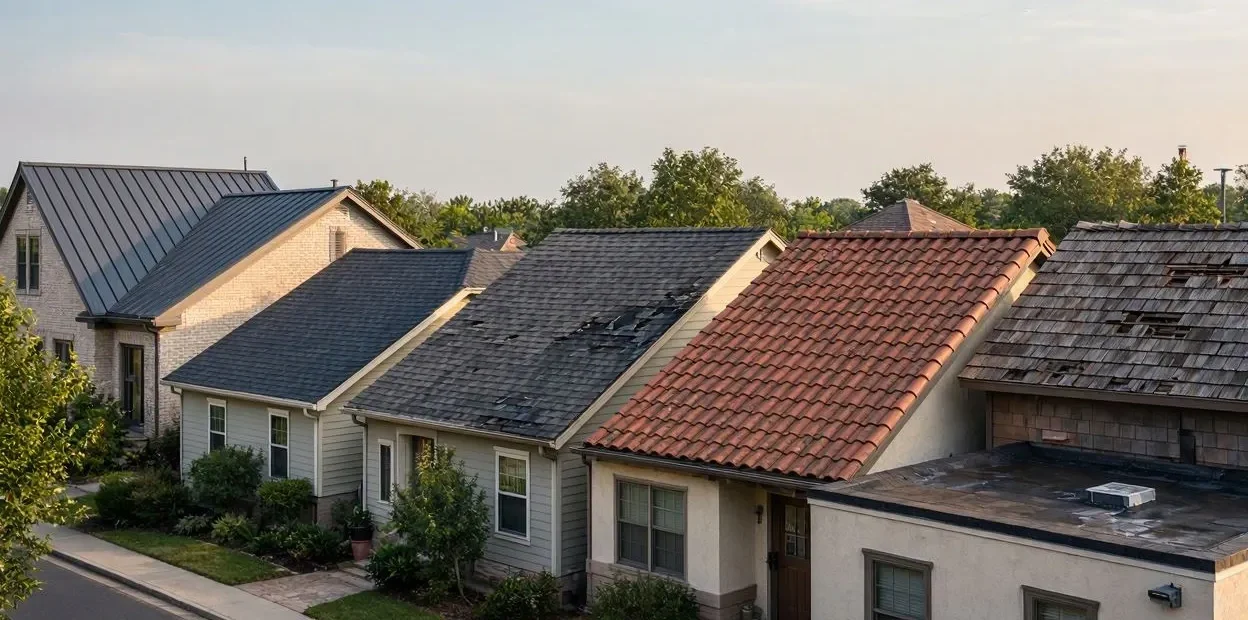
Material sets the life span of roof coverings more than any other factor, from 7 years for a thin TPO membrane to 150 years for hard slate. Expect the ranges below from a properly installed roof in a moderate US climate.
| Material | Realistic life span | InterNACHI estimate | Main weakness |
| 3-tab asphalt shingles | 15 to 20 years | 20 years | Thin mat, wind uplift |
| Architectural asphalt shingles | 25 to 30 years | 30 years | Granule loss in heat |
| Premium/designer asphalt | 30 to 40 years | Not listed | High price for asphalt |
| Metal (steel, aluminum) | 40 to 70 years | 40 to 80 years | Fastener and sealant wear |
| Copper | 70+ years | 70+ years | Upfront cost |
| Clay or concrete tile | 50 to 100 years | 100+ years | Underlayment fails first |
| Slate | 60 to 150 years | 60 to 150 years | Weight, specialist repairs |
| Wood shakes/shingles | 20 to 40 years | 25 years | Rot and fire risk |
| EPDM rubber | 15 to 25 years | 15 to 25 years | Seam failure |
| TPO membrane | 7 to 20 years | 7 to 20 years | UV and seam wear |
| Modified bitumen | 10 to 20 years | 20 years | Ponding water |
| Built-up roofing (BUR) | 15 to 30 years | 30 years | Blistering |
InterNACHI’s standard chart supplies the middle column, listing metal at 40 to 80 years, copper at 70-plus, clay and concrete at 100-plus, slate at 60 to 150, and wood at 25.
Asphalt Shingles: 15 to 40 Years
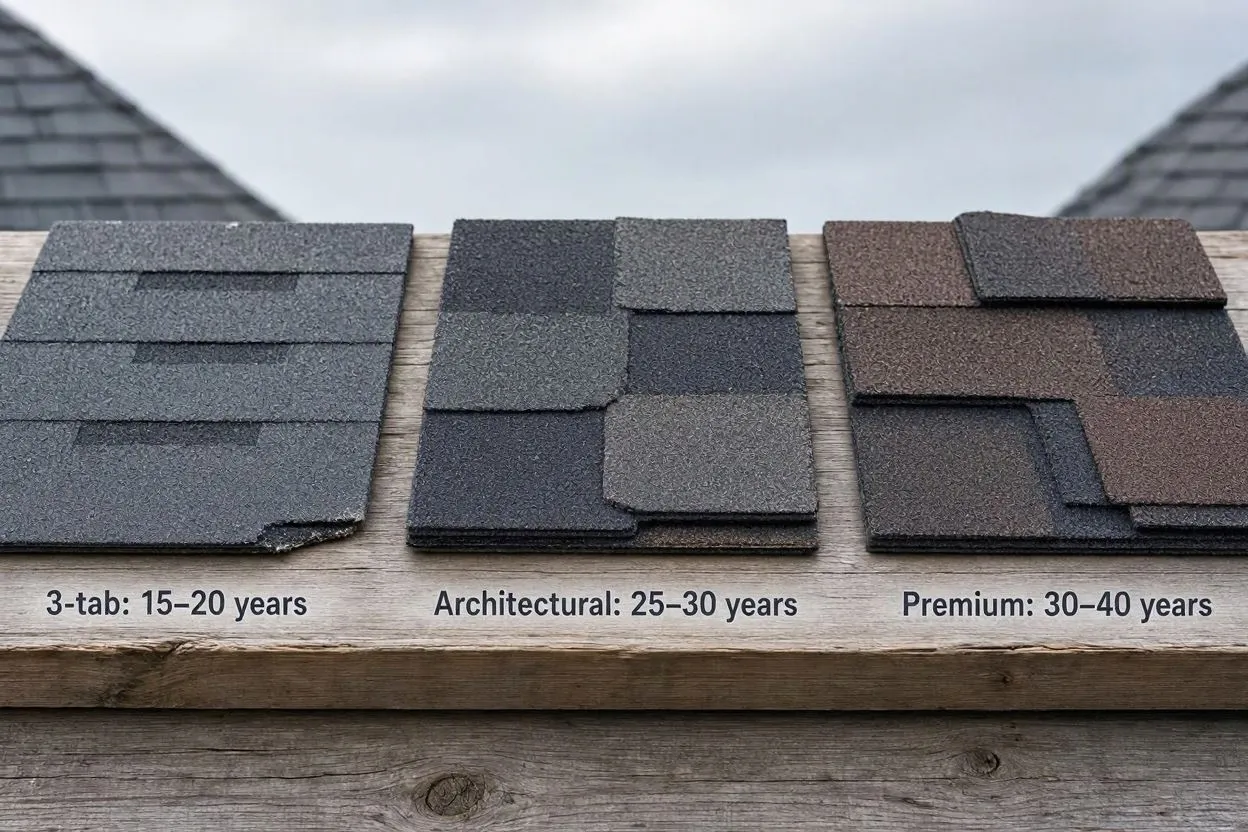
Asphalt shingles last 15 to 20 years in 3-tab form and 25 to 30 years as architectural (dimensional) shingles. Three-tab shingles are a single flat layer, easy to spot by their uniform slots. Architectural shingles laminate two layers together. That extra mass buys roughly 8 to 10 more years, and premium designer lines stretch toward 30 to 40.
The upgrade costs less than most owners expect. HomeGuide lists installed 3-tab shingles at $3 to $5 per square foot and architectural shingles at $4 to $6, a gap of about $1 per square foot, or roughly $3,000 on a 3,000 sq ft (279 m²) roof. For anyone staying past 10 years, 3-tab rarely pays off.
In a storm country, two ratings matter. A Class 4 rating under UL (Underwriters Laboratories) 2218 means the shingle survived a 2-inch (51 mm) steel ball dropped from 20 feet (6.1 m) without cracking, while ASTM (American Society for Testing and Materials) D7158 Class H covers wind gusts up to 150 mph (241 km/h).
Metal Roofing: 40 to 80 Years
Metal roofs last 40 to 80 years, and copper roofs pass 70. Standing-seam panels hide their fasteners under raised seams, which is why they reach the top of that range. Exposed-fastener panels behave differently. Their screws carry neoprene washers that harden in sun and heat, so the screws need checking and replacing long before the steel gives out.
Snow slides off metal fast. In northern states such as Minnesota and Maine, that cuts ice dam risk at the eaves.
Clay and Concrete Tile: 50 to 100+ Years
Clay and concrete tiles last 50 to 100 years or more, but the underlayment beneath them wears out after 20 to 30 years. That gap catches owners off guard. Tiles can look flawless from the street while the membrane under them has cracked and started letting water reach the deck. Roofers fix it with a “lift and relay”: tiles come off, new underlayment goes down, and the same tiles go back on.
Weight is the other catch. Tile can exceed 800 pounds per roofing square of 100 sq ft (about 363 kg per 9.3 m²), so framing has to be rated for it. Clay generally outlasts concrete, since concrete absorbs more moisture and suffers more in freeze-thaw climates.
Slate: 60 to 150 Years
Slate lasts 60 to 150 years, with hard slate at the long end and soft slate closer to the short end. Hard slate gives more durability over time. The stone itself rarely fails first. Flashing and the nails holding each slate wear out sooner, which is why old slate roofs in states like Pennsylvania and Vermont usually get re-flashed rather than replaced.
Walking on slate cracks it. Repairs need a specialist with slate hooks and a ripper.
Wood Shakes and Shingles: 20 to 40 Years
Cedar shingles last 20 to 30 years, and thicker hand-split cedar shakes last 30 to 40 years. Moisture is the enemy in Seattle and Portland, where moss and rot shorten service life. Dry western air does different damage, splitting and cupping untreated shakes. Wildfire rules add pressure: many fire-prone communities in California and Colorado require Class A fire-rated roof coverings, which untreated cedar can’t meet.
Flat and Low-Slope Membranes: 7 to 30 Years
Flat and low-slope roofs last 7 to 30 years, depending on the membrane. InterNACHI lists ethylene propylene diene monomer (EPDM) rubber at 15 to 25 years, modified bitumen at 20, thermoplastic polyolefin (TPO) at 7 to 20, and built-up roofing at 30. Standing water shortens every one of them. Water still sitting 48 hours after rain counts as ponding, and it’s the most common reason a flat roof dies young.
Synthetic Slate and Shake: 10 to 35 Years
Synthetic slate and shake products last 10 to 35 years on InterNACHI’s chart, though several polymer brands advertise 50-year warranties. These products weigh a fraction of real stone, so they suit houses whose framing can’t carry slate. Treat those long warranty numbers with care. Most of these products haven’t been on roofs long enough to prove them.
How Long Should a Roof Last on a House?
A roof on a house should last at least 20 years with 3-tab shingles and at least 30 years with architectural shingles. A roof that fails well short of those numbers points to an installation or ventilation problem, not bad luck.
The number on the shingle wrapper makes a different promise. A GAF Master Elite contractor notes that GAF’s warranty prorates a “25-year” shingle claim to 50% coverage once the roof reaches 25 years, and that such shingles commonly get 15 to 20 years under real weather and average installs. That label describes a controlled test. Your attic in August isn’t one.
What Roof Warranties Actually Cover
Roof warranties come in 3 types, and only 2 of them cover installation mistakes.
| Warranty type | What it covers | Typical term | Who backs it |
| Manufacturer material | Defective shingles or panels | 25 years to “lifetime,” prorated after an early full-coverage period | Manufacturer |
| Contractor workmanship | Installation errors, such as bad flashing or nailing | 2 to 10 years | Roofing contractor |
| Enhanced system | Materials plus workmanship | Up to 50 years on top-tier programs | Manufacturer, through certified installers (GAF Master Elite, Owens Corning Platinum Preferred) |
Most early failures trace back to installation. That makes the workmanship term worth more attention than the headline number on the bundle. “Lifetime” usually means for as long as the original owner holds the home, and most manufacturer warranties must be registered within a set window after installation.
How Long Will a Roof Last in Your Climate?
A roof will last up to 10 to 15 fewer years in hot coastal climates like Florida than the same material in a moderate climate. InterNACHI’s Florida chart rates architectural shingles at just 15 to 20 years, against 30 on its standard chart, and the association states that hot climates drastically reduce asphalt shingle life. Regional roofers answer “how long do roofs last” very differently for exactly that reason.
| US region | Main stressors | Effect on asphalt shingles | Materials that hold up better |
| Florida and Gulf Coast | UV, hurricanes, salt air | 15 to 20 years for architectural shingles | Concrete tile, standing-seam metal, FORTIFIED installs |
| Desert Southwest (AZ, NV, NM) | UV, attic heat above 150°F (66°C) | Shingles dry out and crack early | Clay or concrete tile, reflective “cool roof” shingles |
| Hail belt (TX, OK, KS, NE, CO) | Hailstones 1 inch (25 mm) and larger | One storm can end a roof | Class 4 shingles, metal |
| Upper Midwest and North | Freeze-thaw cycles around 32°F (0°C), ice dams | Cracking and leaks at the eaves | Architectural shingles over ice-and-water shield, metal |
| Pacific Northwest | Constant moisture, moss | Moss lifts shingle edges | Algae-resistant shingles, metal |
| Mid-Atlantic and Northeast | Humidity, wind-driven rain | Ventilation failures cook shingles | Architectural shingles with balanced ventilation, slate |
Gulf Coast owners have a specific upgrade path. The Insurance Institute for Business & Home Safety (IBHS) FORTIFIED Roof standard adds a sealed roof deck and tighter edge nailing, and Alabama and Louisiana both run grant programs that help homeowners pay for it.
Why Do Roofs Fail Before Their Rated Life?
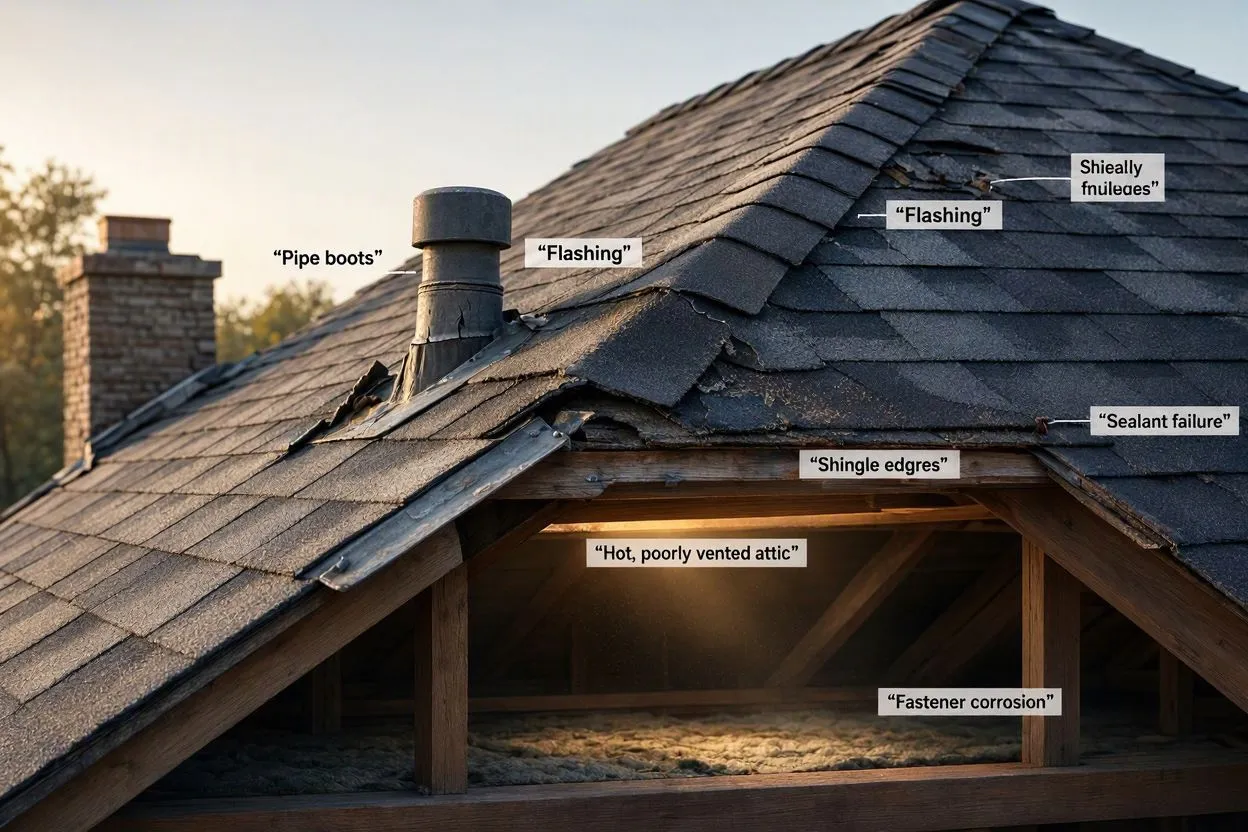
Roofs fail early because the components around the shingles wear out first, and because a hot, poorly vented attic bakes the shingles from underneath. Five parts usually take the blame:
- Pipe boots: Rubber collars around plumbing vents crack under UV exposure, often within 10 to 15 years, well ahead of the shingles around them.
- Flashing: Well-maintained flashing lasts a long time, but its connections tend to fail, which is why InterNACHI recommends seasonal inspection.
- Underlayment: Felt dries out and tears faster than synthetic underlayment, and ice-and-water shield at the eaves and valleys decides whether an ice dam turns into a leak.
- Decking: Plywood and oriented strand board (OSB) sheathing rot once water gets through, turning a shingle job into a structural one.
- Ventilation: Attics without enough intake and exhaust trap summer heat above 150°F (66°C), cooking asphalt shingles from below.
The International Residential Code (IRC) sets the attic venting baseline at 1 sq ft (0.09 m²) of net free vent area per 150 sq ft (13.9 m²) of attic floor, or per 300 sq ft (27.9 m²) when 40 to 50 percent of the vent area sits high in the attic and the rest at the eaves. Plenty of older houses fall short.
Nailing counts as well. High-wind installs typically call for 6 nails per shingle instead of 4, and nails driven above the manufacturer’s nail line let shingles peel off in the first big storm.
How Often Should a Roof Be Replaced?
A roof should be replaced every 15 to 30 years for asphalt shingles, while metal and tile roofs go 40 years or more between replacements.
| Material | Replacement interval | Full replacements over 60 years |
| 3-tab asphalt | 15 to 20 years | 3 to 4 |
| Architectural asphalt | 25 to 30 years | 2 |
| Metal | 40 to 80 years | 0 to 1 |
| Clay or concrete tile | 50 to 100 years (underlayment relaid every 20 to 30) | 0 to 1, plus 1 to 2 relays |
| Slate | 60 to 150 years | 0 to 1 |
Age alone doesn’t trigger a replacement. A 20-year-old architectural roof with sound flashing and a well-vented attic often has 8 good years left, while a 12-year-old 3-tab roof in Phoenix is often finished.
What Is the Typical Age of Roof Replacement?
The typical age of roof replacement is 20 to 25 years for asphalt shingle roofs, younger than most shingle labels suggest. Insurance pushes some of those decisions. Many insurers switch a roof from replacement cost value (RCV) to actual cash value (ACV) coverage once it reaches roughly 15 to 20 years old, and ACV payouts subtract depreciation from any storm claim.
Florida has its own rules. State law bars insurers from refusing or non-renewing coverage based on roof age alone when the roof is under 15 years old, and older roofs can be required to pass an inspection showing at least 5 years of remaining useful life.
Read the roof section of your policy declarations before hail season. After a storm is too late.
How to Find Out How Old Your Roof Is
To find a roof’s age, search your city or county building permit records, since most US jurisdictions require a permit for a full reroof. These 5 methods work together:
- Search permit records online or at the local building department using the property address.
- Review the seller’s disclosure and home inspection report from your purchase.
- Ask neighbors in the same subdivision, because builders often roofed an entire street in the same year.
- Contact the original installer or manufacturer, either of which can pull warranty registration records.
- Check the roof edge for a second layer of shingles, a sign of an earlier roof-over that adds both age and weight.
What Are the Signs a Roof Is Near the End of Its Life?
The 7 clearest signs of a roof near the end of its life are granule loss, curling shingles, a sagging deck, daylight in the attic, repeat leaks, thick moss, and failing flashing.
- Granule loss: A new roof sheds some granules during its first year or two, but heavy “roof sand” in the gutters years later means the protective layer is wearing thin.
- Curling shingles: Edges that lift or centers that bow up mean the asphalt has dried out, and wind tears those shingles off next.
- Sagging deck: A dip in the roofline points to wet, weakened sheathing and calls for an inspection within days.
- Daylight in the attic: Pinpoints of light mean gaps, though many older homes were built with spaced boards, so small gaps between slats are normal there.
- Repeat leaks: Ceiling stains that return after 2 or more repairs show the roof has passed the point where patching works.
- Thick moss: Mats of moss hold water against the shingles and lift their edges, especially on north-facing slopes.
- Failing flashing: Rust, gaps, or dried sealant around chimneys and skylights let water in even when the shingles look fine.
Should You Repair or Replace an Aging Roof?
Replace a roof when a repair would cost more than 30% of a new roof and the roof has used up about 75% of its expected life; repair it when the roof is younger and the damage sits in one area. Published cut-offs disagree. Kin suggests replacing once repairs top 30% of a new roof’s cost, while SERVPRO puts the line at 50%. Both hold up once age enters the math, because a young roof justifies a bigger repair bill with decades of service still ahead.
Take a 6-year-old architectural roof with $3,000 of storm damage and a $15,000 replacement quote. That’s 20%, on a roof with 20-plus years left, so repair it. Swap in a 24-year-old roof with the same damage, and the money is better spent on a tear-off.
Laying new shingles over old ones saves the tear-off fee, which typically runs $1 to $3 per square foot for a single layer of asphalt. Code limits that shortcut. The IRC blocks a roof recover on top of 2 or more existing layers or on a water-soaked roof, and slate or tile can’t be covered at all. A roof-over hides the deck, so any rot underneath goes unseen.
Which Roofing Material Costs the Least Per Year?
Architectural asphalt shingles cost the least per year of service, at about $364 annually on a 2,000 sq ft (186 m²) roof, while 3-tab shingles cost the most at about $457.
| Material | Installed cost per sq ft (midpoint) | Cost for 2,000 sq ft | Life span used | Cost per year |
| 3-tab asphalt | $4.00 | $8,000 | 17.5 years | $457 |
| Architectural asphalt | $5.00 | $10,000 | 27.5 years | $364 |
| Metal | $10.50 | $21,000 | 55 years | $382 |
| Clay or concrete tile | $16.00 | $32,000 | 75 years | $427 |
| Slate | $20.00 | $40,000 | 105 years | $381 |
Midpoints come from national installed ranges of $3 to $5 per square foot for 3-tab, $4 to $6 for architectural, $5 to $16 for metal, $7 to $25 for tile, and $10 to $30 for slate, and local quotes vary. Metal and slate still land within about $20 a year of architectural shingles, and both skip the second tear-off a 50-year owner pays for with asphalt. Three-tab’s low sticker price turns into the priciest choice once it’s spread across such a short life.
How to Extend the Life of a Roof
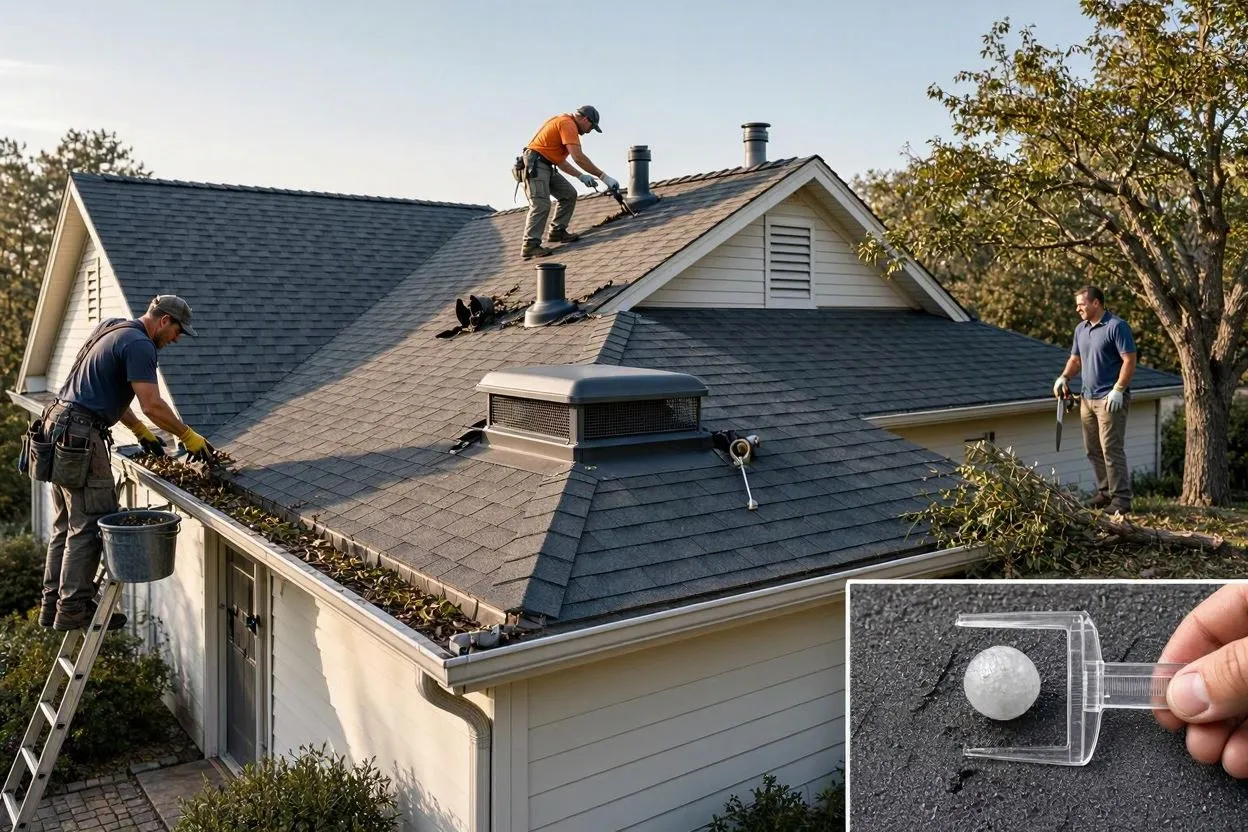
To extend the life of a roof, fix attic ventilation first, then keep water moving off the roof with clean gutters and quick repairs. These 7 habits add years:
- Inspect the roof each spring and fall, and after any hailstorm with stones 1 inch (25 mm) or larger.
- Clean gutters at least twice a year so water can’t back up under the drip edge.
- Trim tree branches back at least 10 feet (3 m) from the roof surface.
- Replace cracked pipe boots and dried sealant before they leak.
- Treat moss with a zinc or copper strip at the ridge instead of a pressure washer, which strips granules.
- Rake heavy, wet snow off the lowest 3 to 4 feet (0.9 to 1.2 m) of the roof to limit ice dams.
- Balance intake and exhaust vents to meet the IRC ventilation ratio.
Conclusion
How long do roofs last? Most last 20 to 30 years, and a slate, tile, or metal roof on a well-vented attic lasts 50 years or longer. Your own number depends on two things you can check this week: the install year and the climate the roof has lived through. Pull the permit record, then compare its date with InterNACHI’s range for your material. Once a roof has used up about 75% of that range, book a professional inspection before storm season, not after the first leak shows up on a ceiling.
FAQs

Rachel Park
Rachel Park leads sustainability, roofing, and building materials content at Constructionspedia, drawing on over 10 years of commercial and residential construction experience. She holds an M.S. in Sustainable Building Systems from UC Berkeley and is a LEED AP BD+C, specializing in roofing systems, insulation, waterproofing, and energy-efficient materials. Her research-backed guides help homeowners and industry professionals make informed decisions about construction and green building.
Related Posts