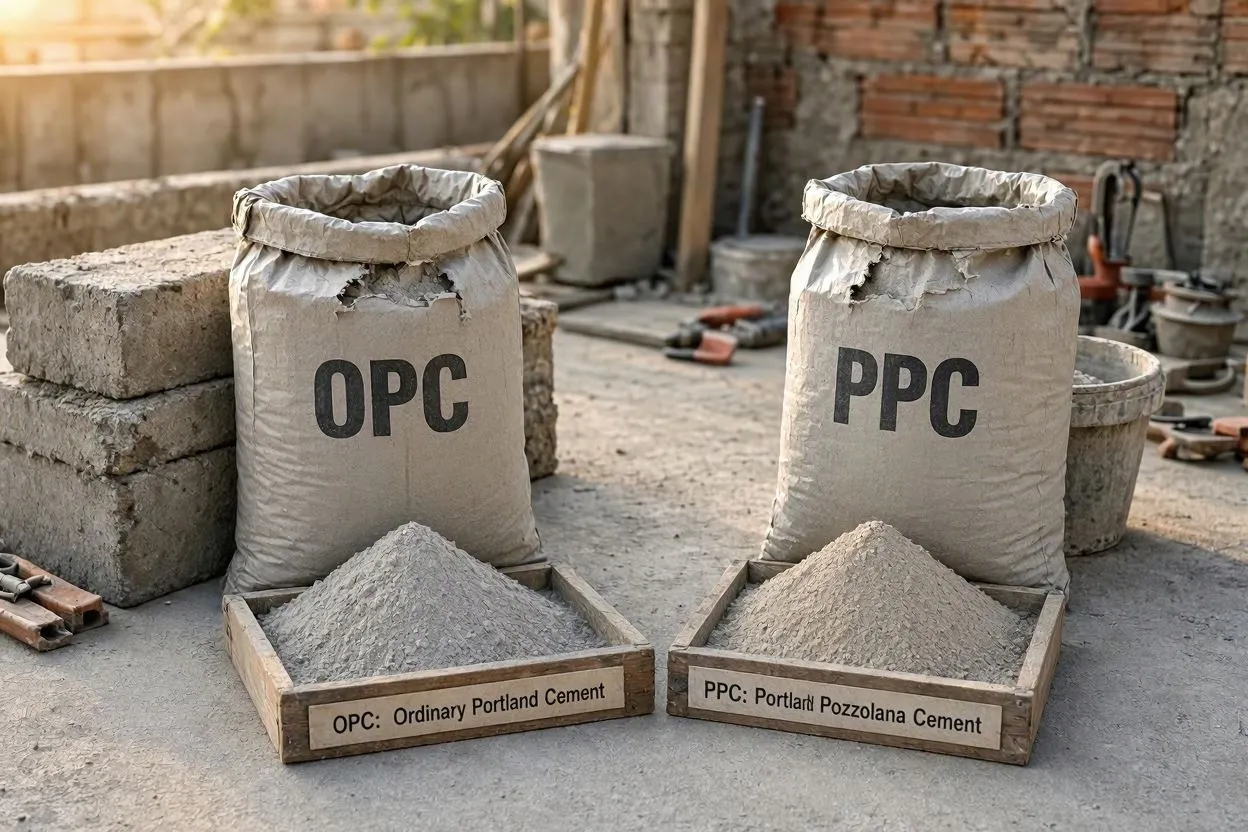
OPC vs PPC Cement: Difference, Grades & Which Is Better
Quick answer: Portland Pozzolana Cement (PPC) is the better pick for most Indian houses, while Ordinary Portland Cement (OPC) wins when a job needs early strength, such as fast-cycle RCC slabs or cold-weather pours.
OPC is almost pure clinker. PPC swaps 15% to 35% of that clinker for fly ash, and the trade-off follows from there: slower early strength, lower heat, denser concrete and a 50 kg (110 lb) bag that usually costs less. Both cements meet Bureau of Indian Standards (BIS) codes, so neither is “weak.”
The smarter question isn’t which cement is better in general. It’s which one fits the element in front of you, whether that’s a roof slab you want to de-shutter in a week or a plaster coat on a damp Mumbai wall. This guide sets out the numbers behind the OPC vs PPC cement decision (strength by age, setting time, curing days, formwork removal and current prices) so you can choose element by element instead of guessing.
What Is OPC Cement?
OPC cement full form is Ordinary Portland Cement, a hydraulic binder made by grinding clinker with roughly 5% gypsum. Clinker forms when limestone and clay are burnt at about 1,450°C (2,642°F) in a rotary kiln. That fuel-hungry step gives OPC the highest carbon load among common cements.
IS 269:2015 governs OPC in India. It covers 3 grades (33, 43 and 53), and each number is the minimum 28-day compressive strength in megapascals (MPa). Site engineers reach for OPC 53 when shuttering has to come off quickly, since it builds a large share of its strength inside the first 7 days.
What Is PPC Cement?
PPC is Portland Pozzolana Cement, a blended cement in which fly ash makes up 15% to 35% of the mass under IS 1489 (Part 1):2015. Fly ash is the fine residue captured from coal-fired power plants. Alone, it won’t harden.
Inside cement paste, though, fly ash reacts with the calcium hydroxide that clinker releases during hydration and produces extra binding gel. That gel plugs capillary pores, so concrete keeps getting denser for months rather than days. Nearly every PPC trait traces back to this slow secondary reaction, from gentler early strength and lower heat to tighter resistance against sulphate and chloride attack. A calcined-clay version exists under IS 1489 (Part 2), but the fly ash type is what you’ll find at almost every Indian dealer.
Difference Between OPC and PPC Cement at a Glance
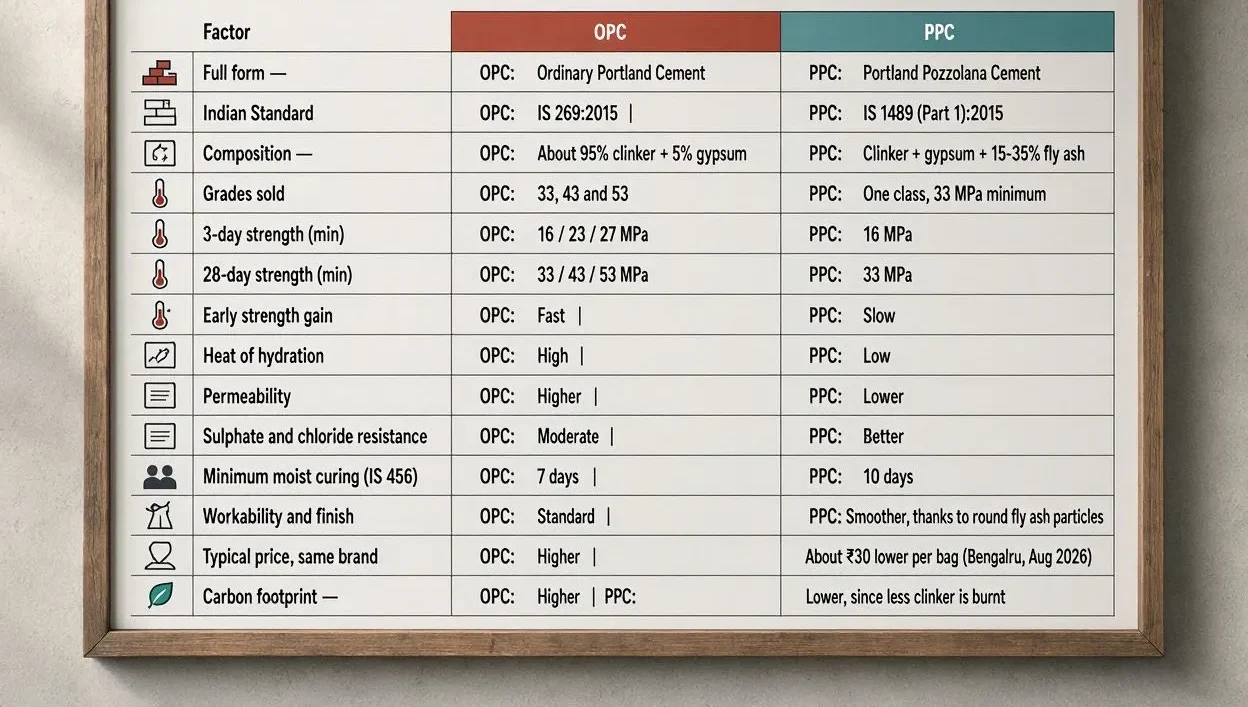
The core difference between OPC and PPC is composition: OPC is about 95% clinker, whereas PPC replaces 15% to 35% of it with fly ash, and that one change shifts strength gain, heat, durability and price. Here’s OPC cement vs PPC cement across 14 factors.
| Factor | OPC | PPC |
| Full form | Ordinary Portland Cement | Portland Pozzolana Cement |
| Indian Standard | IS 269:2015 | IS 1489 (Part 1):2015 |
| Composition | About 95% clinker + 5% gypsum | Clinker + gypsum + 15-35% fly ash |
| Grades sold | 33, 43 and 53 | One class, 33 MPa minimum |
| 3-day strength (min) | 16 / 23 / 27 MPa | 16 MPa |
| 28-day strength (min) | 33 / 43 / 53 MPa | 33 MPa |
| Early strength gain | Fast | Slow |
| Heat of hydration | High | Low |
| Permeability | Higher | Lower |
| Sulphate and chloride resistance | Moderate | Better |
| Minimum moist curing (IS 456) | 7 days | 10 days |
| Workability and finish | Standard | Smoother, thanks to round fly ash particles |
| Typical price, same brand | Higher | About ₹30 lower per bag (Bengaluru, Aug 2026) |
| Carbon footprint | Higher | Lower, since less clinker is burnt |
Strength figures for OPC follow the 33 / 43 / 53 grade order.
OPC vs PPC Cement Strength Under BIS Codes
OPC develops strength faster in the first week, but PPC catches up by 28 days and keeps gaining for months afterwards. BIS sets these minimums for standard mortar cubes:
| Cement | 3 days | 7 days | 28 days |
| OPC 33 | 16 MPa (2,321 psi) | 22 MPa (3,191 psi) | 33 MPa (4,786 psi) |
| OPC 43 | 23 MPa (3,336 psi) | 33 MPa (4,786 psi) | 43 MPa (6,237 psi) |
| OPC 53 | 27 MPa (3,916 psi) | 37 MPa (5,366 psi) | 53 MPa (7,687 psi) |
| PPC | 16 MPa (2,321 psi) | 22 MPa (3,191 psi) | 33 MPa (4,786 psi) |
One MPa equals 1 N/mm², or roughly 145 psi. These are cement cube results, not concrete strength. A slab designed as M20 or M25 concrete reaches its target with any of these cements when the mix is properly proportioned and cured.
OPC Grades: 33, 43 and 53
OPC 43 suits general house construction, and OPC 53 suits high-strength RCC, precast units and fast-track work. Dealers rarely stock 33 grade now. A higher number isn’t automatically better for a home, because 53 grade releases heat quickly and thin plaster coats or mortar joints made with it crack more easily when curing slips.
PPC Cement Grade
PPC cement grade is a single 33 MPa class at 28 days, and IS 1489 (Part 1) defines no 43 or 53 grade PPC. That label undersells the product. Branded PPC routinely tests well above the floor; one Sagar Cements test certificate recorded 22.0 MPa at 3 days against the 16 MPa minimum. Fly ash keeps reacting well past day 28, so 90-day strength climbs higher still.
Setting Time, Curing and Shuttering Removal
PPC needs 3 more days of curing than OPC and slightly longer before props come out, because fly ash reacts slowly. The figures below come straight from the BIS cement codes and IS 456:2000.
Setting Time
Both cements must not begin setting before 30 minutes and must finish setting within 600 minutes (10 hours). OPC sits toward the faster end of that window. PPC stays workable longer, which matters on small sites where a mixer jams or masons stop for lunch midway through a pour.
Curing Period
IS 456:2000 requires at least 7 days of moist curing for OPC concrete and at least 10 days for concrete made with blended cement such as PPC. In hot, dry weather the code raises the OPC minimum to 10 days and recommends 14 days for blended cement.
Skipped curing hurts PPC more. Once the surface dries, fly ash stops reacting, so the dense gel that gives PPC its durability never forms. Ponding a roof slab with 25 mm (1 inch) of water or wrapping columns in wet hessian handles it.
Formwork Removal Time
Column and wall formwork can come off after 16 to 24 hours, while slab props stay at least 7 days for spans up to 4.5 m (14.8 ft), going by IS 456 Table 11.
How to Check a Cement Bag Before Buying
Check 4 details printed on every bag: the ISI mark with its CM/L licence number, the IS code, the grade and the week and year of manufacture.
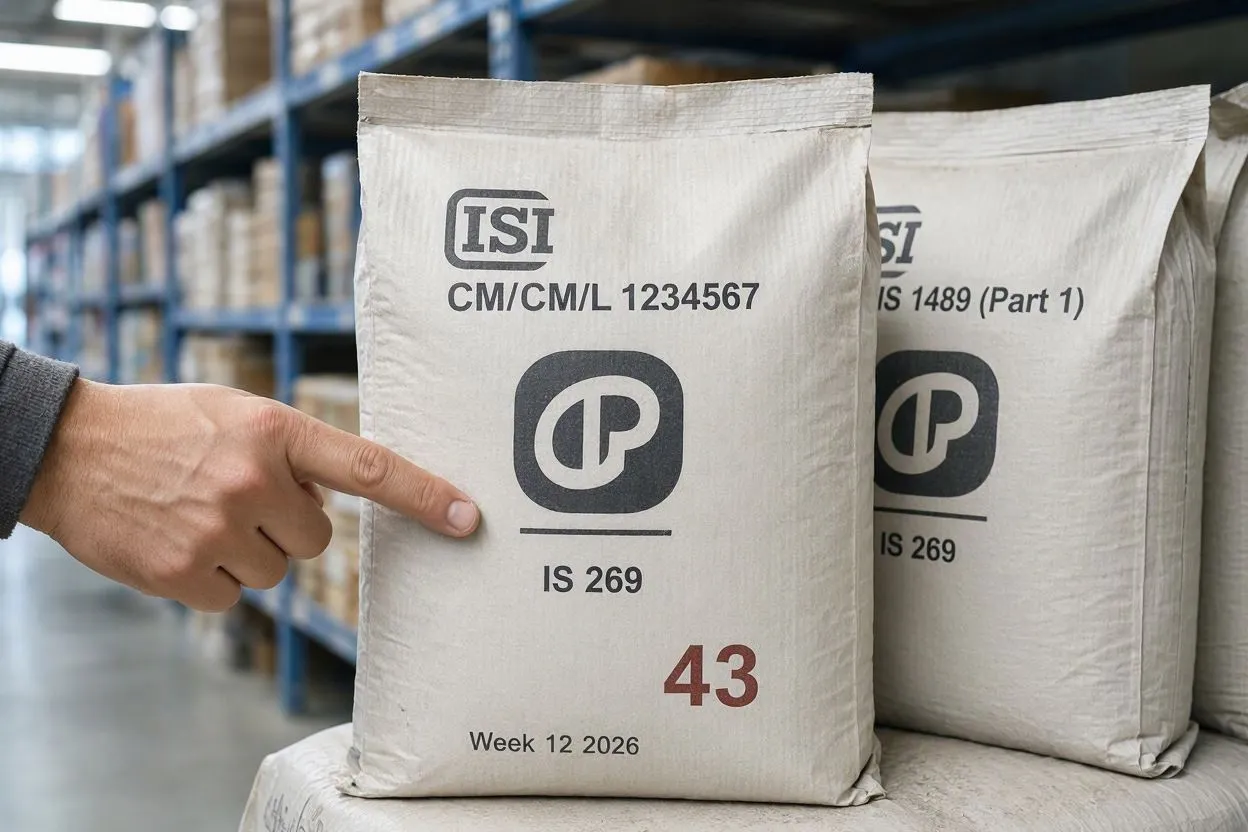
- ISI mark and CM/L number: confirms the plant holds a valid BIS licence.
- IS code: IS 269 marks OPC, and IS 1489 (Part 1) marks fly ash PPC.
- Grade: 43 or 53 appears on OPC bags; PPC carries no grade beyond its standard.
- Manufacturing week and year: buy stock under 90 days old, because stored cement slowly loses strength.
Rub a pinch between your fingers before paying. Fresh cement feels smooth and cool, while hard lumps mean moisture got in. At home, stack bags on planks about 150 mm (6 inches) off the floor and away from walls, no more than 10 bags high.
| Formwork element | Minimum time (OPC basis) |
| Columns, walls, beam sides | 16-24 hours |
| Slab soffit, props left under | 3 days |
| Beam soffit, props left under | 7 days |
| Slab props, span up to 4.5 m (14.8 ft) | 7 days |
| Slab props, span over 4.5 m | 14 days |
| Beam props, span up to 6 m (19.7 ft) | 14 days |
| Beam props, span over 6 m | 21 days |
These periods assume OPC, and the code asks for them to be suitably modified for other cements. With PPC, ask your engineer to extend them unless cube tests prove the concrete is ready.
Which Cement to Use for Each Part of Your House
PPC covers most of a typical house, from footing to final plaster, while OPC 53 earns its place in elements that must carry load or free their shuttering early.
| Element | Better choice | Reason |
| Foundation and footing | PPC | Low permeability resists sulphates in soil and groundwater |
| Plinth beam | PPC | Stays durable next to damp ground |
| Columns | OPC 43/53 or PPC | Both reach M20/M25; OPC helps on a tight schedule |
| Roof slab and beams | PPC, or OPC 53 for fast cycles | PPC cuts thermal cracking; OPC frees props sooner |
| Brickwork mortar | PPC | Better workability, fewer shrinkage cracks |
| Plastering | PPC | Smoother finish, longer working time |
| Tile bedding | PPC | Stays workable while tiles are levelled |
| Water tank and sump | PPC | Dense paste limits seepage |
| Precast lintels and blocks | OPC 53 | Moulds can be reused within a day or two |
| Urgent repairs | OPC 53 | Gains usable strength in days |
A common worry is whether PPC belongs in reinforced cement concrete (RCC) at all. It does. IS 456:2000 lists PPC conforming to IS 1489 among the cements permitted for plain and reinforced concrete. The only real adjustment is longer curing and a little more patience before props come out.
OPC or PPC for Indian Weather Conditions
PPC suits most Indian climates, and OPC is the safer choice only where cold weather slows hydration.
- Coastal cities such as Mumbai, Chennai and Kochi: PPC, because its dense paste slows the chloride entry that rusts reinforcement bars.
- Hot, dry regions such as western Rajasthan and interior Maharashtra: PPC for its lower heat, paired with the 14-day curing the code recommends.
- Cold zones such as Shimla, Srinagar or any North Indian site below 10°C (50°F): OPC, since PPC’s fly ash reaction nearly stalls at low temperatures.
- Monsoon belts such as Kerala and the Konkan coast: PPC, with plastic sheeting over fresh concrete for the first 24 hours to keep rain off the surface.
OPC vs PPC Cement Price in India
The all-India average trade price reached ₹356 per 50 kg (110 lb) bag in September 2026, and PPC sells for about ₹30 less than OPC 53 of the same brand. That average rose ₹7 over August, with South India up ₹11 per bag, and makers are eyeing a further ₹5 to ₹20 hike in October, according to Centrum Broking data reported by Indian Cement Review.
Retail rates run higher than trade averages. A Bengaluru dealer list from August 2026 shows the gap clearly:
| Brand | PPC (50 kg) | OPC 53 (50 kg) | Difference |
| Priya | ₹360 | ₹390 | ₹30 |
| Maha | ₹365 | ₹395 | ₹30 |
| Ramco | ₹390 | ₹415 | ₹25 |
Source: HomeRun Bengaluru price list. Rates shift with city, season and dealer, and cement has carried 18% GST since 22 September 2025.
On a 1,000 sq ft (93 m²) house needing 350 to 500 bags, a ₹30 gap works out to ₹10,500 to ₹15,000 saved by choosing PPC. That saving is real, but durability, not price, should drive the choice.
4 Common Myths About OPC and PPC
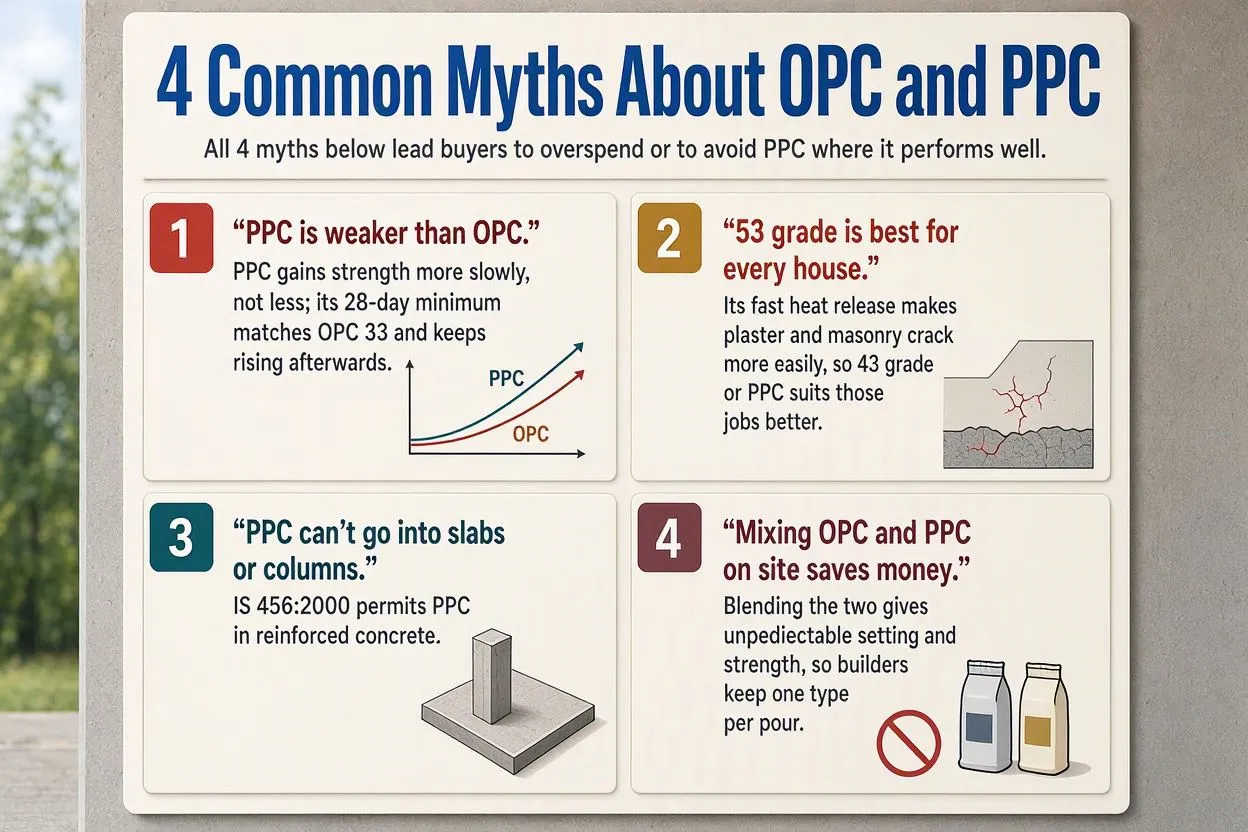
All 4 myths below lead buyers to overspend or to avoid PPC where it performs well.
- “PPC is weaker than OPC.” PPC gains strength more slowly, not less; its 28-day minimum matches OPC 33 and keeps rising afterwards.
- “53 grade is best for every house.” Its fast heat release makes plaster and masonry crack more easily, so 43 grade or PPC suits those jobs better.
- “PPC can’t go into slabs or columns.” IS 456:2000 permits PPC in reinforced concrete.
- “Mixing OPC and PPC on site saves money.” Blending the two gives unpredictable setting and strength, so builders keep one type per pour.
Other Types of Cement Worth Knowing
Two other types of cement suit Indian homes in specific conditions: Portland Slag Cement (PSC) and Composite Cement (CC).
- PSC (IS 455): blends clinker with granulated blast furnace slag from steel plants. It handles sulphates and chlorides very well, which makes it popular for marine works and for projects near East Indian steel hubs such as Jamshedpur.
- Composite Cement (IS 16415): combines fly ash with slag in one bag. On site, it behaves much like PPC.
Neither replaces the OPC vs PPC choice for most buyers, since availability outside certain regions stays patchy.
OPC vs PPC Cement: Which Is Better?
PPC is the better all-round choice for a typical G+1 or G+2 Indian house, and OPC 53 is better only when speed or cold weather sets the terms. Choose PPC if durability and crack control top your list, especially near the coast or on damp ground. OPC 53 makes sense if the formwork must cycle every week or the site sits in a cold zone.
Many experienced contractors split the order. OPC 53 goes into columns and slabs on a tight schedule, while PPC handles footings, masonry and plaster. That split is the practical answer to OPC vs PPC cement which is better, because no single bag is ideal for every stage of a build.
Conclusion
For most homes, PPC is the default and OPC 53 is the specialist. The OPC vs PPC cement decision comes down to 2 questions: how soon must the element carry load, and how harsh is the environment it’ll face for the next 50 years? Fast schedules and cold sites favour OPC. Everything else, from a damp foundation in Kochi to a plastered bedroom wall in Jaipur, leans toward PPC.
The code numbers only hold when the work is done right. Buy fresh stock with a clear ISI mark and cure for the full 7 or 10 days. Props come out only after your structural engineer signs off.
FAQs

Rachel Park
Rachel Park leads sustainability, roofing, and building materials content at Constructionspedia, drawing on over 10 years of commercial and residential construction experience. She holds an M.S. in Sustainable Building Systems from UC Berkeley and is a LEED AP BD+C, specializing in roofing systems, insulation, waterproofing, and energy-efficient materials. Her research-backed guides help homeowners and industry professionals make informed decisions about construction and green building.
Related Posts