9 Eco-Friendly Roofing Materials That Actually Hold Up in the USA (2026 Guide)
Your roof covers roughly 1,500–2,500 sq ft of your home. It takes direct sun, rain, hail, and wind every single day. The roofing material you install determines your energy bills, your carbon footprint, and how many times you’ll reroof in your lifetime.
Most homeowners pick the cheapest shingle available and reroof every 15–20 years. That replacement cycle costs more long-term and dumps over 13 million tons of old shingles into US landfills annually — less than 10% of removed roofing material gets recycled.
This 2026 guide covers 9 eco-friendly roofing materials proven for real US climates — from Texas heat to Northeast snowfall — with installed cost per sq ft, lifespan data, and a region-by-region recommendation for every homeowner considering a roof replacement or new roof installation.
What Makes a Roof Eco-Friendly?
A roof qualifies as eco-friendly when it meets at least 3 of these 4 criteria:
1. Recyclable materials — The roof contains at least 25% recycled content at manufacture and is 100% recyclable at end of life. Metal roofing leads here — aluminum roofing panels contain up to 95% recycled content.
2. Energy efficiency — The roof reflects or manages solar heat, reducing air conditioning demand. The Cool Roof Rating Council (CRRC) sets the standard: a Solar Reflectance Index (SRI) of 29 or higher qualifies for cool roof status on steep-slope residential roofs.
3. Long lifespan — Durability is sustainability. A roof lasting 70 years generates far less waste than 3 asphalt replacements in the same period. Slate roofs last 75–150 years. Clay tile lasts 50–100 years.
4. Low manufacturing emissions — LEED-certified materials and products with Environmental Product Declarations (EPDs) document the carbon cost of production. Malarkey’s NEX polymer-modified asphalt, for example, is GreenCircle certified for waste diversion and recycled content.
9 Eco-Friendly Roofing Materials for US Homeowners
1. Metal Roofing
Metal roofing is the most recyclable roofing material available — 100% recyclable at end of life, with a lifespan of 50–70 years.
Steel, aluminum, and copper panels or shingles reflect 40–70% of solar radiation, which cuts cooling costs by 10–25% in warm climates. Aluminum panels contain up to 95% recycled content. Metal carries a Class A fire rating — the highest classification in the US — making metal the go-to choice for wildfire-prone areas in California, Oregon, and Colorado.
Cost: $7–$14 per sq ft installed ($75–$150 per sq meter)
Lifespan: 50–70 years
Best for: Florida (hurricane resistance up to 130 mph wind), Pacific Northwest, wildfire zones
Watch out for: Noise during hail, color fading over 10–15 years, higher upfront cost vs asphalt
2. Slate Roofing
Slate is the longest-lasting roofing material in existence — natural slate roofs last 75–150 years with almost zero maintenance.
Slate is quarried stone, fully natural, and 100% recyclable. Old slate tiles get reused as vintage roofing, or crushed for construction fill. Slate carries a Class A fire rating and handles freeze-thaw cycles better than any manufactured material, which is why slate dominates historic homes in the Northeast.
The catch is weight. Slate weighs 800–1,500 lbs per square (100 sq ft / 9.3 sq meter). Your roof framing must support that load, which adds structural costs.
Cost: $15–$30 per sq ft installed ($161–$323 per sq meter)
Lifespan: 75–150 years
Best for: Northeast US — New York, Massachusetts, Pennsylvania, Vermont
Watch out for: Weight requires structural reinforcement, very high installation cost, find an experienced installer
3. Clay Tile Roofing
Clay tile roofs last 50–100 years and carry a Class A fire rating — making clay one of the best eco-friendly options for hot, dry US climates.
Clay tiles are made from natural terracotta and require zero synthetic materials. Hot air circulates beneath the curved tile shape, which naturally ventilates the attic and reduces heat buildup. Several clay tile manufacturers offer colors with SRI values above 39, which qualifies for CRRC cool roof ratings without sacrificing style.
Ludowici clay tiles come with a 75-year warranty. US Tile’s clay products contain up to 59% recycled raw materials and are Cradle to Cradle certified.
Cost: $10–$20 per sq ft installed ($108–$215 per sq meter)
Lifespan: 50–100 years
Best for: Southwest US — Arizona, New Mexico, Southern California, Nevada
Watch out for: Heavy (900–1,200 lbs per square), needs extra framing, brittle if walked on incorrectly
4. Cool Roofs
A cool roof reduces surface temperatures by more than 50°F (28°C) compared to a standard dark roof under identical conditions, according to the US Department of Energy.
Cool roofs reflect sunlight rather than absorbing it. Any material — metal, tile, membrane, or modified asphalt — qualifies as a cool roof if it meets CRRC thresholds: solar reflectance of 0.25 or higher for steep-slope roofs. White or light-colored roofs work best, but granule technology from companies like 3M now delivers cool roof ratings in darker colors.
Research published in Urban Sustainability found city-wide cool roof adoption reduces building HVAC energy consumption by 15–35%. For urban homeowners in Houston, Phoenix, or Miami, this is a significant annual saving.
Cost: $1.50–$4 per sq ft installed ($16–$43 per sq meter) for cool roof coatings over existing roofs
Lifespan: Depends on base material
Best for: Urban heat island cities — Phoenix, Houston, Miami, Dallas, Los Angeles
Watch out for: Mold risk in high-humidity areas if ventilation is poor
5. Solar Roofing Tiles
Solar roofing generates electricity from the roof surface itself — replacing conventional tiles entirely, not just adding panels on top.
Standard solar panels bolt onto any existing roof. Solar tiles (Tesla Solar Roof, GAF Energy Timberline Solar) integrate directly into the roof surface, eliminating the need for a separate racking system. A properly sized solar tile system covers 50–100% of a household’s electricity demand. The payback period runs 7–12 years depending on state electricity rates and sun exposure.
Note: The Section 25C federal tax credit for cool roofs expired December 31, 2025. State-level incentives still exist in California, New York, Texas, and 22 other states. Check your state’s DSIRE database for current programs.
Cost: $20–$35 per sq ft installed ($215–$376 per sq meter) for integrated solar tiles
Lifespan: 25–30 years (panels), roof membrane typically 40+ years
Best for: Sun Belt states — California, Arizona, Texas, Florida, Nevada
Watch out for: High upfront cost, only viable in areas with adequate sun hours (4+ peak hours/day)
6. Recycled Shingles
Recycled shingles made from post-consumer rubber, plastic, and wood fiber last 50+ years and cost 30–40% less than natural slate.
These shingles replicate the look of slate, cedar shake, and clay tile using material diverted from landfills. Malarkey’s NEX polymer-modified shingles incorporate upcycled rubber from tires and upcycled single-use plastic bags — roughly 5 rubber tires and 3,200 plastic bags per roof. CertainTeed’s RenuCore technology converts post-consumer asphalt shingle waste back into new shingles, closing the recycling loop.
Recycled shingles carry Class 4 impact resistance ratings — the highest available — making recycled shingles the best option for hail-prone areas in Texas, Oklahoma, and the Midwest.
Cost: $4–$8 per sq ft installed ($43–$86 per sq meter)
Lifespan: 40–50 years
Best for: Hail zones — Texas, Oklahoma, Kansas, Colorado, Nebraska
Watch out for: Quality varies significantly by manufacturer; verify Class 4 impact rating before purchasing
7. Wood Shingles and Shakes
FSC-certified wood shingles from sustainably managed forests last 25–50 years and biodegrade fully at end of life.
FSC (Forest Stewardship Council) certification confirms the timber comes from responsibly managed forests. Untreated wood shingles don’t carry a fire rating, so fire-treated options achieving Class B or Class A ratings exist through added underlayment systems. Wood shingles cost more in areas far from sawmills, so buying from a local Pacific Northwest or Southeast supplier reduces both cost and transport emissions.
Cost: $6–$10 per sq ft installed ($65–$108 per sq meter)
Lifespan: 25–50 years (with maintenance)
Best for: Pacific Northwest — Oregon, Washington, Northern California
Watch out for: Fire risk in wildfire zones, mold and rot in damp climates, 15–20 year replacement cycle without maintenance
8. Green Roofs (Living Roofs)
Green roofs reduce stormwater runoff by 50–90% and lower roof surface temperature by up to 40°F (22°C) — making green roofs the most ecologically impactful roofing option available.
A green roof layers waterproof membrane, drainage board, growing medium (2–6 inches deep), and plants directly on the roof structure. Extensive green roofs use drought-tolerant sedums and weigh 15–50 lbs per sq ft (73–244 kg per sq meter). Intensive green roofs support larger plants and shrubs but require structural reinforcement.
Green roofs see widest adoption in Chicago, New York, Portland, and Seattle — cities with stormwater management incentives that sometimes include direct rebates or reduced stormwater fees.
Cost: $10–$25 per sq ft installed ($108–$269 per sq meter)
Lifespan: 40–50 years (roof membrane lasts longer under plant cover)
Best for: Urban areas with stormwater incentive programs — Chicago, NYC, Portland, Seattle
Watch out for: Requires structural assessment, ongoing plant maintenance, not suitable for steep-pitch roofs
9. Synthetic Shake Shingles
Synthetic shake shingles made from polyurethane deliver Class A fire resistance, Class 4 impact resistance, and a 50-year lifespan at roughly half the cost of natural cedar shake.
CEDUR’s polyurethane shingles weigh a fraction of clay or slate, require zero maintenance, and withstand winds up to 110 mph. DaVinci Roofscapes composite tiles offer a similar performance profile. Both products carry Lifetime Limited Material Warranties. Because synthetic shingles replicate wood shake without actual wood, synthetic shingles eliminate the rot, mold, and fire-risk issues that come with real cedar.
Cost: $5–$10 per sq ft installed ($54–$108 per sq meter)
Lifespan: 50 years+
Best for: Mountain West — Colorado, Utah, Wyoming, Idaho (fire and hail resistance needed)
Watch out for: Newer product category — fewer long-term field performance records vs slate or metal
US Climate Roofing Guide — Best Material by Region
| US Region | States | Best Eco Roof | Key Reason |
| Southwest | AZ, NM, NV, Southern CA | Clay tile or cool roof | Heat reflection, 100-year lifespan |
| Southeast / Gulf | FL, TX coast, LA | Metal roofing | 130 mph hurricane wind rating |
| Northeast | NY, MA, PA, VT, ME | Slate roofing | Freeze-thaw resistance, 100+ year life |
| Pacific Northwest | OR, WA, Northern CA | Wood shake or metal | Moisture resistance, wildfire risk |
| Midwest / Plains | TX, OK, KS, CO, NE | Recycled shingles | Class 4 hail impact rating |
| Mountain West | CO, UT, WY, ID | Synthetic shake | Fire + hail resistance combined |
| Sun Belt | CA, AZ, TX, FL, NV | Solar roofing tiles | 4+ peak sun hours per day |
| Urban Cities | Chicago, NYC, Portland | Green roofs | Stormwater rebates, heat reduction |
Real Cost Comparison — Installed Prices USA 2026
Use this table to compare eco-friendly roofing materials side by side before requesting contractor quotes. Prices reflect average installed cost across the US in 2026 — regional labor rates vary by 15–30%.
| Material | Cost per sq ft | Cost per sq meter | Lifespan | 50-year total cost* |
| Asphalt shingles | $1.50–$4 | $16–$43 | 20–25 years | Highest (3 replacements) |
| Recycled shingles | $4–$8 | $43–$86 | 40–50 years | Low |
| Synthetic shake | $5–$10 | $54–$108 | 50+ years | Low |
| Metal roofing | $7–$14 | $75–$150 | 50–70 years | Low |
| Wood shake | $6–$10 | $65–$108 | 25–50 years | Medium |
| Cool roof (coating) | $1.50–$4 | $16–$43 | Varies | Lowest upfront |
| Clay tile | $10–$20 | $108–$215 | 50–100 years | Very low |
| Green roof | $10–$25 | $108–$269 | 40–50 years | Medium |
| Solar tiles | $20–$35 | $215–$376 | 25–30 years | Low (electricity offset) |
| Slate roofing | $15–$30 | $161–$323 | 75–150 years | Lowest long-term |
*50-year total cost accounts for replacement cycles and energy savings.
How to Choose the Right Eco-Friendly Roof
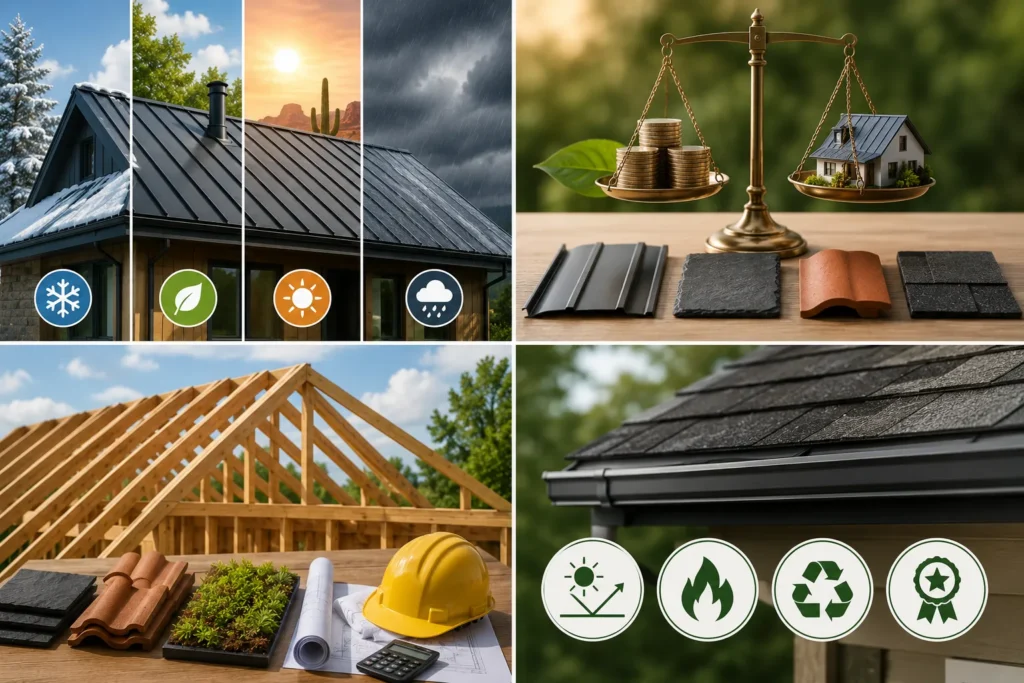
To pick the right material, match these 4 factors to your situation:
1. Match your climate zone first. Use the regional guide above. A cool roof coating in Vermont wastes money. Slate in Phoenix is unnecessary. Climate is the primary filter.
2. Set a realistic budget — upfront vs lifetime. Metal costs $7–$14 per sq ft now but eliminates replacement for 50+ years. Asphalt costs $1.50–$4 now but costs more over three replacement cycles. Calculate the 30-year total, not just today’s price.
3. Check your roof’s structural capacity. Clay, slate, and green roofs require structural assessments before installation. Hire a licensed structural engineer if switching from asphalt to heavy materials. This costs $300–$600 but prevents expensive mistakes.
4. Verify certifications before you buy. Look for CRRC ratings for energy performance, Class A fire rating for fire resistance, Class 4 impact rating for hail zones, and FSC certification for any wood products. For building materials carrying LEED points, request the manufacturer’s Environmental Product Declaration (EPD) — this documents the full carbon cost of producing the material and satisfies most green building specifications.
What Happened to the Federal Roofing Tax Credit in 2026?
The Section 25C Energy Efficient Home Improvement Credit for cool roofs expired December 31, 2025. The One Big Beautiful Bill Act, signed July 4, 2025, accelerated the original 2032 expiration date. Homeowners who installed qualifying cool roof products before December 31, 2025 can still claim the credit on their 2025 federal tax return.
State-level incentives remain active in 26 states. California, New York, Texas, Massachusetts, and Colorado offer the strongest programs — check the DSIRE (Database of State Incentives for Renewables & Efficiency) at dsire.org for current state programs in your area.
How to Hire a Licensed Eco-Friendly Roofing Contractor
Hiring the wrong contractor costs more than the roof itself. Before signing any contract, verify these 5 things:
1. State license. Every US state except Illinois requires roofing contractor licensing. Verify the license number on your state’s contractor license lookup tool.
2. General liability insurance. Minimum $1 million coverage. Request the certificate of insurance directly from the insurer, not just a copy from the contractor.
3. Experience with eco materials. Ask specifically: “How many metal / slate / green roofs have you installed in the last 3 years?” Get references from 2–3 completed jobs.
4. Written warranty. Manufacturer warranties cover materials. Workmanship warranties cover installation defects. A reputable contractor provides both — minimum 5 years on labor.
5. Itemized written estimate. Any legitimate eco-friendly roofing contractor provides a line-by-line written estimate before work begins. If a contractor refuses to put it in writing, walk away.
Conclusion
Your roof is a 50-year decision, not a 20-year one. The material you choose today directly controls your energy bills, your replacement frequency, and how much waste your home adds to US landfills over its lifetime. Standard asphalt shingles cost less upfront, but most homeowners replace asphalt 2–3 times before a metal, slate, or clay tile roof ever needs work — and each replacement cycle contributes to the 13 million tons of shingle waste US landfills absorb every year. Switching to an eco-friendly roofing material is one of the highest-impact green living upgrades a homeowner can make — it reduces household carbon footprint, cuts energy consumption, and keeps hundreds of pounds of waste out of the waste stream for decades.
The 9 materials in this guide each solve a specific problem. Metal handles hurricane winds and wildfire risk. Slate outlasts everything else in the freeze-thaw conditions of the Northeast. Clay tile thrives in desert heat for a full century. Recycled rubber shingles absorb Class 4 hail impacts in Texas and Oklahoma without cracking. Choosing correctly means matching your climate zone first, calculating 30-year cost rather than today’s price, and hiring a licensed, insured contractor who has hands-on experience with the material you select.The federal Section 25C tax credit expired December 31, 2025, but 26 states still run active incentive programs. Check dsire.org before signing any contract — state savings in California, New York, and Massachusetts remain significant. If you’re replacing a roof in 2026, the right eco-friendly material pays for itself through lower energy bills, fewer replacements, and a home that holds its value longer.
FAQ

Related Posts