AAC Blocks vs Red Bricks: Cost, Strength and Specs for US and India
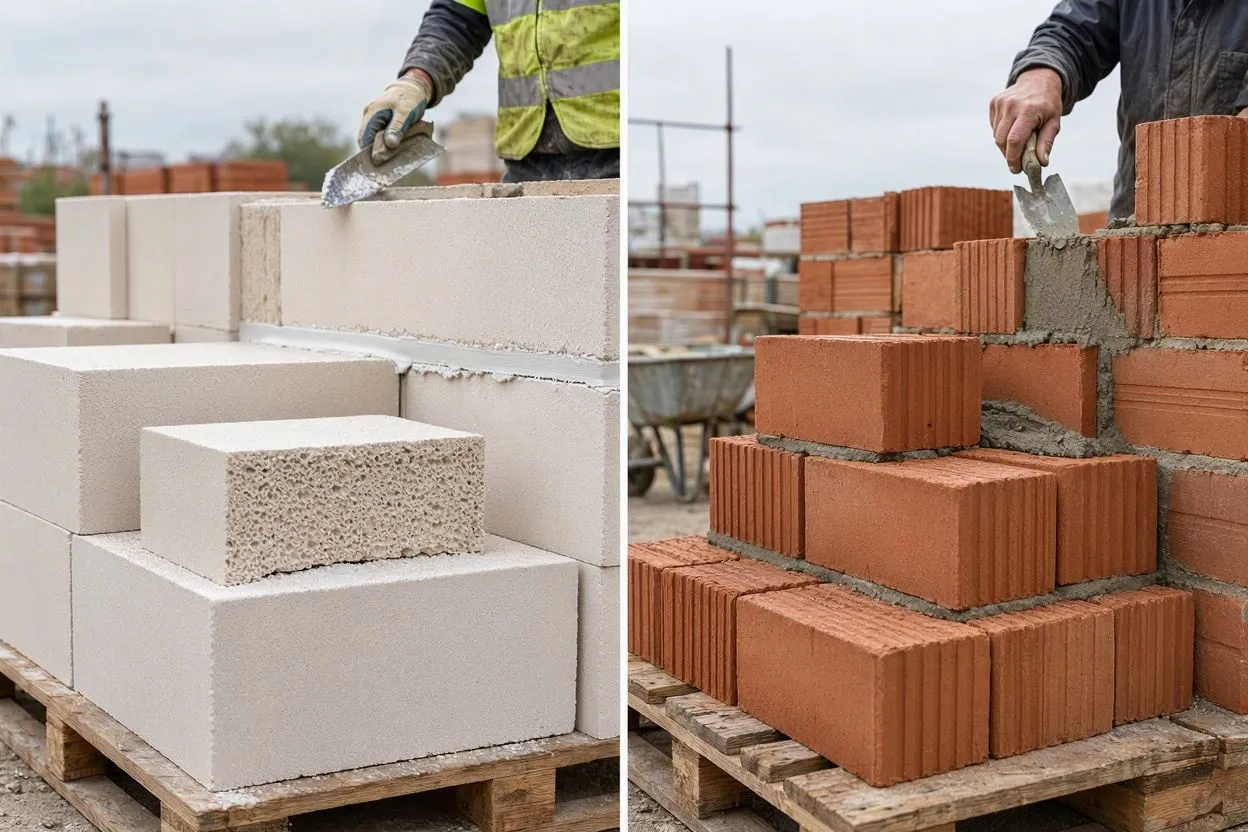
AAC blocks win on insulation, weight and fire rating, while red bricks win on strength, weather durability and familiarity. The right pick depends heavily on where you build. In India, both materials fill the same slot, the infill wall inside a reinforced cement concrete (RCC) frame, so autoclaved aerated concrete (AAC) swaps in for brick one-for-one. American homes work differently. Most US brick is a 4-inch (100 mm) veneer hung on a wood frame, while AAC forms a structural wall that insulates on its own.
This guide settles the AAC blocks vs red bricks question for both markets, using ASTM and Indian Standard (IS) specs, 2026 prices in dollars and rupees, and climate data from Florida to Rajasthan.
AAC Blocks vs Red Bricks at a Glance
AAC blocks are about 3.5 times lighter and roughly 6 times better at resisting heat flow, while US facing bricks are 3 to 10 times stronger in compression.
| Factor | AAC blocks | Red clay bricks |
| Standard (US / India) | ASTM C1693 / IS 2185 (Part 3) | ASTM C216 / IS 1077 |
| Density | 20 to 50 lb/ft³ (320 to 800 kg/m³) | 120 to 130 lb/ft³ (1,920 to 2,080 kg/m³) |
| Compressive strength | 290 to 1,090 psi (2.0 to 7.5 MPa) | US facing brick: 3,000 psi (20.7 MPa) min; Indian bricks: mostly 3.5 to 10 N/mm² (510 to 1,450 psi) |
| Standard unit size | US: 8 x 8 x 24 in; India: 600 x 200 x 100 to 250 mm | US: 3-5/8 x 2-1/4 x 7-5/8 in; India: 230 x 110 x 75 mm (9 x 4.5 x 3 in) |
| Thermal resistance | About R-1.25 per inch; R-10 for an 8-in wall | About R-0.2 per inch |
| Fire rating | 4 hours for a 4-in (100 mm) wall | About 1.5 hours before fire breaches a brick-clad home |
| Sound (STC) | 44 to 50, depending on finish | Varies by wall assembly |
| Exterior finish | Required (stucco, siding or coating) | Not required |
| Typical use | US: structural walls; India: RCC infill | US: veneer over framing; India: RCC infill and load-bearing walls |
| Availability | US: 3 plants, ordered direct; India: widely stocked | Stocked almost everywhere in both countries |
What Are AAC Blocks?
AAC blocks are precast, steam-cured concrete units that are roughly 80% air by volume. Manufacturers mix portland cement, quartz sand, lime, gypsum and water with an expansion agent (usually aluminum powder), and fly ash can stand in for part of the sand. The mix rises, sets, gets wire-cut to size, then cures under high-pressure steam in an autoclave.
That last step matters. Autoclaving turns the mix into a stable calcium silicate hydrate, so a block reaches its full strength in hours instead of the 28 days that ordinary concrete needs. ASTM International (formerly the American Society for Testing and Materials) covers the material under ASTM C1693, which sorts AAC into strength classes such as AAC-2, AAC-4 and AAC-6.
US blocks come with a nominal 8 x 24 in (200 x 600 mm) face and thicknesses from 2 to 16 in (51 to 406 mm). Jumbo sizes of 24 x 24 in and 32 x 24 in (610 x 610 mm and 813 x 610 mm) exist too, and each unit is cut within a 1/8 in (3 mm) tolerance.
What Are Red Bricks?
Red bricks are solid clay or shale units fired in a kiln at high temperature, and they’re the oldest manufactured building material still in everyday use. Iron oxide in the clay produces the red color. American facing brick follows ASTM C216, which grades each brick by how well it survives freezing: Grade SW (severe weathering) and Grade MW (moderate weathering).
A standard US modular brick measures 3-5/8 x 2-1/4 x 7-5/8 in (92 x 57 x 194 mm) and weighs about 4.5 lb (2 kg). It takes 6 to 7 of them to cover one square foot (0.09 m²) of wall. Indian bricks follow IS 1077, which sets strength classes from 3.5 to 35 N/mm² (510 to 5,080 psi), and a traditional 9-inch wall uses about 10 bricks per square foot. Brick lasts a very long time, with most brick exteriors rated for 50 to 100+ years and little upkeep beyond occasional repointing.
How Are AAC Blocks and Red Bricks Used in the US and India?
In India, AAC and red brick compete for the same infill wall, while in the US, brick is mostly cladding and AAC is a structural wall. That single difference changes how you should compare them.
Indian construction relies on RCC columns and beams to carry the load. Walls between them only enclose space, so a 6-inch (150 mm) AAC block replaces a 9-inch (230 mm) brick wall directly, and builders from Pune to Bengaluru switched for exactly that reason.
A typical US brick house in Texas or Georgia is wood-framed underneath. Masons lay one wythe of brick 3 to 4 in (76 to 100 mm) thick, tie it to the framing with metal ties and leave a 1 in (25 mm) air gap behind it for drainage. The brick carries its own weight and nothing else.
AAC works differently. An 8-in (200 mm) AAC wall carries floor and roof loads, provides the insulation and forms the fire barrier all at once, then gets a coat of polymer-modified stucco or a layer of siding outside. You aren’t choosing between two bricks. You’re choosing between two wall systems.
Which Is Stronger, AAC Block or Red Brick?
Red brick is far stronger: Grade SW facing brick must average at least 3,000 psi (20.7 MPa), while AAC ranges from 290 to 1,090 psi (2.0 to 7.5 MPa). Even the strongest AAC class sits well below the weakest code-compliant facing brick.
Strength on paper isn’t the whole story, though. AAC-4, a common residential class, handles load-bearing walls in low-rise homes with correct engineering, and The Masonry Society (TMS) includes AAC masonry design in TMS 402/602, the masonry code that the International Building Code (IBC) references. For a two-story house in Florida, AAC’s compressive strength is rarely the limiting factor. In steel or concrete frames, AAC serves as infill walls, where it carries only its own weight.
Indian conditions tilt the math further. Many site-made bricks test at 3.5 to 7.5 N/mm² (510 to 1,090 psi), which overlaps the IS 2185 (Part 3) range for AAC of 2.0 to 7.0 N/mm² (290 to 1,015 psi), so the strength gap in India is far narrower.
Brick’s strength shows up in impact resistance. A stray baseball, a hailstone or a lawn mower kicking up a rock does little to brick, but it can chip unfinished AAC. That’s one of 2 main reasons AAC always gets a protective finish.
How Much Do AAC Blocks and Red Bricks Weigh?
AAC weighs about 35 lb/ft³ (560 kg/m³), which is roughly one-third to one-quarter the weight of fired clay brick at 120 to 130 lb/ft³ (1,920 to 2,080 kg/m³).
Consider one standard 8 x 8 x 24 in AAC block. It weighs about 31 lb (14 kg) and covers the same wall face as 9 modular bricks. Per square foot of wall, an 8-in (200 mm) AAC wall comes in near 23 lb (11 kg), while a 4-in (100 mm) brick veneer alone weighs about 38 lb (17 kg), and that veneer still needs a frame and insulation behind it.
That lightweight profile lowers the dead load on footings, so foundations shrink and crane time drops.
Which Material Insulates Better?
AAC insulates better: an 8-in (200 mm) AAC wall reaches about R-10 on its own, while brick provides only about R-0.2 per inch. A brick veneer adds under R-1 to a wall, so a brick house depends almost entirely on the insulation inside its framed cavity.
AAC’s thermal insulation comes from its air cells, which slow heat transfer, while its mass stores heat and releases it slowly. Manufacturers call this the dynamic benefit for massive systems (DBMS), and they claim effective values higher than the steady-state R-10 for some climates. The steady-state number is the one code officials check, though.
Here’s the catch for cold regions. A 2×6 wood wall with cavity insulation reaches R-19 to R-21, so AAC falls short of code in northern states unless you add rigid foam or build thicker walls. The International Energy Conservation Code (IECC) gives mass walls lower R-value targets than framed walls, which helps, but a 12-in (300 mm) block or added insulation is common north of the Carolinas. India faces the opposite problem. Cooling dominates in Delhi and Hyderabad, and AAC’s lower heat gain trims air-conditioning loads in top-floor flats and west-facing rooms.
Which Material Has Better Fire Resistance?
AAC has the higher fire rating: a 4-in (100 mm) AAC wall carries a 4-hour rating under ASTM E119 testing, while a brick-clad home holds off fire for about 1.5 hours. Both materials are non-combustible and won’t melt or release toxic smoke. The Brick Industry Association (BIA) sets that 1.5-hour figure against under 30 minutes for vinyl and fiber cement siding.
The difference comes from what’s behind each wall. AAC is solid all the way through, so heat has nowhere to go. Brick veneer protects the outside well, but the wood studs behind it remain combustible, which is why brick’s real-world number reflects the whole assembly rather than the brick itself.
That’s why AAC sells well in California wildfire zones and for townhouse fire walls.
How Do AAC and Brick Handle Water and Freeze-Thaw?
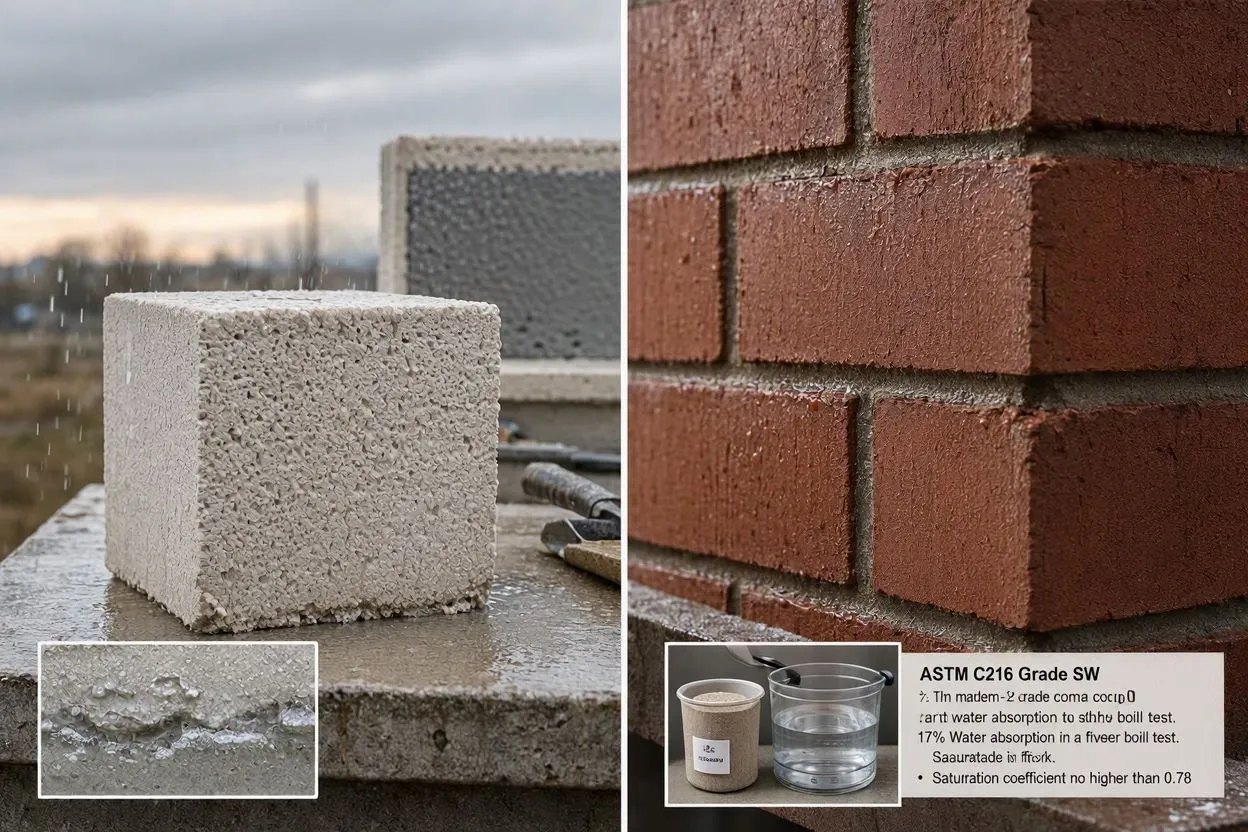
Brick handles weather far better, since AAC absorbs water readily and breaks down if left exposed to rain or soil moisture. Its open cell structure soaks up moisture, so it needs a vapor-permeable exterior finish to stay dry.
Brick earns its reputation here. ASTM C216 Grade SW brick must stay under 17% water absorption in a 5-hour boil test, with a saturation coefficient no higher than 0.78, and that combination is what lets it survive decades of freeze-thaw cycles in Chicago or Boston.
Monsoon rain in Mumbai and Kerala puts the same demand on Indian AAC walls, which need a good external plaster and waterproof paint. For AAC in wet climates, plan on 3 protective steps:
- Apply polymer-modified stucco or a breathable coating on exterior faces.
- Seal below-grade walls with a thick waterproof membrane.
- Keep the first course off the slab with a proper flashing detail.
Which Material Blocks More Sound?
AAC blocks more sound as a single wall, with sound transmission class (STC) ratings of 44 to 50 depending on the finish. An STC of 50 means loud speech on the other side is barely audible.
Brick’s sound insulation depends on the assembly. For shared walls in duplexes, AAC gives a quieter, fire-rated separation in one product.
How Much Do AAC Blocks vs Red Bricks Cost in the US?
Brick veneer costs $12 to 18persquarefootinstalled(129 to $194 per m²), and a finished AAC exterior wall runs in a similar range, though AAC prices depend heavily on shipping distance. The AAC blocks vs red bricks cost gap is smaller than most people expect, because each system includes different pieces.
Material Cost
AAC blocks cost more per square foot of wall face than concrete block. A solid 8 x 8 x 24 in AAC-4 block from a Florida manufacturer listed at $6.98 in 2020, or about 5.24persqft(56 per m²) of wall face, while standard concrete masonry units (CMU) cost about $2.32 per sq ft at the same time. Full-size face bricks cost $2 to 6persqft(22 to $65 per m²) for material alone.
Installed Cost
Full-size brick veneer runs $12 to $18 per sq ft installed, and thin brick runs $8 to $18 per sq ft. For a 2,000 sq ft (186 m²) home, a full brick exterior averages about $26,000.
AAC’s installed cost covers more of the wall. One builder’s estimate put AAC at roughly $12 per sq ft of finished exterior wall, including block, mortar, stucco, interior plaster and labor, but excluding freight. Brick’s $12 to $18 covers only the outer skin, so framing, sheathing, insulation and drywall come on top.
4 Hidden Costs to Budget For
- Freight for AAC: plants are in Florida, South Carolina and Mexico, so shipping to Ohio or Oregon adds real cost.
- Brick ledge foundations: a new footing to support veneer adds $15 to $30 per sq ft if your foundation isn’t wide enough.
- Exterior finish for AAC: stucco or siding is mandatory, not optional.
- Installer premium for AAC: crews experienced with thin-bed mortar are scarce in most states, which pushes labor rates up.
How Much Do AAC Blocks vs Red Bricks Cost in India?
AAC blocks cost less than red bricks per square foot of external wall in India: a 6-inch AAC wall uses about ₹62 to ₹74 of block per sq ft, against ₹80 to ₹120 of brick for a 9-inch wall. Partition walls come out close to even.
| 2026 India prices | AAC blocks | Red bricks |
| Price per unit | ₹55 to ₹70 (100 mm); ₹80 to ₹95 (150 mm) | ₹8 to ₹12 first class; ₹6 to ₹9 second class |
| Units per sq ft of wall | About 0.78 | About 5 (4.5-in wall); about 10 (9-in wall) |
| Material per sq ft, partition | ₹43 to ₹54 (4-in AAC) | ₹40 to ₹60 (4.5-in brick) |
| Material per sq ft, external | ₹62 to ₹74 (6-in AAC) | ₹80 to ₹120 (9-in brick) |
Prices swing by city. First-class bricks run ₹11 to ₹14 in Mumbai but ₹7 to ₹10 in Kolkata, and transport adds ₹2 to ₹4 per brick within 50 km (31 miles). AAC’s savings grow once mortar and plaster enter the bill, since thin-bed joints use far less mortar and the flat block face takes a thinner plaster coat.
How to Build With AAC Blocks and Red Bricks
To build with AAC, crews set large blocks in thin-bed mortar; to build with brick, masons lay small units in full mortar joints over a framed, sheathed wall.
How to Lay AAC Blocks
To lay AAC blocks, follow these 5 steps:
- Set the first course in a full bed of standard mortar on the footing, leveled perfectly.
- Lay upper courses with 1/16 to 1/8 in (1.5 to 3 mm) thin-bed mortar.
- Cut blocks to size with a hand saw or band saw.
- Rout channels for wiring and plumbing directly into the block.
- Finish the exterior with stucco and the interior with plaster or drywall.
Because AAC cuts easily, crews shape openings on site and fasten cabinets with AAC-specific screws. Cutting produces silica dust, so workers need a respirator during that stage.
How to Lay Brick Veneer
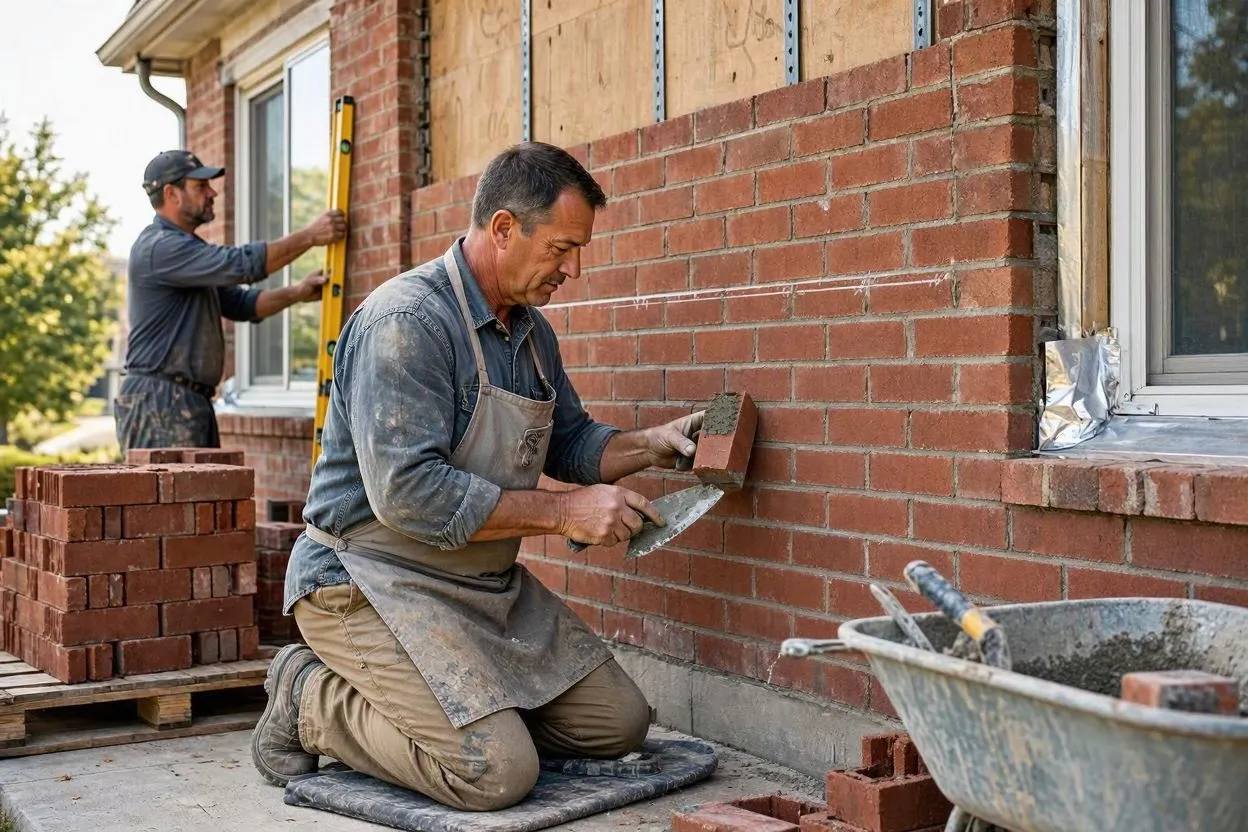
To lay brick veneer, follow these 5 steps:
- Frame and sheathe the wall, then wrap it with a weather-resistant barrier.
- Set a steel shelf angle or build a brick ledge at the foundation.
- Lay brick in 3/8 in (10 mm) mortar joints, fastening wall ties every few courses.
- Keep a 1 in (25 mm) air gap clear of mortar droppings.
- Install flashing and weep holes at the base and over every opening.
Construction speed favors AAC, since a mason handles 6 to 7 bricks for each square foot of wall that a single AAC block covers in one lift.
Where to Buy AAC Blocks in the US and India
In India, AAC blocks are stocked by dealers in nearly every city, while in the US they’re sold directly by a handful of manufacturers and distributors. Indian producers include Magicrete, Bigbloc and UltraTech’s Birla Aerocon, with plants spread across Gujarat, Maharashtra and the south.
US buyers have 3 main plants to choose from:
- Aercon AAC in Haines City, Florida, which ships blocks and panels by rail and truck nationwide.
- AAC East in Bennettsville, South Carolina, which started production in spring 2022.
- Litecrete (Hebel) in Mexico, the longest-running AAC plant in North America.
Distributors such as Performance Concrete in Ohio resell AAC in the Midwest. If your site sits far from these plants, request a freight quote before comparing wall prices, since shipping can change the math entirely.
Which Is Better for the Environment?
AAC has a lower environmental impact per wall, because it uses far less raw material by weight and cures with steam instead of a fossil-fired kiln. Fly ash, a byproduct of coal power plants, can replace part of AAC’s sand, which keeps that ash out of landfills. Crushed AAC is recyclable as aggregate, which is one reason green building programs list it among low-impact materials.
India shows the stakes clearly. Clay brick kilns consume about 600 million tonnes of clay each year, much of it topsoil from farmland, and India’s fly ash rules push brick makers near thermal power plants toward fly ash products instead.
Brick makes its case through lifespan. A brick exterior that lasts 100 years without replacement spreads its kiln energy across a century, while vinyl or fiber cement siding gets replaced 2 or 3 times in that period. AAC does carry trade-offs. Its cement content emits carbon, and long-distance freight from 3 plants adds transport emissions that local brick avoids.
When Should You Choose AAC Blocks?
Choose AAC blocks when fire safety, sound control or a single-material wall matters more than local availability. AAC fits best in 4 situations:
- Wildfire zones in California, Colorado and Oregon, where a 4-hour wall protects the structure.
- Hot-humid climates in Florida and the Gulf Coast, where mass and R-10 cut cooling loads and hurricane-rated designs are proven.
- Multifamily party walls that need fire separation and an STC of 44 or higher.
- Owner-builders who value fewer trades, since one AAC wall replaces studs, insulation and sheathing.
When Should You Choose Red Bricks?
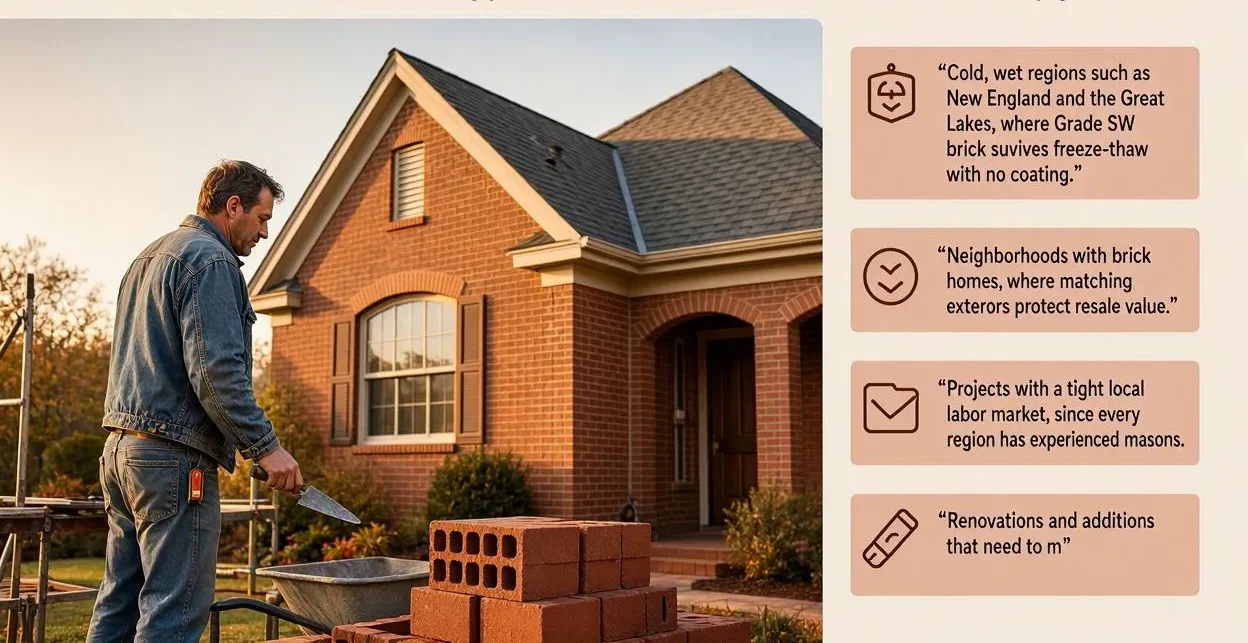
Choose red brick when curb appeal, resale value and low maintenance top your list. Brick outperforms AAC in 4 situations:
- Cold, wet regions such as New England and the Great Lakes, where Grade SW brick survives freeze-thaw with no coating.
- Neighborhoods with brick homes, where matching exteriors protect resale value.
- Projects with a tight local labor market, since every region has experienced masons.
- Renovations and additions that need to match existing brick on the main house.
AAC Blocks vs Red Bricks by Climate
AAC performs best in hot and mixed climates in both countries, while brick veneer performs best in cold, wet US climates. Use this table as a starting point, then confirm with a local engineer and your building department.
| Climate | Example states or regions | Better fit | Reason |
| Hot-humid | Florida, Louisiana, Texas Gulf Coast | AAC | Thermal mass cuts cooling loads; local plants reduce freight |
| Hot-dry | Arizona, Nevada, Southern California | AAC | Mass evens out daily temperature swings; strong fire rating |
| Mixed-humid | North Carolina, Tennessee, Virginia | Either | AAC meets code with modest upgrades; brick is widely available |
| Cold | Minnesota, Michigan, Maine | Brick veneer | Framed walls reach R-20+; Grade SW brick handles freeze-thaw |
| Wildfire-prone | California foothills, Colorado Front Range | AAC | 4-hour rating and fully non-combustible wall |
| Hot-dry (India) | Rajasthan, Gujarat, Telangana | AAC | Lower heat gain cuts cooling bills |
| Heavy monsoon (India) | Mumbai, Kerala, coastal Karnataka | Either, with care | AAC needs waterproof plaster; brick needs damp-proofing |
| Cold (India) | Himachal Pradesh, Uttarakhand, Kashmir | AAC | Better heat retention than solid brick |
Conclusion
In India, AAC blocks are the better choice for most RCC-framed homes and apartments, and in the US, AAC suits hot, fire-prone builds while brick veneer suits cold climates and resale-driven projects. The AAC blocks vs red bricks decision comes down to your wall system and your local prices.
Indian builders should compare delivered prices per square foot of finished wall, including plaster, rather than price per piece. US builders should get a freight quote from the nearest AAC plant and ask the building department how it reviews AAC permits. Those numbers usually settle the question within a week.
Frequently Asked Questions

Related Posts