12 Concrete Sidewalk Ideas for 2026: Materials, Design, Cost, and Code Guide
A concrete sidewalk is a functional walkway and a design feature at the same time, and the building material you pick decides whether it reads as plain infrastructure or an actual curb-appeal upgrade. Homeowners across the US are moving past flat grey slabs toward stamped concrete, colored aggregate, and mixed-material supply combinations, pairing poured concrete with stone, brick, or paver materials that still clear local building codes. This guide walks through 12 sidewalk material and finish ideas, real 2026 material and installation pricing, ADA code requirements, and the maintenance schedule that keeps a poured concrete slab intact for decades.
What Makes Concrete a Good Building Material for Sidewalks?
As a building material, poured concrete lasts 25 to 50 years with basic upkeep and costs less per square foot than paver, brick, or natural stone materials. Standard ready-mix concrete supply runs $6 to $12 per square foot installed. Stamped or colored concrete material costs $10 to $18. Compare that to natural stone paver materials at $15 to $30 per square foot and concrete wins on a straight material-cost basis. A 4-foot by 50-foot front walkway, a common residential layout, needs roughly 200 square feet of concrete supply. That puts a basic pour at $1,200 to $2,400 in material and labor, and a decorative finish at $2,000 to $3,600.
Concrete as a building material also handles the freeze-thaw cycles common in the Midwest and Northeast better than interlocking paver materials, which tend to shift and need regrading every few years. A well-poured slab with correctly spaced control joints won’t heave the way loose-laid building materials do.
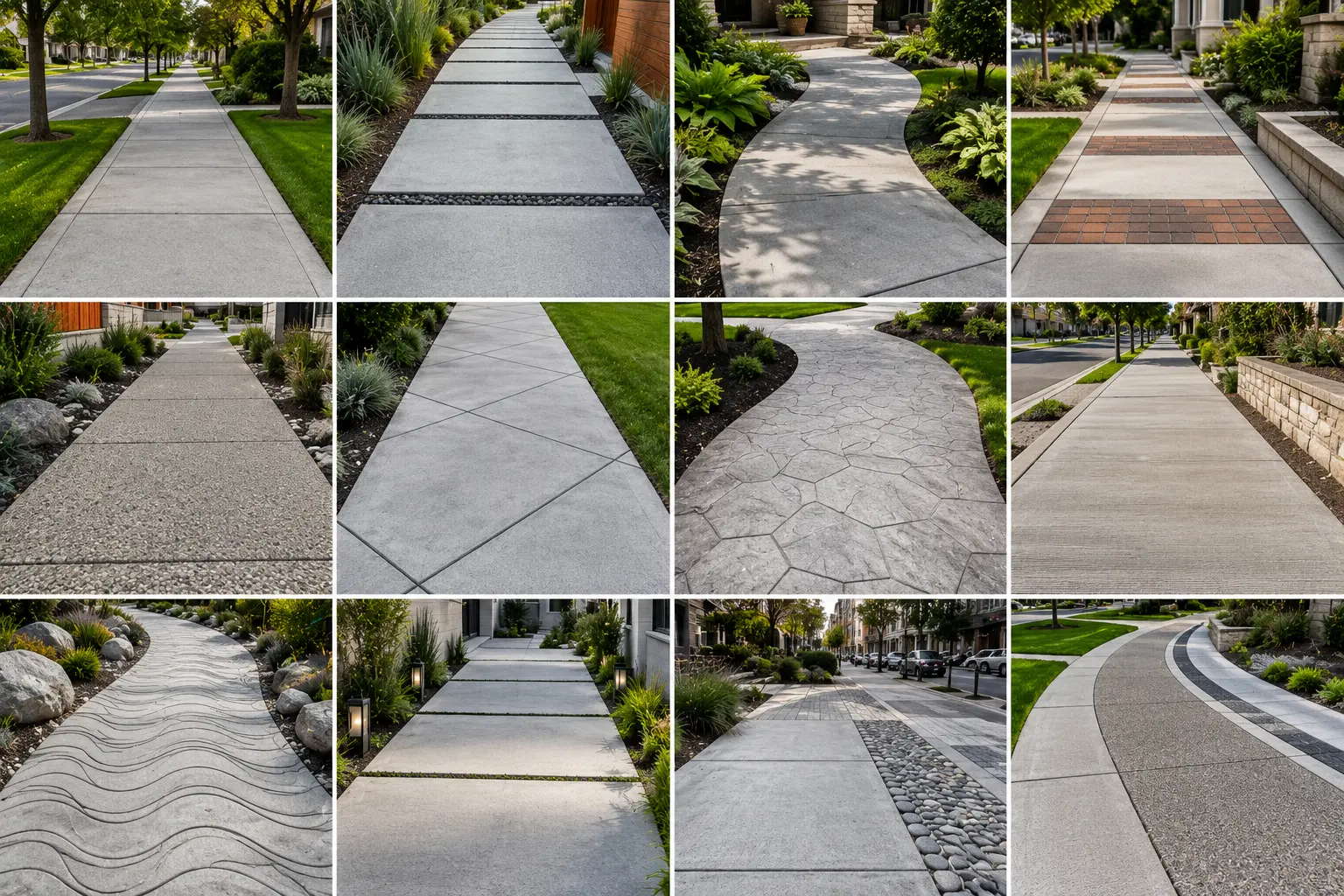
12 Concrete Sidewalk Materials and Finish Ideas by Style
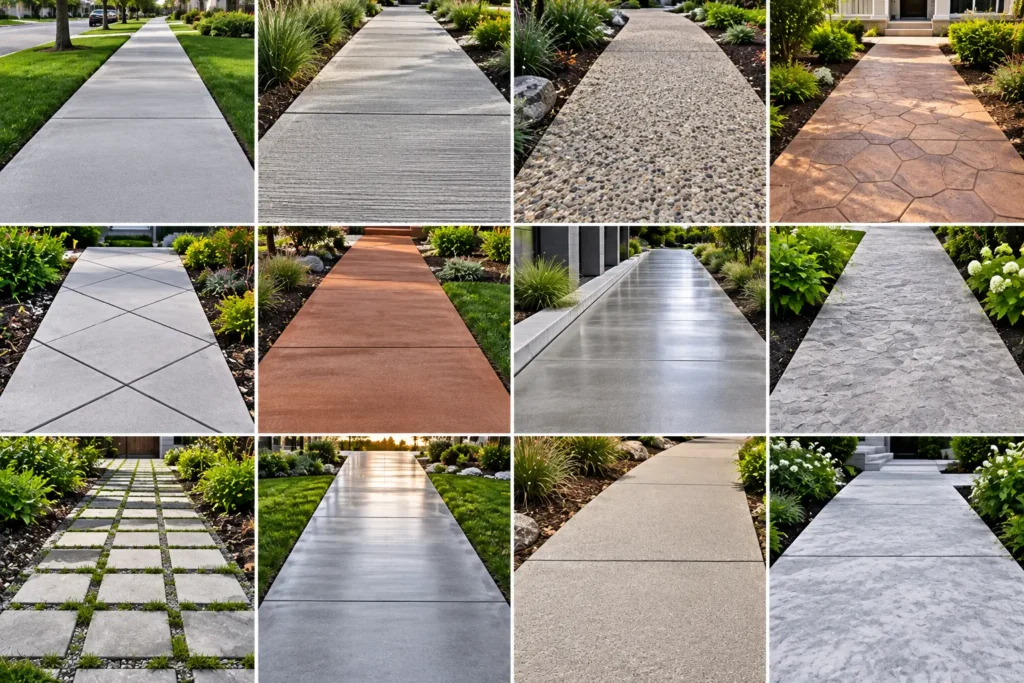
Stamped Concrete Sidewalks
Stamped concrete is a decorative building material that replicates the look of brick, slate, or cobblestone by pressing a textured mold into wet concrete before it cures. John Schimmel of John’s Cement in Milford, Michigan, used a free-form stamped design on a 600-square-foot residential project, which shows the material scales from a small entry walk up to a full backyard path. Stamped concrete typically adds $3 to $6 per square foot in material and labor over plain concrete, and pattern options include ashlar slate, herringbone brick, and running-bond cobblestone.
Exposed Aggregate Sidewalks
This material technique washes away the top layer of cement paste after the pour sets, revealing the natural stone aggregate inside the concrete mix. Sundek of San Antonio used the technique across the Mission Concepción Park pathways in San Antonio, Texas, creating a slip-resistant surface built for heavy foot traffic. The material and installation run $8 to $15 per square foot and work well in high-traffic, public-facing spots because the rough aggregate texture improves grip in wet conditions.
Colored and Stained Concrete Sidewalks
Colored concrete mixes pigment directly into the wet material; stained concrete applies an acid- or water-based coloring product to a slab that’s already cured. Each method produces a different depth of color. Integral color runs through the full slab thickness, so a chip or crack won’t expose grey concrete underneath. Acid staining creates mottled, marbled tones that vary by material batch, a look several ConcreteNetwork contractors specialize in, including finishes in terra cotta and dusty rose. Expect to pay $2 to $4 extra per square foot in material for integral color and $3 to $7 for acid-stain application.
Concrete Paver Combination Walkways
Pairing poured concrete with paver, brick, or stone border materials adds visual contrast without the material cost of an all-paver walkway. A concrete field with a brick or stone border material costs less than a fully paved surface while still giving you that textured edge plain concrete lacks. It also means a contractor can repair a damaged section of border material without breaking up the whole slab.
Curved and Freeform Sidewalks
Curved paths guide foot traffic along a natural line rather than a straight one, which works particularly well around mature trees, garden beds, or uneven grading. Freeform pours cost more in material handling and labor, typically 10% to 15% above a straight-line walkway, since curved formwork takes longer to set and finish correctly.
Broom-Finished Sidewalks
Dragging a stiff-bristled broom across wet concrete leaves fine parallel grooves in the material surface. It’s the most common residential sidewalk finish for a reason: cheap material, minimal labor, and slip-resistant. Absolute Concrete Construction in Federal Way, Washington, uses broom finishing with visible control joints as a standard baseline material treatment, and it costs no more than plain trowel-finished concrete on most bids.
Concrete-and-Grass Checkerboard Walkways
Square concrete paver units alternate with grass or ground-cover joints in this style, cutting total concrete material volume by roughly 40% to 50%. New Path Concrete LLC in Sacramento, California, installed this as a modern alternative to a solid slab. It reduces material cost and cuts stormwater runoff too, since the grass sections stay permeable.
Exposed-Edge Border Sidewalks
A contrasting color material or stamped band along the perimeter frames an otherwise plain walkway without the material cost of stamping the whole surface. It typically adds $1 to $3 per square foot in material and labor, and it works on new pours as well as resurfacing jobs over existing concrete.
Permeable Concrete Sidewalks
A porous concrete mix lets rainwater filter through the slab material into the ground instead of running off into storm drains. Municipalities in flood-prone regions increasingly require or incentivize permeable building materials for new construction. The material and installation cost $10 to $20 per square foot, more than standard concrete supply, but stormwater-fee rebates in some cities offset that.
Concrete Sidewalks with Embedded Lighting
Low-voltage LED fixtures and related electrical supplies along the edge or within paver joints improve nighttime visibility and add $15 to $40 per linear foot depending on fixture spacing. A 50-foot front walkway with a fixture every 8 feet needs about 6 fixtures, which adds $500 to $1,200 in material and installation to the project.
Concrete Sidewalks with Stone Banding
A strip of natural stone or manufactured stone veneer material along one or both edges adds texture without replacing the full concrete field. Concrete Styles Inc. in Schwenksville, Pennsylvania, paired ashlar slate stamping with natural stone accent materials on a residential walkway-and-patio job, which shows how banding material can extend from sidewalk into adjoining hardscape.
Minimalist Slab Sidewalks
Large-format, unadorned concrete slabs with clean control joints match the low-ornament look of modern and mid-century homes. This is the least expensive material option on the list, often under $8 per square foot, because it skips stamping, staining, and embedded materials entirely.
How Much Do Concrete Sidewalk Materials Cost?
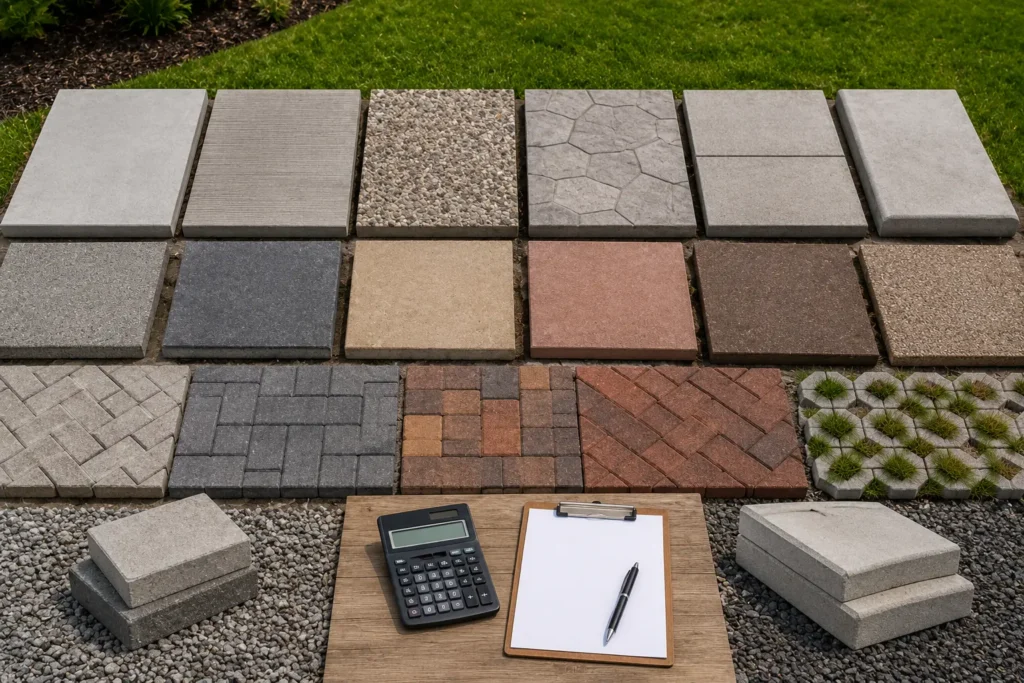
A concrete sidewalk runs $6 to $18 per square foot installed in 2026, depending on the material finish, region, and site prep. Plain broom-finished concrete supply sits at the low end; stamped, colored, or permeable concrete materials sit at the high end. A typical 200-square-foot residential walkway (4 ft. × 50 ft., or roughly 1.2 m × 15 m) costs $1,200 to $3,600 depending on the material finish chosen. Labor makes up 60% to 70% of that total, with concrete materials and equipment covering the rest. Removing an existing sidewalk adds $2 to $5 per square foot before the new material pour even starts, and sites needing extra excavation or a compacted gravel base material cost more still.
Regional material and labor pricing varies too. Contractors on the Northeast and West Coast typically charge 15% to 25% above the national average because of labor rates, while Midwest and Southern markets often land at or below the baseline material figures above.
What Are the Code Requirements for a Concrete Sidewalk?
Sidewalks that connect to public rights-of-way must meet ADA standards. Private residential-only walkways typically don’t require ADA compliance unless the property is a rental or a business. Local municipal codes still apply to private sidewalks in most jurisdictions though, covering thickness, drainage, and permits even when ADA rules don’t.
Width and Slope Rules
ADA-compliant sidewalks need a minimum clear width of 36 inches (91 cm), though many municipalities set a 42-inch (107 cm) local minimum. Cross-slope can’t exceed 2%, and running slope can’t exceed a 1:20 ratio (5%) without triggering ramp requirements. Sidewalks under 60 inches (152 cm) wide need passing spaces at least every 200 feet (61 m) so two wheelchair users can pass each other.
Thickness Requirements
Standard residential sidewalks need 4 inches (10 cm) of concrete over a compacted base. Where a sidewalk crosses a driveway, it needs 6 to 7 inches (15 to 18 cm) to handle vehicle loads without cracking. New York City’s DOT, for example, mandates 4-inch sidewalks on a 6-inch foundation in residential zones and 8-inch slabs for commercial sidewalks.
Joint Spacing Rules
Control joints should sit no farther apart, in feet, than 2.5 times the slab thickness in inches, though most contractors space joints every 4 to 5 feet (1.2 to 1.5 m) on standard-width sidewalks regardless of what that formula allows. A 4-inch-thick sidewalk technically permits joints up to 10 feet apart, but tighter spacing heads off the random cracking that shows up on unjointed or under-jointed slabs within 5 to 10 years.
Should You Pour a Concrete Sidewalk Yourself or Hire a Contractor?
Hire a licensed contractor for anything connecting to a public right-of-way. DIY makes sense only for small, private walkways under 100 square feet with no ADA obligations attached. Public-facing sidewalks need permits and inspections that most homeowners can’t self-certify. A DIY pour also demands correct base compaction, timely joint cutting, and finish work done inside a narrow curing window, and mistakes at any stage tend to show up as cracks, pooling water, or an uneven surface within the first year.
Contractors bring rented equipment, bulk material supply pricing, a crew sized for the pour, and liability coverage that protects against defects. For a straightforward 200-square-foot front walkway, contractor labor typically adds $800 to $1,500 over material cost alone. That’s the price of code compliance and, in most cases, a warranty.
How Long Does a Concrete Sidewalk Last?
A properly installed sidewalk lasts 25 to 50 years. Unsealed slabs in freeze-thaw climates land at the low end; sealed, well-maintained slabs in mild climates reach the high end. Sealing every 2 to 3 years extends surface life by keeping water out, since water infiltration drives the freeze-thaw cracking behind most premature sidewalk failure. Stamped and colored finishes need resealing on the same schedule, or they fade and the surface starts to erode.
How Do You Maintain a Concrete Sidewalk?
Seal the material every 2 to 3 years, repair cracks over 1/4 inch (6 mm) right away, and clear snow with a plastic shovel instead of metal to avoid scarring the concrete surface. Under the ADA, any vertical lift at a joint or crack greater than 1/4 inch counts as a trip hazard that needs material repair. Property owners in most municipalities stay legally responsible for sidewalk material upkeep even though the sidewalk itself sits in the public right-of-way.
Skip de-icing salt on new concrete material through its first winter. The surface hasn’t fully cured yet, and salt accelerates surface scaling. Calcium magnesium acetate is a safer de-icing supply alternative for concrete under a year old.
Conclusion
Choosing among these 12 concrete material and finish ideas comes down to three things: material budget per square foot, local code obligations, and a finish that matches the home’s existing building materials. A broom-finished slab at $6 per square foot in material and labour covers every practical need for a private side-yard path. A stamped or exposed-aggregate front walkway at $12 to $18 per square foot in material and installation delivers the curb-appeal upgrade most homeowners are actually shopping for. Whichever material finish you land on, correct thickness, joint spacing, and ADA compliance where it’s required are what decide whether that sidewalk lasts 10 years or 40.
FAQs

Related Posts