Decking Calculator — Estimate Boards, Cost & Materials (2026)
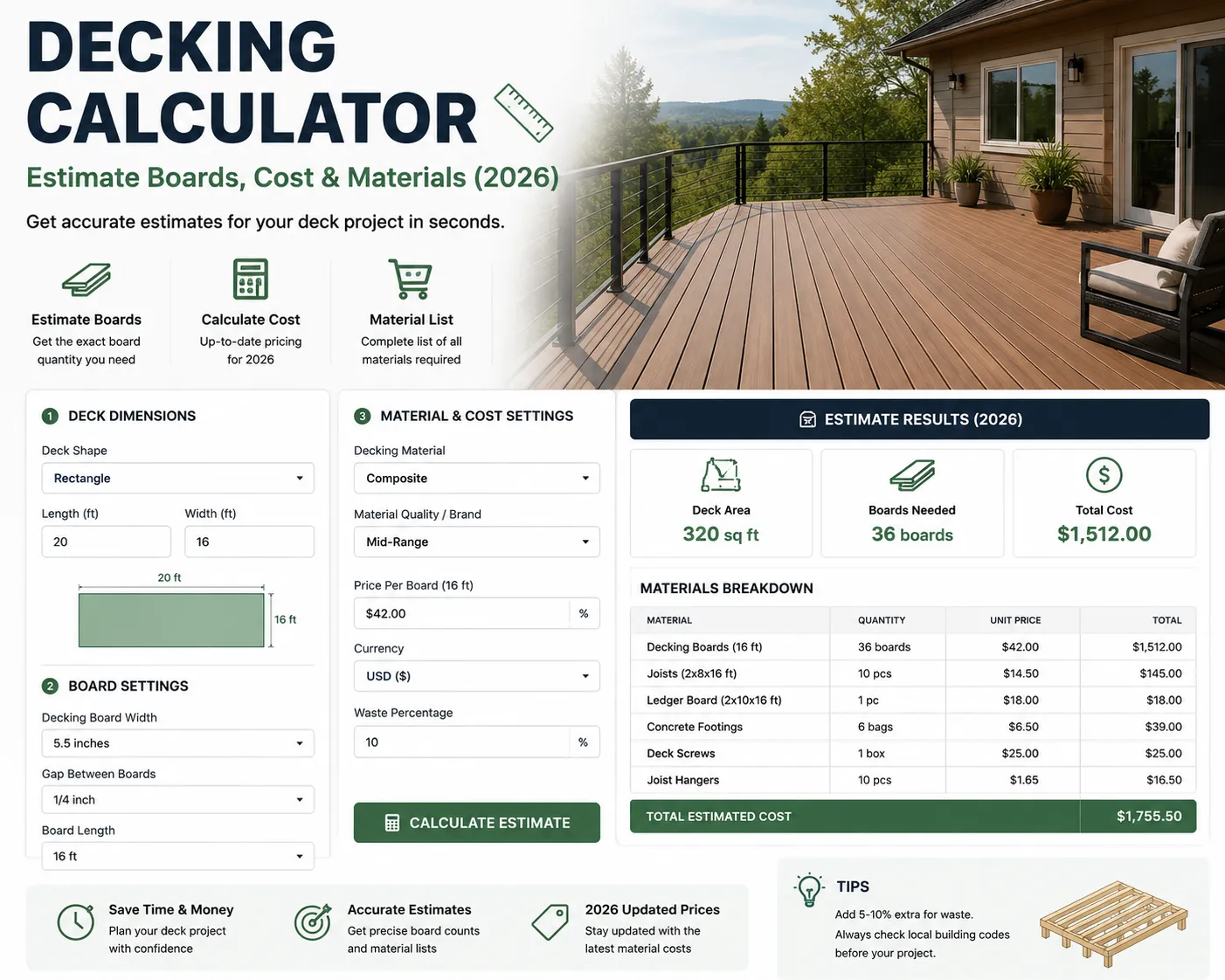
Enter your deck dimensions below and get the exact number of boards, fasteners, and screws you need — no guesswork, no wasted material.
Planning a deck project without calculating materials first costs homeowners an average of 15–20% more in wasted lumber. This free decking calculator gives you board count, fastener count, and total material cost in seconds — built for USA lumber sizes and 2026 pricing.
How to Use This Decking Calculator
Five inputs. Thirty seconds. Here’s what to do:
- Enter your deck length and width in feet. A 12 ft × 20 ft deck = 240 sq ft total area.
- Select your board width — most US decks use 5.5″ (a nominal 6″ board) or 3.5″ (nominal 4″).
- Enter your board length — common lengths are 8 ft, 12 ft, and 16 ft.
- Choose your joist spacing — 12″, 16″, or 24″ on center (OC). Most residential decks use 16″ OC.
- Pick your fastener type — face screws, hidden clips, or nails. The calculator adjusts the count automatically.
Hit calculate. You’ll see total boards needed, total fasteners, and an optional cost estimate when you enter a price per board.
How Many Deck Boards Do You Actually Need?
Divide your deck’s total square footage by the square footage of one board — then add 10% for waste.
Here’s the formula:
Boards needed = (Deck sq ft ÷ Board sq ft) × 1.10
Example: A 16 ft × 14 ft deck = 224 sq ft. Using 5.5″ × 16 ft boards (7.34 sq ft each):
224 ÷ 7.34 = 30.5 → round up → 34 boards (after 10% waste added)
Always round up. Running a short mid-project means a second lumber run — and retail prices are higher than bulk orders.
Deck Board Sizes: What’s Available in the USA
Standard deck boards come in 2 widths and 5 lengths. Here’s what you’ll find at most US lumber yards in 2026:
| Nominal Size | Actual Width | Common Lengths | Best For |
| 4″ | 3.5″ | 8 ft, 12 ft | Narrow decks, tight layouts |
| 6″ | 5.5″ | 8 ft, 12 ft, 16 ft | Most residential decks |
| 2×6 | 5.5″ | 12 ft, 16 ft, 20 ft | Heavy-use decks, contractors |
The 5.5″ × 16 ft board is the most common choice for US homeowners — wide coverage, fewer cuts, less waste.
Note: hardwood exotics (Ipe, Tigerwood) are sold by the board foot, not by the linear foot. If you’re using exotic hardwoods, use the board footage input in the calculator above.
Joist Spacing and Why It Changes Your Board Count
Joist spacing does not change the number of boards — but it changes the number of fasteners by up to 33%.
Standard joist spacing options:
- 12″ OC — strongest floor, highest fastener count, best for heavy loads
- 16″ OC — most common for residential decks in the USA
- 24″ OC — minimum allowed by most local building codes, fewest fasteners
At 16″ OC with face screws, plan on 350 screws per 100 sq ft of decking. At 12″ OC, that number jumps to approximately 467 screws per 100 sq ft.
If you’re using hidden fasteners, cut those numbers in half — hidden clips attach from the board’s grooved edge, using one clip per board-end rather than two screws per joist crossing.
Waste Factor: Why You Always Order Extra
Order 10% extra for a standard straight-run deck. Order 20% extra for diagonal or patterned layouts.
Waste comes from 4 sources:
- End cuts — boards rarely end perfectly at the deck’s edge
- Damaged boards — lumber yards include warped or split boards in bundles
- Measurement errors — one wrong cut wastes a full board
- Future repairs — leftover boards stored in a dry space save money on patch jobs years later
A 200 sq ft deck at 10% waste = 20 sq ft of buffer = roughly 3 extra boards. At $4–$8 per pressure-treated board in 2026, that’s a $12–$24 insurance policy worth taking.
Decking Materials Compared: Cost Per Sq Ft (2026)
No competitor shows all 5 material types side by side. Here’s the full picture for USA buyers in 2026:
| Material | Cost Per Sq Ft (Materials Only) | Lifespan | Maintenance | Best For |
| Pressure-Treated Pine | $2–$5 | 15–25 years | High (annual staining) | Budget builds |
| Cedar | $4–$8 | 20–30 years | Medium (sealing every 2–3 yrs) | Natural look, DIY |
| Composite (mid-grade) | $7–$12 | 25–30 years | Low (cleaning only) | Low-maintenance decks |
| Composite (premium) | $12–$20 | 30–50 years | Very low | High-end outdoor living |
| Ipe / Exotic Hardwood | $15–$25 | 40–75 years | Low (oiling only) | Premium builds |
Prices reflect 2026 USA national averages. Regional lumber costs vary — the Northeast and West Coast run 20–30% higher than the Midwest and South.
Composite decking is now the top-selling material in the USA — its market share passed pressure-treated lumber in 2023 and continues to grow.
Diagonal Decking: How to Calculate Boards at 45°
Diagonal decking at 45° requires 15% more boards than a straight-run layout — not 10%.
When boards run at an angle, every board-end cut creates a longer off-cut. The triangular waste pieces at the deck’s perimeter add up fast.
Use this adjusted formula for diagonal layouts:
Boards needed = (Deck sq ft ÷ Board sq ft) × 1.15
For a herringbone or chevron pattern, increase that multiplier to 1.20–1.25. Complex patterns waste the most material at every directional change.
Joist spacing matters more for diagonal decks. The American Wood Council recommends a maximum of 16″ OC when boards run diagonally — 24″ OC spacing is not sufficient to prevent bounce and flex under foot traffic at a 45° angle.
Quick Reference: Boards Needed by Deck Size
Common deck sizes with pre-calculated board counts — using 5.5″ × 16 ft boards and 10% waste factor:
| Deck Size | Square Footage | Boards Needed | Screws Needed (16″ OC) |
| 10 ft × 10 ft | 100 sq ft | 15 boards | 350 screws |
| 12 ft × 12 ft | 144 sq ft | 22 boards | 504 screws |
| 12 ft × 16 ft | 192 sq ft | 29 boards | 672 screws |
| 16 ft × 16 ft | 256 sq ft | 39 boards | 896 screws |
| 16 ft × 20 ft | 320 sq ft | 48 boards | 1,120 screws |
| 20 ft × 20 ft | 400 sq ft | 60 boards | 1,400 screws |
| 20 ft × 24 ft | 480 sq ft | 72 boards | 1,680 screws |
These counts cover deck surface boards only — not joists, beams, posts, or railing. Use the calculator above for a custom size.
Total Decking Cost: What Else to Budget For
The calculator estimates surface material cost only. A complete deck budget includes 6 additional line items:
- Substructure (posts, beams, joists) — typically 40–50% of total deck cost
- Concrete footings — $150–$350 per footing depending on depth and local frost line
- Permit fees — $150–$1,200 depending on your US city or county
- Railing and balusters — $150–$600 per linear foot for composite railing systems
- Stain or sealant — $0.50–$1.50 per sq ft for pressure-treated or cedar decks
- Labor — $15–$35 per sq ft if hiring a contractor in 2026
Total installed cost for a standard 16 ft × 16 ft composite deck in the USA in 2026: $12,000–$22,000. A pressure-treated deck of the same size: $6,500–$11,000.
DIY vs. Contractor: 2026 USA Cost Breakdown
No competitor compares these two paths directly. Here’s the real difference:
| Cost Factor | DIY Build | Hired Contractor |
| Materials (16×16 composite) | $3,200–$5,500 | $3,200–$5,500 |
| Labor | $0 (your time) | $5,000–$10,000 |
| Tool rental | $200–$600 | Included |
| Permit + inspections | $200–$600 | Often handled by contractor |
| Total estimate | $3,600–$6,700 | $12,000–$20,000 |
DIY saves $7,000–$13,000 on a mid-size deck. The tradeoff is 3–5 weekends of labor and the responsibility of pulling your own permit.
Most US cities require a permit for any deck over 200 sq ft or over 30 inches off the ground. Check your local building department before breaking ground — building without a permit can block a home sale.
Start Your Estimate Now
Use the calculator at the top of this page to get your board count in 30 seconds.
Enter your deck dimensions, pick your board size, and select your material. The calculator outputs boards needed, fasteners needed, and total material cost — ready to take to the lumber yard.
Bookmark this page before your next trip to the store. Getting the number wrong costs time, money, and a second run.
Frequently Asked Questions

Related Posts