EPDM Roofing Cost Calculator | Estimate Flat Roof Costs in 2026
Most homeowners get blindsided by roofing quotes. One contractor says $6,000. Another says $14,000. Same roof. Same material. No explanation.
That gap exists because flat roof pricing has more moving parts than people realize — membrane thickness, attachment method, insulation depth, tear-off, and regional labor rates all hit the final number differently.
This EPDM roofing cost calculator breaks every variable down. Enter your roof size, pick your membrane thickness and attachment method, and get a real installed cost estimate — not a vague range pulled from thin air.
EPDM (Ethylene Propylene Diene Monomer) roofing costs $4 to $14 per square foot installed in 2026. For a 1,000 sq ft flat roof, that means $4,000 to $13,000 total. Run the numbers below before you request a single quote.
What Is EPDM Roofing?
EPDM is a synthetic rubber membrane built for flat and low-slope roofs. Roofers have installed it since the 1960s — no other single-ply membrane has a longer real-world track record.
It handles temperature extremes from -40°F to 300°F (-40°C to 149°C), resists UV radiation and ozone, and stays flexible in sub-zero winters without cracking. That cold-weather performance is why EPDM dominates in the Midwest and Northeast.
EPDM comes in 3 thicknesses: 45 mil (1.14mm), 60 mil (1.52mm), and 90 mil (2.29mm). Sixty mil is the USA industry standard. It works on commercial flat roofs, residential additions, garages, and low-slope sections of any building.
Black EPDM is standard and the most affordable. White EPDM reflects heat and cuts summer cooling costs by up to 30% — worth the 10 to 15% price premium in Texas, Florida, and Arizona.
EPDM Roofing Cost Per Square Foot — 2026
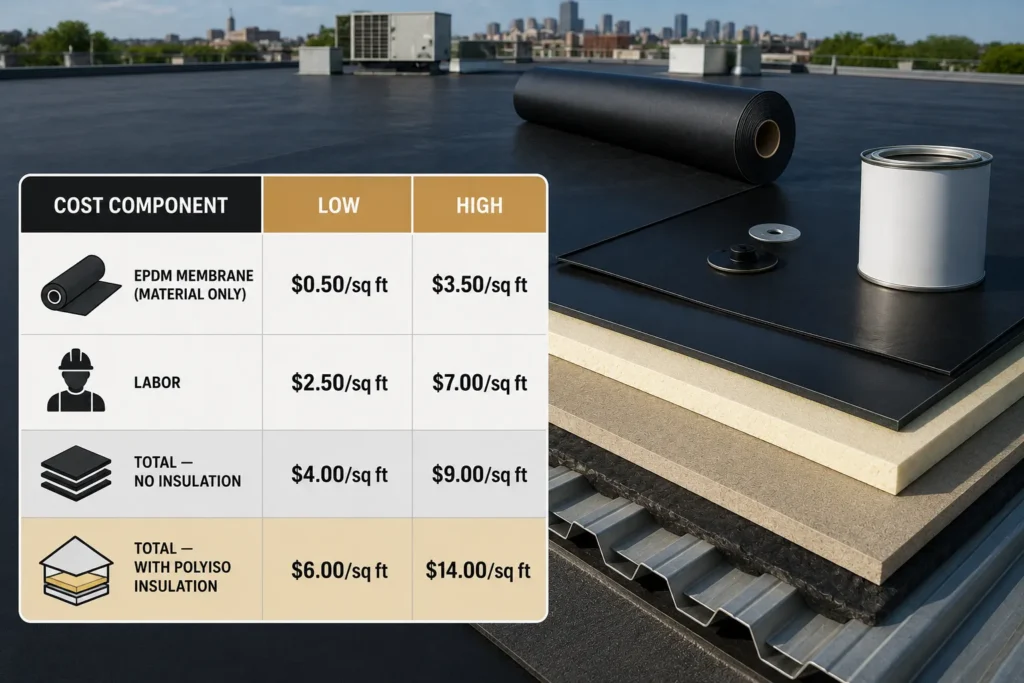
$4 to $14 per square foot installed is the 2026 national range. Here is the line-by-line breakdown of where that money goes.
| Cost Component | Low | High |
| EPDM membrane (material only) | $0.50/sq ft | $3.50/sq ft |
| Labor | $2.50/sq ft | $7.00/sq ft |
| Total — no insulation | $4.00/sq ft | $9.00/sq ft |
| Total — with polyiso insulation | $6.00/sq ft | $14.00/sq ft |
Material is only 30 to 40% of the bill. Labor, insulation, flashing, cover board, and tear-off make up the rest — and that is exactly where low-ball quotes hide the cuts.
Cost by Roof Size — 2026 Quick Reference
Use this table to check any quote before you sign.
| Roof Size | Sq Ft | Ballasted | Mech. Fastened | Fully Adhered |
| 20 × 25 ft (6×7.6m) | 500 | $2,000–$3,500 | $3,000–$5,000 | $4,500–$7,500 |
| 25 × 40 ft (7.6×12m) | 1,000 | $4,000–$6,500 | $5,500–$9,000 | $7,500–$14,000 |
| 40 × 50 ft (12×15m) | 2,000 | $7,500–$12,000 | $10,000–$16,000 | $14,000–$26,000 |
| 50 × 80 ft (15×24m) | 4,000 | $14,000–$22,000 | $19,000–$30,000 | $26,000–$50,000 |
| 100 × 100 ft (30×30m) | 10,000 | $34,000–$54,000 | $47,000–$75,000 | $65,000–$120,000 |
All figures include membrane, insulation, flashing, and labor. Tear-off adds $0.50 to $2.00/sq ft extra.
Larger roofs cost less per square foot. A 10,000 sq ft commercial roof runs $6.50 to $12/sq ft. A 500 sq ft residential flat runs $9 to $15/sq ft — setup and mobilization costs spread differently.
3 EPDM Installation Methods and Their Costs
The attachment method drives 20 to 30% of total project cost. Each system suits different buildings and wind zones.
Ballasted — $4 to $6/sq ft
River stone or concrete pavers (10–20 lbs/sq ft) hold the loose membrane down. Fast to install. Lowest labor cost. The catch: your structure must carry that extra dead load, and warranties max out at 10 to 12 years. Works best on large commercial roofs with strong structural decks.
Mechanically Fastened — $5 to $8/sq ft
Metal plates and screws fasten the membrane at seams without adhesive. Good wind uplift resistance. Works on lightweight structures where ballast weight is not possible. Mid-range cost, 15-year warranties available on 60 mil membrane.
Fully Adhered — $7 to $13/sq ft
Bonding adhesive covers the entire substrate. The membrane bonds completely across every inch. Highest performance, best wind resistance, longest warranties (20 to 30 years on 60 and 90 mil). Costs the most in both material and labor. Required in high-wind zones — Florida, Texas Gulf Coast, Oklahoma panhandle.
45 Mil vs 60 Mil vs 90 Mil — Which Thickness Do You Need?
| Thickness | Material Cost | Best For | Warranty |
| 45 mil (1.14mm) | $0.40–$0.70/sq ft | Residential, garages, small DIY | 10 years |
| 60 mil (1.52mm) | $0.60–$0.90/sq ft | Standard commercial and residential | 15 years |
| 90 mil (2.29mm) | $1.00–$1.50/sq ft | Rooftop traffic, high-wind, green roofs | 20 years |
Go with 60 mil for most projects. It costs only 20 to 25% more than 45 mil but carries a 15-year manufacturer warranty from Carlisle SynTec, Firestone Building Products, GAF EverGuard, and Johns Manville.
Go with 90 mil if HVAC technicians or maintenance crews walk the roof regularly, or if you need a 20+ year warranty without re-roofing.
EPDM vs TPO vs Modified Bitumen
| EPDM | TPO | Modified Bitumen | |
| Installed cost | $4–$13/sq ft | $5–$14/sq ft | $4–$10/sq ft |
| Lifespan | 20–50 years | 15–25 years | 15–20 years |
| Cold climate | ✅ Excellent | ✓ Good | ✓ Good |
| Warm climate | ⚠ Poor (dark surface absorbs heat) | ✅ Excellent | Moderate |
| Seam strength | Adhesive/tape | Heat-welded (strongest) | Torched |
| Energy efficiency | Poor (black standard) | ✅ Cool Roof rated | Moderate |
Pick EPDM for cold climates, tight budgets, and reroofing over existing membrane. Pick TPO for warm-weather states where energy savings matter year-round. Pick modified bitumen for warehouses and heavy foot-traffic flat roofs needing maximum puncture resistance.
8 Factors That Change Your Final EPDM Price
8 variables determine your actual installed cost:
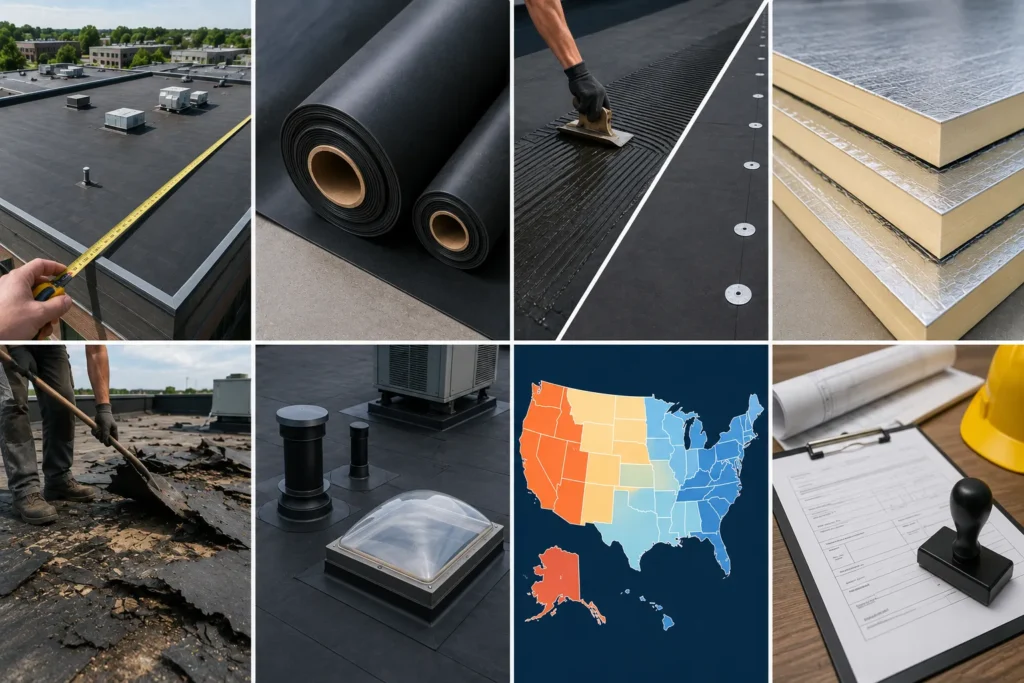
- Roof size — every 1,000 sq ft added drops the per-sq-ft cost by $0.50 to $2.00
- Membrane thickness — 90 mil costs 2× to 3× more in materials than 45 mil
- Attachment method — fully adhered adds $3 to $5/sq ft over ballasted
- Insulation depth — each inch of polyiso board adds $0.50 to $0.60/sq ft; northern US needs R-30, southern US needs R-25
- Tear-off — removing 1 existing layer adds $0.50 to $2.00/sq ft; 2+ layers add $1.50 to $3.00/sq ft
- Penetrations — each HVAC unit, vent pipe, or skylight adds $150 to $400 in flashing labor
- Regional labor — New York and San Francisco run 30 to 40% above national average; rural Midwest runs 10 to 20% below
- Permits — $400 in small towns to $1,700 in major cities; required in most US jurisdictions
DIY vs Professional — Real Numbers
DIY saves $2.50 to $7.00/sq ft in labor. The risk is real.
| DIY | Professional | |
| Materials | $1.50–$4.50/sq ft | Included in total |
| Labor | $0 (your time) | $2.50–$7.00/sq ft |
| 1,000 sq ft total | $1,500–$4,500 | $4,000–$13,000 |
| Workmanship warranty | None | 2–10 years |
Ballasted EPDM on a simple flat roof under 500 sq ft (46.5 m²) is the one viable DIY scenario — the membrane lays loose and seaming requires only tape overlap.
Any roof with penetrations, drains, parapet walls, or HVAC curbs needs a certified installer. One bad flashing causes $5,000 to $15,000 in interior water damage — that wipes out every dollar saved on labor.
5 Red Flags in a Contractor Quote
A legitimate EPDM quote lists membrane spec, insulation R-value, cover board, flashing footage, tear-off, and permit — separately. Watch for these 5 problems:
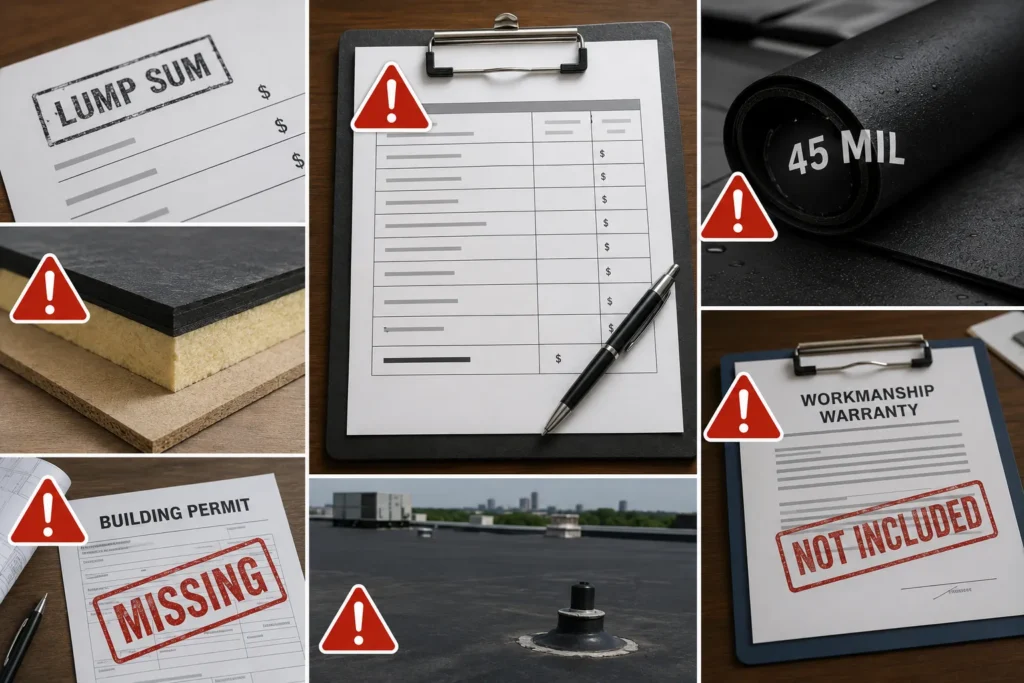
- Lump-sum pricing — no line items means no way to compare bids or spot substitutions
- No insulation spec — contractors skip insulation to win the bid; you pay for it in energy costs and failed inspections
- No permit mentioned — skipping permits voids most manufacturer warranties
- 45 mil quoted for a commercial roof — undersized membrane, shorter warranty, faster failure
- No workmanship warranty — manufacturer warranty covers material defects only; installation errors are not covered without a separate workmanship guarantee
Always ask: “Are you certified by the membrane manufacturer?” Carlisle, Firestone, GAF, and Johns Manville all certify installers for extended 20 to 30-year warranties unavailable through non-certified contractors.
EPDM Roofing Cost by Region — 2026
| Region | States | Installed Cost | vs. National Avg |
| Northeast | NY, MA, CT, NJ, PA | $9–$14/sq ft | +25 to +35% |
| Pacific Coast | CA, WA, OR | $8–$13/sq ft | +20 to +30% |
| Southeast | FL, GA, SC, NC | $6–$10/sq ft | 0 to +10% |
| Southwest | TX, AZ, NV, NM | $5–$9/sq ft | -5 to +5% |
| Midwest | IL, OH, MI, MN, WI | $5–$9/sq ft | -10 to 0% |
| South Central | OK, AR, MS, AL | $4–$8/sq ft | -15 to -5% |
| Mountain West | CO, UT, ID, MT | $6–$10/sq ft | 0 to +10% |
Northern states also carry higher insulation costs. Minnesota, Wisconsin, and Maine require R-30 insulation, adding $1.50 to $2.50/sq ft. Florida and Texas require R-25, adding $1.20 to $2.00/sq ft.
FAQs

Related Posts