Hardwood vs Engineered Wood Flooring: Which Should You Buy?
Choose solid hardwood for above-grade rooms over a wood subfloor where you want 6 to 10 refinishes across 50 to 100 years, and choose engineered wood flooring for concrete slabs, basements, radiant heat, or any room where relative humidity swings more than 20 percentage points a year. Looks rarely decide the outcome, since a sawn-face engineered oak plank and a solid oak plank are indistinguishable once installed and finished.
Treating hardwood vs engineered wood flooring as a quality question sends buyers in the wrong direction. Both products carry a real hardwood surface in oak, maple, hickory or walnut, and both can last half a century. What separates them is wear layer thickness in millimeters, subfloor type, grade level, installed cost per square foot, and species hardness. Those five specifications rule one option out before you reach a showroom.
How Hardwood And Engineered Flooring Are Built
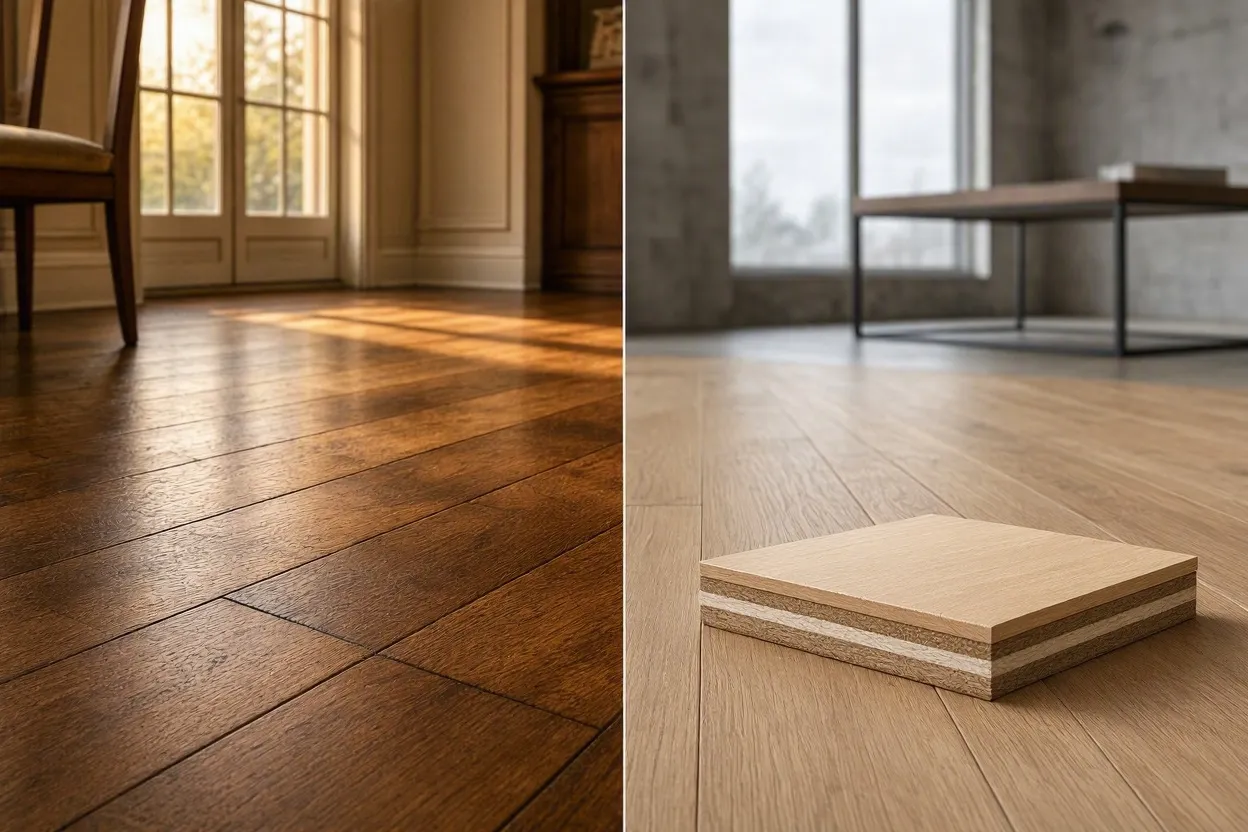
Solid hardwood is one piece of wood milled to 3/4 inch (19mm) thickness, while engineered wood flooring bonds a real hardwood face to a cross-laminated core of plywood or high-density fiberboard (HDF). That structural difference drives every performance gap between the two hardwood flooring options.
How Solid Hardwood Flooring Is Built
Solid hardwood planks are sawn from a single timber and milled with a tongue on one edge and a groove on the other. Standard planks run 3/4 inch (19mm) thick and 2-1/4 inches (57mm) wide, in random lengths from 12 to 84 inches (305mm to 2,134mm). Because the board is one uniform piece, it expands and contracts as a whole. A 15-foot (4.6m) run of red oak can move roughly 1/4 inch (6mm) across the grain between a dry February and a humid August, which is why installers leave expansion gaps at every wall.
Wider planks amplify that movement. Solid hardwood above 5 inches (127mm) wide usually needs glue assist alongside nailing, and many manufacturers void warranties on wide solid hardwood planks installed over anything but a properly acclimated wood subfloor.
How Engineered Wood Flooring Is Built
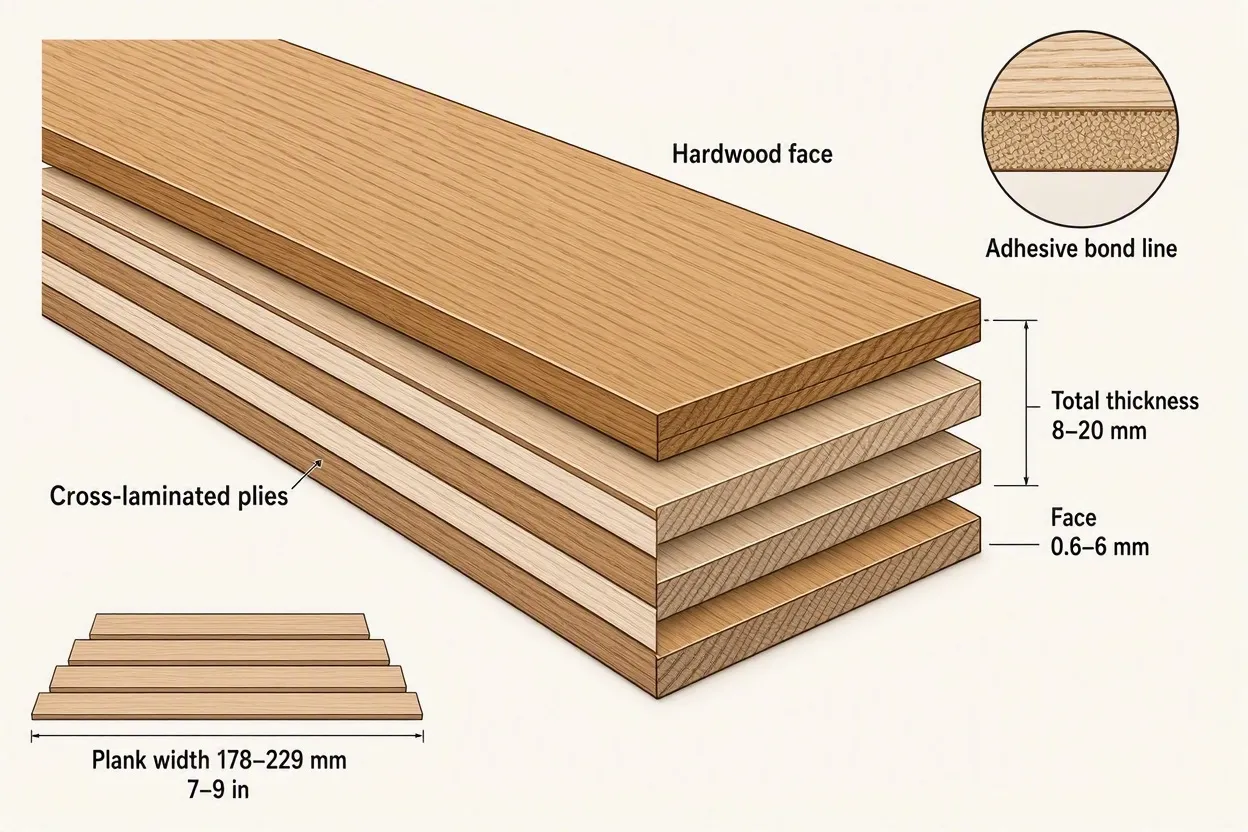
Engineered wood planks stack three to twelve plies, each rotated 90 degrees against the one below, then bond a hardwood face to the top. Cross-lamination cancels out most seasonal movement because adjacent layers pull against each other. Total plank thickness ranges from 8mm to 20mm (5/16 inch to 3/4 inch), with the face layer running anywhere from 0.6mm to 6mm.
Engineered boards also come wider. Plank widths of 7 to 9 inches (178mm to 229mm) are routine in engineered wood construction and rare in solid, which matters if you want the wide-plank look that’s dominated interior design for the past decade.
Why Wear Layer Thickness Matters Most
The wear layer, meaning the millimeters of real hardwood above the core, determines refinishing life, and a 6mm engineered floor outperforms a thin-veneer engineered floor by a wider margin than solid hardwood outperforms engineered wood as a category. Two planks both labeled “engineered oak” can differ by a factor of ten in how much sandable wood they contain.
Wear Layer Thickness And Refinishing Life
The National Wood Flooring Association (NWFA) publishes a 2.5mm (3/32 inch) sanding threshold: below that figure, the association’s Sand and Finish Guidelines advise against sanding a hardwood floor at all. Every refinishing pass removes roughly 0.5mm to 1mm of wood, so the math is straightforward.
| Wear Layer | Refinishing Passes | Realistic Lifespan |
| Under 1mm (3/64 in) | None, screen and recoat only | 15 to 25 years |
| 2mm (5/64 in) | 1, and below the NWFA threshold | 30 to 40 years |
| 3mm (1/8 in) | 2 to 3 | 40 to 50 years |
| 4mm (5/32 in) | 3 to 4 | 50 to 80 years |
| 6mm (15/64 in) | 5 or more | 80 to 100 years |
| Solid 3/4 in (19mm) | 6 to 10 | 50 to 100 years |
NWFA sets separate minimums for its refinishable designation: 3.2mm (4/32 inch) for unfinished smooth flooring and 2.5mm (3/32 inch) for factory-finished smooth flooring. Sculpted and distressed products must hold 2.5mm at the lowest point of the texture, since sanding a hand-scraped hardwood floor erases the scraping.
A 4mm engineered hardwood floor and a 3/4 inch solid floor land in the same ownership bracket. A 1.2mm engineered floor from a big-box clearance aisle is a finish-life product, and buying one while expecting to refinish it in 2045 is the single most common mistake in this category.
How To Find Wear Layer Thickness Before You Buy
Manufacturer spec sheets list the figure in millimeters, though marketing copy often buries it. Terms like “premium,” “heavy duty,” and “commercial grade” carry no defined thickness. Ask the retailer for the wear layer thickness number in millimeters, and walk away from any product where nobody can produce it.
For a hardwood floor already installed, pull a vent cover or remove a threshold and look at the exposed plank edge. The face layer reads as continuous grain above a visibly laminated core, and a caliper gives you the measurement in under a minute.
Subfloor
Engineered wood flooring installs over concrete, plywood, oriented strand board (OSB) and existing floors, while solid hardwood requires a wood subfloor and above-grade placement. Diagnose what’s underneath before you shortlist products, because the subfloor eliminates options faster than budget does.
Grade Level Rules Out One Option Fast
Builders classify floor levels three ways, and the classification is a hard gate for hardwood flooring installation:
- Below Grade: any floor sitting below surrounding soil, including finished basements. Solid hardwood is not approved here by any major manufacturer. Engineered wood flooring is.
- On Grade: ground-floor rooms built on a slab. Engineered wood flooring installs with glue-down or floating methods. Solid hardwood requires a sleeper system or a plywood overlay, which adds 3/4 inch to 1-1/2 inches (19mm to 38mm) of height and $2 to $5 per square foot.
- Above Grade: second floors and any level above the surrounding ground. Both hardwood flooring products work.
A 1970s ranch on a slab, a condo on the fourth floor, and a walk-out basement all point the same direction, and the answer isn’t solid hardwood.
How To Test A Concrete Slab Before Installing
Concrete releases moisture vapor for years after pouring, and a slab that looks bone dry can still destroy a hardwood floor. Two ASTM tests settle the question. ASTM F1869 measures moisture vapor emission rate (MVER) with a calcium chloride kit, and most manufacturers cap acceptance at 3 pounds per 1,000 square feet per 24 hours. ASTM F2170 uses in-situ relative humidity probes drilled to 40 percent of slab depth, with typical limits between 75 and 85 percent RH depending on the adhesive.
A test kit runs $30 to $60 and takes 72 hours. Skipping the test and gluing engineered hardwood planks to a wet slab produces adhesive failure and hollow-sounding boards within 18 months, and no warranty covers the outcome.
Hardwood Floor Costs Explained
Solid hardwood runs $11 to $25 per square foot installed, while engineered wood flooring runs $9 to $20 per square foot installed, with premium wide-plank European oak pushing past $30. Comparing material prices alone distorts the picture, since site-finishing solid hardwood adds $2 to $7 per square foot that engineered wood flooring never incurs.
Here’s how the hardwood floor types break down for a 500 square foot (46.5 m²) space:
| Line Item | Solid Hardwood | Engineered Wood Flooring |
| Materials Per Sq Ft | $6 to $1 | $6 to $12 |
| Labor Per Sq Ft | $5 to $10 | $3 to $8 |
| Site Finishing | $2 to $7 | Included (Factory Finished) |
| Total Installed, | $5,500 to $12,500 | $4,500 to $10,000 |
Labor favors engineered wood flooring because floating click-lock systems install roughly twice as fast as blind-nailed tongue-and-groove hardwood. A capable homeowner can float an engineered floor and save $3 to $5 per square foot, though glue-down and nail-down hardwood installations demand tools and experience that push most projects toward a professional.
Where The Hidden Costs Land
Four line items appear on final invoices and almost never on advertised per-square-foot prices:
- Tear-Out And Disposal: $0.09 to $1.55 per square foot, with tile and glued-down hardwood at the top of that range and carpet at the bottom.
- Subfloor Repair: squeaking joists, cupped plywood and out-of-level slabs add $1 to $4 per square foot before a single hardwood plank goes down.
- Waste Allowance: order 10 percent over your measured square footage for straight-lay patterns and 15 percent for herringbone, chevron or diagonal layouts, since angled cuts generate more offcuts.
- Stairs: each tread, riser and nosing needs individual fitting, at $40 to $120 per step, and your main-floor square-foot rate doesn’t apply.
Cost Per Year Of Ownership
Price per year exposes value that price per square foot hides. A $14 per square foot engineered floor with a 4mm wear layer, lasting 50 years, costs $0.28 per square foot annually. A $6 per square foot hardwood floor with a 1.2mm veneer, replaced at year 18, costs $0.33 per square foot annually before you pay to tear out and reinstall.
Solid hardwood at $18 per square foot installed, running 80 years across three refinishes at $4 per square foot each, works out to $0.60 per square foot per year. The premium is real, and it buys a floor your grandchildren can sand.
Durability: Humidity, Pets And Traffic
Engineered wood flooring wins on humidity stability and factory finish hardness, while solid hardwood wins on damage recovery because deep scratches sand out instead of exposing a plywood core. Neither hardwood construction type beats the other on scratch resistance, since surface hardness tracks species, not build.
Humidity And Dimensional Movement
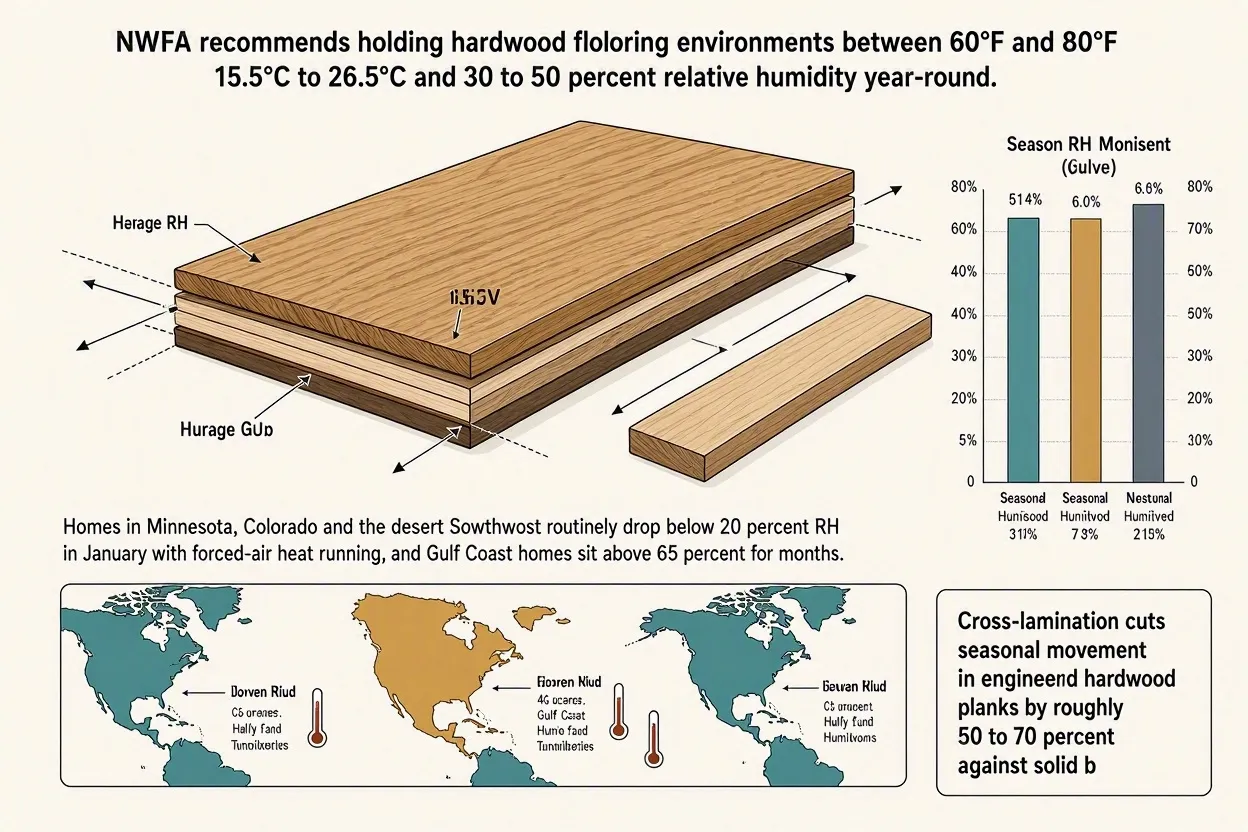
NWFA recommends holding hardwood flooring environments between 60°F and 80°F (15.5°C to 26.5°C) and 30 to 50 percent relative humidity year-round. Homes in Minnesota, Colorado and the desert Southwest routinely drop below 20 percent RH in January with forced-air heat running, and Gulf Coast homes sit above 65 percent for months.
Cross-lamination cuts seasonal movement in engineered hardwood planks by roughly 50 to 70 percent against solid boards of the same width. In a house that swings from 18 percent RH in winter to 62 percent in summer, solid hardwood develops visible gaps between boards each January and closes them by July. Engineered hardwood planks move too, just far less, and a whole-house humidifier costing $400 to $900 solves most of the problem for either hardwood product.
Species Hardness Beats Construction Type For Dents
The Janka hardness scale measures the force needed to embed a steel ball halfway into a wood sample, and it applies identically to a solid plank and an engineered hardwood face layer:
| Species | Janka Rating |
| Heart Pine | 690 |
| American Walnu | 1,010 |
| Red Oak | 1,290 |
| White Oak | 1,360 |
| Hickory | 1,820 |
| Brazilian Cherry | 2,350 |
A household with two 70-pound dogs gets more protection from hickory at 1,820 than from any choice between solid and engineered hardwood construction. Walnut at 1,010 dents under a dropped can of soup whether the plank is solid or engineered, so households prioritizing dent resistance should filter by species first and construction second.
Engineered Hardwood Quality Tiers
No. Engineered wood flooring spans three quality tiers set by veneer cutting method and core material. Sawn-face veneers are cut with a saw blade exactly like solid lumber, yielding full natural grain at 3mm to 6mm. Rotary-peeled veneers are shaved off a spinning log, producing thin 0.6mm to 2mm faces with a repeating wavy grain that reads artificial under raking light. Sliced-face veneers sit between the two.
Core material decides dimensional stability and water tolerance. Multi-ply plywood cores of 7 to 12 birch or poplar plies hold flattest and grip fasteners best, HDF cores cost less but swell permanently once water reaches an edge, and stone-plastic composite (SPC) cores carry waterproof ratings while feeling harder underfoot. Ask how the veneer was cut and what the core contains. Those two answers separate a $4 per square foot engineered floor from a $16 per square foot engineered floor.
Resale Value: Hardwood vs Engineered
Both hardwood flooring types add resale value, and appraisers rarely distinguish between the two once installed. An engineered oak floor with a 4mm wear layer presents identically to solid oak at a walkthrough.
Solid hardwood keeps a modest prestige edge in 1920s housing stock across Northeast and Midwest markets, though that edge surfaces in listing language more than appraised value. Thin veneers cost sellers: a 1mm hardwood face with worn traffic lanes and no refinishing option reads as deferred maintenance, and buyers price replacement into offers.
Continuous hardwood flooring across the main level matters more than construction type. Engineered wood flooring makes that continuity affordable in slab-built homes where solid hardwood can’t go.
When To Skip Wood Flooring Entirely
Skip both hardwood flooring products in full bathrooms, laundry rooms, mudrooms with exterior doors, and basements with any history of water intrusion. Hardwood flooring tolerates humidity, and standing water destroys it regardless of construction.
Three alternatives handle those rooms properly:
- Porcelain Tile: fully waterproof, works over concrete, available in wood-look planks with realistic texture at $8 to $20 per square foot installed.
- Luxury Vinyl Plank (LVP): waterproof core, warmer and quieter underfoot than tile, installs over almost any flat substrate at $4 to $12 per square foot installed.
- Sheet Vinyl: seamless across an entire room, which matters in laundry rooms where a supply line can let go at 3 a.m., at $3 to $7 per square foot installed.
A basement that flooded once will flood again. Spending $9,000 on engineered oak hardwood flooring in that room means spending it twice.
Five Signs Of Installation Failure
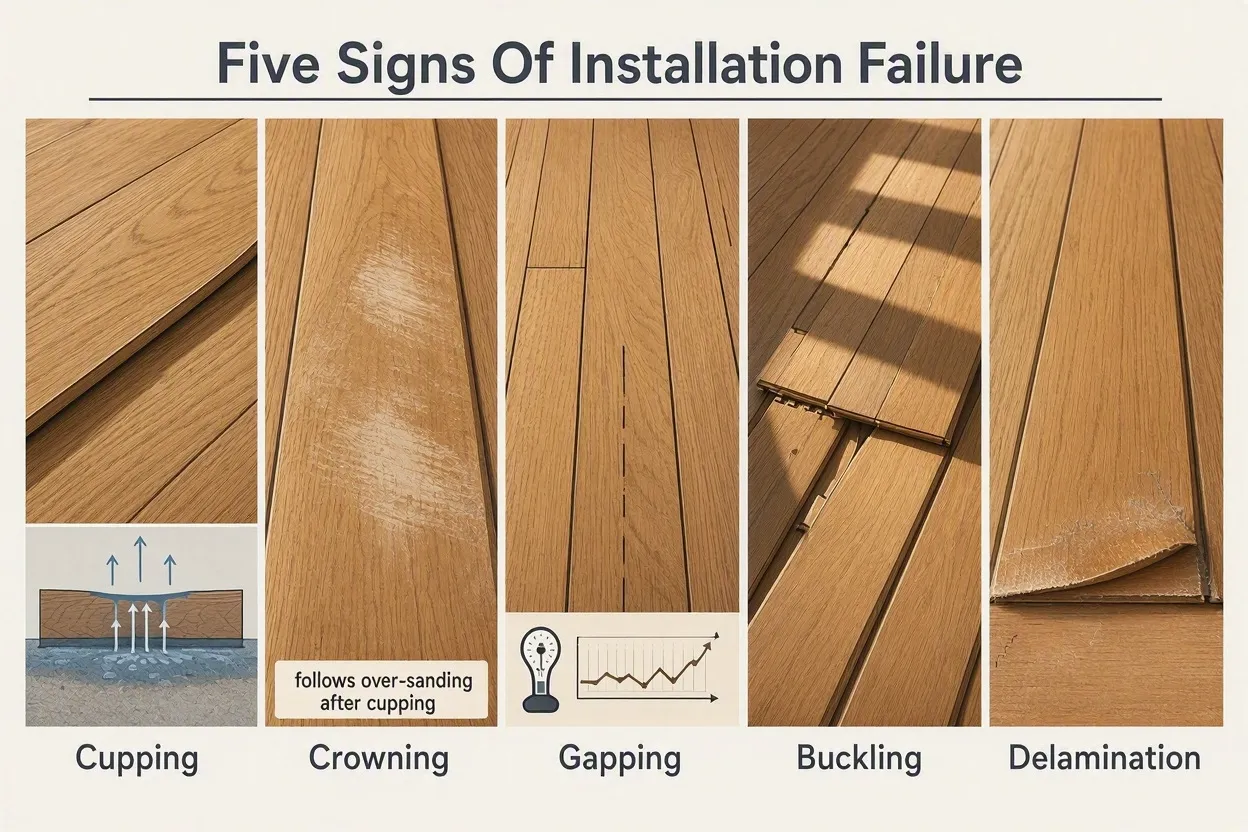
Five visible symptoms indicate hardwood flooring installation or environmental failure rather than normal wear, and catching them early determines whether a warranty claim succeeds:
- Cupping: board edges rise above the center, indicating moisture entering from below through an untested slab or a crawlspace without a vapor barrier in your hardwood flooring.
- Crowning: board centers rise above the edges, which typically follows sanding a cupped hardwood floor before the moisture source was corrected.
- Gapping: visible seams between boards in dry months, caused by hardwood installation at high moisture content or a house held below 30 percent RH.
- Delamination: the wear layer separates from the core on engineered hardwood planks, pointing to adhesive failure or sustained water exposure.
- Telegraphing: subfloor seams or fastener heads showing through the finished hardwood floor, meaning the subfloor wasn’t flattened to the required tolerance of 3/16 inch over 10 feet (5mm over 3m).
Photograph the symptom, record indoor temperature and relative humidity daily for two weeks with a $15 hygrometer, and contact the manufacturer before anyone sands anything. Warranty claims turn on documentation of the in-home environment, and NWFA-certified inspectors are the party manufacturers send to adjudicate hardwood flooring disputes.
Conclusion
Work the hardwood flooring decision in order and hardwood vs engineered wood flooring resolves itself for most homes. Subfloor and grade level come first, since a concrete slab or below-grade basement eliminates solid hardwood and leaves engineered wood flooring as the only approved hardwood option, radiant heat included. Set a wear layer thickness minimum of 3mm or thicker to protect refinishing life past 2045, pick the species by Janka rating, choosing hickory at 1,820 for dogs and children or walnut at 1,010 for a quiet adult household, then price the full installed cost per square foot, counting tear-out, subfloor repair, 10 percent waste and stairs.
A 4mm sawn-face white oak engineered hardwood floor over a tested slab and a 3/4 inch solid white oak hardwood floor over plywood will both look correct in 2060, and both hold resale value equally at a walkthrough. The hardwood floor that fails is the one installed on the wrong substrate at the wrong moisture content, in a house running outside 30 to 50 percent relative humidity. Wood subfloors should read 6 to 9 percent, within 4 percentage points of the hardwood flooring itself, on a $45 moisture meter the day before installation.
FAQs

Related Posts