How to Build a Stone Wall: A Complete Step-by-Step Guide
To build a stone wall, dig a trench below the local frost line, compact a gravel base, then stack stones from largest to smallest in level courses, tilting each face slightly inward so gravity holds the structure together. This inward lean is called batter, and it’s the single detail that separates a wall that lasts fifty years from one that falls over after its first hard winter. Freestanding walls and retaining walls follow different rules for drainage and thickness, so the right method depends on what the wall needs to do. The sections below cover foundation depth, stone selection, tools, cost, and the mistakes that cause most amateur walls to fail.
What Is a Stone Wall Foundation and Why Does It Matter?
A stone wall foundation is the buried base layer of gravel and large stones that spreads the structure’s weight and stops frost from pushing it out of alignment. Skip it, and a wall built straight on topsoil will lean within two or three winters as the ground beneath it freezes, expands, and thaws. Two problems account for most foundation failures: frost heave and poor drainage. Water that pools under a wall freezes in winter, expands by roughly 9%, and lifts sections of stone unevenly, cracking joints that took hours to fit. A properly dug and compacted foundation removes both risks at once.
How to Build a Stone Wall Foundation (Step-by-Step)
To build a stone wall foundation, dig a trench below the frost line, add a compacted gravel base, and set your largest stones directly on top of it. Follow these six steps in order:
- Mark the wall’s outline with stakes and mason’s line, keeping the string dead straight.
- Dig a trench at least twice as wide as your finished wall and deep enough to clear the local frost line.
- Remove roots, loose soil, and any buried debris from the trench floor.
- Spread 2 to 4 inches (5 to 10 cm) of crushed gravel across the bottom.
- Compact the gravel in layers using a plate compactor, working in 2-inch (5 cm) lifts.
- Lay your heaviest, flattest stones on the compacted base with the best face turned outward.
A trench dug on sloped ground needs to be stepped, not angled, or water will channel along the base and undermine one end of the wall within a single rainy season.
What Tools and Materials Do You Need to Build a Stone Wall?
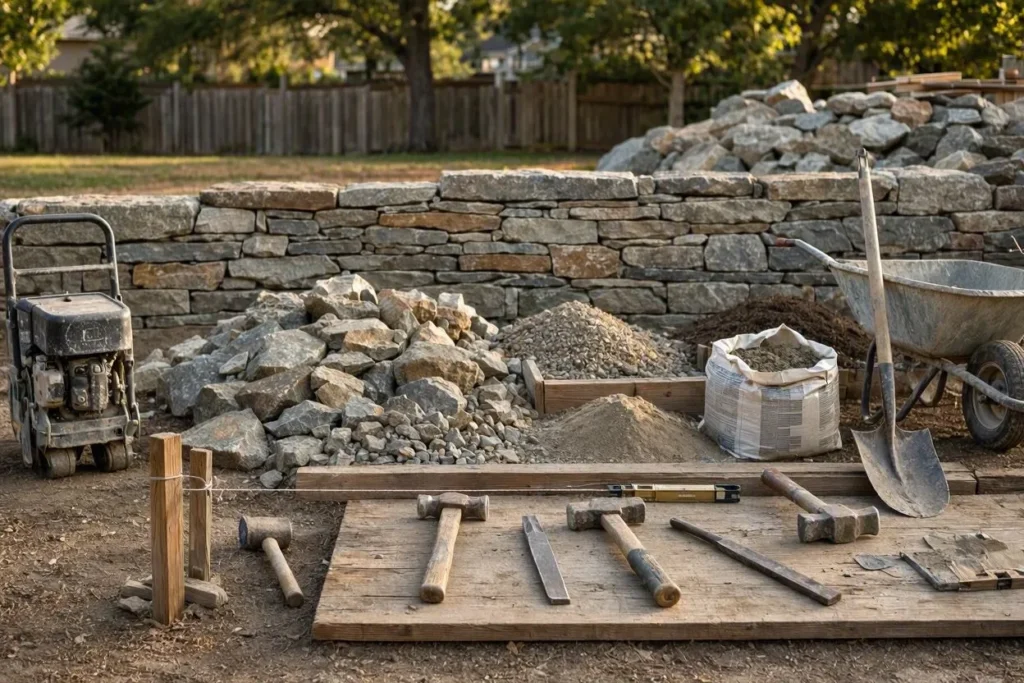
You need nine core tools and five core materials to build a stone wall properly. Buying or renting the right gear before you start saves hours of improvising mid-project.
Tools
- Mason’s hammer for tapping stones into place
- Stone chisel and 4-lb (1.8 kg) hand sledge for splitting and shaping
- Mason’s line and line level for keeping courses straight
- Wooden stakes to anchor the string
- Plate compactor for the gravel base
- Long-handled shovel and cutting spade for the trench
- Wheelbarrow for moving stone and gravel
- Steel-toe boots, leather gloves, and eye protection
- Angle grinder with a diamond blade, for cutting stubborn stones
Materials
- Wall stone (fieldstone, flagstone, granite, limestone, or sandstone)
- Crushed gravel or road base for the foundation
- Stone dust or fine gravel for chinking gaps
- Landscape drain pipe, if you’re building a retaining wall
- Mortar and sand, only if you’ve chosen a mortared build
How to Choose the Right Stone for Your Wall
Choose flat, tabular stone such as fieldstone, flagstone, or sedimentary limestone for the easiest build, since flat surfaces stack and lock together with far less trimming than rounded stone. Three sedimentary types split cleanly and stack well: limestone, sandstone, and slate. Granite and other igneous stone hold up longer against weather, but their rounded shape demands more chiseling and patience. If your property already has loose fieldstone scattered across it, use that first; sourcing local stone costs nothing beyond your own labor. Buying stone by the ton runs cheaper than buying by the piece, and a reputable stone yard can estimate tonnage once you give them the wall’s length, height, and thickness.
Dry Stone Wall vs. Mortared Wall: Which Should You Build?
Build a dry stone wall for a freestanding garden or boundary wall under about 4 feet (1.2 m), and switch to a mortared wall if the structure needs to retain heavy soil, support a building, or exceed your local height limit without an engineer’s sign-off. Dry stone construction relies entirely on gravity, weight distribution, and precise stacking, with no binding agent at all. Mortared walls use a cement-based bond that adds rigidity but also traps water behind the face if drainage isn’t planned in advance. Freeze-thaw cycles favor dry construction, because a dry wall flexes slightly with the ground instead of cracking. Warmer, drier climates tolerate mortared walls with fewer maintenance issues over time.
How to Build a Freestanding Stone Wall
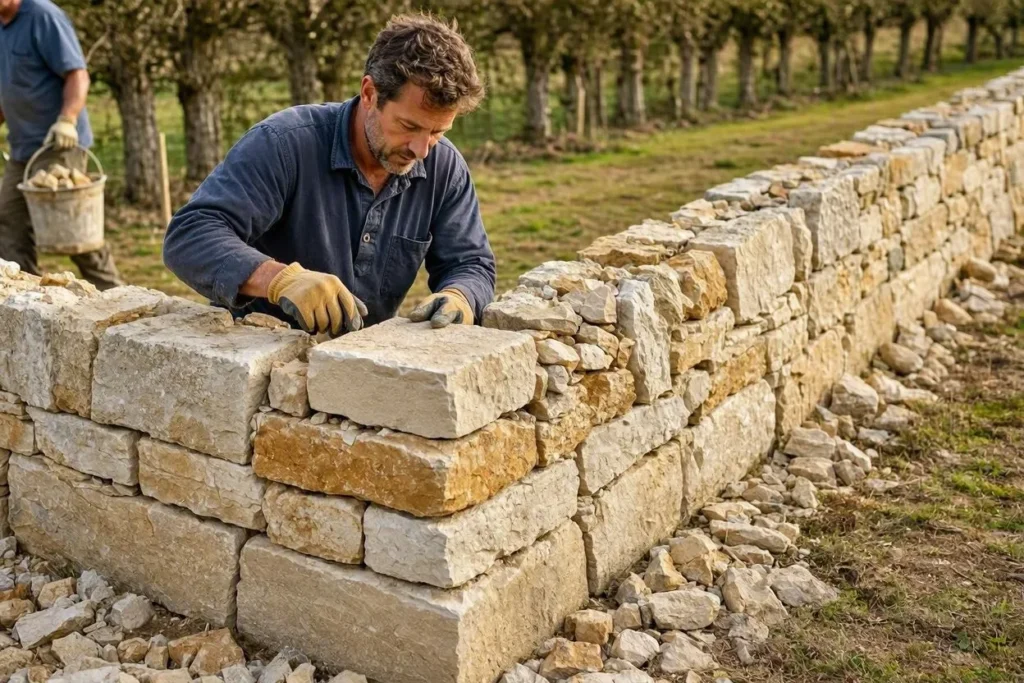
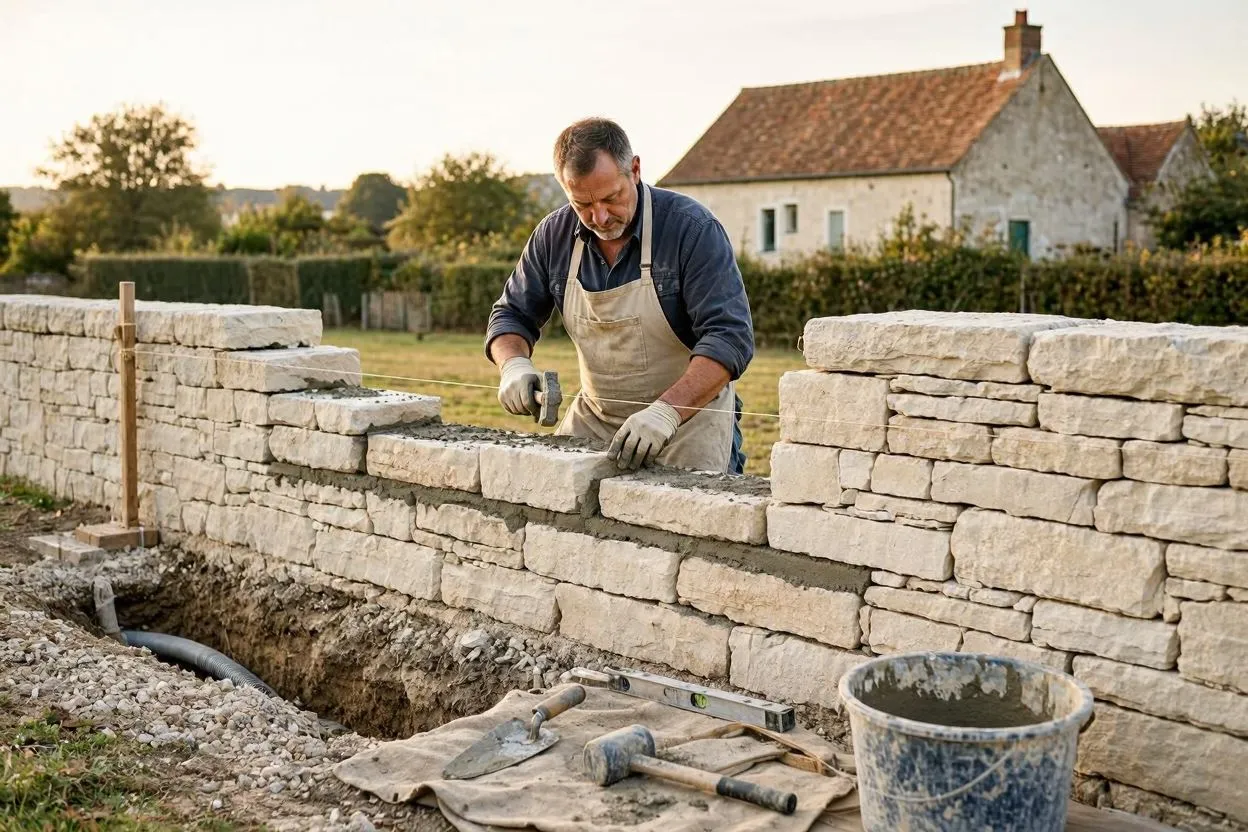
To build a freestanding stone wall, lay two parallel faces of stone that lean slightly toward each other, filling the gap between them with smaller rubble and rock. Work through these stages:
- Set corner stones first, using the largest, most rectangular pieces you have.
- Lay the base course along both faces, largest stones down, best side facing out.
- Fill the core between the two faces with fist-sized rubble as you go, never leaving the middle hollow.
- Stagger every joint so no stone sits directly above the seam of two stones below it.
- Repeat the process course by course, checking batter with a line level every few rows.
- Cap the finished wall with your heaviest, flattest stones, set tight and level.
A wall built this way, roughly 18 to 24 inches (46 to 61 cm) wide at the base, will comfortably reach 3 to 4 feet (0.9 to 1.2 m) in height without engineering input in most US states and UK regions.
How to Build a Stone Retaining Wall
To build a stone retaining wall, install drainage behind the stone before you backfill, since trapped water is the single most common cause of retaining wall failure. Dig a trench at least twice the width of your stone and lay 2 inches (5 cm) of gravel per lift, compacting as you go. Set a perforated drain pipe along the base, sloped toward a safe outlet, then line the soil side of the trench with geotextile fabric. Backfill behind each course with 3/4-inch (19 mm) clear gravel rather than native soil: gravel drains freely and soil doesn’t. Bury roughly 2 inches of wall height per foot of total height, and set every course back about a 1/4 inch (6 mm) from the one below it. Weep holes spaced every 3 to 6 feet (1 to 2 m) along the base give trapped water somewhere to escape besides pushing the wall forward.
What Is Wall Batter and How Do You Get It Right?
Wall batter is the slight inward lean built into both faces of a stone wall so gravity pulls each stone toward the center of the structure instead of outward. To get batter right, aim for roughly 1 inch of inward lean for every 12 inches of wall height, or about a 15-degree angle from vertical. A straight, plumb wall looks tidy on day one, but frost heave and settling will eventually tip it outward, because nothing holds the top course in place except its own weight. Batter boards, a simple wooden jig set at your target angle, let you check every course without guesswork. Skilled wallers often eyeball batter after enough practice, but beginners should check it against a board or angle gauge every two or three courses.
How Deep Should a Stone Wall Foundation Be? (US and UK Frost Line Guide)
A stone wall foundation should sit at least 12 inches (30 cm) deep in mild climates, and as deep as 42 to 48 inches (107 to 122 cm) or more in the coldest northern US states, while UK garden walls generally require a minimum of 450 mm (18 inches) below finished ground level. Frost depth varies sharply by region, so digging to a fixed number without checking local data is a common beginner error.
| Region | Typical minimum foundation/frost depth |
| Florida, Hawaii, Gulf Coast (US) | 0 to 12 inches (0 to 30 cm) |
| Mid-Atlantic and Central US | 30 to 36 inches (76 to 91 cm) |
| Northeast and Upper Midwest (US) | 42 to 60 inches (107 to 152 cm) |
| Minnesota, North Dakota (US) | 75 to 80 inches (191 to 203 cm) |
| UK, sandy or gravel soil | 300 to 450 mm (12 to 18 inches) |
| UK, firm clay | 450 to 600 mm (18 to 24 inches) |
| UK, shrinkable clay (London, Oxford areas) | 750 mm to 1.0 m (30 to 39 inches) |
If your property sits on shrinkable clay or near mature trees, dig deeper than the regional minimum. Root activity and soil movement push the effective frost line further down. Local building departments in the US and Building Control officers in the UK can confirm the exact figure for your postcode or zip code before you break ground.
How to Lay Courses, Corners, and Capstones
To lay courses correctly, follow the one-over-two, two-over-one rule: every stone should bridge the joint of the two stones beneath it, never sitting directly above a single seam. This staggering eliminates vertical run, a continuous seam running through several courses that weakens the whole structure. Corners carry more stress than any other section, because wind and frost pull at them from two directions instead of one, so reserve your squarest, heaviest stones for these spots and tie alternating courses into both walls that meet there. Capstones, called coping stones in the UK, finish the top course and protect everything below from rain penetration. Choose the largest, flattest stones you have for capping, set them tight against each other, and fill any remaining gaps with stone dust brushed into the joints.
How Much Does It Cost to Build a Stone Wall?
Building a stone wall costs between $45 and $200 per square foot in the US, averaging around $5,025 for a typical residential project, while UK dry stone and retaining wall work generally runs £100 to £500 per square metre depending on wall type and region. A DIY dry-stack wall using stone you source yourself costs far less, often $10 to $30 per square foot for gravel, stone dust, and rented tools alone. Professionally installed dry-stack retaining walls run $20 to $85 per square foot in the US, with labor making up the largest share of that range. Four factors drive the final price the most: wall height, stone type, site accessibility, and whether the project needs engineering approval. A 50-foot (15 m) retaining wall between 2 and 4 feet tall commonly lands in the $3,800 to $8,800 range once labor and materials are both included.
How Long Does It Take to Build a Stone Wall?
An experienced stone waller lays roughly 10 to 16 square feet (1 to 1.5 square meters) of finished wall per day, while a first-time builder should expect 3 to 5 square feet (0.3 to 0.5 square meters) in that same time. Sourcing and sorting stone before construction begins often takes longer than the actual stacking, especially if you’re pulling fieldstone from your own property rather than buying pre-sorted pallets. A 30-foot (9 m) garden wall, 3 feet (0.9 m) tall, typically takes a beginner one to two weekends once the foundation trench is already dug. Weather slows the timeline further: wet or frozen ground makes trenching and compacting far harder than working in dry conditions.
What Safety Precautions Should You Take?
Wear steel-toe boots, leather gloves, and eye protection every time you handle stone, since crushed toes and eye injuries account for most reported stone-wall injuries. Six precautions matter most on a wall-building site:
- Lift with your legs and never bend at the waist over a heavy stone.
- Roll or slide rocks larger than you can comfortably lift while seated, using a ramp or lever instead.
- Position yourself behind a stone and push with your legs when force is unavoidable.
- Keep the work area clear of tripping hazards like loose rubble and tool cords.
- Check for underground utilities before digging any trench deeper than 12 inches (30 cm).
- Pace the work. Muscle strain from overexertion causes more lost work time than any single dropped stone.
If you’re using a grinder or masonry saw to cut stone, add a dust mask and hearing protection to that list: both tools generate fine silica dust and sustained noise that build up over a full day of cutting.
Common Mistakes to Avoid When Building a Stone Wall
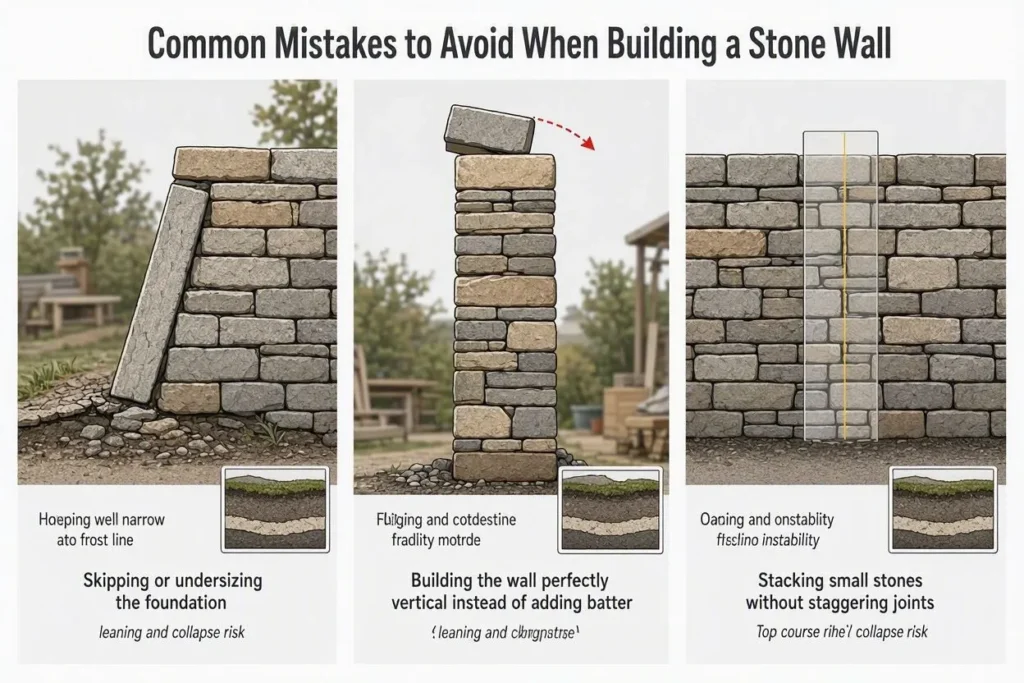
The most common mistake is skipping or undersizing the foundation, which causes the majority of amateur stone walls to lean or collapse within a few years. Five other mistakes show up just as often:
- Building the wall perfectly vertical instead of adding batter, which invites the top course to tip outward over time.
- Stacking small stones directly on top of each other without staggering joints, creating a vertical run that splits the wall apart.
- Skipping drainage behind a retaining wall, which lets trapped water freeze, expand, and push the entire structure forward.
- Using rounded stone for a wall’s face, because round stones roll under load instead of locking together.
- Rushing corners and ends, the two points where a wall is under the most stress and needs its strongest stones.
Each of these mistakes is preventable at the planning stage, and every one of them costs far more to fix after the wall is built than it does to avoid from the start.
Conclusion
A stone wall built on a proper foundation, with correct batter and staggered joints, will outlast the person who built it by a century or more. The technique hasn’t changed much since farmers first cleared fields by hand, and the same rules that kept those walls standing still apply today: dig below the frost line, keep water moving away from the stone, and let gravity do the work.
FAQs

Related Posts