How To Paint Concrete: A Complete Step-by-Step Guide
Painting concrete is a great way to refresh floors, patios, driveways, and walls, but the results only last if you prep the surface correctly first. Concrete looks solid. It isn’t. Underneath, it’s porous, and skip the prep work and paint peels within a year. Get the surface right and pick the correct paint type, though, and a concrete surface can stay protected for a decade or more. This guide walks through every stage, from cleaning and etching to picking the right product for walls versus floors versus patios, along with the cost, timing, and maintenance details a lot of guides leave out.
Can You Paint Concrete?
Yes, as long as you clean, repair, and etch the surface before applying primer. Concrete takes paint well because its surface has microscopic pores that let coatings grip, once those pores have actually been opened up. Skip that step and the paint just sits on top instead of bonding, which is why so many DIY concrete paint jobs fail within a couple of years.
Moisture is the real enemy here. Water trapped beneath a paint film causes blistering, blistering leads to flaking, and a properly prepped surface avoids nearly all of it.
Indoor and outdoor concrete behave differently once painted, too. A basement floor sits in a fairly stable environment, so failures there usually trace back to moisture rising up from below the slab. A patio deals with rain, frost, and direct sun, all of which stress a paint film in different ways. Knowing which category your project falls into changes which product and which prep steps matter most.
Why Paint Concrete in the First Place?
Painting concrete does more than change its color. A painted floor resists oil, grease, and chemical stains far better than bare concrete, which soaks up everything it touches. Painted walls pick up a layer of weather resistance that cuts down on water absorption, and painted patios and driveways hide surface imperfections like old stains, minor spalling, or uneven coloring from patch repairs.
There’s a resale angle here as well. A driveway or patio with peeling, chipped paint tells a buyer the place hasn’t been maintained, while a properly coated surface reads as cared for. None of that shows up, though, if the job itself was rushed or under-prepped.
What You Need Before You Start
Gather these before you begin:
- Concrete etching solution or muriatic acid cleaner
- Concrete primer (masonry or epoxy-based, depending on the surface)
- Concrete or masonry paint
- Long-pile roller and paintbrush
- 120-grit sandpaper
- Concrete filler or patching compound
- Stiff-bristle broom
- Pressure washer or garden hose
- Masking tape and plastic sheeting
- Rubber gloves, safety goggles, and a respirator mask
- A moisture-testing kit or plastic sheeting for a DIY moisture check
Skip any of these and it tends to show up later as an uneven finish or paint that peels early. A pressure washer, for instance, removes ground-in grease that a garden hose won’t touch, and leftover grease is one of the most common reasons paint won’t stick to a garage floor.
How To Prepare Concrete for Painting
Surface prep is what decides whether paint bonds for years or peels off within months.
Clean the Surface
Sweep away loose debris, then pressure-wash the concrete at 3,000 PSI (pounds per square inch) to strip off dirt, grease, and old coatings. Grease sits inside the pores of concrete and blocks paint from bonding, so a degreasing detergent works better than plain water on garage floors and driveways. Let the surface dry fully. Concrete can look dry on top while still holding moisture a few millimeters down, so give it at least 24 hours in warm weather and up to 48 hours if it’s cooler or humid.
Repair Cracks and Holes
Fill anything wider than 1/8 inch (3 millimeters) with a concrete patching compound, then sand the patched areas flush once cured. Leave hairline cracks in a driveway unfilled and they’ll telegraph straight through the new paint layer within a season. Wider structural cracks need a polyurethane or epoxy filler instead of a standard patching compound, since those flex slightly as the slab expands and contracts with temperature.
Test for Moisture
Tape an 18-inch by 18-inch (46-centimeter by 46-centimeter) sheet of plastic to the concrete and leave it for 24 hours. Condensation underneath, or darker patches on the surface, both mean the slab is holding too much moisture for paint. Contractors call this a “plastic sheet” test, and the American Society for Testing and Materials (ASTM) publishes a more rigorous calcium chloride version under ASTM F1869 for high-stakes commercial floor coatings. You don’t need lab-grade accuracy for a patio repaint, but skipping the moisture check entirely is one of the fastest ways to end up with peeling paint a year later.
Etch the Concrete
Mix an etching solution at a 1-to-4 ratio with water, apply it evenly, then scrub with a stiff broom and let it sit for 10 to 15 minutes without drying out. Rinse thoroughly and let the surface dry completely before moving to primer. This step opens up the concrete’s pores so paint has something to grip, and it’s the single most skipped step in DIY concrete painting. Muriatic acid works as an alternative to commercial etching solutions, but it needs more careful handling: always add acid to water, never water to acid, and wear gloves, goggles, and a respirator while mixing.
How To Choose the Right Paint for Concrete
Walls, floors, and patios each need a different product, and treating all concrete surfaces the same is probably the most common reason paint jobs fail early.
Concrete Walls
Masonry paint works best on vertical concrete because it resists rain and frost while still letting trapped moisture escape. A low-breathability paint traps water inside instead, and that trapped water causes blistering within a few years no matter how well the surface was prepped. If the wall faces direct sun and rain year-round, look for masonry paint rated for at least 15 years of exterior weathering.
Concrete Floors and Garages
Epoxy paint, or a two-part epoxy coating, holds up far better than standard latex on garage floors, basements, and interior slabs. These coatings resist abrasion, chemical spills, and heavy foot traffic in ways ordinary paint just can’t. An elastomeric coating is worth considering on floors with existing hairline cracking, since it bridges small gaps instead of cracking along with them. Skip the cheap water-based floor paints from a big-box store if the garage sees daily vehicle traffic. Those formulas shrink over time and usually need reapplication within 2 to 3 years.
Patios, Driveways, and Steps
Exterior floor paint with anti-slip additives is the right call for patios, driveways, and steps, not masonry paint. Masonry paint isn’t built for standing water or constant foot traffic, and it typically peels on a patio within one to two years. If you’re painting in California or another state with strict air-quality rules, look for products labeled low-VOC (volatile organic compound), since some standard formulas don’t meet CARB (California Air Resources Board) compliance. Steps need extra attention to slip resistance, so add traction grit to the final coat, especially on steps that get wet from rain or snowmelt.
Basements
Basement floors and walls face a unique problem: moisture pushing up from the ground or in through foundation walls. A vapor-barrier primer built specifically for below-grade concrete blocks that moisture path before paint ever goes on. Standard masonry paint applied straight to a basement wall without this barrier often fails within a single season, no matter how well the surface was cleaned first.
How To Paint Concrete Step by Step
- Clean, repair, and etch the surface as outlined above.
- Mask off adjacent surfaces with tape and plastic sheeting.
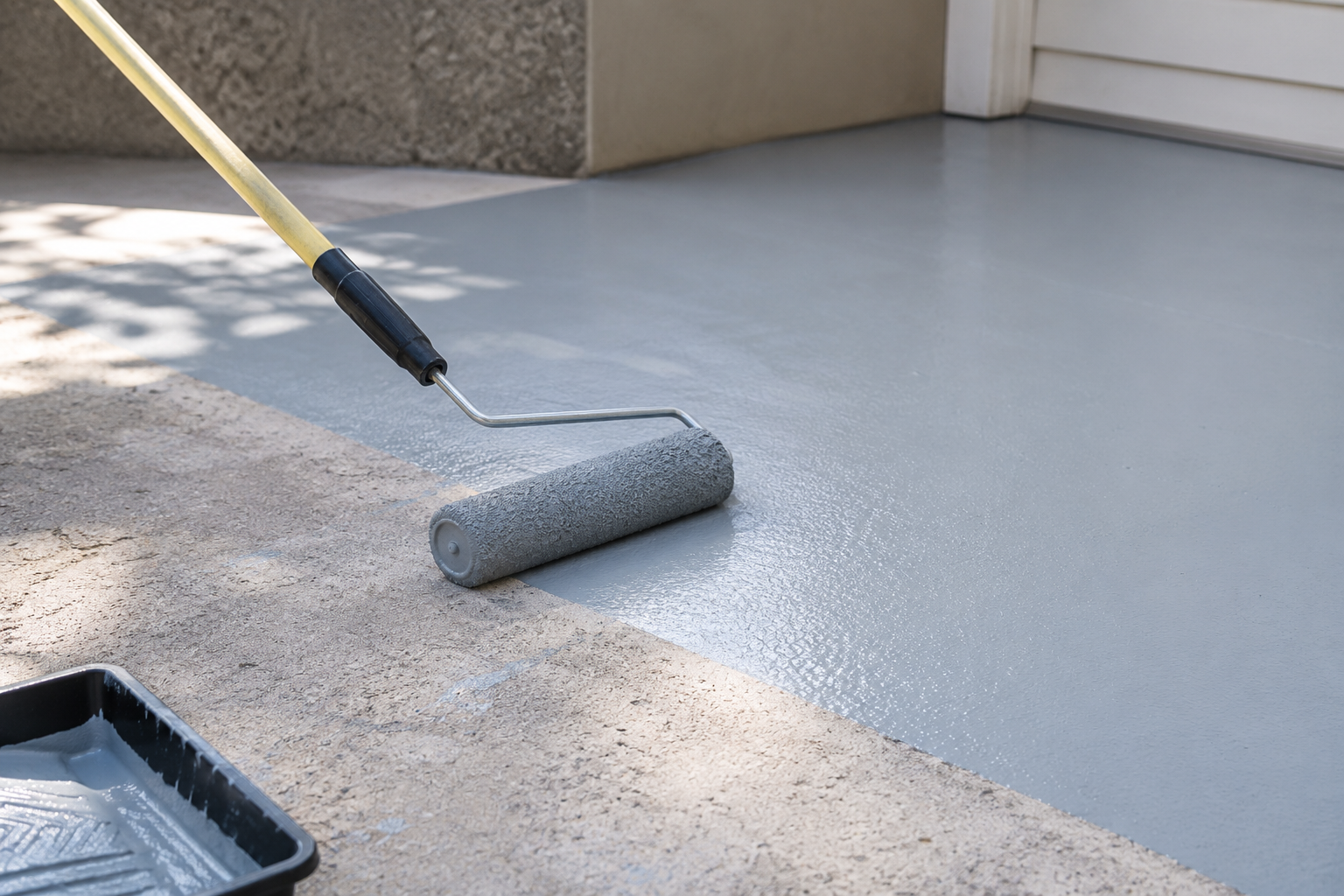
- Apply primer with a brush around edges, then roll the rest of the surface.
- Let the primer dry for the time listed on the product label, typically 1 to 4 hours.
- Apply the first coat of paint, working in small sections to avoid lap marks.
- Let the first coat dry for 12 to 24 hours before applying a second coat.
- Apply the second coat and let it cure for 3 to 4 days before walking on it.
- Wait a full 7 days before placing furniture or heavy equipment back in place.
Freshly poured concrete needs even more patience. New slabs should cure for a minimum of 28 days, and some manufacturers recommend waiting a full 90 days before painting to let residual moisture escape. Weather matters during application too. Avoid painting when the temperature sits below 50°F (10°C) or above 90°F (32°C), since both extremes affect how paint cures and bonds, and humidity above 85% slows dry time significantly and raises the risk of moisture getting trapped under the first coat.
How Long Does Paint Last on Concrete?
Anywhere from 1 to 10 years, depending on the paint type, how well the surface was prepped, and how much foot traffic or weather it takes. Standard latex masonry paint on an exterior wall often starts showing wear after 3 to 5 years. A professionally applied epoxy or polyaspartic coating on a garage floor, on the other hand, can last 10 to 15 years with minimal touch-up. Patios and driveways sit at the low end of that range, since standing water and vehicle traffic wear a surface down faster than a vertical wall ever will.
Three things shorten that lifespan more than anything else: skipped surface prep, moisture trapped beneath the coating, and a paint type that doesn’t match the surface. Get all three right, and even a mid-range paint can outperform a premium one applied over an unprepped, damp slab.
What Does It Cost To Paint Concrete?
Materials for a DIY job usually run $0.75 to $2.50 per square foot, depending on whether you go with acrylic latex, masonry paint, or a two-part epoxy system. A typical two-car garage floor at 400 square feet costs roughly $300 to $800 in materials for a full etch, prime, and two-coat epoxy job. Hiring a pro adds $2 to $7 per square foot in labor on top of that, which brings a professionally coated garage floor to $1,000 to $3,000 total, depending on the region and the coating system.
Walls and patios scale similarly by square footage, though masonry paint tends to run cheaper per gallon than floor-rated epoxy. A mid-grade product with every prep step done properly will almost always outperform a premium paint applied over a surface that skipped the etching or moisture test.
Common Concrete Painting Mistakes
Most premature paint failures on concrete come down to one of these:
- Skipping the etching step and priming straight onto unetched concrete
- Using interior wall paint on an exterior patio or driveway
- Painting over a damp slab that hasn’t passed a moisture test
- One thick coat instead of two thin, even ones
- Cracks left unpatched before painting
- Walking on a newly painted floor before the cure window has passed
- Painting in direct sun or high heat, which dries the paint too fast and causes blistering
Any single one of these can cut a paint job’s lifespan in half, even on concrete that was otherwise prepped well.
How To Maintain Painted Concrete
Sweep or hose down painted floors and patios weekly so grit doesn’t scratch the finish underfoot. Clean up spills, oil, grease, de-icing salt, within a few hours rather than letting them sit, since prolonged chemical contact breaks down the paint film faster than normal foot traffic does. Plan on a fresh topcoat every 3 to 5 years on high-traffic areas like garage floors and patios, even if the existing paint still looks fine, so you stay ahead of hairline wear before it turns into real peeling. And keep pressure-washing under 2,000 PSI on painted concrete. Higher pressure can strip paint at the edges and around any existing chips.
Conclusion
Concrete takes paint well once the surface has been cleaned, patched, tested for moisture, and etched. Match the paint to the surface, masonry for walls, epoxy for floors, anti-slip exterior paint for patios and driveways, and build in the real cost and cure-time windows before you start. Get the prep right and use the right product, and a painted concrete surface will hold its finish for years instead of months.
FAQs

Related Posts