Open Cell vs Closed Cell Spray Foam: Which One Is Right?
Walk into any home improvement store and you’ll find spray foam insulation on the shelf — but no label tells you which type actually fits your project. Open-cell and closed-cell spray foam look similar coming out of the gun. Once they cure, they perform like completely different materials. One traps air and sound. The other locks out moisture and adds structural strength to your walls. Picking the wrong one costs you money twice — once to install it and once to fix the problem it creates.
The difference comes down to cell structure. Closed-cell spray foam seals tight at R-6.0 per inch and acts as a vapor barrier at 1.5 inches (3.8 cm). Open-cell spray foam stays soft and porous, delivering R-3.6 per inch with excellent sound absorption. This guide covers 6 performance differences, exact installation costs per board foot, a full climate zone breakdown, and a head-to-head comparison table — so you pick the right foam the first time.
What Is Spray Polyurethane Foam (SPF)?
Spray polyurethane foam (SPF) is a two-part chemical insulation. A polyol resin and an isocyanate compound mix at the spray gun tip and expand up to 30 times their original volume on contact with a surface. The foam fills every gap, crack, and cavity — then hardens into a permanent thermal barrier.
The difference between the 2 foam types comes down to what happens during that expansion.
How Open-Cell Foam Forms
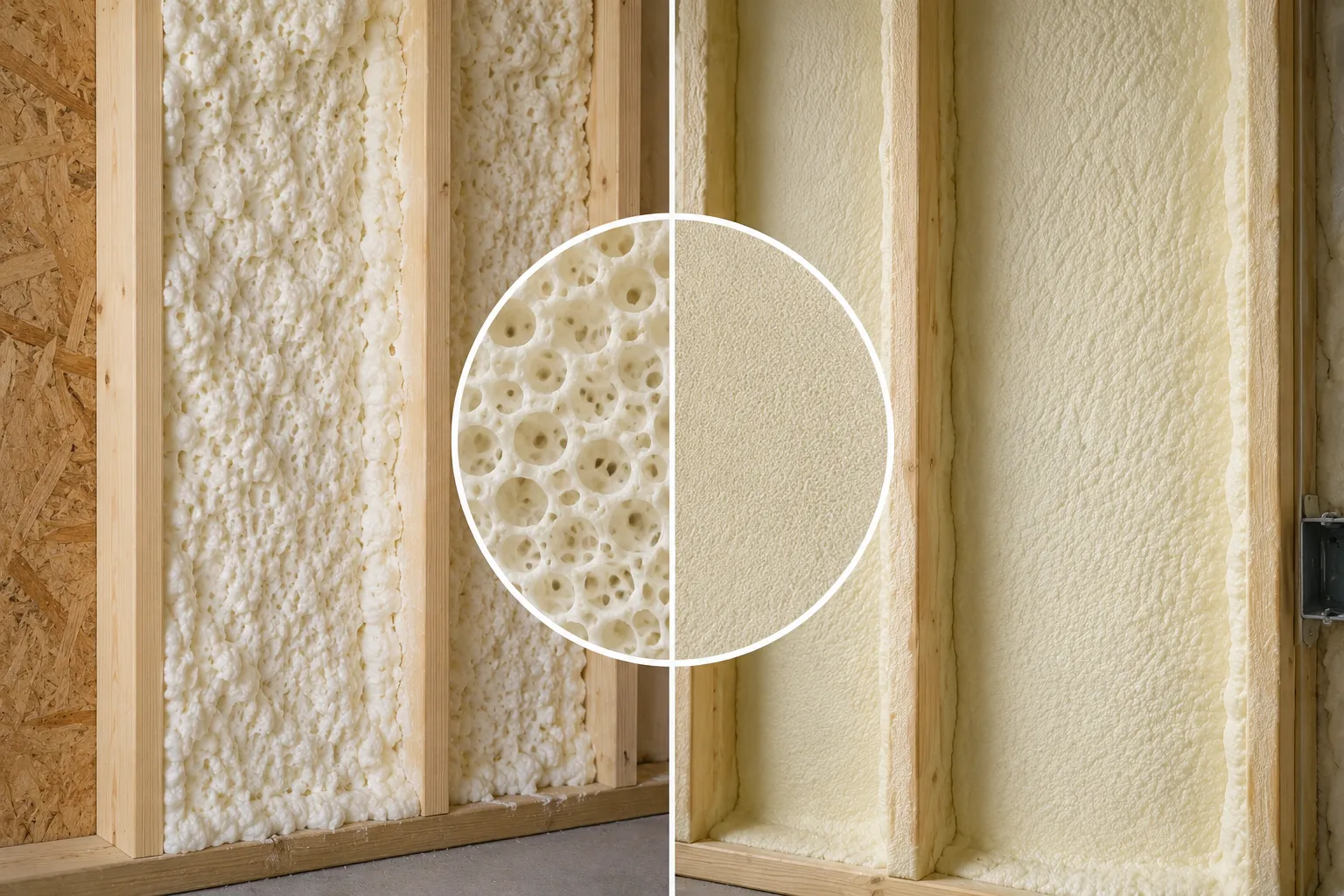
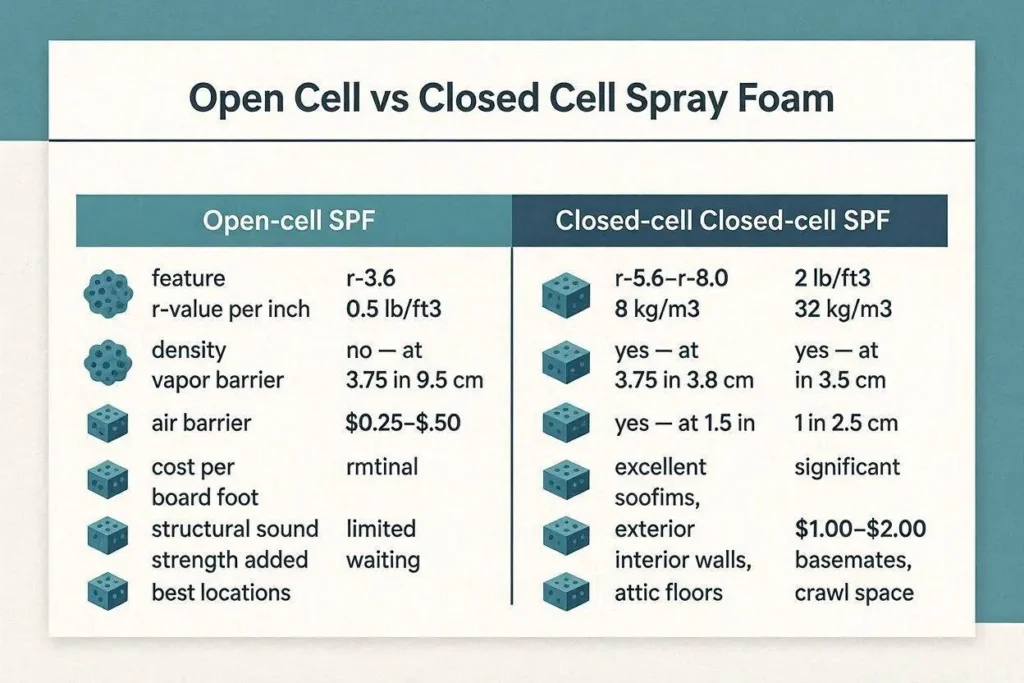
During expansion, the foam’s cell walls rupture. This leaves behind a soft, sponge-like structure of interconnected air pockets. Open-cell foam has a density of 0.5 lb/ft³ (8 kg/m³) — lightweight, flexible, and porous.
How Closed-Cell Foam Forms
The cell walls stay intact. Each bubble seals off from its neighbor, creating a rigid, compact structure. Closed-cell foam has a density of 2 lb/ft³ (32 kg/m³) — 4 times denser than open-cell and nearly impermeable to air and water vapor.
R-Value Per Inch: Open Cell vs Closed Cell Spray Foam
Closed-cell spray foam delivers R-5.6 to R-8.0 per inch. Open-cell spray foam delivers R-3.6 per inch.
R-value measures thermal resistance — the higher the number, the less heat passes through. For thin wall cavities or cold climates, this difference is decisive.
R-Value by Wall Cavity Depth
| Wall Type | Cavity Depth | Open-Cell Total R | Closed-Cell Total R |
| 2×4 wall | 3.5 in (8.9 cm) | R-12.6 | R-21.0 |
| 2×6 wall | 5.5 in (14 cm) | R-19.8 | R-33.0 |
| Attic (full fill) | 10 in (25.4 cm) | R-36.0 | R-60.0 |
| Crawl space wall | 2 in (5 cm) | R-7.2 | R-12.0 |
A 2×4 exterior wall in a cold climate needs at least R-20. Open-cell foam falls short at 3.5 inches. Closed-cell hits R-21 in that same cavity — no extra thickness required.
Which Spray Foam Acts as a Vapor Barrier?
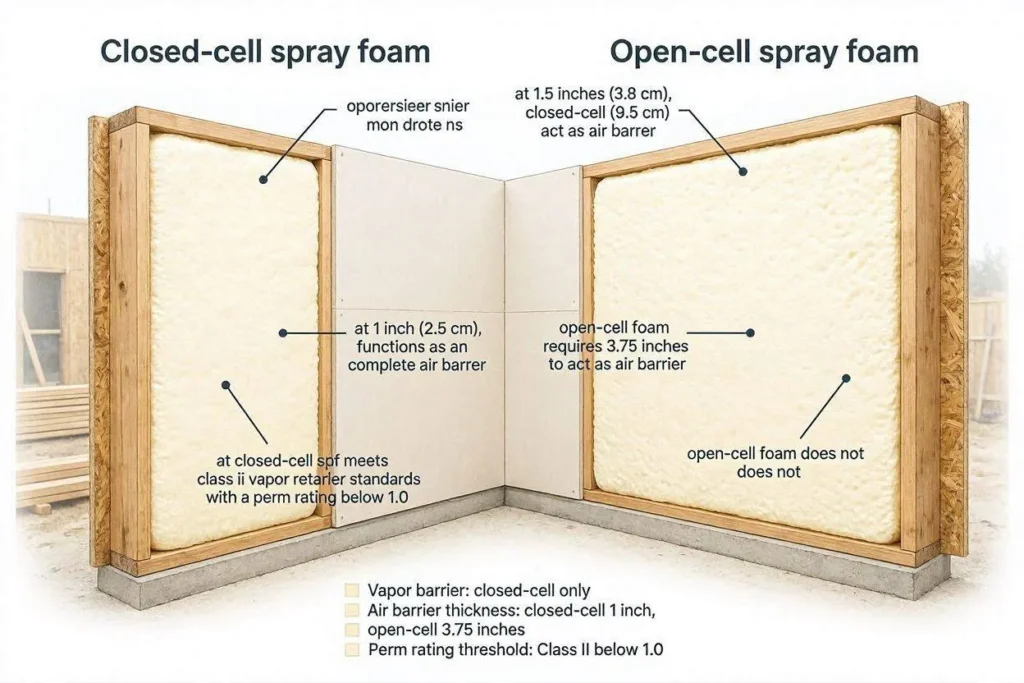
Closed-cell spray foam. Open-cell foam does not.
At 1.5 inches (3.8 cm) thickness, closed-cell SPF meets Class II vapor retarder standards with a perm rating below 1.0. At 1 inch (2.5 cm), closed-cell functions as a complete air barrier. Open-cell foam requires 3.75 inches (9.5 cm) to act as an air barrier — and never functions as a vapor barrier regardless of thickness.
Open-Cell Foam and Moisture Absorption
Open-cell foam’s porous structure absorbs water. In a basement, crawl space, or any below-grade area, this means trapped moisture, reduced R-value over time, and potential mold growth behind walls. Keep open-cell foam away from these 4 locations: basement walls, crawl space walls, below-grade exterior walls, and areas near plumbing leaks.
Open Cell vs Closed Cell Spray Foam Cost
Open-cell foam costs $0.25–$0.50 per board foot. Closed-cell foam costs $1.00–$2.00 per board foot.
Installed project costs look like this:
| Foam Type | Material Cost | Installed Cost (avg) |
| Open-cell | $0.44–$0.65/sq ft per inch | $0.80–$1.20/sq ft |
| Closed-cell | $1.00–$1.50/sq ft per inch | $1.50–$3.00/sq ft |
Cost Per R-Value: Which Foam Gives More for Your Dollar?
This is the calculation no competitor runs — and it changes the picture.
| Foam | Cost per board foot | R-value per inch | Cost per R-unit |
| Open-cell | $0.35 avg | R-3.6 | $0.097 per R |
| Closed-cell | $1.50 avg | R-6.0 | $0.25 per R |
Open-cell delivers more R-value per dollar in large open areas like attics where thickness is not limited. Closed-cell becomes cost-efficient in thin cavities — a 2×4 wall where you need R-20+ leaves you no choice but closed-cell.
Bottom line: In a 2×4 exterior wall, closed-cell reaches code-required R-values in one pass. Open-cell cannot — and filling the gap with extra layers adds material cost that erases the price advantage.
Where to Use Open-Cell Spray Foam
Open-cell foam performs in 5 specific locations:
- Interior partition walls — sound control between bedrooms, home offices, and living areas
- Attic floors (not rooflines) — large areas where R-value depth is available
- Basement ceilings — above a finished basement, away from foundation walls
- Vaulted ceilings — where acoustic comfort matters and moisture is controlled
- Sound studios or media rooms — where maximum sound absorption is the goal
Open-cell foam expands aggressively — up to 100 times its volume — filling irregular cavities completely. In dry interior spaces, this makes open-cell the faster, cheaper option.
Where to Use Closed-Cell Spray Foam
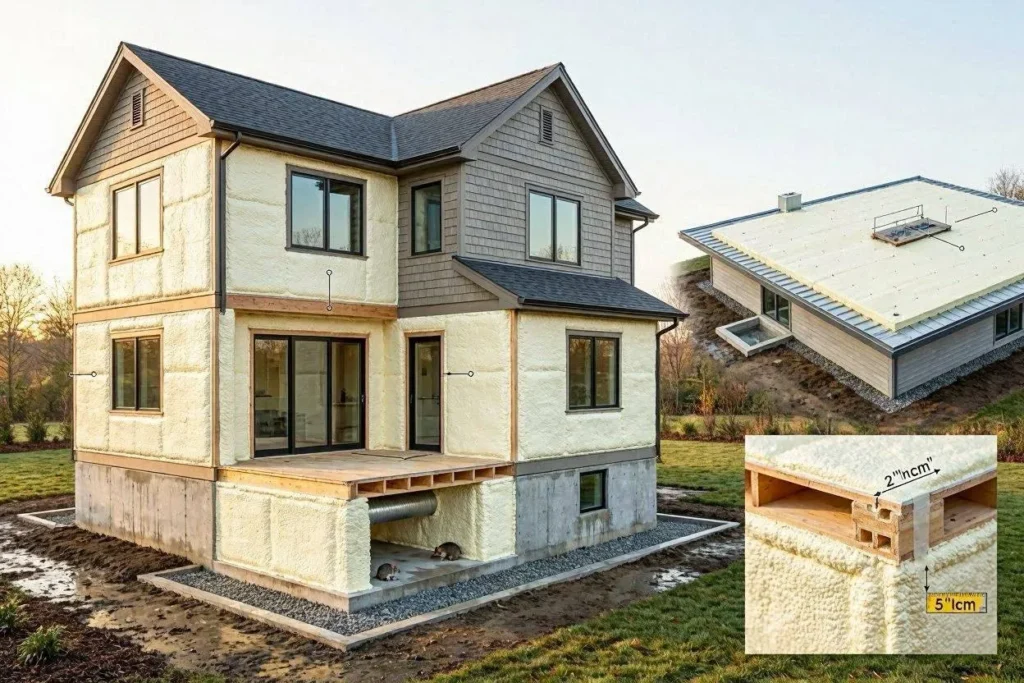
Closed-cell foam belongs in 6 high-performance locations:
- Exterior walls — moisture exposure is constant; closed-cell blocks it
- Basement walls — below-grade walls face ground moisture and hydrostatic pressure
- Crawl spaces — high humidity, pest intrusion, and cold air require a sealed barrier
- Rim joists — the most common air leak point in any home; 2 inches (5 cm) of closed-cell seals it completely
- Commercial roofs — load-bearing surfaces need the structural rigidity closed-cell adds
- Flood-prone areas — closed-cell resists bulk water; open-cell saturates and fails
Climate Zone Guide: Which Foam for Your Region
The Pennsylvania border rule used in the industry maps directly to DOE climate zones:
| Climate Zone | States (examples) | Recommended Foam |
| Zones 1–2 | Florida, Hawaii, Louisiana | Open-cell acceptable |
| Zone 3 | Texas, Georgia, Arizona | Open-cell with vapor barrier |
| Zone 4 | Virginia, Kansas, Oregon | Either — closed-cell preferred for exterior |
| Zones 5–8 | Minnesota, Montana, Alaska | Closed-cell required |
In climate zones 5–8, winter temperature differentials between indoor (70°F / 21°C) and outdoor (-10°F / -23°C) reach 80°F (44°C). Open-cell foam cannot maintain vapor control at these extremes. Closed-cell holds.
Open-Cell Foam Improves Soundproofing
Open-cell foam’s soft, porous structure absorbs mid-to-high frequency sound waves — voices, TV, music, general household noise. A 3.5-inch (8.9 cm) fill of open-cell foam in a 2×4 interior wall improves the Sound Transmission Class (STC) rating by 10–15 points, the equivalent of reducing perceived noise by half.
Closed-cell foam reduces noise only through air sealing — it stops airborne sound leakage but does not absorb sound waves. For dedicated soundproofing between rooms, open-cell wins every time.
Closed-Cell Foam Increases Structural Rigidity
A 2-inch (5 cm) closed-cell foam application adds measurable racking strength to wall assemblies — tested at up to 300% improvement in wall rigidity under lateral load. This structural benefit makes closed-cell the standard choice for:
- Buildings in high-wind zones
- Structures in seismic activity areas
- Commercial roof decks under snow loads
- Walls where additional vapor barriers or sheathing cannot be added
No competitor quantifies this clearly — but it is a real, tested performance property documented in SPFA (Spray Polyurethane Foam Alliance) technical data.
Open Cell vs Closed Cell Spray Foam: Full Comparison
Conclusion
Where the foam goes. Exterior, below-grade, or moisture-exposed locations need closed-cell. Interior, dry locations work well with open-cell. Your climate zone. Zones 1–3 can use open-cell on most applications. Zones 4–8 require closed-cell on any exterior surface.
Your wall cavity depth. Thin 2×4 cavities needing R-20+ require closed-cell. Deep attic spaces where R-36 is achievable at low cost favor open-cell. Most professional installations combine both: closed-cell where performance is non-negotiable, open-cell everywhere else. This hybrid approach delivers the best total R-value, moisture control, and acoustic performance at the lowest overall cost.
Frequently Asked Questions

Related Posts