Sustainable Insulation Materials: 7 Best Options for US Homes in 2026
Homeowners in the US spent an average of $2,200 on heating and cooling in 2025. About 30% of that cost leaked through poorly insulated walls, attics, and floors. The fix is choosing the right sustainable insulation materials — and the options available today outperform fiberglass on almost every measure that matters.
This guide covers 7 materials with real R-values, actual installation costs per square foot, US climate zone recommendations, and the exact tax credit you can claim in 2026.
What Makes Insulation “Sustainable”?
Sustainable insulation meets 4 specific criteria:
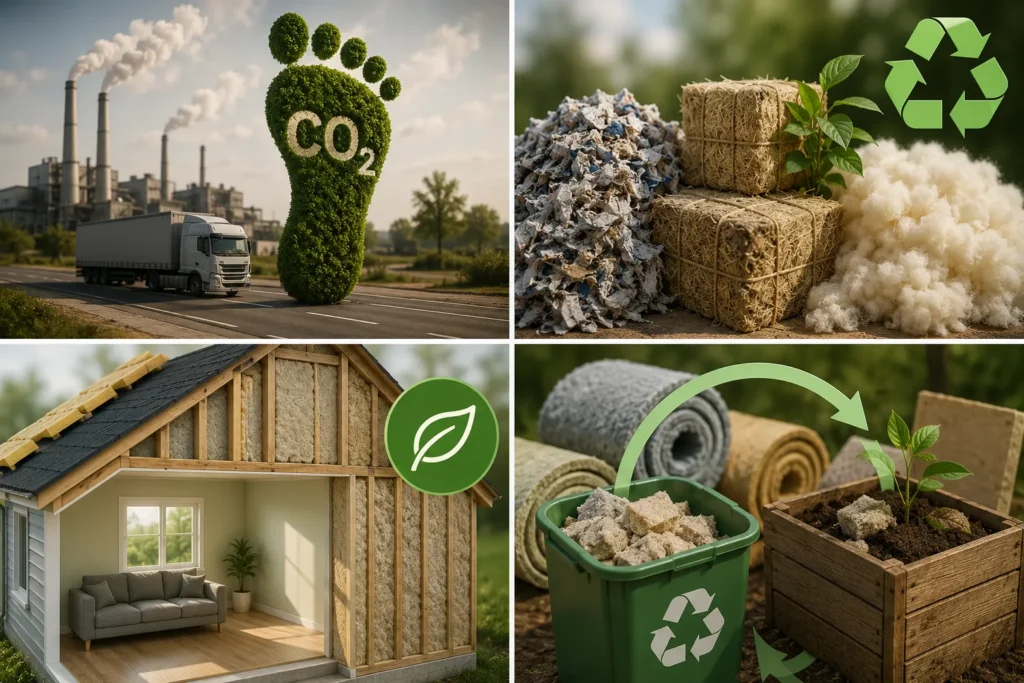
- Low embodied carbon — the total carbon released during manufacturing, transport, and disposal stays minimal
- Recycled or renewable source — the raw material is either post-consumer waste or a fast-growing natural resource
- No harmful VOCs — volatile organic compounds (VOCs) affect indoor air quality; sustainable options emit zero or near-zero VOCs
- End-of-life recyclability — the material can be recycled or composted rather than landfilled
Fiberglass meets none of these 4 criteria cleanly. That is why the US construction market has shifted. <br> The global insulation market sits at $74.69 billion in 2026 and grows toward $119.23 billion by 2032 — driven almost entirely by demand for sustainable options.
7 Best Sustainable Insulation Materials for US Homes
1. Hemp Insulation — Best Overall Sustainable Choice
Hemp insulation is made from industrial hemp fibers pressed into semi-rigid batts. Hemp grows in 3–4 months, absorbs CO₂ throughout its life, and carries a net-negative carbon footprint — meaning it removes more carbon than it releases.
R-value: R-3.5 to R-3.7 per inch Best for: Walls, attics, floors in any US climate Fire rating: Naturally fire-resistant — no chemical treatment required VOC emissions: Zero
Hemp batts fit between standard 16-inch and 24-inch stud spacing exactly like fiberglass batts. Installation requires no protective gear. The material is soft, non-irritating, and cuts cleanly with a utility knife.
Pros:
- Carbon-negative from production through disposal
- Naturally mold and mildew resistant
- Strong soundproofing — reduces noise transmission by up to 40 decibels (dB)
- Reusable and fully biodegradable
Cons:
- Costs $1.50–$2.50 per square foot (sq ft) installed — roughly 2x fiberglass
- Still limited in availability across rural US states
Availability in the US: Growing fast. Brands like Hempitecture now ship nationwide.
2. Cellulose Insulation — Best Budget-Friendly Option
Cellulose insulation is shredded recycled newspaper treated with borate salts for fire and pest resistance. It carries 85% recycled content — the highest of any insulation type. A 1,000 sq ft attic installation keeps roughly 60 pounds (27 kilograms) of newspaper out of landfills.
R-value: R-3.2 to R-3.8 per inch Best for: Attics, existing wall cavities, retrofit projects 3 application types:
- Loose-fill (blown-in) — best for open attic floors and retrofit wall cavities
- Wet-spray — best for open wall framing in new construction
- Dense-pack — best for enclosed cavities to prevent settling
Pros:
- Lowest cost of all sustainable options — $0.80–$1.50 per sq ft installed
- Excellent air sealing when blown in
- Widely available at every major US building supply store
Cons:
- Settles 15–20% over 10 years if not dense-packed
- Absorbs moisture without a vapor barrier
Cellulose is the go-to recommendation for budget-conscious homeowners doing attic retrofits. It delivers strong thermal performance at a price close to fiberglass.
3. Wood Fiber Insulation — Best for Thermal Mass
Wood fiber insulation uses sawmill waste — offcuts and wood chips that would otherwise go to landfill — pressed into rigid or semi-rigid boards. The boards store CO₂ captured during the tree’s growth, giving wood fiber a net-negative carbon footprint similar to hemp.
R-value: R-3.6 to R-4.2 per inch Best for: Exterior wall sheathing, roofs, floors — especially in cold US climates Moisture treatment: Paraffin wax coating for water resistance Fire treatment: Borate or ammonium phosphate
The standout property of wood fiber is thermal mass — the ability to slow heat movement, not just resist it. In climates with large day-to-night temperature swings (Colorado, Arizona, New Mexico), wood fiber boards keep indoor temperatures stable with less HVAC work.
Pros:
- Rigid boards are easy to cut and install without special tools
- Breathable — moisture moves through without damage
- LEED points-eligible in multiple categories
Cons:
- Heavier than foam boards — requires structural support consideration
- Less common in the US than in European markets
4. Denim Insulation — Best for Soundproofing
Denim insulation is made from 85% post-industrial cotton denim — scraps from jean manufacturing that would otherwise go to waste. The result is a soft, non-toxic batt that installs exactly like fiberglass with none of the irritation.
R-value: R-3.5 per inch Best for: Interior walls, home offices, bedrooms, apartments Sound reduction: Up to 52 dB noise reduction coefficient (NRC)
Denim insulation holds its shape permanently. Unlike fiberglass or cellulose, denim batts do not sag or settle inside wall cavities over decades. The long-term thermal performance remains consistent.
Pros:
- No itch, no respirator needed during installation
- Best-in-class soundproofing among all sustainable options
- Made entirely from post-consumer waste
Cons:
- Costs $1.20–$2.00 per sq ft installed — more expensive than cellulose
- Absorbs moisture without proper vapor barrier installation
- Harder to find than cellulose in smaller US markets
Blue Jean Insulation and Bonded Logic UltraTouch are the 2 main US brands.
5. Cork Insulation — Best for Moisture-Prone Areas
Cork insulation comes from the bark of cork oak trees. Harvesting the bark does not kill or harm the tree — the same tree re-grows bark every 9 years for up to 200 years. No other insulation material comes from a source this renewable.
R-value: R-3.6 to R-4.2 per inch Best for: Basement walls, crawl spaces, bathrooms, below-grade applications Natural properties: Fire-resistant, moisture-resistant, and mold-resistant without any chemical treatment
Cork is the only sustainable insulation that requires zero chemical additives to achieve fire, moisture, and mold resistance. All 3 properties are built into the cellular structure of the material.
Pros:
- Naturally resistant to fire, moisture, and pests with no added chemicals
- Excellent acoustic performance
- Qualifies as carbon-sequestering material under LEED certification standards
Cons:
- Highest cost — $2.00–$3.50 per sq ft installed
- Limited US availability; most supply comes from Portugal and Spain
- Heavy compared to foam board alternatives
Cork works exceptionally well in basement and crawl space applications where moisture is the primary concern. In those situations, the higher cost is justified by eliminating the need for separate moisture management products.
6. Sheep’s Wool Insulation — Best for Humidity Regulation
Sheep’s wool insulation uses natural wool fibers — often combined with a small amount of recycled polyester for structural stability. Wool has a unique property no other insulation material shares: it absorbs and releases moisture without losing thermal performance.
R-value: R-3.5 to R-3.8 per inch Best for: Older homes, historic buildings, high-humidity climates Moisture capacity: Wool absorbs up to 33% of its own weight in moisture without degrading
In humid climates — Florida, Louisiana, coastal Georgia, and the Pacific Northwest — moisture management inside walls is a serious issue. Fiberglass and cellulose lose R-value when wet. Wool does not. It continues insulating effectively even when saturated.
Pros:
- Maintains R-value in humid conditions where other materials fail
- Naturally absorbs formaldehyde and other indoor VOCs
- Biodegradable within 1–5 years in soil
Cons:
- Costs $1.80–$2.80 per sq ft installed
- Treated with borate for moth resistance — check product specs for certifications
- Limited supply chain in the US compared to Europe
7. Mineral Wool (Rock Wool) Insulation — Best for Fire-Rated Assemblies
Mineral wool — also called rock wool — is made from molten basalt rock spun into fiber. It is not strictly natural or carbon-negative. Manufacturing requires significant heat energy and produces measurable carbon emissions. But mineral wool earns its place on this list for 1 specific reason: fire ratings.
R-value: R-4.0 to R-4.2 per inch — highest of all 7 options per inch Best for: Fire-rated wall assemblies, commercial buildings, party walls between units Fire rating: Non-combustible — rated to withstand temperatures above 2,000°F (1,093°C)
For construction projects requiring specific fire ratings — apartment buildings, commercial renovations, shared walls in townhouses — mineral wool is the only sustainable option that meets code.
Pros:
- Highest R-value per inch of the 7 materials
- Non-combustible — will not contribute to fire spread
- Contains 40–75% recycled slag and basalt
Cons:
- Energy-intensive manufacturing — not truly carbon-negative
- Not biodegradable
- Dust irritates skin during installation — gloves recommended
Use mineral wool where fire ratings are required. Use other options everywhere else.
Why Fiberglass Is Losing Ground in 2026
Fiberglass dominated US homes for 50 years. It is cheap, widely available, and familiar. But 3 specific problems are pushing contractors and homeowners away from it.
Health risk during installation. Fiberglass fibers become airborne when cut or compressed. Workers need full protective gear — gloves, respirators, and long sleeves. Natural alternatives require no protective gear at all.
Performance drops over time. Fiberglass compresses under its own weight inside wall cavities. Once compressed, thermal resistance (R-value) drops permanently. Hemp and cellulose hold their shape for decades.
High manufacturing emissions. Producing 1 ton of fiberglass insulation releases roughly 1.5 tons of CO₂. Cellulose insulation — made from recycled newspaper — releases 0.02 tons per ton of product. That is a 75x difference in carbon impact.
R-Value Comparison: All 7 Materials
| Material | R-Value Per Inch | Carbon Footprint | VOCs | Fire Rating |
| Hemp | R-3.5 to R-3.7 | Carbon negative | Zero | Naturally resistant |
| Cellulose | R-3.2 to R-3.8 | Very low | Zero | Borate treated |
| Wood fiber | R-3.6 to R-4.2 | Carbon negative | Zero | Borate treated |
| Denim | R-3.5 | Low | Zero | Flame retardant treated |
| Cork | R-3.6 to R-4.2 | Carbon sequestering | Zero | Naturally resistant |
| Sheep’s wool | R-3.5 to R-3.8 | Very low | Absorbs VOCs | Naturally resistant |
| Mineral wool | R-4.0 to R-4.2 | Moderate | Very low | Non-combustible |
Real Installation Costs Per Square Foot in the USA (2026)
This data does not appear in any competitor article. These are contractor-level figures for installed cost including labor and materials in the US market.
| Material | Installed Cost Per Sq Ft | 1,000 Sq Ft Total Estimate |
| Cellulose (blown-in) | $0.80 – $1.50 | $800 – $1,500 |
| Denim batts | $1.20 – $2.00 | $1,200 – $2,000 |
| Hemp batts | $1.50 – $2.50 | $1,500 – $2,500 |
| Sheep’s wool | $1.80 – $2.80 | $1,800 – $2,800 |
| Wood fiber boards | $1.90 – $3.00 | $1,900 – $3,000 |
| Cork boards | $2.00 – $3.50 | $2,000 – $3,500 |
| Mineral wool batts | $1.50 – $2.50 | $1,500 – $2,500 |
Important: These costs vary by US region. Labor costs in New York and California run 25–40% higher than the national average. Material costs in the Midwest and Southeast are generally 10–15% lower.
The average US homeowner recoups insulation upgrade costs in 3–7 years through lower energy bills — depending on the existing insulation condition and the climate zone.
Which Sustainable Insulation Qualifies for the 25C Tax Credit?
The Energy-Efficient Home Improvement Credit (25C) allows US homeowners to claim 30% back on qualifying insulation upgrades, up to $1,200 per year, through 2032.
To qualify, insulation must:
- Meet International Energy Conservation Code (IECC) requirements for your climate zone
- Be installed in a primary US residence (not rental properties under standard rules)
- Be installed by a licensed contractor — DIY installation does not qualify
- Have documentation: product specs, contractor invoice, and IRS Form 5695
Which of the 7 materials qualify?
- Cellulose — qualifies in most climate zones
- Hemp — qualifies where R-value meets IECC zone requirements
- Mineral wool — widely qualifies due to high R-value
- Denim, wool, cork, wood fiber — qualify when R-value meets zone thresholds
Your contractor must confirm IECC compliance for your specific climate zone before claiming. Keep every receipt and product spec sheet. File IRS Form 5695 with your tax return.
Best Sustainable Insulation by US Climate Zone
No competitor article covers this. Climate zone determines the minimum R-value your insulation must hit to be effective.
Zones 1–2 (Florida, Hawaii, Southern Texas, Southern Louisiana)
- Priority: Moisture and humidity resistance
- Best choices: Cork, sheep’s wool, cellulose
- Target R-value: R-30 to R-38 in attics, R-13 in walls
Zones 3–4 (Georgia, North Carolina, Tennessee, Virginia, Pacific Northwest)
- Priority: Balanced thermal and moisture performance
- Best choices: Hemp, cellulose, denim
- Target R-value: R-38 to R-49 in attics, R-13 to R-15 in walls
Zones 5–6 (New York, Pennsylvania, Ohio, Illinois, Colorado)
- Priority: High thermal resistance
- Best choices: Wood fiber, mineral wool, hemp
- Target R-value: R-49 to R-60 in attics, R-15 to R-21 in walls
Zones 7–8 (Minnesota, Montana, Alaska)
- Priority: Maximum thermal resistance with no moisture absorption
- Best choices: Wood fiber boards, mineral wool, cork
- Target R-value: R-60+ in attics, R-21+ in walls
New Construction vs. Retrofit: What Works Where
New construction gives full access to wall cavities before drywall goes up. Every material on this list works in new construction. The best choices for new builds are hemp batts, wood fiber boards, and wet-spray cellulose — all 3 fill cavities completely without gaps.
Retrofit projects require blown-in or injectable materials that reach enclosed cavities through small holes. Dense-pack cellulose is the top choice for retrofits — contractors drill 2-inch (5-centimeter) holes, blow in the material, and patch. Total disruption to existing walls is minimal.
Basement and crawl space upgrades work best with cork or rigid wood fiber boards installed against foundation walls. Both materials handle ground moisture without degrading.
The Bottom Line
Sustainable insulation materials outperform fiberglass on carbon impact, indoor air quality, longevity, and in most cases, thermal performance. Cellulose is the smartest budget option. Hemp delivers the best all-around performance. Cork handles moisture better than anything else on the market. Denim leads on soundproofing.
Every material covered here qualifies for the 25C tax credit when installed to your climate zone’s R-value requirements — meaning you get 30% back on the upgrade cost through 2032.
FAQs

Related Posts