HDPE Pipe vs PVC Pipe: Which Building Material Actually Holds Up on the Job Site?
Choosing the wrong pipe material on a construction project creates problems that show up years later — failed joints, emergency excavations, and replacement costs that dwarf the original savings. For contractors, project managers, and civil engineers across the US, the choice between HDPE pipe and PVC pipe is one of the most common building material decisions on any job site.
Both are plastic pipe building supplies. Both are used in commercial construction, industrial facilities, and municipal infrastructure. But their material properties, installation requirements, and long-term performance differ in ways that matter on real projects.
This guide gives you a direct, specification-level comparison so you order the right building material the first time.
HDPE Pipe vs PVC Pipe: Construction Specification Comparison
| Specification | HDPE Pipe | PVC Pipe |
| Material classification | Thermoplastic building supply | Thermoplastic building supply |
| Construction use | Industrial, commercial, civil | Residential, commercial, municipal |
| Flexibility | High — bends without cracking | Rigid — cracks under stress |
| Pressure surge tolerance | 200 psi above rated class | 100 psi above rated class |
| Max safe flow velocity | 14 ft/sec | 5.5 ft/sec |
| Operating temperature | -40°F to 140°F | 32°F to 113°F |
| UV resistance | Complete — outdoor storage safe | Degrades without shielding |
| Joint method | Heat fusion — seamless | Solvent cement or gasket |
| Minimum bend radius | ~25x outer diameter | ~200x outer diameter |
| Service life | 100+ years | 50–100 years |
| Failure rate | 1 per 10,000,000 | 1 per 48,650 |
| Supply cost vs equivalent | 15–25% higher | Lower upfront |
| Recyclability | High — 33% recycling rate | Limited infrastructure |
What Is HDPE Pipe? (Building Material Overview)
HDPE pipe is a thermoplastic building supply made from high-density polyethylene. It is manufactured by polymerizing ethylene gas under pressure, producing a pipe with a density between 0.93 and 0.97 g/cm³. That low density gives HDPE its defining characteristic — flexibility under load without structural failure.
In the US construction and industrial supply market, HDPE pipe is the standard specification for demanding applications. Over 100 million miles of HDPE pipe are currently installed across North America, making it the most widely used thermoplastic pipe in industrial and civil construction.
HDPE pipe construction and industrial applications:
- Municipal water mains and wastewater infrastructure
- Natural gas distribution systems
- Industrial chemical transport lines
- Commercial stormwater and drainage networks
- Construction projects using trenchless methods — HDD, pipe bursting, sliplining
- Mining slurry and tailings management
- Geothermal building systems
- Marine outfall and underwater civil works
What Is PVC Pipe? (Building Material Overview)
PVC pipe is a thermoplastic building supply made from polyvinyl chloride. Its density ranges from 1.3 to 1.45 g/cm³ — nearly 50% heavier than HDPE — giving it the rigid, structurally stable profile that makes it the default building material for standard plumbing and drainage construction.
More than one million miles of PVC pressure pipe serve over 40,000 US municipalities. It has been in commercial and residential construction since the 1950s. On most building supply lists, PVC pipe appears as the cost-effective standard for any application where conditions are predictable and static pressure is the primary load.
PVC pipe construction and building applications:
- Residential and commercial building plumbing
- Municipal drinking water distribution
- Gravity sewer and drainage construction
- Commercial and residential irrigation systems
- Fire sprinkler system supply lines
- Electrical conduit installation
- Cold water building supply lines
Pressure Performance on Construction Projects
PVC pipe handles static pressure reliably. In standard commercial building plumbing and low-demand municipal supply lines, PVC performs at spec for decades. It tolerates pressure surges up to 100 psi above its rated class — sufficient for most residential construction and stable municipal systems.
HDPE pipe handles dynamic construction environments better. It absorbs pressure surges up to 200 psi above its rated class. The more significant number for industrial and civil construction: HDPE pipe is 2,500 times more resistant to fatigue cracking than PVC pipe under cyclical pressure loading.
On construction projects with pumping systems, industrial process lines, or high-demand water mains, that fatigue resistance difference determines maintenance frequency over the facility’s operational life. A system that cycles pressure daily — every pumping station, every industrial supply line — is loading that pipe thousands of times per year. PVC’s fatigue limit becomes a real budget risk at that scale.
Flow velocity is the other specification that separates the two materials on construction projects. PVC pipe holds its rated pressure at flow velocities up to 5.5 feet per second. HDPE pipe performs at up to 14 feet per second. For commercial and industrial piping systems running high-throughput flow, HDPE pipe handles the load without upsizing the pipe diameter.
Flexibility: What It Means for Construction Installation
HDPE pipe bends at a minimum radius of approximately 25 times its outer diameter. On a construction site with underground obstacles, grade changes, or constrained right-of-ways, that tight curve reduces fittings, reduces joints, and reduces future maintenance points in the ground.
PVC pipe requires a minimum bend radius of 200 times its outer diameter. Fusible PVC specifications push that to 250 times. Every direction change on a PVC installation requires a fitting — an elbow, a coupling, a mechanical joint. Each fitting is a material cost, a labor cost, and a long-term leak risk buried underground.
On commercial and industrial construction projects with large-diameter pipe runs, this fitting difference is significant. Fewer mechanical connections means lower bill-of-materials cost, faster installation labor, and a cleaner underground system that requires less maintenance over its service life.
For trenchless construction methods — horizontal directional drilling, pipe bursting, sliplining — HDPE pipe is the only viable building material. PVC pipe cannot be pulled through a curved HDD bore path. Any construction project specifying trenchless installation is specifying HDPE by default.
Joining Methods: Construction Site Installation
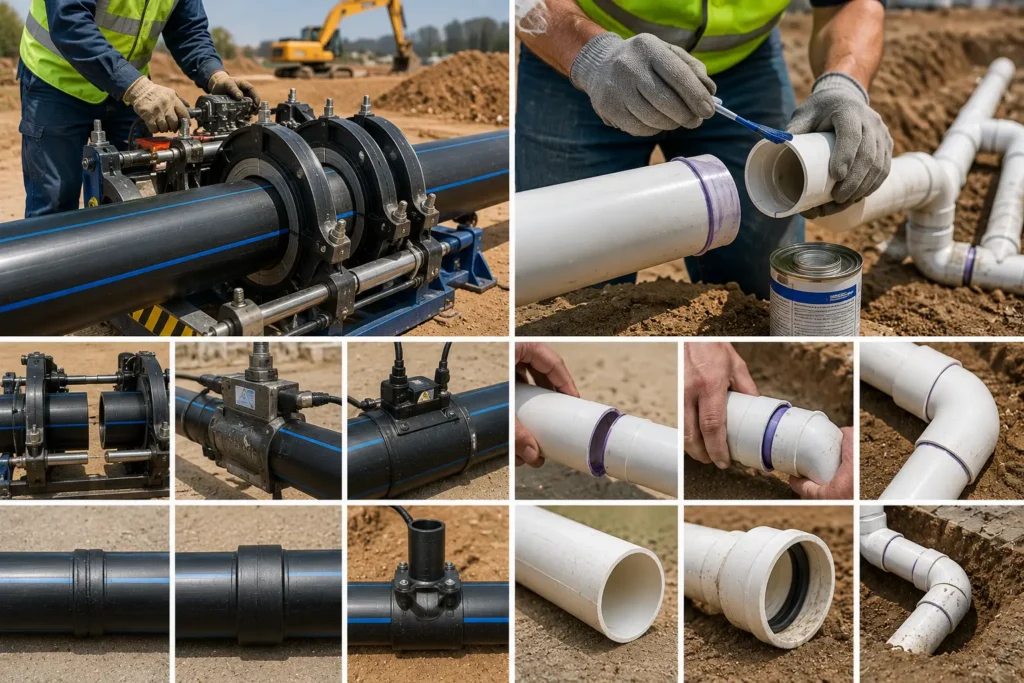
HDPE pipe — heat fusion joining
HDPE pipe sections are joined on the construction site using heat fusion. Pipe ends are heated to melting point and pressed together, fusing into a single continuous piece of material. The joint has no gasket, no cement, no mechanical fitting. It is as strong as the pipe wall itself.
Four fusion methods are available for construction use: butt fusion, electrofusion, socket fusion, and saddle fusion. Each requires a certified fusion operator and specialized construction equipment. That increases project setup cost but produces a monolithic pipeline with no mechanical weak points — the correct specification for buried industrial and civil infrastructure.
PVC pipe — solvent cement and gasket joining
PVC pipe is joined on the construction site using solvent cement or bell-and-spigot gasket connections. Solvent cement bonds pipe sections chemically. It is fast, requires no specialized equipment, and is familiar to every plumbing and construction crew in the US.
The long-term limitation is joint performance under stress. Misalignment during construction installation, soil movement after backfill, or sustained pressure cycling can all degrade a cemented or gasketed joint over time. Overbelling — improper sizing of a receiving pipe connection — is a documented construction failure mode on PVC systems that causes joint leaks in buried infrastructure.
For industrial facilities, commercial building mechanical systems, and civil infrastructure carrying gas or high-pressure water, heat-fused HDPE pipe delivers superior long-term joint reliability. For standard residential construction plumbing and commercial irrigation in stable soil conditions, PVC cement joints perform to specification for the project life.
Temperature and Weather Resistance for Construction Use
HDPE pipe operates across a temperature range of -40°F to 140°F. It retains full material strength and flexibility across this range, making it the specified building material for construction projects in climates with hard winters, hot summers, or significant daily temperature variation. Black HDPE pipe contains carbon black pigment for complete UV resistance — it can be stored on a construction site outdoors without protective covering and installed in above-ground runs without UV degradation.
PVC pipe performs within a temperature range of 32°F to 113°F. Below -10°F the material becomes brittle and susceptible to impact failure on the construction site. Above its rated temperature range it softens and loses structural load capacity. PVC pipe also requires UV protection — it cannot be stored unprotected outdoors on a construction site or used in exposed above-ground installations without shielding or protective coating.
For construction projects in northern US states with freezing winters, in sun-belt states with sustained high temperatures, or in any application with above-ground pipe runs, HDPE pipe is the appropriate building material specification. PVC pipe’s temperature limitations create material risk in those construction environments.
Chemical Resistance for Industrial and Construction Use
Both HDPE pipe and PVC pipe resist the standard range of construction-environment chemicals — water, saltwater, hydrochloric acid, phosphoric acid, calcium hypochlorite, and sodium chloride. In most commercial building plumbing and standard construction drainage applications, both materials perform equivalently.
Chemical performance diverges in industrial construction and specialized municipal applications:
HDPE pipe has superior resistance to:
- Nitric acid — industrial chemical processing facilities
- Sulfuric acid at most concentrations — industrial and mining construction
- Lubricating oils and hydrocarbons — industrial facility piping
- Contaminated soil environments — construction in brownfield or industrial sites
PVC pipe has superior resistance to:
- Chlorine above 50 ppm — municipal water treatment infrastructure
- Sodium hypochlorite — water treatment construction
- Oxidative disinfectants — drinking water distribution system construction
Municipal drinking water construction is the key exception for PVC pipe. HDPE pipe can degrade under sustained exposure to the high chlorine concentrations used in US drinking water treatment. PVC pipe is the more stable building material for that specific construction application — which is why PVC remains the dominant pipe supply specification for municipal potable water distribution construction across the US.
For industrial facility construction, chemical processing plants, mining infrastructure, and commercial construction in contaminated soil environments, HDPE pipe’s hydrocarbon and acid resistance makes it the correct material specification.
Service Life and Failure Rates for Construction Planning
Both HDPE pipe and PVC pipe are specified as 100-year building materials. The failure rate data is what separates them for construction and maintenance planning purposes.
PVC pipe: 1 failure per 48,650 events. HDPE pipe: 1 failure per 10,000,000 events. That is a 205-times difference in failure probability — a number that directly affects construction maintenance budgets, infrastructure repair schedules, and long-term facility operating costs.
Every PVC pipe repair means crew mobilization, road excavation, and emergency procurement. On a large municipal system, those events add up fast. The HDPE premium pays for itself well before the first major repair cycle hits.
On paper, both pipes last 100 years. In the ground — with shifting soil, frost heave, or seismic movement — PVC concentrates stress at its joints. HDPE flexes through it. That difference shows up in the maintenance log, not the spec sheet.
Construction Project Cost: Supply Price vs Total Build Cost
HDPE pipe costs 15 to 25% more than PVC pipe on the building material supply invoice for equivalent diameter and pressure class. That is the number that appears on the construction estimate and the one that drives initial material selection decisions.
Total construction project cost includes more than pipe supply:
- Installation labor — HDPE pipe’s flexibility means fewer fittings to install, faster pipe runs on complex routes, and no cement cure time waiting before backfill
- Construction site storage — HDPE pipe requires no UV protection during outdoor storage; PVC pipe does
- Fittings and hardware — fewer elbows, couplings, and mechanical joints on HDPE pipe runs reduce bill-of-materials cost
- Construction maintenance — HDPE pipe’s 205-times lower failure rate reduces future repair mobilizations
- Replacement cycle — HDPE pipe’s longer service life defers full pipe replacement capital cost
For residential construction and small commercial building projects with straightforward pipe runs, stable soil, and standard operating pressures, PVC pipe’s lower supply cost makes it the correct building material choice. The construction economics are clear.
For commercial construction, industrial facility builds, civil infrastructure, and any project in challenging ground conditions or climate, HDPE pipe delivers lower total project cost over the construction asset’s life. The supply price premium disappears when full build cost and maintenance cost are included in the analysis.
Construction Project Specification Guide
Specify HDPE pipe for:
- Industrial facility construction — chemical, mining, oil and gas
- Civil infrastructure with trenchless installation requirements
- Construction projects in seismic zones or unstable ground
- Any build in climate zones with temperature extremes
- High-velocity flow systems above 5.5 feet per second
- Above-ground or UV-exposed pipe runs
- Natural gas distribution construction
- Commercial construction with long-term performance priority
Specify PVC pipe for:
- Residential building construction — plumbing and drainage
- Municipal drinking water distribution construction
- Standard commercial building irrigation and drainage
- Construction projects with budget as primary specification driver
- Stable soil, predictable pressure, low-velocity applications
- Electrical conduit installation
- Fire sprinkler system supply in standard commercial construction
Many commercial and industrial construction projects specify both materials — HDPE pipe for primary mains and trenchless runs, PVC pipe for interior building plumbing and irrigation laterals. The correct specification is application-driven, not material-preference driven.
Conclusion
No single building material wins every construction application. PVC pipe is a proven, cost-effective building supply for stable, standard-pressure construction projects. It delivers reliable service life when the installation is correct and conditions are predictable.
HDPE pipe costs more on the supply invoice and demands more from the construction crew. It returns that investment in lower failure rates, longer service life, and reliable performance in the construction environments where PVC pipe reaches its material limits. Specify the right building material for the actual construction conditions. That decision pays off across the full life of the asset.
Frequently Asked Questions

Related Posts