Low Carbon Concrete: Complete 2026 USA Guide (Cost, Types & Specs)
Concrete causes 7% of global CO₂ emissions — more than any country except China and the USA. Low carbon concrete cuts that number by 40–70%. Same strength. Same structural performance. Built with a different material mix.
In 2026, low carbon concrete is not optional on federal and state projects. The Buy Clean Act requires it. LEED v4.1 rewards it. And owners now request Environmental Product Declarations (EPDs) before approving a concrete order.
This guide covers what low carbon concrete is, which SCMs reduce carbon the most, what it costs per cubic yard (yd³) at USA batch plants, how to select a certified supplier, and how to spec it correctly on any USA job site.
What Is Low Carbon Concrete?
Low carbon concrete is a structural concrete mix produced with 40–70% fewer CO₂ emissions than standard Portland cement concrete, while meeting identical compressive strength specifications.
Standard concrete uses Portland cement (CEM I) as its primary binder. Producing 1 ton (0.9 t) of Portland cement releases approximately 1 ton (0.9 t) of CO₂ at the kiln. Multiply that across 4 billion tons of concrete poured globally per year, and the emissions problem becomes clear.
Low carbon concrete replaces part of that Portland cement with Supplementary Cementitious Materials (SCMs) — fly ash, Ground Granulated Blast-furnace Slag (GGBS), silica fume, calcined clay, and limestone fines. Each SCM reduces the carbon footprint of the mix without compromising structural performance.
The result: concrete that meets the same 3,000–6,000 psi (20.7–41.4 MPa) compressive strength specifications at significantly lower embodied carbon per cubic yard (yd³) or cubic meter (m³).
Why Standard Concrete Has a High Carbon Footprint
Cement production drives the carbon problem. Kilns heat limestone at 2,300°F–3,000°F (1,260°C–1,650°C) using coal or natural gas. Two separate carbon releases occur: fuel combustion and limestone calcination. Both are unavoidable with traditional Portland cement manufacturing.
3 hard facts about cement’s carbon output:
- 1 ton (0.9 t) of Portland cement produces roughly 1 ton (0.9 t) of CO₂
- Cement manufacturing accounts for 7% of global CO₂ emissions — one of the highest-emitting industrial processes on earth
- Concrete is responsible for 50–85% of the embodied carbon in any building project
Transport from batch plant to job site, plus placement and finishing, adds another 8–12% to concrete’s total carbon footprint per cubic yard. Reducing embodied carbon starts at the batch plant — specifically, at the cement content in the mix design.
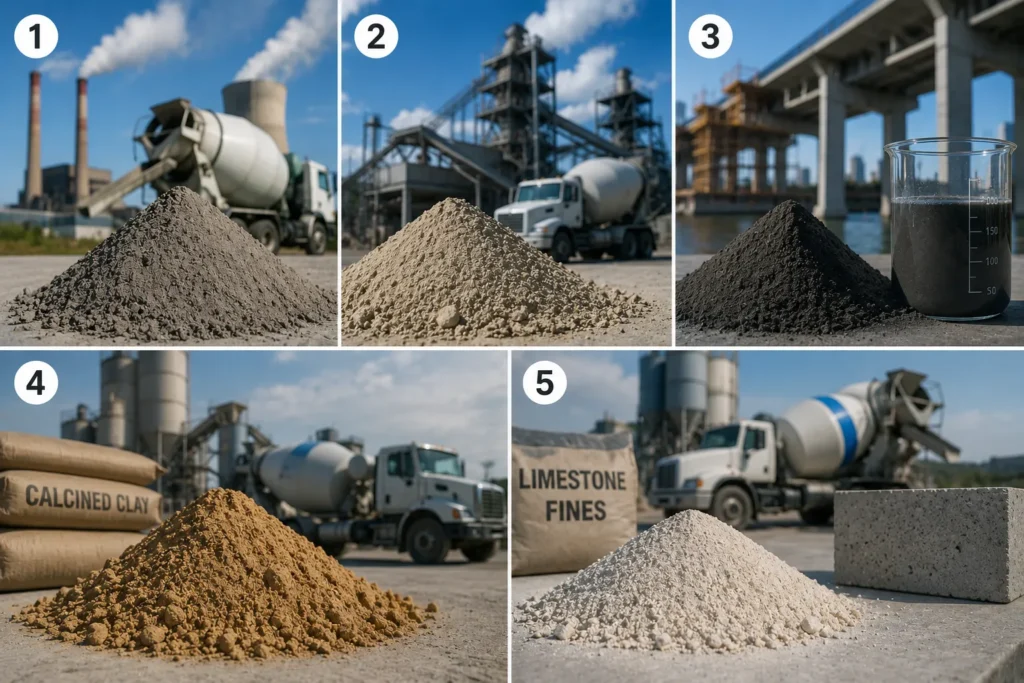
5 Building Materials That Cut Concrete’s Carbon by Up to 70%
These are the 5 SCMs used in low carbon concrete production across USA batch plants. Each delivers different carbon savings, availability, and concrete mix performance.
1. Fly Ash — Best for Cost-Sensitive Projects
Fly ash is a by-product of coal-burning power stations. It replaces 15–40% of Portland cement in a standard concrete mix specification and reduces embodied carbon by 20–40%. Class C and Class F fly ash are both used in USA construction. Class F performs better in structural applications and sulfate-rich soils.
Fly ash supply is tightening in the USA as coal plants close. States with strong availability include Texas, Illinois, Ohio, Pennsylvania, and Indiana. Cost at batch plant: $20–$40 per ton ($22–$44 per 0.9 t) — the most affordable SCM for ready-mix suppliers to stock.
2. GGBS — Best for Maximum Carbon Reduction
GGBS replaces up to 70% of Portland cement in a concrete mix and reduces embodied carbon by 40–60%. GGBS concrete also improves long-term durability — better resistance to sulfate attack, chloride penetration, and alkali-silica reaction (ASR) compared to standard mixes.
GGBS supply concentrates near steel-producing regions: Pennsylvania, Ohio, Indiana, and the Great Lakes corridor. Cost at batch plant: $30–$55 per ton ($33–$61 per 0.9 t). Most large ready-mix suppliers in the Midwest and Northeast carry GGBS as a standard product.
3. Silica Fume — Best for High-Strength Applications
Silica fume replaces 5–15% of cement in high-performance concrete mix specifications and reduces carbon by 15–25%. Silica fume dramatically increases concrete density — mixes regularly achieve 8,000–12,000 psi (55–83 MPa) compressive strength, making it the SCM of choice for bridges, parking structures, and marine construction.
Cost at batch plant: $200–$500 per ton ($220–$551 per 0.9 t) — the most expensive SCM. Used in small quantities, typically 5–10% replacement only.
4. Calcined Clay — Fastest Growing SCM in 2026
Calcined clay replaces 30–50% of Portland cement and reduces carbon by 30–50%. Unlike fly ash and GGBS, calcined clay does not depend on industrial by-products. It is manufactured from natural clay deposits found across the USA, making supply more predictable.
The LC³ (Limestone Calcined Clay Cement) system pairs calcined clay with limestone fines to achieve up to 40% cement replacement with consistent strength development. Availability is expanding fastest in the Southeast and Southwest. Cost at batch plant: $40–$80 per ton ($44–$88 per 0.9 t).
5. Limestone Fines — Best for Blend Combinations
Limestone fines replace 5–15% of cement and reduce carbon by 10–20%. Used primarily in combination with other SCMs rather than as a standalone replacement. Widely available from building materials suppliers nationwide. Cost at batch plant: $15–$30 per ton ($16–$33 per 0.9 t) — the cheapest option in any blend.
SCM Comparison — USA Batch Plant Data 2026:
| SCM | Max cement replacement | Carbon reduction | Cost per ton (USA) |
| Fly ash | 40% | 20–40% | $20–$40 |
| GGBS | 70% | 40–60% | $30–$55 |
| Silica fume | 15% | 15–25% | $200–$500 |
| Calcined clay | 50% | 30–50% | $40–$80 |
| Limestone fines | 15% | 10–20% | $15–$30 |
3 Production Methods Used at USA Batch Plants
SCM substitution is the most common method. USA batch plants use 3 distinct production approaches to reduce concrete’s embodied carbon per cubic yard.
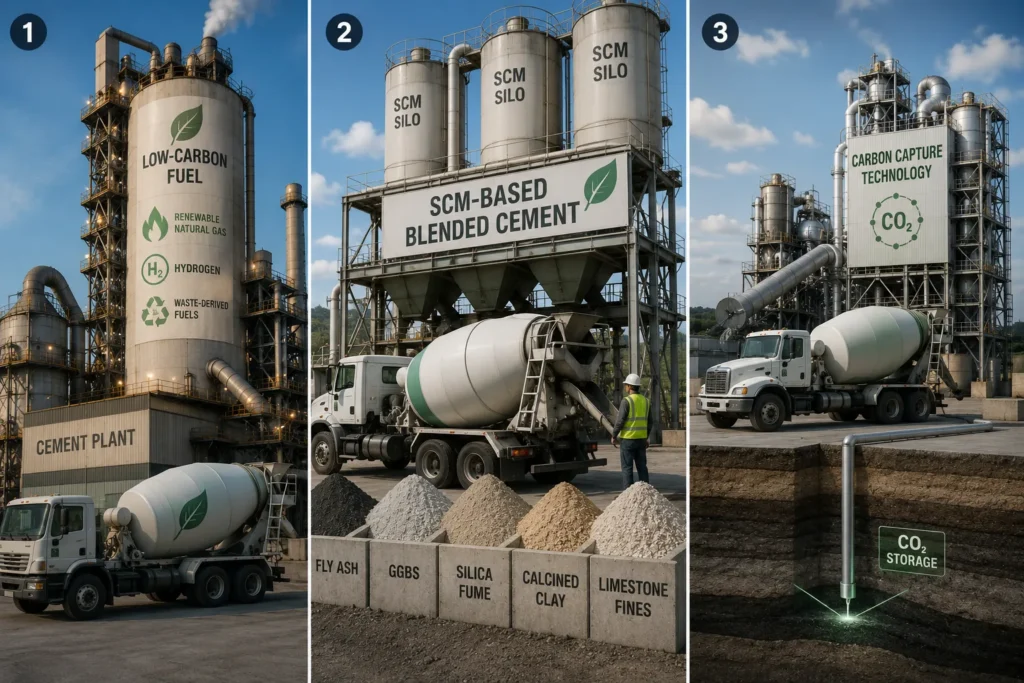
Method 1: Low-Carbon Fuel Switching
Cement kilns switch from coal to renewable natural gas, hydrogen, or waste-derived fuels. This reduces combustion-related CO₂ by 15–30% without changing mix design or batch plant operations. Holcim USA and Lehigh Hanson both have active fuel-switching programs at domestic cement plants.
Method 2: SCM-Based Blended Cement
Portland cement is partially replaced with SCMs at the batch plant during mixing. This is the most scalable method available through USA ready-mix concrete suppliers today. It reduces embodied carbon by 20–70% depending on SCM type and replacement rate. Most NRMCA-certified ready-mix suppliers offer blended cement mixes as standard products in 2026.
Method 3: Carbon Capture, Utilization, and Storage (CCUS)
CCUS technology injects captured CO₂ into fresh concrete at the batch plant during mixing. The CO₂ mineralizes permanently inside the mix — it does not off-gas or escape. CarbonCure Technologies leads this approach in North America, with over 700 certified ready-mix batch plants across the USA.
CCUS reduces CO₂ per cubic yard by 5–10% while improving compressive strength by 3–5%, allowing a small cement reduction for the same design strength. CCUS works alongside SCM replacement — the two methods combine to achieve 50–80% embodied carbon reduction in a single concrete mix specification.
What Does Low Carbon Concrete Cost at USA Batch Plants? (2026)
Low carbon concrete costs $2–$10 more per cubic yard ($2.60–$13.10 per m³) than standard concrete at USA ready-mix batch plants. The premium depends on SCM type, replacement rate, and regional building materials market.
2026 USA cost ranges by mix type:
| Concrete mix specification | Cost per yd³ | Cost per m³ | CO₂ vs. standard |
| Standard 4,000 psi Portland cement | $140–$165 | $183–$216 | Baseline |
| 20% fly ash blend | $142–$168 | $186–$220 | –20% |
| 40% GGBS blend | $148–$172 | $194–$225 | –45% |
| 50% calcined clay blend | $152–$178 | $199–$233 | –40% |
| CCUS + 30% fly ash | $155–$180 | $203–$236 | –55% |
| 70% GGBS high-SCM blend | $158–$185 | $207–$242 | –60% |
On a typical 1,000 yd³ (764 m³) commercial pour, switching to a 40% GGBS blend adds $8,000–$12,000 to the concrete budget. Against LEED credit value, EPD compliance savings, and Buy Clean Act qualification on state and federal projects, the premium pays back on most commercial jobs.
How to Select a Certified Low Carbon Concrete Supplier in the USA
Choosing the right ready-mix concrete supplier determines whether your low carbon concrete specification holds up in the field. Use these 5 criteria when comparing suppliers.
1. NRMCA certification — Order only from National Ready Mixed Concrete Association (NRMCA) certified batch plants. NRMCA certification confirms the plant operates to documented quality management standards for concrete mix design and production.
2. Product-specific EPD availability — Request a product-specific EPD for each concrete mix you plan to order, not an industry-wide EPD. Product-specific EPDs reflect the actual GWP of the mix leaving that batch plant — the only document that satisfies LEED v4.1 MR credit requirements and Buy Clean Act procurement rules.
3. SCM supply chain confirmation — Ask your supplier directly: where does their fly ash or GGBS come from, and what is their backup supply if primary sources tighten? Fly ash supply disruptions from coal plant closures have affected batch plants in the Midwest and Southeast since 2023.
4. Trial mix data — Request 28-day and 56-day compressive strength data for any SCM blend before ordering. A credible ready-mix concrete supplier carries this data for every standard product mix in their catalog.
5. CCUS partnership — Check whether your supplier operates a CarbonCure-equipped batch plant using the CarbonCure producer map. CCUS adds a verifiable, third-party-validated CO₂ reduction on top of any SCM blend — valuable for projects targeting aggressive GWP targets.
USA Green Building Standards: LEED, Buy Clean Act and EPA 2026
LEED v4.1
Low carbon concrete earns credits under LEED v4.1 in the Materials and Resources (MR) — Building Product Disclosure and Optimization (BPDO) category. To claim credits, your ready-mix concrete supplier must provide product-specific EPDs for each mix. Mixes with 10–20% lower embodied carbon than the NRMCA industry average earn 1 MR credit. Mixes exceeding 20% reduction qualify for Innovation credits.
Buy Clean Act — Federal and State Projects
The Buy Clean Act requires federal construction projects to source structural concrete that meets EPA-published maximum Global Warming Potential (GWP) thresholds. In 2026, 23 US states have adopted Buy Clean-aligned procurement policies for state-funded construction projects. Contractors bidding on federal or state public works must source concrete with valid EPDs and meet the GWP threshold — or face disqualification from the bid.
EPA Federal Buy Clean Initiative 2026
The EPA’s Federal Buy Clean Initiative sets GWP limits for ready-mix concrete supplied to federal projects. Suppliers must submit EPDs through recognized programs — including the NRMCA Industry-Wide EPD — to verify compliance. Procurement officers on federal jobs now require EPD documentation at the time of concrete order, not after delivery.
How to Specify Low Carbon Concrete on a USA Job Site
To specify low carbon concrete correctly on a commercial or residential project, follow these 6 steps:
- Set your GWP target — Define a maximum kg CO₂e per yd³ (kg CO₂e per m³) based on LEED requirements, Buy Clean thresholds, or owner sustainability goals.
- Request product-specific EPDs — Contact your ready-mix concrete supplier and request EPDs for each mix before placing an order. Compare GWP values across at least 3 suppliers.
- Write the SCM minimum into the spec — State the SCM type and minimum replacement rate directly in the concrete mix specification: “minimum 30% GGBS replacement of Portland cement by mass.”
- Specify 56-day strength if schedule allows — SCM-rich mixes gain strength more slowly than Portland cement mixes. A 56-day strength specification allows the mix to develop full design strength without increasing cement content.
- Confirm regional SCM availability — Use the NRMCA supplier locator to verify fly ash or GGBS supply in your project’s state before writing the specification.
- Verify CCUS batch plant access — Check the CarbonCure producer map for certified batch plants within delivery range of your job site. Most urban USA markets have at least one CCUS-equipped supplier within 30 miles (48 km).
Is Low Carbon Concrete as Strong as Standard Concrete?
Yes — low carbon concrete meets identical compressive strength specifications as standard concrete. A 40% GGBS blend reaches the same 4,000 psi (27.6 MPa) design strength as a standard Portland cement mix. A 20% fly ash blend performs identically to standard concrete at 28 days in most structural applications.
The only practical difference is strength gain rate. SCM-rich mixes reach design strength at 56 days rather than 28 days. For projects with fast pour-to-load schedules, specify 28-day strength minimums and confirm with trial mix data from your supplier.
Durability improves with SCMs. GGBS and fly ash mixes outperform standard concrete on sulfate resistance, chloride penetration resistance, and ASR mitigation — making low carbon concrete the stronger long-term choice for foundations, below-grade structures, and marine applications.
Conclusion
Low carbon concrete delivers 40–70% fewer CO₂ emissions than standard concrete at a cost premium of just $2–$10 per cubic yard ($2.60–$13.10 per m³). In 2026, it meets LEED v4.1 requirements, Buy Clean Act thresholds, and EPA GWP limits on federal and state construction projects across the USA.
The 5 SCMs — fly ash, GGBS, silica fume, calcined clay, and limestone fines — each reduce carbon differently. GGBS cuts the most. Fly ash costs the least. Calcined clay grows fastest. CCUS stacks on top of any SCM blend for maximum reduction.
Select an NRMCA-certified ready-mix supplier, request product-specific EPDs, write the SCM minimum into your concrete mix specification, and confirm 56-day strength with trial mix data. That covers compliance, performance, and carbon in one specification.
FAQs About Low Carbon Concrete

Related Posts