Best Type of Paint for Interior Walls: Chemistry, Finish and Room Guide
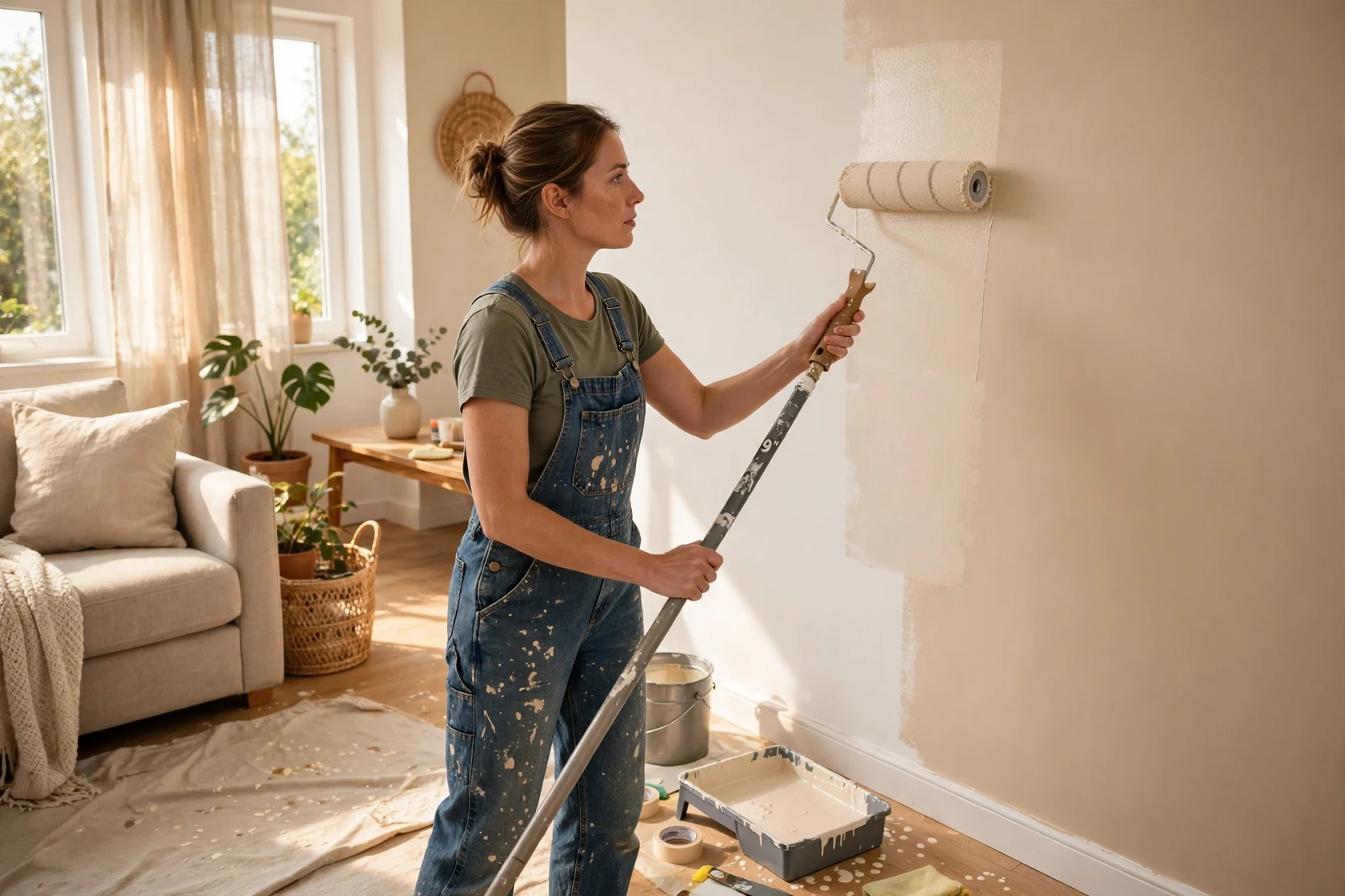
The best type of paint for interior walls is water-based acrylic latex in a low-VOC formula, with a flat or matte finish for ceilings and low-traffic walls and an eggshell or satin finish for living areas, hallways, kitchens and bathrooms. It fits about 90% of residential walls, is touch-dry in 1 to 2 hours and washes up with water.
What Is the Best Type of Paint for Interior Walls?
Acrylic latex paint is the best type of paint for interior walls in most homes because it combines durability, low odor, fast drying, flexibility and easy cleanup. Latex here is a trade term. It describes a water-based paint whose binder is a synthetic acrylic or vinyl acrylic polymer, so no natural rubber latex goes into the can.
Why acrylic latex wins for most rooms
Acrylic latex paint wins on 6 measurable points:
- Drying time: Touch-dry in 1 to 2 hours and recoatable in 2 to 4 hours, against 6 to 8 hours or more for alkyd paint.
- Flexibility: The film flexes with seasonal movement in drywall (plasterboard) and doesn’t crack.
- Color retention: Acrylic binders don’t yellow with age, which matters in white and pale colors.
- Odor and emissions: Water-based formulas release far fewer volatile organic compounds (VOCs) than solvent-based products.
- Cleanup: Brushes and rollers wash out with warm water and soap.
- Availability: Every major brand, including Sherwin-Williams, Benjamin Moore, Dulux, Behr, Valspar and PPG, sells multiple acrylic latex tiers.
When oil-based (alkyd) paint still makes sense
Oil-based paint suits trim, doors and cabinetry, where a hard, self-leveling film resists knocks. Alkyd paint cures to a harder surface than most wall paints, but it yellows over time in white shades and needs mineral spirits for cleanup, and its smell lingers for days. Water-based alkyd hybrids, which many manufacturers now sell, give a similar hard film with lower VOC content. For trim beside acrylic walls, they’re the practical pick.
Best Type of Interior Paint for Walls: Chemistry Compared
Acrylic latex, vinyl acrylic, alkyd, mineral (silicate), clay and lime paints are the 6 main chemistries for interior walls, and each one has a clear best use.
Comparison table
| Paint type | Binder | Best for | Durability | Odor and VOC | Drying (touch-dry) | Typical price tier |
|---|---|---|---|---|---|---|
| Acrylic latex | 100% acrylic polymer | Most walls, high-traffic areas | High | Low | 1 to 2 hours | Mid to premium |
| Vinyl acrylic (PVA) | Vinyl acetate and acrylic blend | Ceilings, rental units, new plaster | Low to medium | Low | 1 hour | Budget |
| Alkyd (oil-based) | Oil-modified resin | Trim, doors, cabinets | Very high (hard film) | High | 6 to 8 hours | Mid |
| Water-based alkyd hybrid | Alkyd-modified acrylic | Trim, doors, high-wear walls | High | Low to medium | 1 to 4 hours | Premium |
| Mineral (silicate) | Potassium silicate | Plaster, lime render, masonry | High on mineral surfaces | Very low | 2 to 4 hours | Premium |
| Clay and lime | Natural clay or slaked lime | Plaster, breathable period walls | Medium | Very low | 2 to 6 hours | Premium |
Vinyl acrylic is the budget option for ceilings and spare rooms. The 100% acrylic version costs more because its binder holds up under repeated cleaning. When durability matters, check the product data sheet, which lists the binder type, for “100% acrylic.”
Mineral, clay and lime paints
Mineral, clay and lime paints are the best choice for breathable plaster and masonry walls, particularly in older buildings. These products bond chemically with mineral substrates and let water vapor pass through, which reduces trapped moisture. Over existing acrylic-painted drywall they’re a poor choice, because the film won’t bond properly. Color choice is narrower than with acrylic latex.
Paint Finishes Explained: The Sheen Ladder
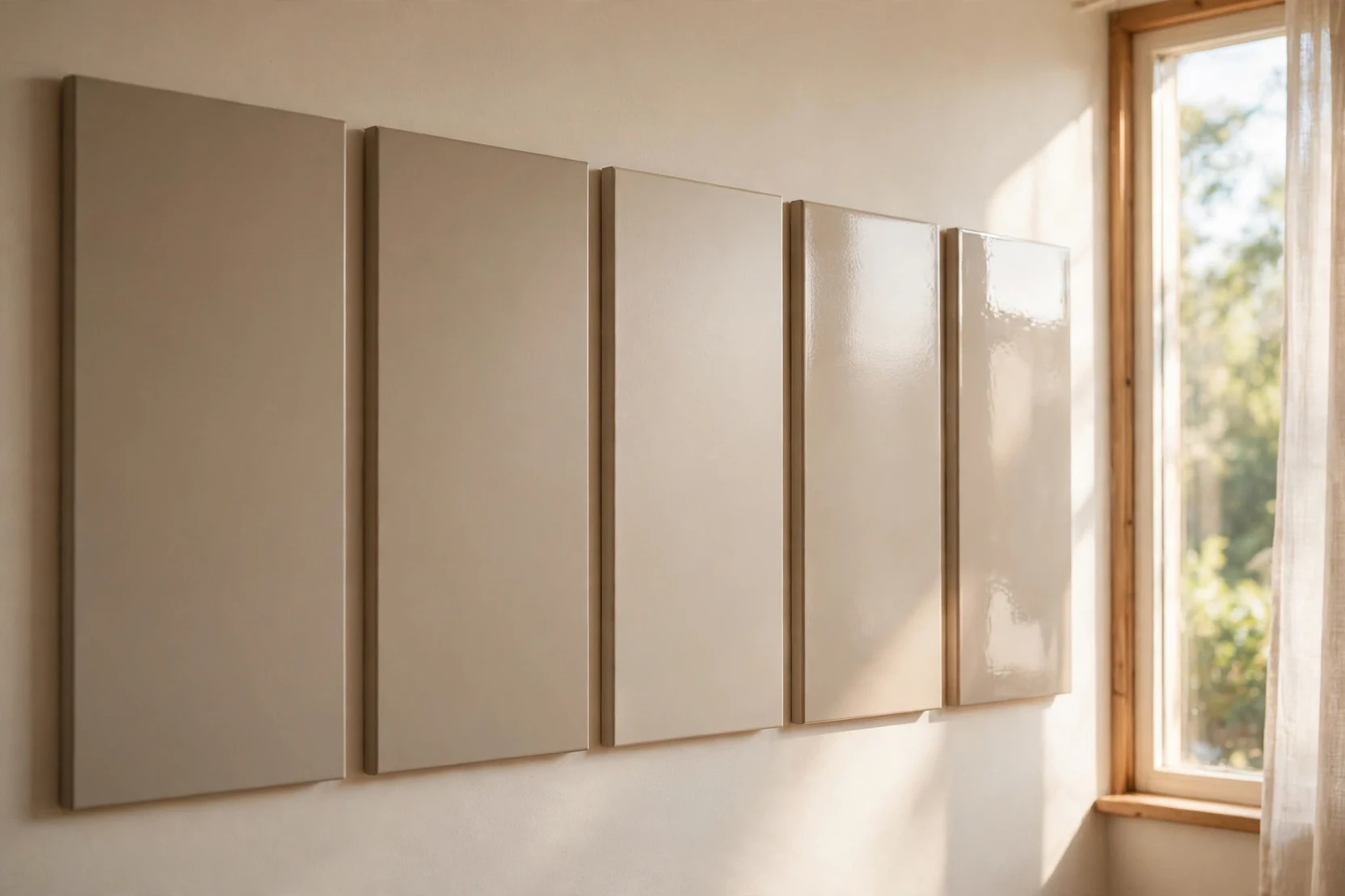
Paint finishes range across 6 levels, from flat to high-gloss, and each higher level increases shine, washability and visible surface imperfections.
| Finish | Typical gloss at 60° (GU) | Hides wall flaws | Washability | Best for |
|---|---|---|---|---|
| Flat | Below 5 | Excellent | Low | Ceilings, adult bedrooms, formal living rooms |
| Matte | 5 to 10 | Very good | Low to medium | Living rooms, bedrooms, low-traffic walls |
| Eggshell | 10 to 25 | Good | Medium | Hallways, living rooms, family rooms |
| Satin | 25 to 40 | Moderate | High | Kitchens, bathrooms, children’s rooms |
| Semi-gloss | 40 to 70 | Poor | Very high | Trim, doors, bathroom splash zones |
| High-gloss | Above 70 | Very poor | Very high | Doors, cabinets, accent furniture |
Gloss units behind sheen names
Gloss units (GU) measured at a 60° angle under the ASTM D523 test method are the objective measure of sheen, and sheen names vary by brand and country. One maker’s “matte” can read 8 GU. Another’s “eggshell” reads 12 GU. The European standard EN 13300 classifies gloss at 60° as matt (below 10 GU), mid-sheen (10 to 60 GU) and gloss (above 60 GU), while its 85° measurement classifies “flat matt” paints below 5 GU. Data sheets list GU values. Comparing them removes guesswork when you switch brands.
Satin vs flat paint
Satin is the better choice than flat paint for walls that are touched, splashed or scrubbed, and flat paint is the better choice for walls and ceilings that need to hide imperfections. The comparison breaks down across 4 factors:
- Cleaning: Satin tolerates repeated wiping with a damp cloth, while flat paint can burnish or lose pigment when scrubbed.
- Imperfections: Flat paint absorbs light and hides roller marks, patched drywall seams and uneven plaster, while satin highlights them under side lighting.
- Touch-ups: Flat paint blends invisibly in most cases, while satin touch-ups can show as shiny patches, a defect called flashing.
- Rooms: Satin suits kitchens, bathrooms, children’s rooms and hallways, and flat suits ceilings, dining rooms and bedrooms.
Eggshell vs flat paint
Eggshell is the better all-round choice than flat paint for living areas, and flat paint is better for ceilings and very uneven walls. Eggshell reflects about 10 to 25 GU of light and gives a soft glow that wipes clean with a damp sponge. Flat paint reflects under 5 GU, which produces a velvet, non-reflective look. Eggshell costs about the same as flat in most product lines, but it demands slightly more careful wall preparation, because its sheen reveals dents and sanding marks that flat paint conceals.
Best Interior Paint by Room
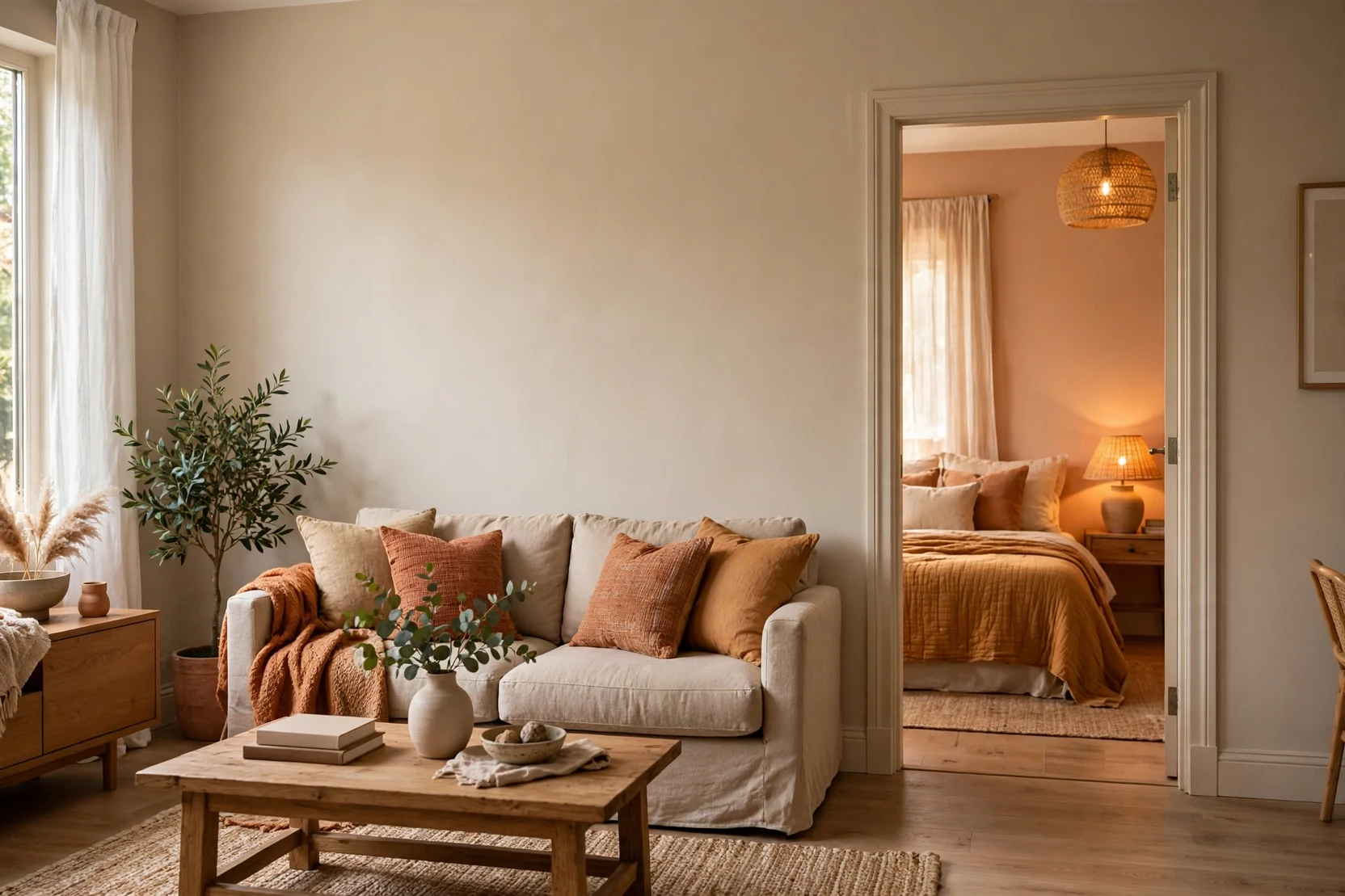
The best interior paint depends on the room’s traffic, moisture and light, and 4 room categories cover most homes.
| Room | Recommended chemistry | Recommended finish | Key feature to look for |
|---|---|---|---|
| Ceilings | Vinyl acrylic or acrylic latex | Flat | Spatter resistance, high hide |
| Bedrooms | Acrylic latex, low-VOC | Matte or flat | Low odor, soft light reflection |
| Living rooms | Acrylic latex | Matte or eggshell | Stain resistance, color depth |
| Hallways and stairs | 100% acrylic latex | Eggshell or satin | Scuff resistance, scrub class 1 or 2 |
| Kitchens | 100% acrylic latex | Satin | Washability, grease resistance |
| Bathrooms | Mould-resistant acrylic | Satin or semi-gloss | Moisture and mildew resistance |
| Trim and doors | Water-based alkyd hybrid | Semi-gloss | Hard film, block resistance |
Best interior wall paint for living rooms, bedrooms and hallways
The best interior wall paint for living rooms and bedrooms is a low-VOC acrylic latex in a matte or eggshell finish, and hallways need an eggshell or satin finish because bags, furniture and hands scuff the lower 1 meter (3 feet) of wall. Matte finishes in bedrooms cut glare from lamps and window light and let darker colors look deeper. Hallways stay cleaner for longer with a scuff-resistant paint rated scrub class 1 or 2.
Best paint finish for bathroom walls
The best paint finish for bathroom walls is satin or semi-gloss in a mould-resistant acrylic formula, because these finishes shed moisture and wipe clean. Without an extractor fan, a bathroom needs a mildew-resistant additive or a product rated for humid rooms. Ventilation that moves at least 15 liters per second (about 30 cubic feet per minute) in a standard bathroom reduces long-term condensation. Flat paint absorbs moisture and develops mildew spots within months. Avoid it here.
Best washable paint for walls (kitchens and high-traffic areas)
The best washable paint for walls is a 100% acrylic satin or eggshell with a wet scrub resistance of EN 13300 class 1 or 2, because these classes survive repeated cleaning without losing pigment. Grease settles within 1 to 2 meters (3 to 6 feet) of the cooker in kitchens, so satin on those walls and eggshell elsewhere balances washability with a softer appearance. Wait at least 3 to 4 weeks after painting before you scrub. The film reaches full hardness only after that period.
How to Judge the Best Interior Paint: Quality Markers
The best interior paint is identified by 5 measurable markers: scrub resistance, hide, solids content, VOC level and binder type. Price alone doesn’t identify the best type of paint for interior walls, though budget tiers generally contain more fillers and less titanium dioxide (TiO₂), the pigment that provides opacity and whiteness.
Scrub resistance (EN 13300 and ISO 11998)
ISO 11998 measures wet scrub resistance, and EN 13300 sorts the results into 5 classes, where class 1 survives the most cycles and class 5 the fewest. Class 1 means less than 5 micrometers of film loss after 200 scrub cycles, class 2 means 5 to less than 20 micrometers, and class 3 means 20 to less than 70 micrometers. Kitchens, hallways and children’s rooms call for class 1 or 2. Bedrooms and ceilings get by with class 3.
Coverage, hide and cost per area
A typical acrylic latex covers 10 to 12 m² per liter (400 to 480 sq ft per gallon) on a smooth primed surface. Rough or porous surfaces cut that to 6 to 8 m² per liter (240 to 320 sq ft per gallon). To estimate paint volume, divide wall area in m² by coverage in m²/L and multiply by the number of coats.
Take a 4 m by 5 m room with 2.5 m ceilings: it has about 45 m² of wall after subtracting a door and a window (roughly 485 sq ft). Two coats at 10 m² per liter need about 9 liters (2.4 US gallons).
| Paint tier | Price per liter (per gallon) | Coverage | Cost per m² per coat (per sq ft per coat) | Expected life |
|---|---|---|---|---|
| Budget | 5 to 9 USD (19 to 34 USD) | 8 m²/L (320 sq ft/gal) | 0.63 to 1.13 USD (0.06 to 0.11 USD) | 3 to 5 years |
| Mid-range | 10 to 18 USD (38 to 68 USD) | 10 m²/L (400 sq ft/gal) | 1.00 to 1.80 USD (0.09 to 0.17 USD) | 5 to 8 years |
| Premium | 20 to 35 USD (76 to 132 USD) | 11 m²/L (440 sq ft/gal) | 1.82 to 3.18 USD (0.17 to 0.30 USD) | 8 to 12 years |
Prices are indicative ranges that vary by country and retailer. Premium paint costs more per liter but often costs less per year of service, since it needs fewer coats and fewer repaints. Run the numbers: a premium paint lasting 10 years at 2.50 USD per m² per coat costs 0.50 USD per m² per year for two coats, while a budget paint lasting 4 years at 0.90 USD per m² per coat costs about 0.45 USD per m² per year. Still, the premium paint requires less labor over the same period.
Best Low-VOC Interior Paint and Regional Rules
The best low-VOC interior paint contains under 50 grams of VOC per liter (0.42 pounds per gallon), and zero-VOC paints contain under 5 g/L. VOCs are carbon-based chemicals that evaporate from wet paint and add to indoor air pollution. Headaches and respiratory irritation are the usual effects.
| Region | Regulation | Limit for interior matt wall paint (water-based) | Notes |
|---|---|---|---|
| European Union | Directive 2004/42/EC | 30 g/L (Phase II, subcategory a) | Labels show the category and limit value |
| United States | US EPA national rule, California CARB, SCAQMD | 50 g/L in California and South Coast districts, 250 g/L nationally for flat coatings | Rules vary by state |
| United Kingdom | Paints (Limitation on Volatile Organic Compounds) regulations, aligned with EU limits | 30 g/L | Follows EU-equivalent limits |
| Australia | Voluntary Green Star and AS/NZS 4361 | Voluntary levels around 16 g/L for Green Star credit | Mandatory limits are not universal |
For a non-toxic wall paint, look for third-party certifications such as Green Seal GS-11 and GREENGUARD Gold, both of which cover low chemical emissions. VOC content is measured in the wet paint. Certification tests emissions in the finished room, so it gives a fuller picture. Ventilate rooms for at least 48 hours after painting, even with zero-VOC products, because colorants and additives still emit small amounts of compounds.
Substrates, Primer and Climate
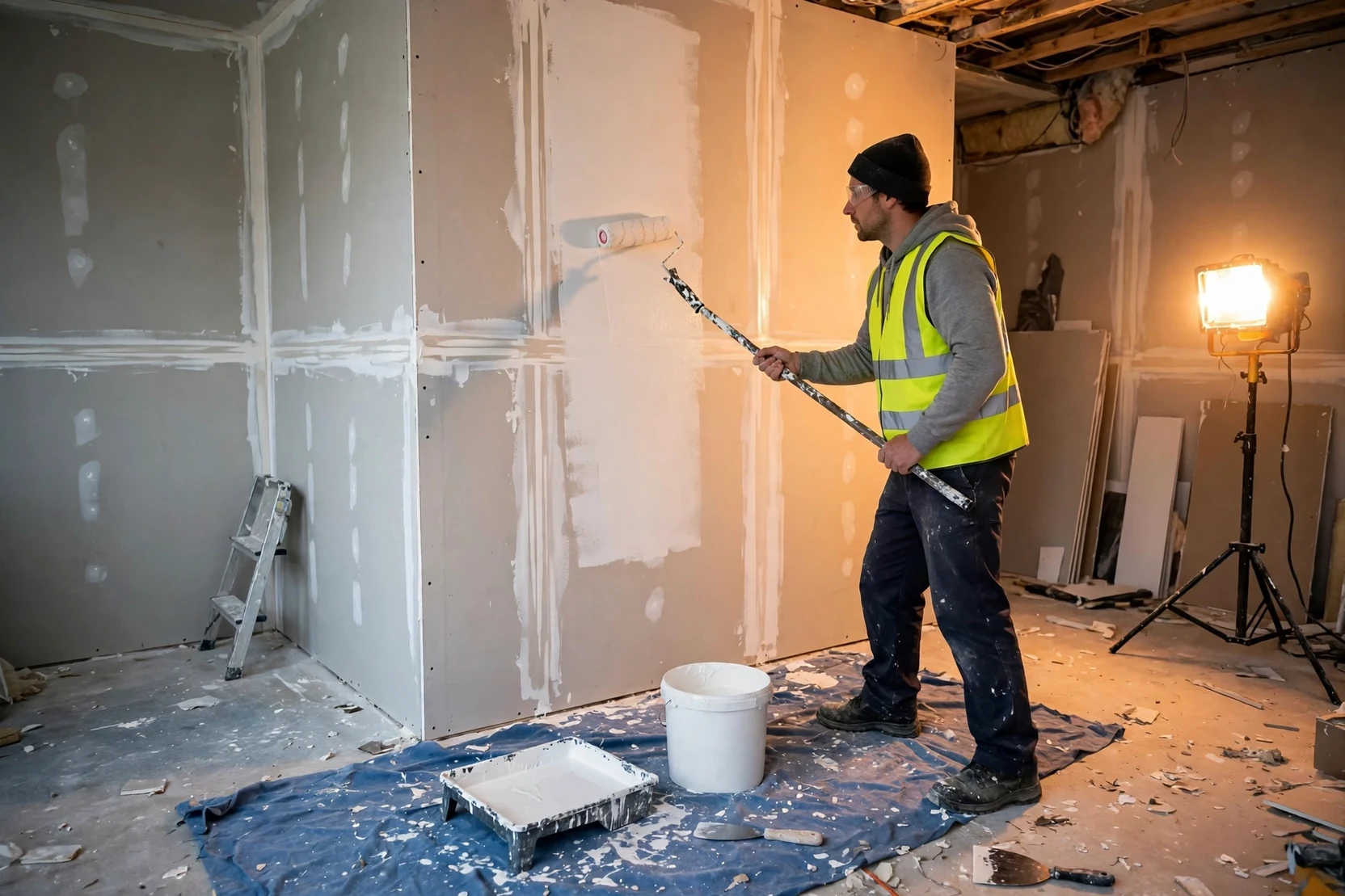
Drywall, plaster, masonry and wood need different preparation, and primer is mandatory on new, patched, stained or very porous surfaces.
- Drywall (plasterboard): Apply a PVA primer on new boards, because the paper face and joint compound absorb paint at different rates and cause uneven sheen called flashing.
- Plaster: Allow new plaster to dry for 4 to 6 weeks, then apply a mist coat of 50% water and 50% matte emulsion, or use a mineral paint for breathability.
- Masonry and concrete: Use an alkali-resistant primer and wait until the wall is below 4% moisture content, as measured with a moisture meter.
- Wood and painted trim: Sand to a dull finish with 180 to 220 grit paper and apply a bonding primer.
- Stained walls: Use a stain-blocking primer on water marks, smoke, grease and tannin bleed, because acrylic latex alone lets stains reappear.
Paint-and-primer-in-one products work on previously painted walls in good condition. They don’t replace separate primer on bare drywall, plaster or heavy stains.
Climate affects performance across 3 conditions. In high-humidity regions, such as tropical and coastal zones, mould-resistant acrylic is the best type of paint for interior walls, in satin finishes on bathroom, kitchen and exterior-facing walls. Cold climates call for painting only when the room temperature is at least 10°C (50°F), because acrylic latex doesn’t form a proper film below its minimum film-forming temperature. Dry, hot climates reward small sections and a wet edge, since paint dries before it levels.
Application Notes and Common Mistakes
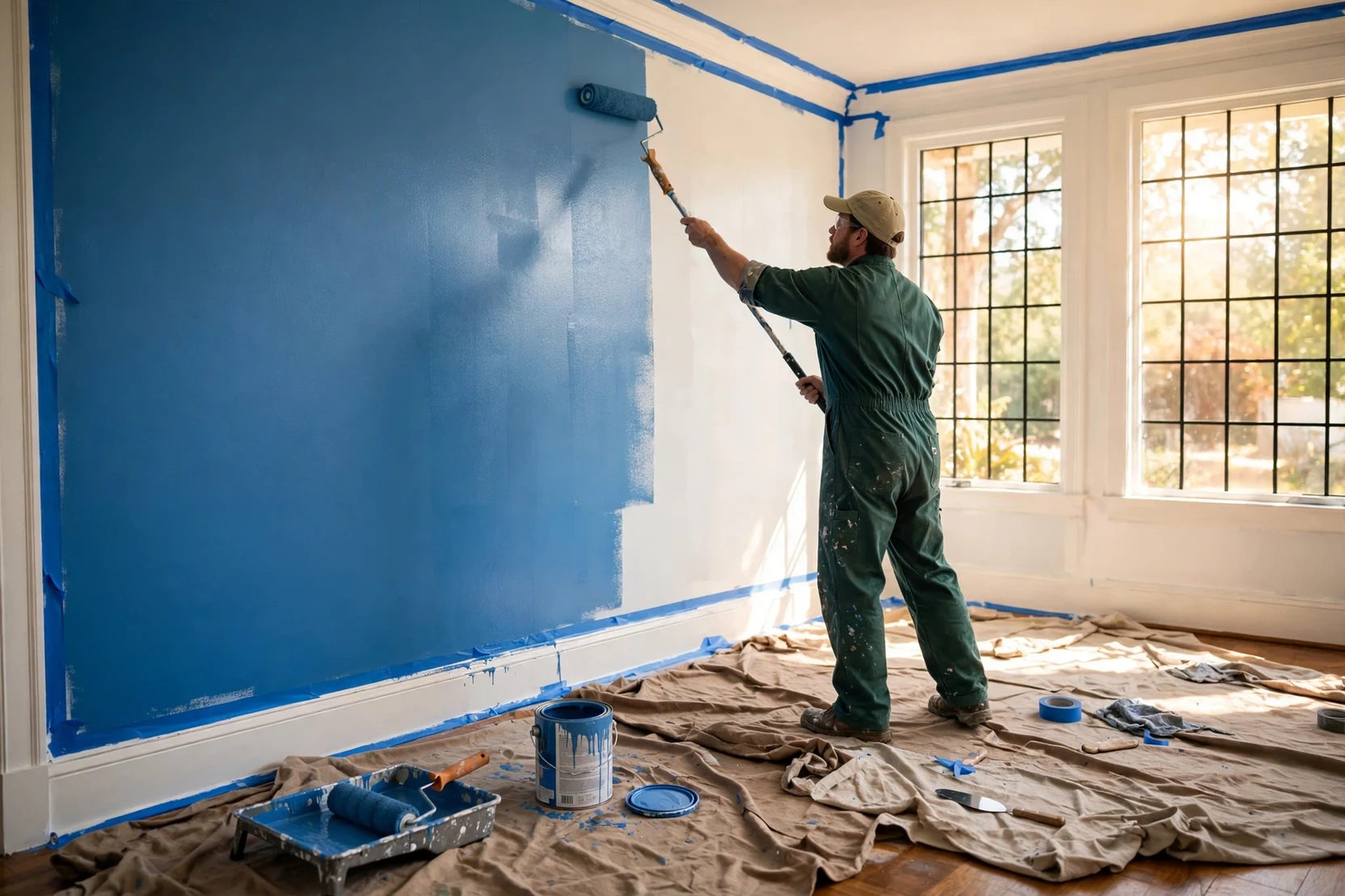
To apply interior wall paint correctly, follow these 7 steps in order:
- Fill holes and cracks with lightweight filler and sand smooth with 120 to 180 grit paper.
- Wash grease and dust from the walls with a mild detergent solution and let them dry for 2 to 4 hours.
- Mask trim and floors with painter’s tape and drop cloths.
- Apply primer to bare, patched or stained areas.
- Cut in corners and edges with a 50 mm (2 inch) angled brush.
- Roll the first coat with a 10 mm (3/8 inch) nap roller on smooth walls, or a 13 to 19 mm (1/2 to 3/4 inch) nap on textured walls.
- Apply a second coat after the time stated on the can, usually 2 to 4 hours.
6 common mistakes cause most failed paint jobs:
- Skipping primer on patches, which creates dull spots called flashing
- Painting damp walls, which causes blistering and peeling
- Choosing a flat finish for kitchens and bathrooms, which stains and absorbs moisture
- Stopping mid-wall, which leaves visible lap marks when the edge dries
- Buying too little paint, which risks color variation between batches
- Using cheap rollers, which shed lint and leave an uneven texture
Buy 10% extra paint. Mix all cans of the same color together in one large container, a technique called boxing, to prevent batch variation. For touch-ups, store leftover paint in a sealed, labeled container away from freezing temperatures, because a 0.5 liter (1 pint) can covers small repairs for 2 to 3 years.
Conclusion
The best type of paint for interior walls is a 100% acrylic latex with a low-VOC formula, applied in flat or matte on ceilings and bedrooms, eggshell in living areas and hallways, and satin in kitchens and bathrooms. Sheen names mislead, so compare gloss units and EN 13300 scrub classes, and calculate quantities with 10 to 12 m² per liter (400 to 480 sq ft per gallon) for two coats. Prime new drywall, plaster and stains, and use mineral or clay paints on breathable plaster and masonry walls. Before you commit to a full room, test a sample on a 1 m by 1 m (3 ft by 3 ft) patch and view it in morning and evening light.
FAQs

Related Posts