Green Building Materials: How to Choose, Compare and Certify
Green building materials are construction products that cut environmental and health impacts across a life cycle spanning extraction, manufacturing, installation, use and disposal. Proof separates them from the rest. The strongest picks carry third-party documentation such as an Environmental Product Declaration (EPD) or Forest Stewardship Council (FSC) certification, many interior products add UL GREENGUARD Gold, and every good choice suits the project’s climate zone and budget.
Key Takeaways
- The greenest choice for any project is the material with verified low embodied carbon, low chemical emissions and a long service life in that project’s climate.
- An Environmental Product Declaration (EPD) is the most reliable proof of a product’s carbon footprint, and the free EC3 tool compares EPDs side by side.
- Leadership in Energy and Environmental Design (LEED) is the most recognized green building certification in the USA, and the National Green Building Standard (NGBS) is the main residential alternative.
- FSC-certified lumber, cellulose insulation and low-emission paint are sold by mainstream US retailers, including Home Depot and Lowe’s.
- Federal legislation signed in July 2025 ended the 25C home improvement tax credit for property placed in service after December 31, 2025, so check IRS.gov and state programs for current incentives.
- Durability matters as much as recycled content, because replacing a failed product adds a second round of manufacturing impacts.
What Are Green Building Materials?
Green building materials are construction products that lower environmental and health impacts through recycled or renewable content, low embodied carbon, low chemical emissions, energy efficiency or long durability. Most products excel in only one or two of these traits, so the real goal is the best verified balance for a specific building rather than a flawless product. That’s normal.
Architects and builders, along with retailers, treat “eco friendly green building materials” and “environmentally friendly building materials” as interchangeable phrases, and “green construction materials” means the same thing. Nothing separates them. Every one of these phrases points to a building that uses fewer resources and emits less carbon while keeping the people inside healthy.
The table below compares the five traits that make a material green and the proof to request for each.
| Trait | What It Means | Proof to Request |
|---|---|---|
| Low Embodied Carbon | Less greenhouse gas from making the product | Product-specific EPD |
| Recycled or Reclaimed Content | Uses waste or salvaged material | Recycled content certification or EPD |
| Renewable Sourcing | Comes from fast-regrowing or managed sources | FSC chain-of-custody certificate |
| Low Chemical Emissions | Releases few indoor air pollutants | UL GREENGUARD Gold or FloorScore |
| Durability | Lasts decades with little maintenance | Warranty and ASTM test data |
How to Verify a Material Is Green
Words like “natural” or “eco” mean nothing without documents behind them. Treat them as noise. The Federal Trade Commission (FTC) Green Guides warn sellers against vague environmental claims, and buyers should bring that same skepticism to every spec sheet they read.
- Request a product-specific EPD that follows ISO 14025, not an industry-average EPD, whenever one exists.
- Ask for a Health Product Declaration (HPD) or a Declare label to see the product’s chemical ingredients.
- Check for an emissions certification, such as UL GREENGUARD Gold for interior products or FloorScore for hard-surface flooring.
- Confirm wood and bamboo sourcing with an FSC chain-of-custody number, then verify that number in the FSC public database.
- Search the product in the free EC3 tool from Building Transparency to compare its carbon data against similar products.
- Reject any claim that the seller can’t back with a document you can read.
Types of Eco Friendly Green Building Materials
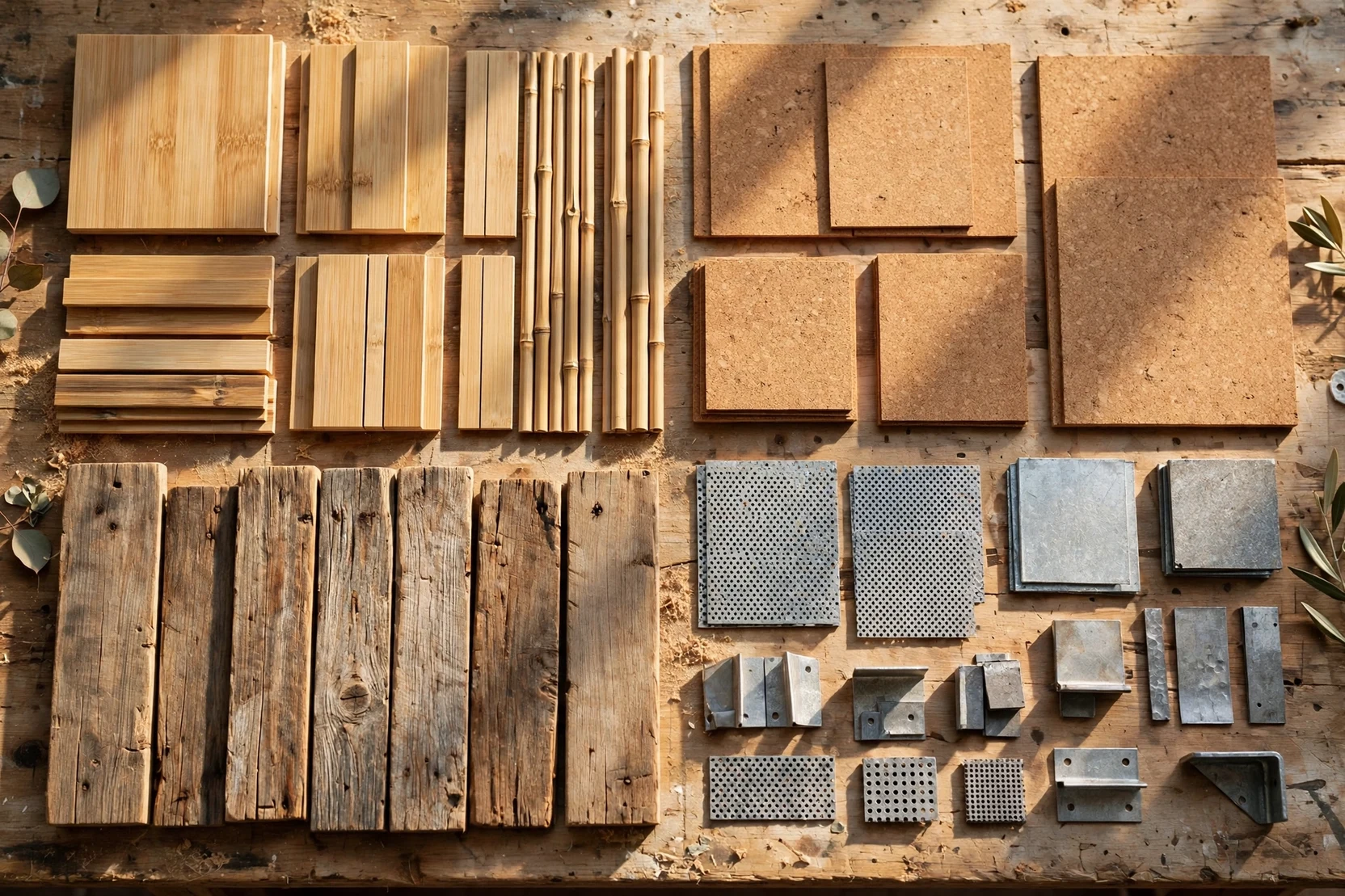
The main categories of eco friendly green building materials are sustainably sourced wood, recycled metals, low-carbon concrete, low-impact insulation, natural wall systems and low-emission finishes. Each category targets its own problem. Some cut embodied carbon in the structure, and others protect indoor air quality inside finished rooms once the building is occupied.
Several new building materials, including cross-laminated timber and hempcrete, now have their own dedicated paths written into US model codes. Old options still compete. Reclaimed brick and cellulose, both long-standing eco friendly materials, remain some of the lowest-impact choices available.
The table below compares common material types by their main benefit, best use and main caution.
| Material | Main Green Benefit | Best Use | Watch Out For |
|---|---|---|---|
| Reclaimed Wood | Reuses existing lumber | Flooring, beams, accent walls | Needs regrading for structural use |
| FSC-Certified Lumber | Responsibly harvested renewable resource | Framing, sheathing, trim | Verify chain-of-custody number |
| Cross-Laminated Timber (CLT) | Stores carbon, replaces concrete and steel | Mid-rise structures | Requires engineering and fire design |
| Bamboo | Fast-growing renewable grass | Flooring, cabinetry | Import distance, adhesive emissions |
| Recycled Steel | High recycled content, fully recyclable | Framing, roofing, structure | Energy-intensive if not scrap-based |
| Low-Carbon Concrete | Less cement in the mix | Foundations, slabs | Slower early strength in cold weather |
| Cellulose Insulation | Made mostly from recycled paper | Attics, wall cavities | Must stay dry |
| Hempcrete | Plant-based, vapor-open infill | Non-structural walls | Few US suppliers and installers |
| Rammed Earth | Uses local soil, high thermal mass | Walls in dry climates | Specialist builders, high labor cost |
| Low-VOC Paint | Fewer indoor air pollutants | Interior walls and trim | Check third-party emissions label |
Wood, Bamboo and Mass Timber
Wood is the only major structural material that grows back, and it stores carbon for as long as the building stands. Reclaimed wood goes further. It skips new harvesting entirely, and salvage yards across the country sell beams and flooring, along with siding, pulled from demolished barns and factories.
Cross-Laminated Timber (CLT) is a mass timber panel built from layers of lumber glued at right angles. Codes caught up in 2021. The 2021 International Building Code (IBC) added construction Types IV-A, IV-B and IV-C, permitting mass timber buildings up to 18 stories and 270 feet (82 m) in specific occupancies.
Bamboo is a grass, not a tree. After harvest, the plant regrows from its roots, and it performs well in flooring and cabinetry as long as the adhesives holding it together are low-emission.
Recycled Steel and Low-Carbon Concrete
Most US structural steel comes from electric arc furnace (EAF) mills that melt down scrap steel, which gives the finished product high recycled content. The cycle can repeat. Steel survives recycling again and again without losing strength, so today’s frame becomes feedstock for future buildings.
Low-carbon concrete swaps part of the portland cement for supplementary cementitious materials (SCMs) such as fly ash or slag cement. Finding it isn’t hard. Concrete suppliers in most US metro areas will batch these mixes on request.
Insulation and Natural Wall Systems
Cellulose insulation is made mostly from recycled newsprint, and that paper is treated with borate fire retardants to slow flame spread. Its embodied carbon is very low. The material also fills irregular cavities well.
Mineral wool insulation is made from rock or slag, and it resists both fire and moisture. Builders also use it as continuous exterior insulation board. Insulated concrete forms (ICFs) are hollow foam blocks filled with concrete, and they deliver strong thermal performance and storm resistance. The catch is higher embodied carbon.
Hempcrete is a mix of hemp hurd and lime binder used as non-structural wall infill, and the 2024 International Residential Code (IRC) added Appendix BL to cover hemp-lime construction. Rammed earth works differently. Builders compact moist soil into thick walls that store heat and release it slowly.
Low-VOC Finishes and Flooring
Volatile organic compounds (VOCs) are gases released from paints, adhesives, sealants and furniture, and the US Environmental Protection Agency (EPA) lists them as a major indoor air quality concern. Better paint helps. Low-VOC and zero-VOC formulas cut these emissions.
Composite wood products sold in the USA must meet formaldehyde emission limits under Title VI of the Toxic Substances Control Act (TSCA). Flooring needs its own check. Look for FloorScore certification on cork, linoleum, bamboo and wood products.
What Is the Most Eco-Friendly Building Material?
No single material is the most eco-friendly everywhere; reclaimed wood and other salvaged materials rank highest because they reuse existing products and avoid new manufacturing. Among new products, FSC-certified wood and cellulose insulation rank near the top for low embodied carbon and long service life, and earthen materials such as rammed earth sit alongside them. Salvage still leads.
Local stock matters too. A material shipped across the country gives back part of its advantage to transport emissions, so what nearby suppliers carry shapes the best choice for any given site.
The table below compares regional availability for top low-impact materials in the USA.
| Material | US Availability | Strongest Regions |
|---|---|---|
| Reclaimed Wood | Nationwide through salvage dealers | Older industrial areas of Northeast and Midwest |
| FSC-Certified Lumber | Nationwide through lumberyards | All regions |
| Cellulose Insulation | Nationwide at big-box retailers | All regions |
| Rammed Earth | Specialist builders only | Southwest and West |
| Hempcrete | Limited specialist suppliers | No verified regional data available |
| CLT | Few manufacturers, ships nationally | No verified regional data available |
What Is Embodied Carbon in Construction?
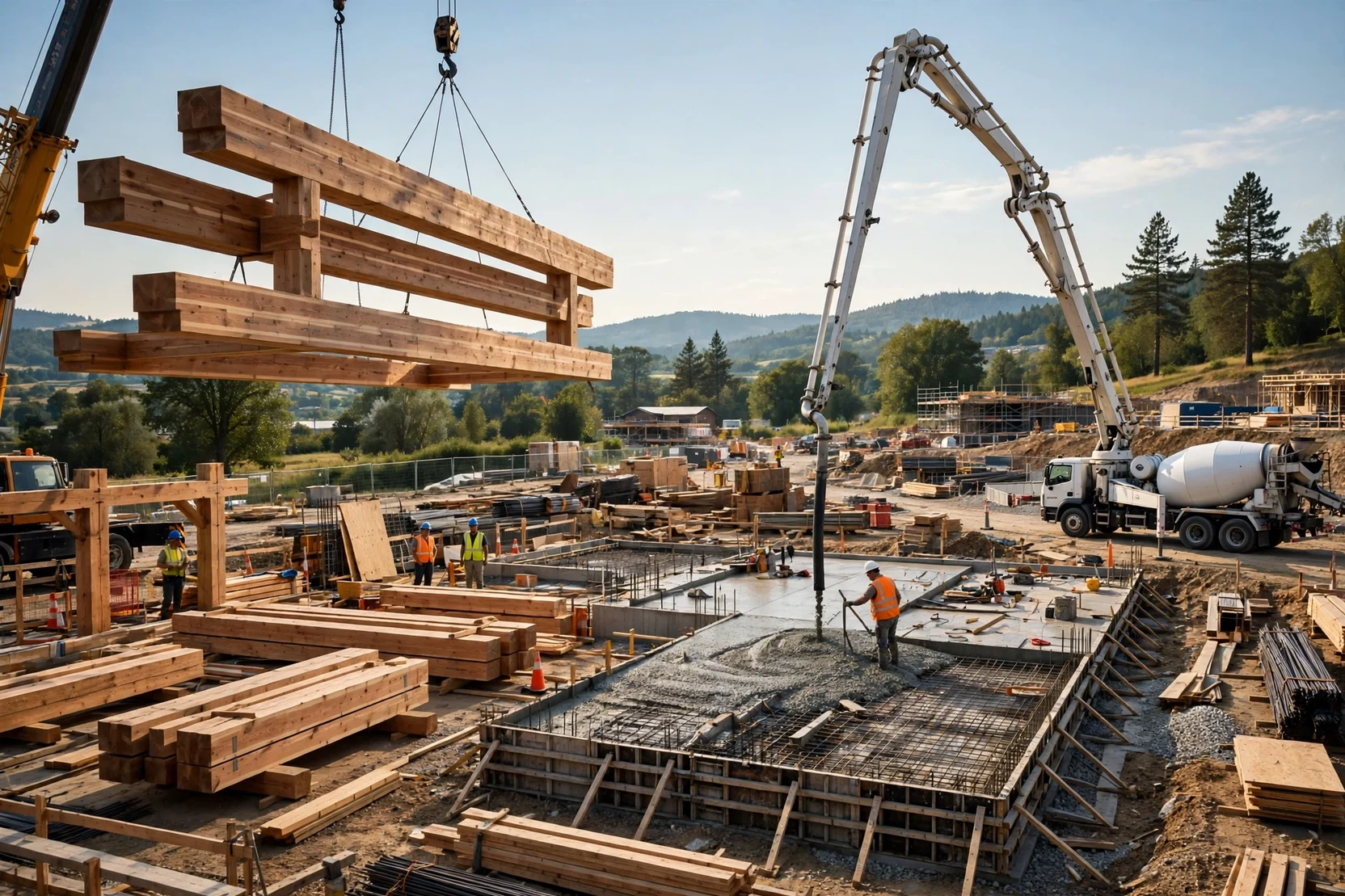
Embodied carbon is the greenhouse gas emitted to extract, manufacture, transport, install, maintain and dispose of building materials, as distinct from operational carbon released by heating, cooling and powering the building. It’s locked in after construction. Material selection and efficient structural design are therefore the only ways to reduce embodied carbon.
A life cycle assessment (LCA) measures these emissions stage by stage. Most EPDs stop early. Their “cradle to gate” results cover raw material supply and transport to the factory, along with manufacturing itself, so most product EPDs leave out later stages.
EPDs report global warming potential (GWP) in kilograms of carbon dioxide equivalent per declared unit, such as one cubic yard of concrete or one ton of steel. Units set the limits. Because of that declared unit, products compare fairly only within their own category.
How to Compare Embodied Carbon with EPDs
Comparing two EPDs takes only a few minutes when both products share the same rules, and the steps below keep that comparison fair. Start with the rules.
- Confirm that both EPDs follow the same product category rule (PCR), which sets the measurement method for that product type.
- Match the declared unit, such as square feet of flooring or cubic yards of concrete.
- Compare products with equal performance, such as concrete of the same compressive strength.
- Prefer product-specific or plant-specific EPDs over industry-average EPDs.
- Search the free EC3 tool to see where a product falls against others in its category.
Is Concrete Environmentally Friendly?
No, conventional concrete is not environmentally friendly because portland cement, its binder, is carbon-intensive to produce. Concrete still earns a place in green construction through durability and thermal mass. Better mixes help. Low-carbon blends using fly ash, slag cement or portland-limestone cement reduce concrete’s embodied carbon with little change to placement.
Here’s how the low-carbon concrete options available to US projects compare.
| Option | How It Cuts Carbon | Notes |
|---|---|---|
| Fly Ash Mixes | Replaces part of the cement | Supply depends on regional coal plants |
| Slag Cement Mixes | Replaces part of the cement | Common in Midwest and East markets |
| Portland-Limestone Cement (Type IL) | Uses less clinker than ordinary cement | Covered by ASTM C595 |
| CO2 Mineralization | Injects captured CO2 into fresh concrete | Offered by select ready-mix suppliers |
| Performance-Based Specs | Lets suppliers optimize cement content | Specify strength, not cement quantity |
Public procurement is pushing these options forward. The Buy Clean California Act sets carbon limits for structural steel, concrete reinforcing steel, flat glass and mineral wool board insulation on state projects, and other states have studied similar rules.
Is Bamboo a Sustainable Building Material?
Yes, bamboo is a sustainable building material when it comes from responsibly managed plantations and uses low-emission adhesives, because bamboo is a fast-growing grass that regrows from its roots after harvest. Distance is bamboo’s weak spot. Most bamboo flooring sold in the USA is imported, so the trip adds to its carbon footprint.
No law requires FSC certification for bamboo, but FSC-certified stock still gives the clearest proof of responsible harvesting. Construction type matters too. Strand-woven bamboo flooring is harder than traditional horizontal or vertical bamboo, so it holds up better in kitchens and entryways.
Ask the seller for FloorScore or UL GREENGUARD Gold certification, along with an adhesive disclosure that names the bonding agents in the product. Paperwork protects two things. It backs up the environmental claim and safeguards your indoor air quality.
Green Building Certifications Compared
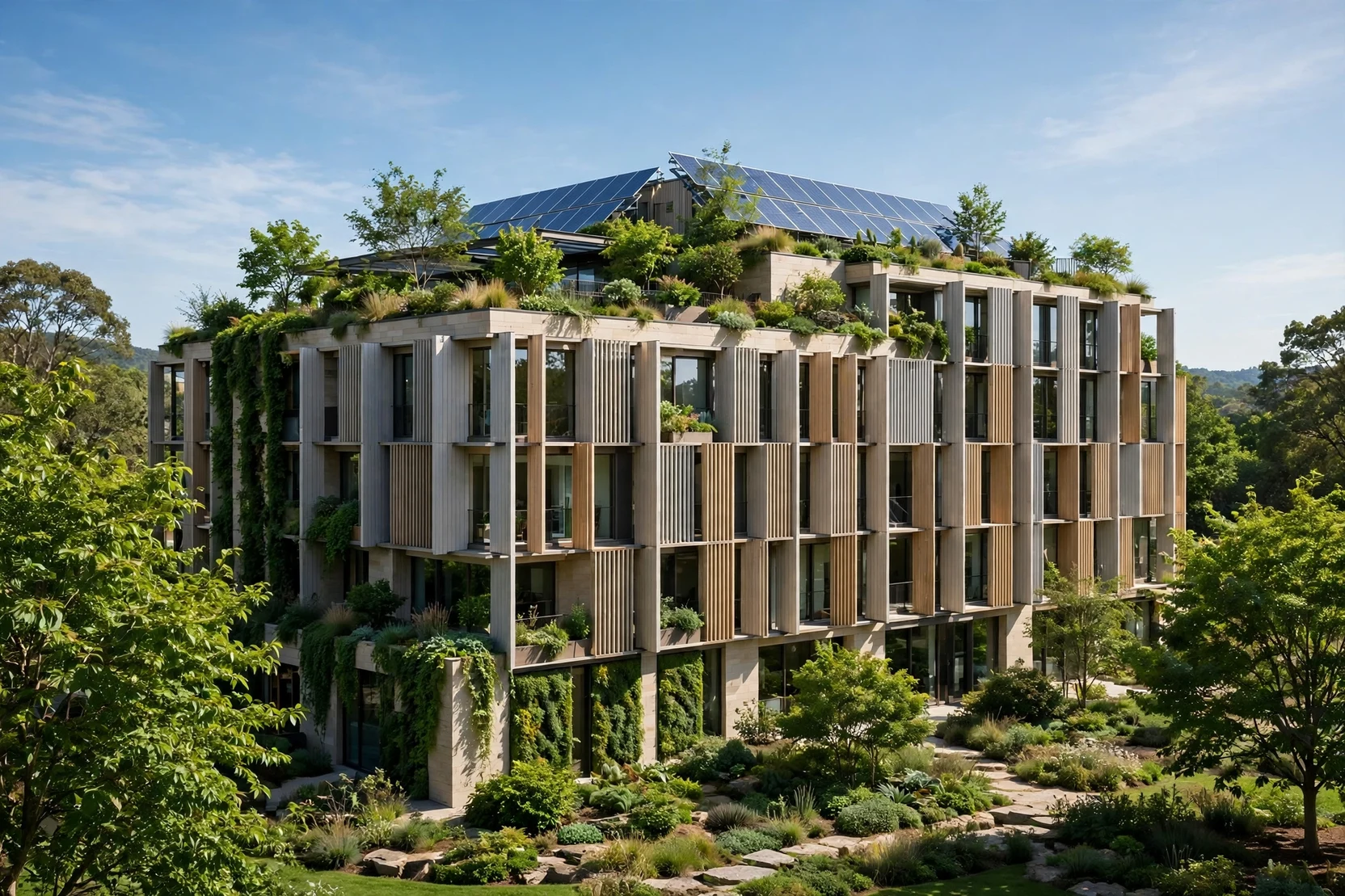
The main green building certifications in the USA are LEED for most commercial and multifamily projects, the National Green Building Standard (NGBS) for homes, Energy Star for efficient homes and products, and the Living Building Challenge for the strictest projects. UK-origin BREEAM sees limited US use.
This table sets the major certifications side by side by owner, best fit and material focus.
| Certification | Run By | Best For | Material Focus |
|---|---|---|---|
| LEED | U.S. Green Building Council (USGBC) | Commercial, multifamily, homes | EPDs, sourcing, ingredients, waste |
| NGBS (ICC 700) | Home Innovation Research Labs certifies | Single-family and multifamily homes | Resource efficiency, indoor air |
| Energy Star | EPA | Efficient homes and products | Energy performance, not materials |
| Living Building Challenge | International Living Future Institute (ILFI) | Net-positive showcase projects | Red List chemical ban |
| BREEAM | BRE Group | UK and international projects | Responsible sourcing, life cycle impacts |
What Is the Difference Between LEED and BREEAM?
LEED is the US standard, so American projects should pursue it unless an owner or an international portfolio requires BREEAM instead. Oversight differs. The USGBC runs LEED, with third-party review handled by Green Business Certification Inc. (GBCI), while the Building Research Establishment Environmental Assessment Method (BREEAM) was created by the UK’s Building Research Establishment and relies on licensed assessors.
LEED and BREEAM penetration shapes materials selection in each market. The effect is practical. Because US manufacturers organize their EPDs and HPDs, plus sourcing documents, around LEED credits, product data for LEED projects is easier to track down in the USA.
The table below compares LEED and BREEAM on the points that matter to US teams.
| Factor | LEED | BREEAM |
|---|---|---|
| Origin | USA | United Kingdom |
| US Market Use | Dominant | Limited |
| Rating Levels | Certified, Silver, Gold, Platinum | Pass, Good, Very Good, Excellent, Outstanding |
| Verification | GBCI review of submitted documents | Licensed assessor review |
| US Product Data Support | Extensive | Limited |
How Materials Earn Certification Credits
Each certification rewards materials differently, so a single product can earn credit in several systems at once. Versions matter. The credit names below come from LEED v4.1, but USGBC released LEED v5 in 2025, so confirm the names in whichever version your project registers under.
The table below maps common materials to the credits they support in each system.
| Material | LEED V4.1 Credit | NGBS Practice Area | Living Building Challenge |
|---|---|---|---|
| Product With EPD | Building Product Disclosure: EPDs | Resource efficiency | Supports embodied carbon reporting |
| FSC-Certified Wood | Sourcing of Raw Materials | Resource efficiency | Meets responsible sourcing for wood |
| Reclaimed Wood | Building Life-Cycle Impact Reduction | Resource efficiency | Meets responsible sourcing for wood |
| Product With HPD or Declare | Material Ingredients | Indoor environmental quality | Supports Red List verification |
| GREENGUARD Gold Finishes | Low-Emitting Materials | Indoor environmental quality | Must also avoid Red List chemicals |
| Recycled Steel | Sourcing of Raw Materials | Resource efficiency | Depends on full ingredient disclosure |
How to Choose Green Construction Materials
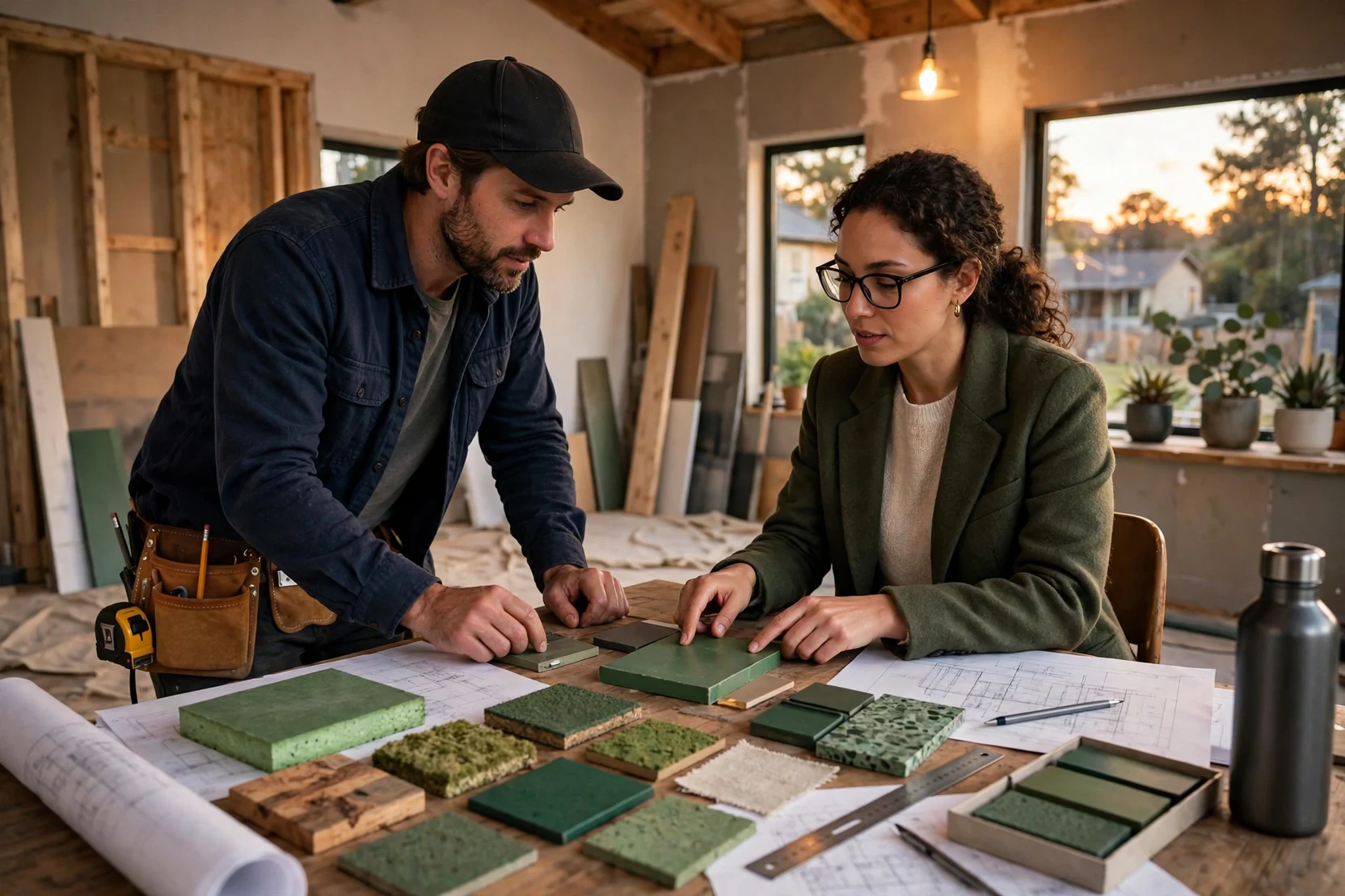
Choose green construction materials by scoring each option on embodied carbon, indoor air quality, cost and durability, then checking its fit for the local climate zone and the certification the project targets. This scoring method replaces guesswork with documents, and it works for a kitchen remodel just as well as for a new office building. Project size doesn’t change it.
Material Selection Scorecard
The scorecard ratings below are relative comparisons drawn from common US residential use, and they aren’t measured values from any lab test. Treat them as a starting point. Verify each rating against the product’s own EPD and emissions certification before purchase.
The table below compares common materials across four selection criteria.
| Material | Embodied Carbon | Indoor Air | Cost Tier | Durability |
|---|---|---|---|---|
| Reclaimed Wood | Very low | Good with low-VOC finish | Medium to high | High |
| FSC-Certified Lumber | Low | Good with low-VOC finish | Medium | High |
| CLT | Low to medium | Good | High | High |
| Bamboo Flooring | Medium | Good if certified | Medium | Medium to high |
| Recycled Steel | Medium | Neutral | Medium | Very high |
| Low-Carbon Concrete | Medium | Neutral | Low to medium | Very high |
| Cellulose Insulation | Very low | Good | Low | High if kept dry |
| Mineral Wool | Medium | Good | Medium | High |
| Hempcrete | Very low | Good | High | High |
| Low-VOC Paint | Low | Very good | Low | Medium |
Use the scorecard with these steps.
- List every major material by building assembly: structure, envelope, insulation, finishes and flooring.
- Rank the assemblies by quantity, because foundations, framing and insulation carry most of a building’s embodied carbon.
- Score two or three options for each assembly with the scorecard columns.
- Request EPDs and emissions certifications for the top option in each assembly.
- Check each choice against the target certification’s credit requirements.
- Confirm local availability and installer experience before you finalize the specification.
Matching Materials to US Climate Zones
The International Energy Conservation Code (IECC) divides the USA into numbered climate zones, running from hot (Zone 1) all the way to subarctic (Zone 8). Finding yours is simple. The US Department of Energy (DOE) publishes the county-level map on energycodes.gov.
This table lines up material priorities across US climate zones.
| Climate Zones | Example Cities | Material Priorities |
|---|---|---|
| 1 to 2 (Hot-Humid) | Miami, Houston | Mold-resistant materials, CRRC-rated cool roofing |
| 2 to 3 (Hot-Dry) | Phoenix, Las Vegas | Rammed earth, thermal mass, cool roofing |
| 3 to 4 (Mixed) | Atlanta, New York City | Cellulose, balanced insulation, efficient windows |
| 4 Marine | Seattle, Portland | FSC wood, rainscreen siding, moisture control |
| 5 to 6 (Cold) | Chicago, Minneapolis | Mineral wool exterior board, ICFs, dense cellulose |
| 7 to 8 (Very Cold) | Duluth, Fairbanks | Thick continuous insulation, airtight assemblies |
Cool roofing rated by the Cool Roof Rating Council (CRRC) reflects sunlight and cuts cooling loads in hot zones. Cold zones flip the priority. There, thick insulation and airtight construction pay off most, and low-carbon options like cellulose deliver both energy savings and lower embodied carbon.
Are Green Building Materials More Expensive?
No, green building materials are not always more expensive; low-VOC paint, cellulose insulation and low-carbon concrete mixes are often priced close to conventional options, while CLT, hempcrete and rammed earth carry premium prices. Price tags mislead. Lifetime cost matters more than purchase price, because durable and efficient materials keep lowering energy and replacement bills.
No verified figure is available for a standard payback period. Too much varies. Payback depends on local energy prices, climate zone, installation quality and the conventional product being replaced, so ask your builder or energy rater for a project-specific energy model.
The table below compares typical price positions and the main payback drivers for common materials.
| Material | Price vs Conventional | Payback Driver |
|---|---|---|
| Low-VOC Paint | Similar | Health benefit, not energy savings |
| Cellulose Insulation | Similar | Lower heating and cooling bills |
| Low-Carbon Concrete | Similar to slightly higher | Durability; no energy payback |
| Reclaimed Wood | Often higher | Durability and resale appeal |
| CLT | Higher material cost | Faster construction schedules |
| Hempcrete | Higher | Thermal comfort, moisture control |
Do Green Materials Qualify for Tax Credits?
No, most green materials no longer qualify for new federal homeowner tax credits. Timing decides everything. Legislation signed in July 2025 ended the Energy Efficient Home Improvement Credit (25C) for property placed in service after December 31, 2025, and it ended the New Energy Efficient Home Credit (45L) for homes acquired after June 30, 2026.
Confirm the current status of each credit on the Internal Revenue Service (IRS) website before you buy, because eligibility rules hinge on installation and closing dates. Don’t guess.
Here are the incentives US buyers should check, compared by coverage and status.
| Incentive | Covers | What to Check |
|---|---|---|
| 25C Credit | Insulation, windows, doors, heat pumps | Ended after December 31, 2025 per 2025 law |
| 45L Credit | Builders of efficient new homes | Ends for homes acquired after June 30, 2026 |
| State Home Energy Rebates | Efficiency upgrades | Program status varies by state |
| Utility Rebates | Insulation, windows, equipment | Search the DSIRE database by ZIP code |
Are Recycled Materials as Durable as New Ones?
Yes, many recycled materials match new ones in durability, because recycled steel, recycled aluminum and properly graded reclaimed lumber meet the same ASTM and building code standards as virgin products. Durability depends on the material and its installation rather than on recycled content alone, so ask for the same performance specifications you’d require from any product. Specs matter, not origin.
Reclaimed lumber for structural use must be regraded and stamped by a certified grading agency before code officials will accept it. Decorative pieces are different. Nonstructural reclaimed wood, such as flooring or paneling, needs no grade stamp.
No verified lifespan figures are available for direct comparison, so this guide sticks to qualitative strengths instead of invented numbers. Guessing helps nobody.
The table below compares the durability strengths of recycled materials and the condition each one needs.
| Material | Durability Strength | Key Condition |
|---|---|---|
| Recycled Steel | No strength loss from recycling | Corrosion protection in wet climates |
| Recycled Aluminum | Same properties as virgin aluminum | Proper coating and fasteners |
| Reclaimed Brick | Already weathered for decades | Check for cracking and spalling |
| Reclaimed Lumber | Dense old-growth wood | Regrading for structural use |
| Recycled Glass Tile | Hard, nonporous surface | Correct setting materials |
| Recycled Plastic Decking | Resists rot and insects | Follow span and heat guidance |
Where to Buy Green Building Products in the USA
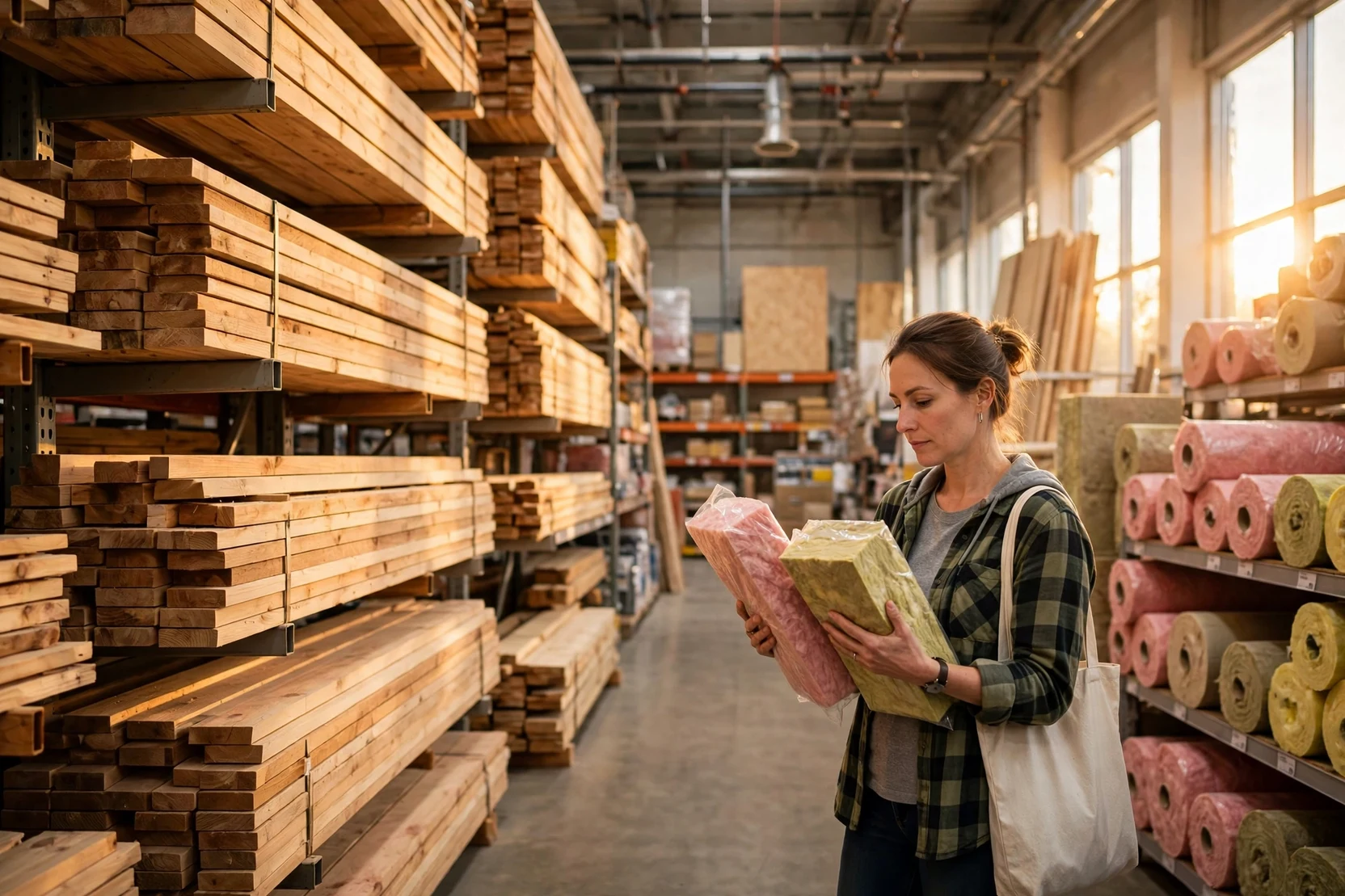
Buy green building products from big-box retailers for common items, specialty green suppliers for nontoxic finishes, salvage stores for reclaimed materials and local lumberyards for FSC-certified wood. Verify before ordering. Product databases such as UL SPOT, the Declare database and EC3 let you confirm each claim before any money changes hands.
Big-box stores cover the basics. Home Depot and Lowe’s stock low-VOC paint, cellulose insulation, mineral wool and certified flooring, while Habitat for Humanity ReStores sell donated cabinets, doors, fixtures and lumber at reduced prices.
Searches for “green country building materials” usually point to a specific supplier by that name rather than a general product category. Treat it like any vendor. Confirm a local supplier’s product certifications directly, using the verification steps in this guide.
- Write down the certification you need, such as FSC, GREENGUARD Gold or FloorScore, before you shop.
- Ask the supplier for the EPD and emissions certificate for each product.
- Compare at least two suppliers for price and lead time on specialty items.
- Check return policies on special-order products such as CLT, hempcrete and reclaimed flooring.
Conclusion
Material selection in the USA is shifting from marketing claims to documented proof. Data now drives specs. With EPDs and HPDs, plus tools like EC3, any builder can compare embodied carbon in minutes, and certification systems such as LEED v5 are placing greater weight on that data.
Code pathways or procurement support arrived in recent years for mass timber and hempcrete, as well as for low-carbon concrete, and public Buy Clean policies are expanding demand for verified low-carbon products. No verified figure is available here for the size of the green building materials market. The direction is still clear. Products with transparent data will win specifications.
Start your next project with the scorecard and match each choice to your climate zone. Then ask every supplier for documents. That habit will matter more each year, because codes and owners, along with lenders, increasingly expect proof before they sign off.
Frequently Asked Questions
Sources
These publications and organizations provide the standards, tools and regulations referenced in this guide.
- U.S. Green Building Council, LEED rating system: https://www.usgbc.org/leed
- BRE Group, BREEAM: https://breeam.com
- Home Innovation Research Labs, National Green Building Standard certification: https://www.homeinnovation.com

Related Posts