Types of Roofing Sheets — 14 Materials, Uses & Cost Guide USA (2026)
Choosing the wrong roofing sheet costs you money twice — once during purchase, once during repairs. This guide covers 14 types of roofing sheets, their real-world specs, US price ranges, and which one works best for your specific home or building project.
Whether you are replacing an old roof, re-roofing after storm damage, building a new home, adding a porch or garage, or waterproofing a flat commercial roof — the roofing sheet you choose directly affects indoor temperature, leak frequency, insurance premiums, and maintenance cost for the next 20–40 years. A licensed roofing contractor installs most sheet types in 1–3 days on an average residential roof. DIY installation is practical on corrugated, polycarbonate, FRP, and PVC panels with standard hand tools.
Quick Answer: The 14 main types of roofing sheets are corrugated metal, galvanized steel (GI), color coated, galvalume (aluzinc), aluminum, polycarbonate, FRP (fibre-reinforced plastic), UPVC, bitumen, PUF sandwich panel, rubber (EPDM), plastic (PVC), fiber cement, and metal shingle sheets.
What Is a Roofing Sheet?
A roofing sheet is a flat or profiled panel installed over a structure to protect it from rain, heat, wind, snow, and UV exposure. Modern sheets use steel, aluminum, plastic, or composite materials — each with a different coating, thickness, and performance profile.
Roofing sheets are sold by building material suppliers in standard widths of 36 inches to 48 inches and lengths of 6 feet to 20 feet. Pricing is quoted per square foot or per square (100 sq.ft) depending on the supplier. Standard roofing sheet coverage per panel ranges from 22 sq.ft to 30 sq.ft depending on profile and overlap width.
Steel-based sheets with metallic coatings dominate residential, industrial, and commercial construction in the US because they meet ICC building codes, carry UL certifications, and last 20–40 years with minimal maintenance.
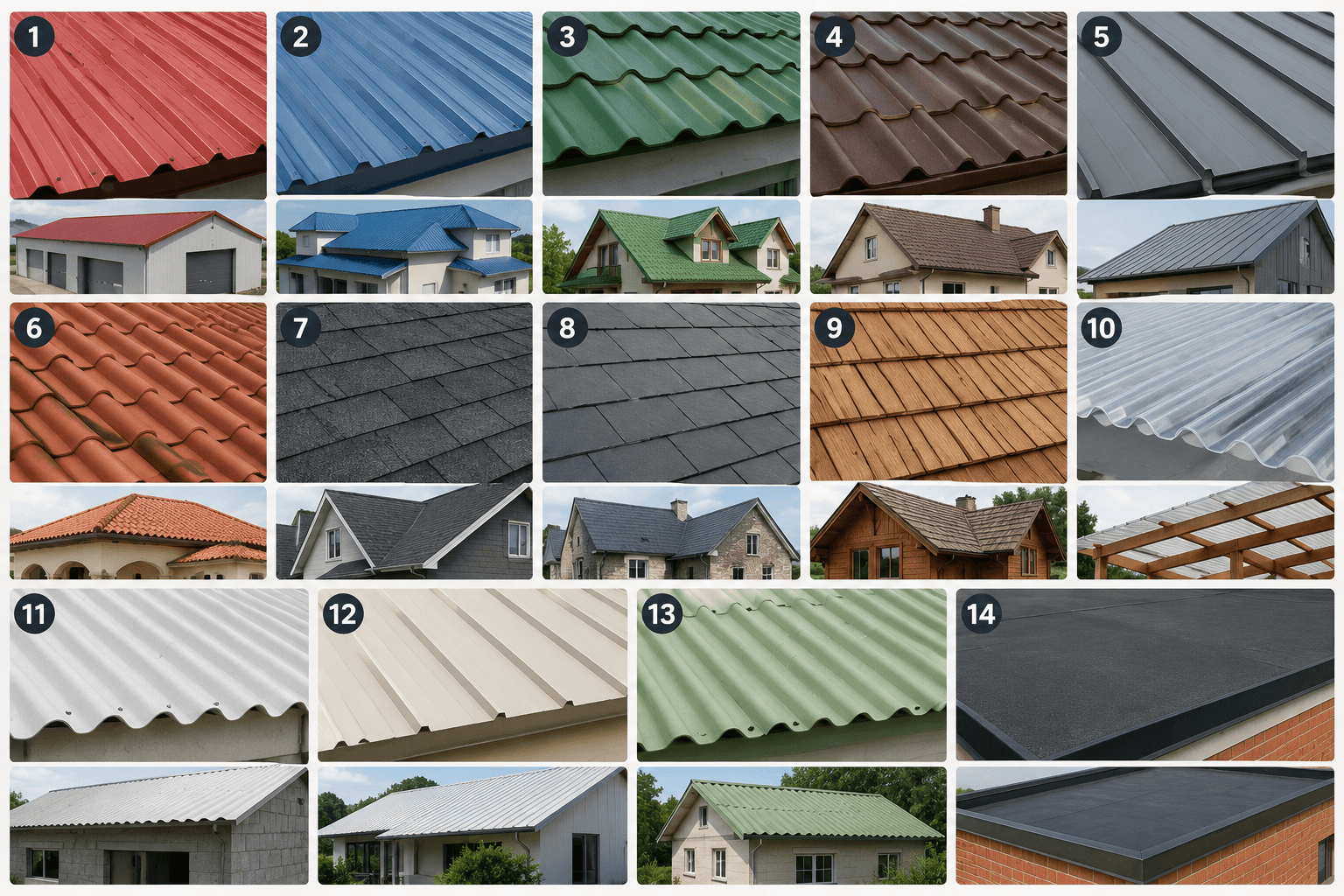
14 Types of Roofing Sheets
1. Corrugated Metal Roofing Sheets
Corrugated sheets have a wave-shaped profile that adds structural rigidity without increasing weight. The rippled design channels rainwater off the roof faster than flat sheets, reducing leak risk significantly in high-rainfall regions.
Material: Galvanized steel, aluminum, or Galvalume Thickness: 0.018 in – 0.031 in (26–29 gauge) Lifespan: 25–40 years Best for: Barns, warehouses, agricultural buildings, residential roofs Price range: $1.50–$4.50 per sq.ft installed US Standard: ASTM A653 (galvanized), ASTM A792 (Galvalume)
The corrugated shape distributes load evenly across purlins, making these sheets suitable for large spans. Screws pass through the peaks of the ribs — not the valleys — so water cannot pool around the fixing points.
Corrugated sheets are stocked at Home Depot, Menards, and roofing supply distributors in standard 8-foot and 10-foot lengths. Most suppliers carry 26-gauge and 29-gauge profiles for same-day pickup.
2. Galvanized Steel (GI) Roofing Sheets
Galvanized steel sheets are carbon steel coated with zinc through a continuous hot-dip galvanizing process. Zinc acts as a sacrificial coating — it corrodes first, protecting the steel underneath for decades.
Coating weight: G60–G90 (0.60–0.90 oz/sq.ft per ASTM A653) Thickness: 0.018 in – 0.031 in Lifespan: 15–25 years Best for: Budget residential roofing, farm buildings, sheds, garages Price range: $1.20–$3.00 per sq.ft installed US Standard: ASTM A653, UL 790 Class A fire rating
Galvanized steel is the most widely used roofing material for agricultural and light commercial buildings across the Midwest and South. The zinc coating degrades faster in coastal areas — Florida, Gulf Coast, and Pacific Northwest installations should specify G90 coating weight minimum.
Galvanized base metal is cold-rolled low-carbon steel (CRCA grade) with a minimum yield strength of 33,000 psi (228 MPa). The zinc coating is applied via continuous hot-dip galvanizing at 845–860°F (450–460°C).
Value rating: 3/5 — lowest upfront cost but highest long-term replacement frequency.
3. Color Coated Roofing Sheets (PPGI)
Color coated sheets — also called PPGI (pre-painted galvanized iron) or pre-finished metal — are galvanized or Galvalume sheets with a primer coat and high-quality polyester or PVDF (Kynar 500) paint layer baked on at the factory.
Coating layers: Primer + top coat + back coat Available colors: 40+ standard colors including Energy Star-rated cool roof colors Lifespan: 20–40 years Best for: Modern homes, commercial buildings, retail, offices Price range: $3.00–$8.00 per sq.ft installed US Standard: ASTM A755, Energy Star Cool Roof certification available
PVDF (Kynar 500) paint systems carry a 30-year fade warranty and are specified on high-end commercial projects. Polyester systems carry a 10–15 year warranty at lower cost. Light-colored Energy Star certified panels reflect 65–75% of solar radiation, reducing cooling loads by 10–15% in hot US climates.
Value rating: 4.5/5 — best overall balance of price, aesthetics, and lifespan for US residential roofing.
4. Galvalume / Aluzinc Roofing Sheets
Galvalume sheets use an aluminum-zinc alloy coating (55% aluminum, 43.5% zinc, 1.5% silicon) developed by Bethlehem Steel in the 1970s. Aluminum resists oxidation; zinc protects cut edges and scratches through cathodic action.
Coating weight: AZ50–AZ55 (per ASTM A792) Thickness: 0.018 in – 0.040 in Lifespan: 30–45 years Best for: Coastal areas, Gulf Coast, Florida, Pacific Northwest, industrial zones Price range: $2.50–$6.00 per sq.ft installed US Standard: ASTM A792, Galvalume is a registered trademark of BIEC International
Galvalume outlasts standard galvanized steel by 2–4x in corrosive environments. The aluminum content reflects solar heat more effectively, keeping buildings 5–8°F cooler than galvanized-roofed structures — a measurable energy saving in Sun Belt states like Texas, Arizona, and Florida.
Galvalume base metal carries a minimum tensile strength of 80,000 psi (550 MPa). The Al-Zn alloy bath operates at 1,110°F (600°C) during coating — 270°F higher than standard zinc galvanizing.
Value rating: 5/5 — highest recommended sheet for most US climate conditions.
5. Aluminum Roofing Sheets
Aluminum sheets contain no iron, making rust impossible regardless of environment. The material is 65% lighter than steel, reducing structural dead load significantly.
Weight: 0.55 lb/sq.ft (vs 1.60 lb/sq.ft for steel) Thickness: 0.019 in – 0.050 in Lifespan: 40–50 years Best for: Coastal buildings (Florida, Gulf Coast, Pacific Coast), lightweight structures, high-end residential Price range: $4.00–$9.00 per sq.ft installed US Standard: ASTM B209, Florida Building Code approved
Aluminum costs more upfront but total lifecycle cost is lower because the material requires zero maintenance over decades. Standing seam aluminum roofing is widely specified in Florida for hurricane resistance — aluminum panels rated for 130+ mph wind uplift meet Florida High-Velocity Hurricane Zone (HVHZ) requirements.
Value rating: 4/5 — best for coastal and hurricane-zone projects where lifecycle cost matters more than upfront price.
6. Polycarbonate Roofing Sheets
Polycarbonate sheets transmit 80–90% of daylight while blocking 99% of UV radiation. These are the only roofing sheets that let natural light into a space without UV damage to occupants or interior materials.
Impact resistance: 250x stronger than glass Thickness: 4 mm – 16 mm (multiwall) / 0.030 in – 0.118 in (solid) Lifespan: 10–20 years Best for: Greenhouses, patios, carports, skylights, pool enclosures Price range: $3.50–$10.00 per sq.ft installed US Standard: ASTM D3935, IBC compliant
Multiwall polycarbonate panels trap air between layers, improving thermal insulation by 30–40% compared to single-sheet glass. UV-protected grades meet ASTM D4329 weathering standards and prevent yellowing for 10+ years. Polycarbonate panels are widely used in sunrooms and covered walkways across the Southeast and Southwest.
Value rating: 4/5 — only correct choice when natural light transmission is a design requirement.
7. FRP (Fibre-Reinforced Plastic) Roofing Sheets
FRP sheets combine glass fibres with polyester or vinyl ester resin. The fibre layer adds tensile strength; the resin matrix provides weather resistance and shape retention across a wide temperature range.
Light transmission: 30–80% (specified at time of order) Thickness: 0.060 in – 0.120 in Lifespan: 15–25 years Best for: Industrial buildings, agricultural barns, chemical plants, covered walkways Price range: $2.00–$5.00 per sq.ft installed US Standard: ASTM D3841
FRP sheets resist chemical exposure better than metal sheets — critical for facilities handling fertilizers, acids, or industrial gases. Fiberglass corrugated panels from manufacturers like Palruf and Tuftex are widely available at Home Depot and Lowe’s for DIY barn and shed applications.
8. UPVC (Unplasticized PVC) Roofing Sheets
UPVC sheets contain no plasticizers, making the material rigid, dimensionally stable, and resistant to both impact and chemical attack. UPVC does not support combustion.
Fire rating: Class B self-extinguishing (ASTM E84) Thickness: 0.040 in – 0.120 in Lifespan: 20–30 years Best for: Residential additions, carports, covered patios, storage buildings Price range: $2.50–$6.00 per sq.ft installed US Standard: ASTM D1784
UPVC does not conduct electricity and resists acids, alkalis, and salt spray. Thermal expansion is significant in US climates with wide temperature swings — installation requires 3/16-inch expansion gaps at all fixed points in regions with temperature ranges exceeding 80°F seasonal variation.
9. Bitumen Roofing Sheets
Bitumen sheets are modified bitumen membranes reinforced with fiberglass or polyester mat. These roll-out sheets bond to the substrate with a torch or cold adhesive, forming a continuous waterproof membrane with no exposed fasteners.
Thickness: 3 mm – 5 mm (0.118 in – 0.197 in) Lifespan: 15–25 years Best for: Flat roofs, low-slope commercial roofing, roof decks, terraces Price range: $3.00–$7.00 per sq.ft installed (material + labor) US Standard: ASTM D6163 (SBS), ASTM D6222 (APP)
Modified bitumen membranes are the #1 specified flat roof system for low-slope commercial buildings in the US. SBS (styrene-butadiene-styrene) modified sheets remain flexible in cold climates like the Northeast and Midwest. APP (atactic polypropylene) modified sheets perform better in hot climates like the Southwest and Southeast. Sheets overlap 3–4 inches at joints, sealed with a propane torch.
10. PUF (Polyurethane Foam) Sandwich Panel
PUF panels — also called insulated metal panels (IMPs) in the US — consist of two outer steel face sheets with a polyurethane foam core. The foam core delivers structural rigidity and thermal insulation in a single panel.
Core density: 2.4–2.6 lb/cu.ft (38–42 kg/m³) R-value: R-6 per inch (R-25 for 4-inch panel) Thickness: 2 in – 6 in (50 mm – 150 mm) Lifespan: 25–35 years Best for: Cold storage, food processing plants, refrigerated warehouses, data centers Price range: $8.00–$18.00 per sq.ft installed US Standard: ASTM C1289, FM Approved, UL listed
A 4-inch PUF/IMP panel delivers R-25 insulation — exceeding ASHRAE 90.1 energy code requirements for commercial roofs in all US climate zones. Major US manufacturers include Kingspan, Metl-Span, and Nucor Building Systems. PUF panels eliminate separate insulation installation, reducing total project time by 30–40% on large commercial buildings.
11. EPDM Rubber Roofing Sheets
EPDM (Ethylene Propylene Diene Monomer) rubber sheets are single-ply membranes installed on flat and low-slope roofs. EPDM remains flexible from -40°F to +300°F (-40°C to +150°C) — the widest temperature range of any roofing membrane.
Thickness: 0.045 in – 0.060 in (45 mil – 60 mil) Lifespan: 25–35 years Best for: Commercial flat roofs, residential low-slope roofs, roof rehabilitation Price range: $4.00–$8.00 per sq.ft installed US Standard: ASTM D4637, NRCA recommended
EPDM is the most widely installed single-ply roofing membrane in North America — over 1 billion square feet installed annually. The membrane installs with adhesive, ballast (river rock), or mechanical fasteners without open flame, making it safer on occupied commercial buildings. 60-mil EPDM carries a 20-year manufacturer warranty from suppliers like Firestone, Carlisle, and Johns Manville.
Value rating: 4.5/5 — industry standard for US commercial flat roofing.
12. PVC (Plastic) Roofing Sheets
Flexible PVC roofing sheets are lightweight, semi-translucent, and cost-effective for small structures. PVC sheets differ from rigid UPVC — plasticizers in PVC allow bending and easy cutting with tin snips or a circular saw.
Weight: 0.30–0.60 lb/sq.ft Thickness: 0.030 in – 0.080 in Lifespan: 8–15 years Best for: Storage sheds, carports, temporary structures, budget covered areas Price range: $1.00–$3.00 per sq.ft installed US Standard: ASTM D1784
PVC corrugated panels from brands like SunTuf and Palruf are sold at Home Depot and Lowe’s for under $30 per panel. The trade-off is lifespan — standard PVC yellows and becomes brittle within 7–10 years in high-UV regions like the Southwest, Florida, and Texas. Specify UV-stabilized grades (look for “UV protected” label) for any outdoor installation south of the 35th parallel.
13. Fiber Cement Roofing Sheets
Fiber cement sheets replace the older asbestos cement product — same Portland cement matrix, but glass fiber or cellulose fiber replaces the carcinogenic asbestos reinforcement. Fiber cement is 100% asbestos-free and safe to cut and handle.
Weight: 2.5–3.5 lb/sq.ft Thickness: 0.25 in – 0.50 in Lifespan: 25–40 years Best for: Agricultural buildings, low-cost industrial roofing, replacement of old asbestos sheets Price range: $2.50–$5.00 per sq.ft installed US Standard: ASTM C1186, asbestos-free
Fiber cement sheets from manufacturers like Eternit and Cembrit are direct replacements for older asbestos cement corrugated sheets on agricultural buildings. Fire resistance is Class A (non-combustible), making fiber cement acceptable under IBC for occupancies requiring non-combustible roofing. Note: if you have existing asbestos cement sheets on a pre-1980 building, hire a licensed asbestos abatement contractor before removal — never cut or drill old sheets without respiratory protection and proper disposal procedures per EPA regulations.
14. Metal Shingle Roofing Sheets
Metal shingle panels are stamped or roll-formed steel or aluminum sheets designed to replicate the appearance of traditional asphalt shingles, wood shakes, or slate tiles. These combine metal durability with conventional residential aesthetics.
Material: 26-gauge Galvalume or aluminum Lifespan: 40–70 years Best for: Residential homes, HOA neighborhoods, historic districts, steep-slope roofs Price range: $7.00–$15.00 per sq.ft installed US Standard: UL 2218 Class 4 Impact Resistance (hail rating), FM 4473
Metal shingles qualify for a 30% federal tax credit under the Inflation Reduction Act (IRA) when they meet Energy Star cool roof requirements — a direct $2,000–$5,000 savings on a typical 2,000 sq.ft home. Class 4 impact-rated metal shingles (the highest hail resistance rating) reduce homeowners insurance premiums by 20–30% in hail-prone states like Texas, Oklahoma, Colorado, and Kansas.
Value rating: 5/5 — best long-term roofing investment for US residential homes.
Where to Buy Roofing Sheets in the USA
4 main purchasing channels — each with different price points and product availability:
1. Big-box home improvement stores: Home Depot and Lowe’s stock corrugated galvanized, Galvalume, polycarbonate, and FRP panels in standard lengths. Home Depot SKU examples: Tuftex 2.17 ft x 8 ft Polyester panels (~$14/panel), Union Corrugating 2 ft x 8 ft Galvanized Steel (~$18/panel). Best for small projects under 500 sq.ft and DIY installs. Prices run 15–25% higher than wholesale.
2. Metal roofing distributors: Regional distributors like Metal Sales Manufacturing, ABC Supply, and Gulfeagle Supply stock full commercial product lines — 24-gauge through 29-gauge in cut-to-length options, all ASTM certifications, and full color palettes. Minimum orders typically 1 square (100 sq.ft). Prices run 20–30% below retail for contractor accounts.
3. Direct from manufacturer: Manufacturers like Nucor Building Systems, McElroy Metal, ATAS International, and Fabral sell direct to contractors and large projects. Lead times run 2–4 weeks. Custom lengths, gauges, and colors available. Best for projects over 5,000 sq.ft.
4. Online suppliers: Metal Roofing Direct, DIY Metal Roofing, and S-5! sell direct-to-consumer with nationwide shipping. Online pricing often beats local distributor rates by 10–15% on standard profiles. Verify ASTM certifications and gauge before ordering — not all online suppliers stock US-manufactured panels.
Roofing Sheet Comparison Table
Prices below reflect 2026 US contractor rates including material and standard installation labor. DIY installation reduces costs by 40–50% on corrugated and polycarbonate sheets. Prices vary by region — Southeast and Midwest rates run 15–20% lower than Northeast and West Coast markets.
| Sheet Type | Lifespan | Thickness | Price ($/sq.ft installed) | Best US Climate Use |
| Corrugated Metal | 25–40 yrs | 26–29 gauge | $1.50–$4.50 | All climates |
| Galvanized Steel | 15–25 yrs | 26–29 gauge | $1.20–$3.00 | Midwest/Dry regions |
| Color Coated (PPGI) | 20–40 yrs | 26–29 gauge | $3.00–$8.00 | All climates |
| Galvalume / Aluzinc | 30–45 yrs | 26–28 gauge | $2.50–$6.00 | Coastal/humid |
| Aluminum | 40–50 yrs | 0.019–0.050 in | $4.00–$9.00 | Coastal/hurricane zones |
| Polycarbonate | 10–20 yrs | 4–16 mm | $3.50–$10.00 | Sunrooms/covered areas |
| FRP | 15–25 yrs | 0.060–0.120 in | $2.00–$5.00 | Industrial/agricultural |
| UPVC | 20–30 yrs | 0.040–0.120 in | $2.50–$6.00 | Carports/patio covers |
| Bitumen Membrane | 15–25 yrs | 3–5 mm | $3.00–$7.00 | Flat/low-slope roofs |
| PUF/IMP Panel | 25–35 yrs | 2–6 in | $8.00–$18.00 | Cold storage/commercial |
| EPDM Rubber | 25–35 yrs | 45–60 mil | $4.00–$8.00 | Commercial flat roofs |
| PVC Plastic | 8–15 yrs | 0.030–0.080 in | $1.00–$3.00 | Sheds/temporary |
| Fiber Cement | 25–40 yrs | 0.25–0.50 in | $2.50–$5.00 | Agricultural/industrial |
| Metal Shingle | 40–70 yrs | 26 gauge | $7.00–$15.00 | Residential steep-slope |
Top Roofing Sheet Brands in the USA — Compared
5 leading US manufacturers rated on quality, warranty, and availability:
1. Nucor Building Systems:
Best for large commercial and industrial projects. Offers 26-gauge and 24-gauge Galvalume panels with PVDF coatings. 40-year paint warranty on Kynar 500 systems. Sold through authorized dealers nationwide. Price premium: 15–20% above market average. Worth it for 30+ year commercial builds.
2. McElroy Metal:
Best for residential standing seam. UL 2218 Class 4 hail-rated panels available. 40-year fade warranty. Strong dealer network across the South and Midwest. Panels qualify for IRA Section 25C tax credit. Price range: $4.50–$9.00/sq.ft installed.
3. Metal Sales Manufacturing:
Best value for mid-range residential and agricultural roofing. Wide product range from 29-gauge agricultural corrugated to 24-gauge residential panels. Available through Home Depot Pro and independent distributors. Price range: $2.50–$7.00/sq.ft installed.
4. Firestone Building Products:
Best for EPDM flat roofing. RubberGard EPDM 60-mil membrane carries a 20-year manufacturer warranty. Installed on over 2 billion square feet of US commercial roofs. Available through commercial roofing distributors only — not sold at retail. Price: $5.00–$8.00/sq.ft installed.
5. Palruf / Tuftex:
Best budget polycarbonate and FRP panels for DIY projects. Available at Home Depot and Lowe’s. 10-year UV warranty on polycarbonate grades. Price range: $1.80–$4.50/sq.ft. Ideal for carports, greenhouses, and covered patios under 300 sq.ft.
Roofing Sheet Buying Guide — What to Check Before You Purchase
Buying a roofing sheet without verifying these 4 things leads to code violations, warranty voids, and early replacement.
1. Verify the coating specification — not just the product name: Every galvanized and Galvalume sheet carries an ASTM coating designation stamped on the coil — G60, G90, AZ50, or AZ55. G60 coating (0.60 oz/sq.ft) is adequate for dry inland regions. G90 or AZ50 minimum is required for coastal areas within 5 miles of saltwater. Ask your supplier for the mill certification (MTR) — a reputable distributor provides one with every order.
2. Check gauge with a digital micrometer: Sheet thickness marketed as “29 gauge” varies between 0.013 in and 0.018 in depending on the supplier. That difference means 28% less steel per sheet. A $30 digital micrometer from Harbor Freight confirms actual thickness before bulk purchase — critical on large orders where small discrepancies add up to significant structural differences.
3. Calculate cost per square (100 sq.ft) — not just per sheet: A $40 corrugated panel covering 26 sq.ft costs $1.54/sq.ft. A $65 Galvalume panel covering the same area costs $2.50/sq.ft. Over a 2,000 sq.ft roof, the Galvalume option costs $1,920 more upfront but eliminates 1–2 replacement cycles over 30 years, saving $8,000–$15,000 in material and labor.
4. Confirm local building code compliance before purchasing: High-wind zones (Florida, Gulf Coast, Tornado Alley) require panels with specific UL or FM wind uplift ratings. Wildfire-prone areas (California, Colorado, Pacific Northwest) require Class A fire-rated panels. HOA neighborhoods may restrict color choices to approved palettes. Check with your local building department or AHJ (Authority Having Jurisdiction) before ordering — non-compliant materials fail inspection and require costly replacement.
How to Choose the Right Roofing Sheet
5 factors determine the correct choice:
1. Roof slope (steep vs low): Steep-slope roofs above 3:12 pitch work with metal panels, color coated sheets, polycarbonate, FRP, UPVC, or metal shingles. Low-slope roofs below 2:12 pitch require bitumen membrane or EPDM — metal sheets on low-slope roofs trap water at laps and fail within 3–5 years. The IBC defines low-slope as under 2:12; always match the membrane system to the actual roof slope.
2. Climate zone and location: The US has 8 ASHRAE climate zones — sheet selection should match the zone. Coastal areas within 5 miles of saltwater (Florida, Gulf Coast, Pacific Coast) require Galvalume AZ55 or aluminum minimum. Hot-humid zones (Climate Zones 1–2: Florida, Texas Gulf Coast, Louisiana) benefit from Energy Star cool roof coatings that reflect 65%+ solar radiation. Cold zones (Climate Zones 6–8: Minnesota, Montana, Maine) prioritize insulated panels and snow load capacity. High-wind zones require UL 580 Class 90 or FM 1-90 rated panels.
3. Structural load capacity: Verify your roof framing can handle the material weight before specifying heavy panels. A 4-inch PUF/IMP panel weighs 3.5–4.0 lb/sq.ft — significantly more than a 29-gauge corrugated panel at 0.75 lb/sq.ft. In snow country (Northeast, Midwest, Mountain West), confirm the combined dead load plus ground snow load does not exceed the roof structure’s design load. A structural engineer review costs $300–$600 and prevents catastrophic failures.
4. Total installed cost — not material price alone: Material cost is 40–60% of total roofing cost in the US. Labor, underlayment, flashing, fasteners, and disposal of old roofing add 40–60%. A $3.00/sq.ft metal panel may cost $7.00–$9.00/sq.ft fully installed. Get 3 contractor bids that break out material vs labor — the cheapest total bid often uses thinner gauge material to lower the number.
5. HOA rules and local aesthetics: Many US neighborhoods have HOA covenants restricting roof material color, profile, and reflectivity. Historic districts require approval from local historic preservation boards before installing metal roofing. Check these restrictions before purchasing — non-conforming materials require removal at the homeowner’s expense.
Best Roofing Sheet for US Climate Zones
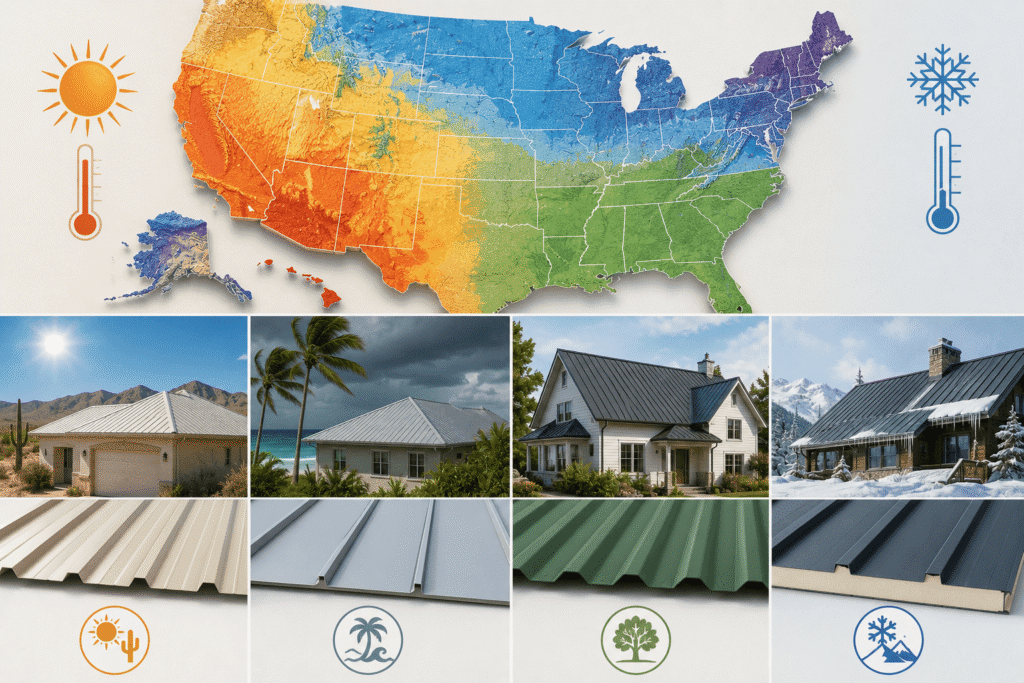
The US covers 8 distinct climate zones — 4 key zones require specific sheet types:
Hot-Dry (Climate Zones 2B–3B: Phoenix, Las Vegas, Albuquerque, Fresno): Energy Star certified Galvalume or color coated sheets with light-colored finishes (white, light grey, beige) reflect 65–75% of solar radiation. A cool-roof certified Galvalume panel reduces attic temperatures by 20–30°F compared to dark asphalt shingles, directly cutting air conditioning costs by 15–25% annually.
Hot-Humid (Climate Zones 1A–2A: Miami, Houston, New Orleans, Tampa): Aluminum or Galvalume AZ55 sheets are mandatory within 5 miles of saltwater — standard galvanized steel shows visible corrosion within 5–8 years in salt-air environments. Standing seam aluminum panels rated for 130+ mph wind uplift meet Florida HVHZ requirements for hurricane zones. Color coated panels with PVDF coatings handle the combination of UV intensity and salt air better than polyester systems.
Mixed-Humid (Climate Zones 3A–4A: Atlanta, Charlotte, Washington DC, St. Louis): Corrugated Galvalume or color coated panels handle the combination of hot summers and cold winters. Minimum 26-gauge thickness withstands ice damming and freeze-thaw cycles. 26-gauge panels with G90 zinc coating minimum — the Southeast’s high summer humidity accelerates zinc depletion on G60-coated sheets.
Cold/Very Cold (Climate Zones 5–7: Chicago, Minneapolis, Denver, Boston): Snow load capacity is the primary selection criterion — 26-gauge or heavier panels on purlins spaced 24 inches or less. Standing seam profiles prevent ice dam infiltration better than exposed fastener panels because water cannot wick up through screw penetrations. Insulated metal panels (IMPs) with R-25+ values meet or exceed ASHRAE 90.1 energy code requirements in all cold US climate zones.
Roofing Sheet Thickness and Gauge Guide
Sheet thickness directly affects performance, snow load capacity, wind resistance, and lifespan. Thicker gauges cost more but span wider purlin spacings and resist hail, wind uplift, and foot traffic during installation.
| Gauge | Thickness (in) | Thickness (mm) | Weight (lb/sq.ft) | Recommended Use |
| 22 gauge | 0.031 in | 0.80 mm | 1.28 lb | Heavy industrial, high wind zones |
| 24 gauge | 0.024 in | 0.70 mm | 1.13 lb | Commercial roofing, standing seam |
| 26 gauge | 0.018 in | 0.55 mm | 0.90 lb | Residential roofing (recommended minimum) |
| 29 gauge | 0.013 in | 0.36 mm | 0.72 lb | Agricultural buildings, sheds |
| 30 gauge | 0.012 in | 0.30 mm | 0.62 lb | Temporary structures only |
Rule: Never use below 26 gauge (0.018 in) for permanent residential roofing. Thinner gauges dent during installation, lose paint adhesion faster, and fail at fastener points within 5–8 years. Most residential roofing manufacturers void their warranties on installations using 29 gauge or thinner panels.
Purlin spacing by gauge:
- 29 gauge (0.013 in) → maximum 24 in purlin spacing
- 26 gauge (0.018 in) → maximum 36 in purlin spacing
- 24 gauge (0.024 in) → maximum 48 in purlin spacing
Snow load note: In Climate Zones 5–7, reduce purlin spacing by 25% from the standard recommendation to account for ground snow loads exceeding 30 psf.
How to Install Corrugated Metal Roofing Sheets — Step-by-Step
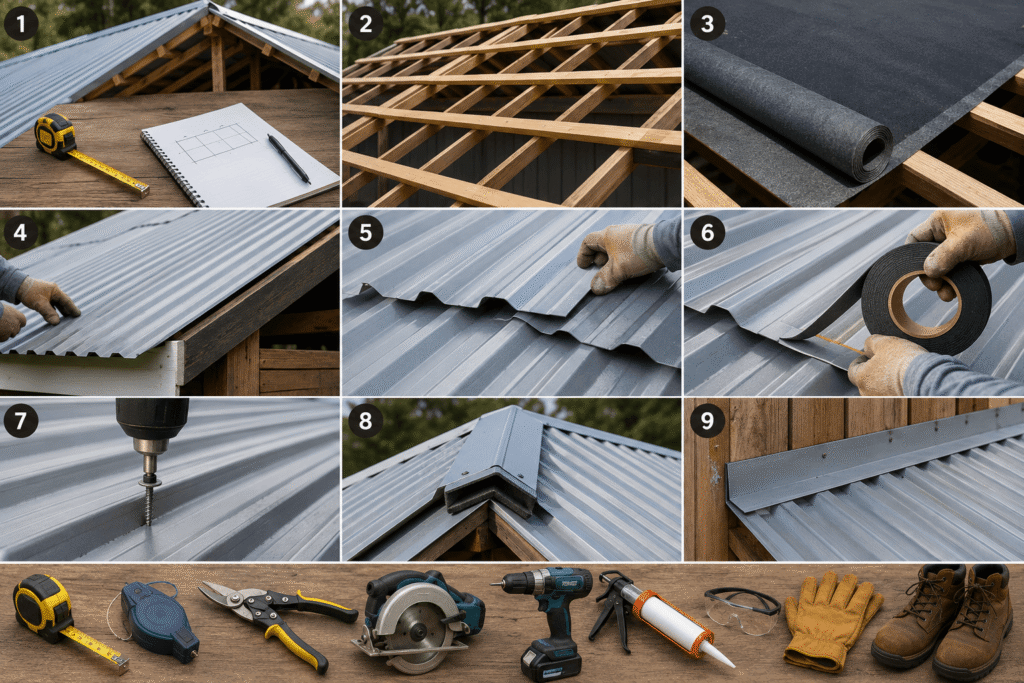
Corrugated metal panels are the most DIY-friendly roofing sheet. To install a corrugated metal roof on a shed, garage, or porch, follow these 9 steps:
Step 1 — Measure your roof area Measure roof width x length in feet. Add 10% for waste and overlap. A 20 ft x 30 ft roof = 600 sq.ft + 60 sq.ft waste = 660 sq.ft total. Divide by panel coverage (26 sq.ft per standard 3 ft x 10 ft panel) to get panel count — 660 ÷ 26 = 26 panels.
Step 2 — Install purlins Purlins are horizontal wood or steel members running across the roof rafters. Space purlins at 24 inches on center for 29-gauge panels, 36 inches for 26-gauge. Use 2×4 lumber (1.5 in x 3.5 in) for residential purlin applications. Secure purlins to rafters with 3-inch structural screws.
Step 3 — Install underlayment (optional but recommended) 30-lb felt paper or synthetic roofing underlayment on top of purlins reduces condensation and adds a secondary water barrier. Staple every 6 inches along edges, 12 inches in the field.
Step 4 — Start at the downwind edge Begin at the downwind corner of the roof so panel overlaps face away from prevailing wind. The first panel overhangs the eave by 2 inches (50 mm) to direct water into the gutter.
Step 5 — Overlap panels correctly Overlap each panel by 1.5 corrugations (approximately 3 inches) side-to-side. End-to-end overlaps require a minimum 6 inches on slopes above 4:12, and 12 inches on slopes below 4:12.
Step 6 — Apply butyl tape at all overlaps Run a bead of butyl tape (3/4-inch wide) along every side lap and end lap before placing the next panel. Butyl tape is the #1 leak prevention measure on metal roofing — do not skip this step.
Step 7 — Fasten with roofing screws Use 1.5-inch hex-head self-drilling screws with EPDM washers. Drive screws through the rib peaks — not the valleys. Space fasteners every 12 inches along purlins at panel edges, every 24 inches in the panel field. Snug — not over-torqued. Over-torquing crushes the EPDM washer and creates a leak point.
Step 8 — Install ridge cap The ridge cap overlaps both roof faces by 6 inches minimum. Apply butyl tape under both edges of the ridge cap before fastening. Use foam closure strips (corrugated profile) to seal the gap between the panel ribs and the ridge cap.
Step 9 — Install flashing at all penetrations Every vent, chimney, skylight, and wall intersection needs step flashing and counter-flashing. Use the same metal (galvanized or Galvalume) as the roof panels — mixing metals causes galvanic corrosion.
Tools needed: Tape measure, chalk line, tin snips or circular saw with metal blade, cordless drill with hex driver, caulk gun, safety glasses, gloves, non-slip footwear. Time estimate: 1–2 days for a 600 sq.ft DIY project with 2 people. Permit required: Most US jurisdictions require a roofing permit for full re-roofing — check with your local building department before starting.
Conclusion
The right roofing sheet for a US project depends on 4 things: your roof slope, your climate zone, local building codes, and your 30-year budget — not just today’s material price. For most US homes, 26-gauge Galvalume color coated panels or metal shingles deliver the best balance of durability, energy efficiency, and code compliance. For flat commercial roofs, 60-mil EPDM is the proven industry standard. For cold storage and insulated commercial buildings, PUF/IMP panels are the only single-product solution that meets ASHRAE 90.1 energy code requirements.
FAQs About Roofing Sheets

Related Posts