Construction Loans for Homes: How They Work, Rates, and Requirements
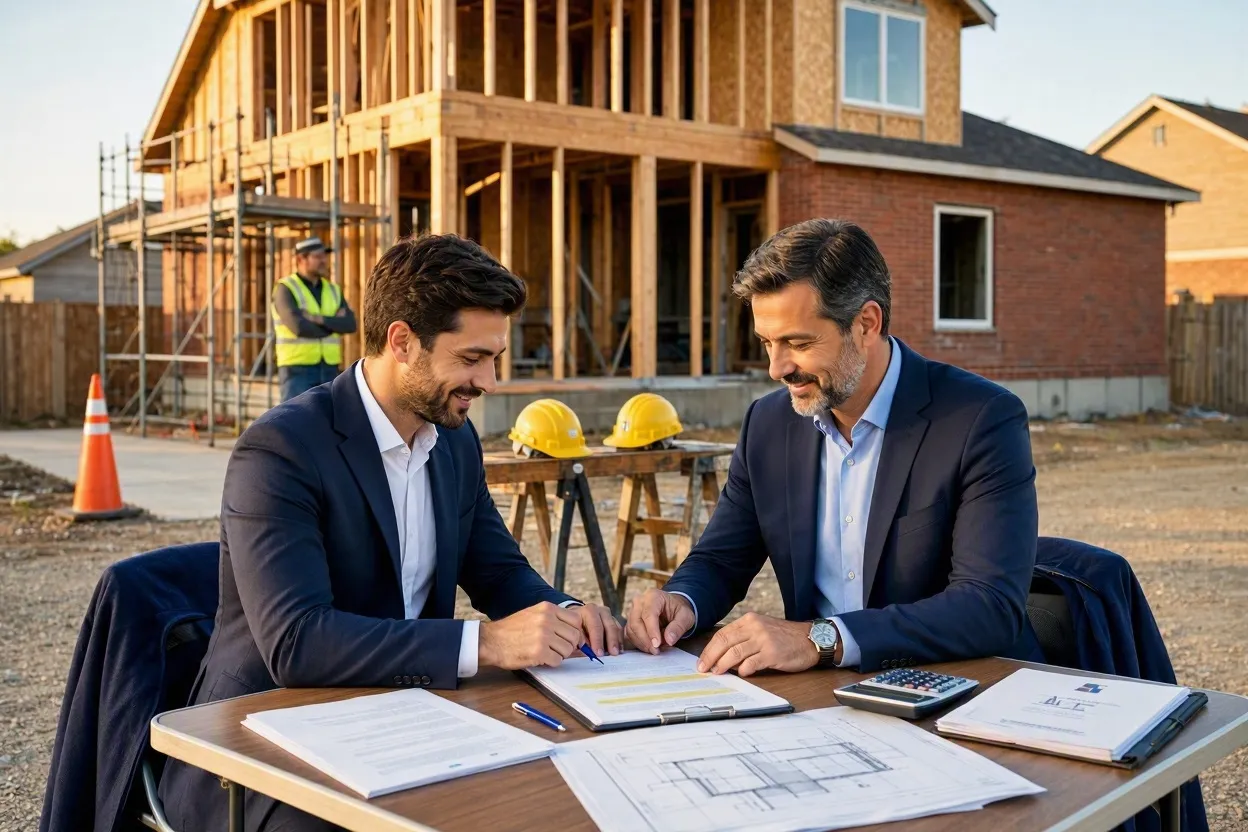
Building a house costs money before there’s a house to show for it, and that’s the whole reason construction loans work differently from a regular mortgage. Instead of wiring the full loan amount at closing, the lender pays out through a draw schedule, releasing funds only after an inspector signs off on finished work. A standard mortgage can hand over one lump sum because the collateral, the house, already exists. There’s nothing to secure a loan against when the lot is still just dirt, so a lender financing new construction offsets that gap with smaller payments, tighter inspections, and a shorter loan term overall.
Anyone comparing home construction financing options will notice the terminology shifts fast: draws, owner-builder, construction-to-permanent. This guide breaks down each term, walks through real payment math, and lists the exact documents a lender will ask for before approving a build.
What Is a Construction Loan for a Home?
A construction loan for a home is short-term financing, typically 12 to 18 months, that pays a builder in installments through a draw account instead of releasing the full amount at closing, since no completed structure exists yet to serve as collateral. A borrower building a $420,000 custom home in Round Rock, Texas, for example, doesn’t receive a lump-sum check. The lender releases money in pieces as an inspector confirms each stage, from foundation to framing to mechanical systems, matches the approved blueprints. That staged draw structure is what separates residential construction loans from every other form of home construction financing, including the 15- to 30-year traditional mortgages used to buy an existing house.
How Do Construction Loans for Homes Work?
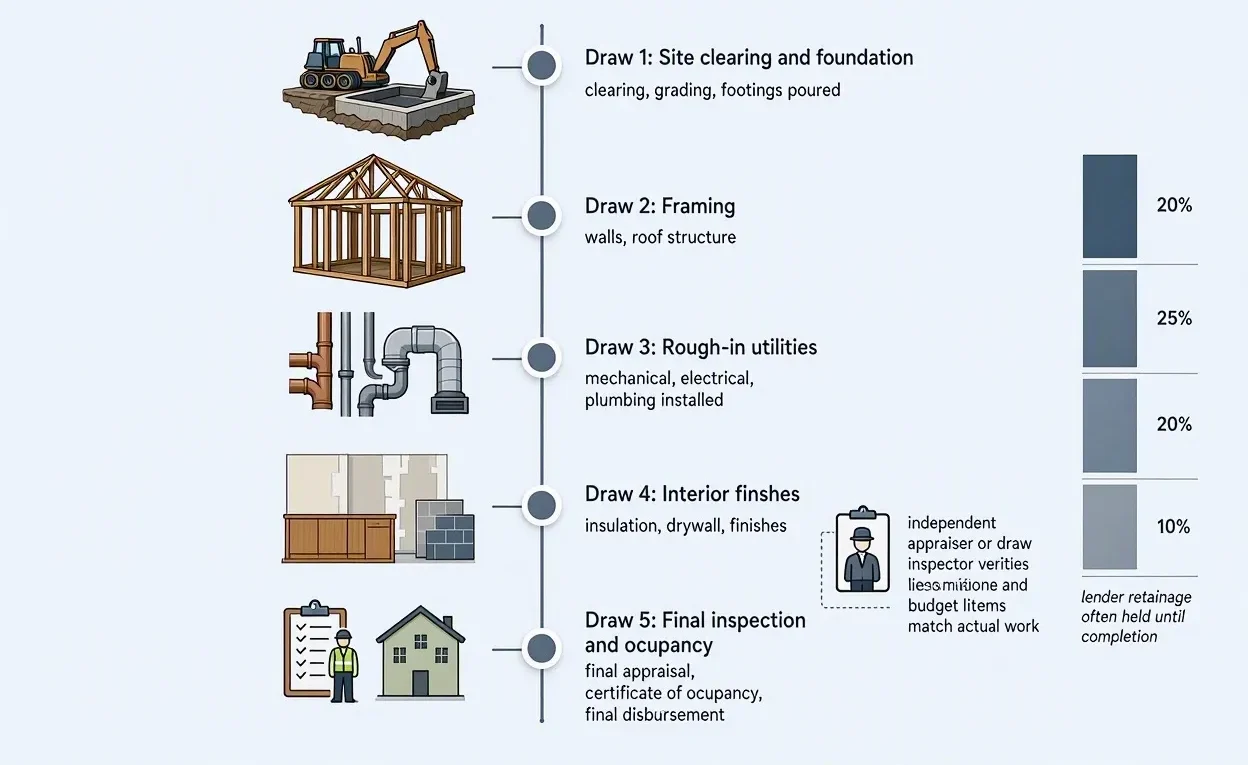
Construction loans work through scheduled disbursements called draws, released after an inspector verifies that a specific building milestone has been completed. Before each draw, an independent appraiser or construction draw inspector visits the job site, checks the work against the approved plans, and confirms the budget line items match what’s actually been built.
Five stages commonly trigger a draw release:
- Site clearing and foundation pour
- Framing, roofing, and exterior sheathing
- Rough-in plumbing, electrical wiring, and HVAC (heating, ventilation, and air conditioning) systems
- Drywall, interior trim, and paint
- Final fixtures, flooring, and exterior landscaping
Funds go directly to the general contractor rather than the homeowner, protecting subcontractors and suppliers from missed payments and giving the lender a paper trail if a project stalls. Interest accrues only on the amount drawn: a borrower approved for $350,000 who has drawn $60,000 for the foundation pays interest on just that $60,000 for the month. Builders also set aside a contingency reserve, commonly cited at 5% to 10% of the construction cost, to absorb material price swings, weather delays, and site surprises before a borrower brings additional cash to the project.
What Types of Construction Loans Are Available for Homes?
Construction loans come in more varieties than most first-time builders expect, and picking the wrong one can mean paying for financing you didn’t actually need. Here’s how the main types break down by builder situation, borrower profile, and what happens to the loan once the house is done.
- Construction-only loan: Covers the build phase and nothing past it. Once the house clears final inspection, the balance comes due, and most borrowers pay it off with a brand-new mortgage application and a second round of closing costs. Lenders call this a two-time-close loan. It costs more over the life of the deal, but it leaves the door open to shop for a permanent lender once the home actually exists.
- Construction-to-permanent loan: One closing covers both phases. The loan funds construction, then rolls straight into a permanent mortgage the day the house is finished, with no second underwriting cycle and no second appraisal. Because the long-term rate locks in at the start, this single-close structure has become the default pick for a lot of custom-home borrowers.
- Owner-builder loan: Built for the borrower who wants to act as their own general contractor. Lenders don’t hand this out lightly. Expect them to ask for a contractor’s license, proof of insurance, and a track record of finished builds before approving it, since a self-managed project is more likely to stall out without that oversight.
- FHA (Federal Housing Administration) construction loan: Backed by HUD (Department of Housing and Urban Development) guidelines, this program lets a borrower put down as little as 3.5%, which makes it one of the more forgiving entry points into new-construction financing.
- VA (Department of Veterans Affairs) construction loan: Open to eligible active-duty service members, veterans, and surviving spouses, with a 0% down payment option.
- USDA (Rural Development) construction loan: Covers eligible rural and suburban properties for qualifying low- to moderate-income borrowers, also with 0% down, though income limits and location restrictions apply.
- Renovation loan: Sized against what the house will be worth once the work is done, not what it’s worth today. FHA 203(k) loans and Fannie Mae’s HomeStyle® program both fall under this umbrella, and both let a buyer roll renovation costs into the purchase mortgage instead of taking out a separate loan.
- Land or lot loan: Finances a parcel purchase before blueprints or a signed builder contract exist. This product covers acquisition only, separate from the construction financing that comes later.
A borrower who already owns the building lot and only needs construction funds skips the land loan entirely and moves straight into a construction-only or construction-to-permanent application.
How Much Do Construction Loans for Homes Cost?
Construction loan rates commonly run higher than standard mortgage rates. Lenders often price in an extra half-point to two points to account for financing a home that doesn’t exist yet as collateral. That premium reflects the uncertainty built into any active construction project: supply delays, contractor issues, and weather all factor into a lender’s pricing decision, and actual spreads vary by lender and market.
Monthly payments during the build phase are interest-only, calculated against the amount drawn to date. Consider a $300,000 construction loan at a fixed 6.5% rate over a 12-month build:
| Milestone | Amount Drawn | Monthly Interest Payment |
| Month 2, foundation complete | $55,000 | $298 |
| Month 7, framing and roof complete | $165,000 | $894 |
| Month 12, final draw released | $300,000 | $1,625 |
Payments climb because the draw balance climbs, not because the rate changes, though some construction loans carry a variable rate instead of a fixed one. Borrowers on a longer build timeline sometimes negotiate a rate lock extension, often for a fee in the range of 0.25% to 0.5% of the loan amount, to protect against market movement past the original 12-month window. Construction loan closing costs generally run 2% to 5% of the loan amount and cover the appraisal, title work, and lender origination fees. A construction-to-permanent loan charges these costs once, while a construction-only loan charges them twice, since it requires a second closing for the permanent mortgage.
What Are the Requirements for a Construction Loan?
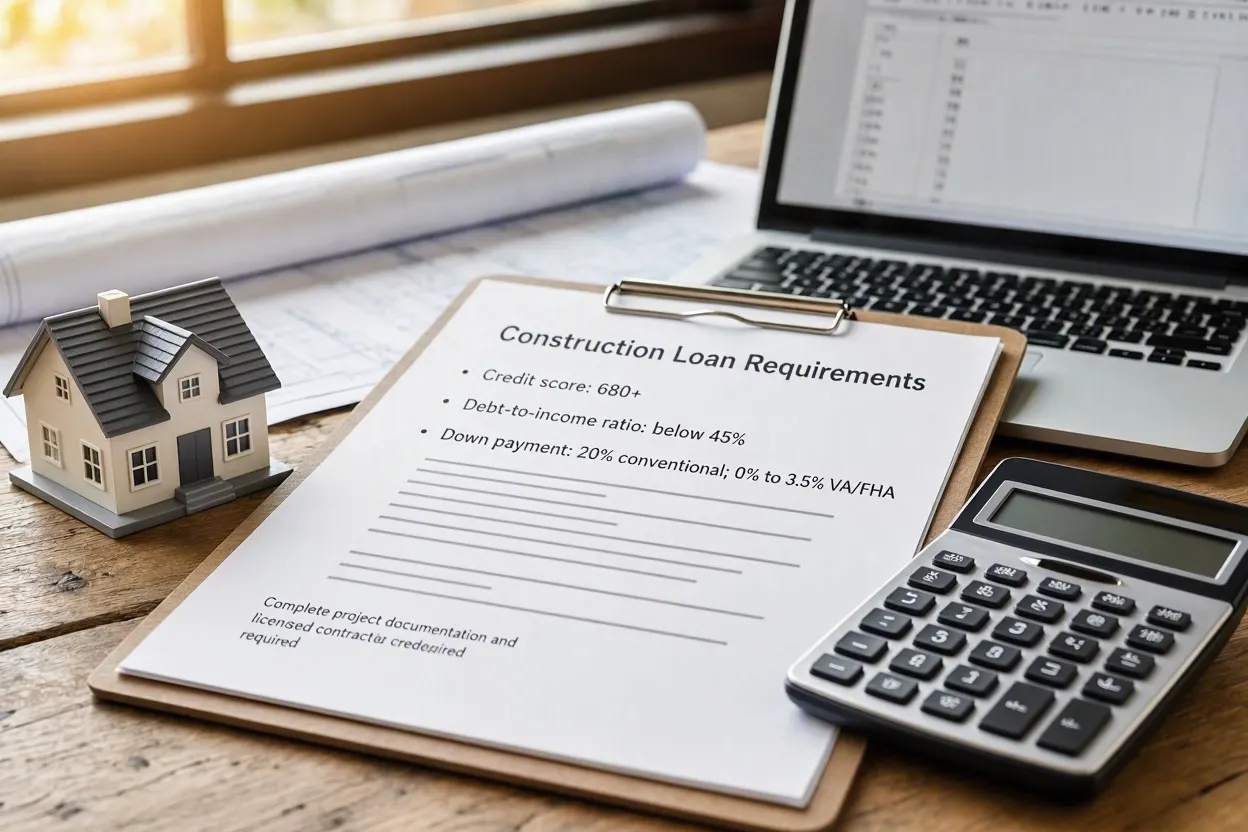
Construction loan approval depends on borrower financial strength, contractor credentials, and complete project documentation. Those standards generally run stricter than a typical mortgage application.
Borrower requirements commonly include:
- A credit score of 680 or higher
- A debt-to-income ratio that generally stays below 45%
- A down payment of 20% for conventional programs, or as low as 0% to 3.5% under VA and FHA programs
Contractor and project requirements include:
- A licensed general contractor with verified liability insurance and workers’ compensation coverage
- A signed builder contract with a defined project timeline
- An itemized budget covering materials, permits, and labor
- Finalized architectural blueprints reviewed by the lender’s underwriting team
- A builders risk insurance policy covering theft, fire, and storm damage during the build
A borrower with a 640 credit score generally won’t qualify for a conventional construction loan. An FHA-backed program may still open a path forward, depending on total debt load and the contractor’s qualifications, since FHA guidelines allow more flexibility on credit thresholds than conventional underwriting.
How Do You Get a Construction Loan for a Home?
Five steps stand between a borrower and a fully approved construction loan, starting with picking a contractor and ending with underwriting sign-off.
- Line up a licensed general contractor who’s actually built something this size before, not just something in the same zip code.
- Shop the loan itself. Local banks, credit unions, and specialty construction lenders all price draws, rates, and down payments differently, and the gap between offers is often bigger than borrowers expect.
- Pull together the paperwork: tax returns, recent bank statements, pay stubs, the signed builder contract, and a line-item project budget an underwriter can actually follow.
- Submit the application. From there, the lender runs credit underwriting, verifies income, and orders an as-completed appraisal, one based on the home’s future value once it’s built, not what the empty lot is worth today.
- Purchase builders risk insurance before the first draw releases, since most lenders won’t fund construction without proof of coverage on file.
Step five is a common source of closing delays: many lenders hold the first draw until builders risk coverage documentation arrives, so borrowers who line up insurance early tend to move through closing faster than those who wait.
Construction Loan vs. Land Loan: What’s the Difference?
A land loan pays for the dirt. A construction loan pays for what gets built on it, and it comes with strings attached: an approved builder, finalized blueprints, and a construction timeline locked in before closing. Buyers who aren’t ready to break ground right away use a standalone land loan to secure the property first, then apply for construction financing once the design phase wraps up.
| Feature | Land Loan | Construction Loan |
| Purpose | Purchases a parcel of raw or developed land | Funds the building phase of a home |
| Collateral | The land itself | The land plus the approved construction plan |
| Builder required | No | Yes, a licensed general contractor |
| Blueprints required | No | Yes, finalized architectural plans |
| Fund disbursement | Lump sum at closing | Staged draws tied to inspected milestones |
| Typical term | 2 to 5 years, or shorter for raw land | 12 to 18 months |
| Typical down payment | 20% to 50%, higher for land with no utilities | 20% conventional, 0% to 3.5% for VA/FHA |
| Interest structure | Fixed or variable, full principal accrues | Interest-only on the amount drawn |
If a lot purchase and a construction start date fall within the same closing window, combining both into a single land-and-build loan is usually more efficient than financing them separately. A borrower who already owns the parcel skips this comparison altogether; most lenders treat the land’s appraised value as equity, and that equity can satisfy some or all of the required down payment on the construction loan.
Is a Construction Loan Worth It for Building a Home?
Yes, if what you’re after is a custom home built to your own specifications. Control over the floor plan, lot selection, and finish materials comes at the cost of a stricter approval process and a higher short-term interest rate. A buyer working against a tight move-in deadline, say 60 days, is usually better served by a resale purchase under a traditional mortgage. No construction timeline fits that window. Spec homes sit between the two options: built by a developer on a set schedule without buyer input on design, they move faster than a custom build but offer less personalization. Change orders (a homeowner’s request to modify the plan mid-build) draw from the contingency reserve first, and they can add both cost and inspection delay. A kitchen layout change requested in month six often does exactly that, if it wasn’t budgeted upfront.
What Happens After Construction Is Complete?

Once the home passes final inspection, a municipal inspector issues a certificate of occupancy under local building code enforcement, and the construction loan either converts automatically into a permanent mortgage or gets replaced by one. Borrowers with a construction-to-permanent loan skip a second closing entirely, since principal-and-interest payments begin immediately under the new mortgage terms, while borrowers with a construction-only loan face a separate mortgage application, a second closing, and an additional round of closing costs.
Conclusion
Construction loans solve a problem traditional mortgages can’t: financing a house that doesn’t exist yet. Staged draws, interest-only payments, and stricter contractor vetting all stem from one fact. The collateral a normal mortgage relies on isn’t there until the final walkthrough. Line up a licensed contractor, a strong credit profile, and builders risk insurance before you apply, and you’ll generally move through underwriting faster than borrowers who don’t. From there it’s one real decision: rate certainty now with a construction-to-permanent loan, or the flexibility to shop lenders again once the home is built.
FAQs

Rachel Park
Rachel Park leads ConstructionSpedia’s sustainability, roofing, and building materials content. She holds a Master of Science in Sustainable Building Systems from the University of California, Berkeley and is a LEED Accredited Professional (LEED AP BD+C).
With over 10 years of experience in commercial and residential construction, Rachel specializes in roofing systems, sustainable building practices, energy-efficient materials, waterproofing, insulation, and building performance. At ConstructionSpedia, she researches, reviews, and publishes expert content on roofing, construction, home improvement, and green building to help homeowners and industry professionals make informed decision
Related Posts