Cool Roofing Materials: Types, Costs, and Savings Guide for U.S. Homes and Buildings
Cool roofing materials are roof products engineered to reflect sunlight and release absorbed heat rather than trap it, which lowers roof surface temperature and reduces the energy a building needs for cooling. A standard dark asphalt shingle roof can reach 150°F to 190°F on a sunny afternoon. A white or reflective roof under the same conditions often stays 50°F to 60°F cooler, according to measurements from the Lawrence Berkeley National Laboratory (LBNL) Heat Island Group. That temperature gap is the entire reason cool roofing materials exist, and it’s the number every homeowner, contractor, and building owner should anchor their decision to.
This guide breaks down every major category of cool roofing materials sold in the United States, compares cost and performance data, and explains which options fit which climate.
What Are Cool Roofing Materials?
Cool roofing materials are products with high solar reflectance and high thermal emittance, the two properties that determine how much heat a roof absorbs versus releases. Solar reflectance measures the percentage of sunlight a surface bounces away, rated on a scale from 0 to 1. Thermal emittance measures how efficiently a surface releases absorbed heat as infrared radiation, also rated from 0 to 1. Combine both values and you get the Solar Reflectance Index (SRI), a single number the Cool Roof Rating Council (CRRC) and ENERGY STAR use to rate and certify roofing products.
A dark asphalt shingle typically scores between 0.05 and 0.15 on solar reflectance; a white membrane roof can score between 0.70 and 0.85, per CRRC directory listings. Color plays the largest role in this difference, but it isn’t the only factor: surface texture, coating chemistry, and product age all shift the number over time.
How Cool Roofing Materials Work
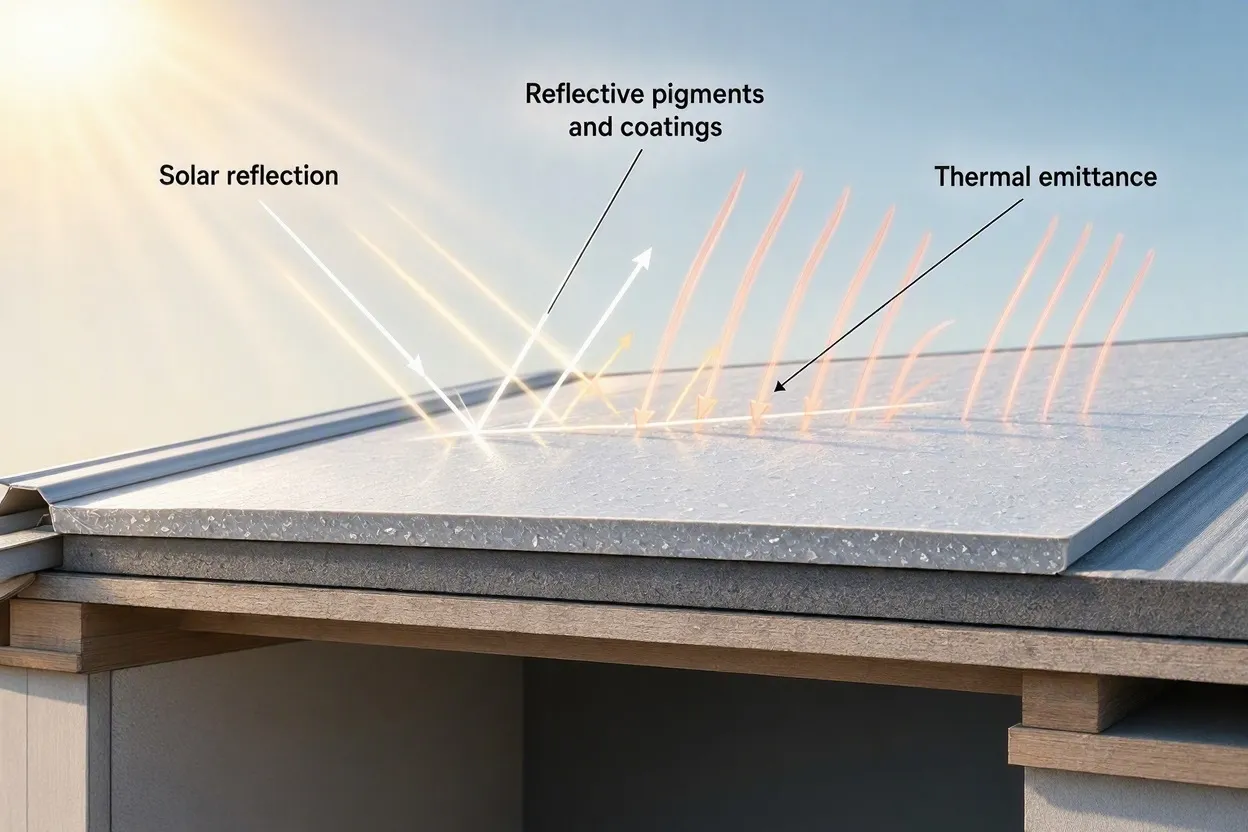
Cool roofing materials work by combining reflective pigments or coatings with surface finishes that release heat quickly instead of storing it in the roof deck below. Two mechanisms drive the effect, along with the pigment technology manufacturers use to achieve it:
- Solar reflection: the surface bounces incoming solar radiation away before it converts to heat
- Thermal emittance: whatever radiation the surface does absorb gets released back into the atmosphere as infrared energy rather than transferring into the building’s interior
- Light-colored pigments: reflect more wavelengths across the visible spectrum naturally, which explains why traditional white roofs perform so well
- Cool-color pigment technology: reflects infrared wavelengths even in darker colors like green, brown, or terracotta, so the roof looks conventional while its reflective performance approaches that of a white surface
CRRC-listed products show a dark green metal roof using cool-color pigment technology reaching a solar reflectance around 0.40, compared to 0.05–0.10 for a standard dark-painted metal panel.
Types of Cool Roofing Materials
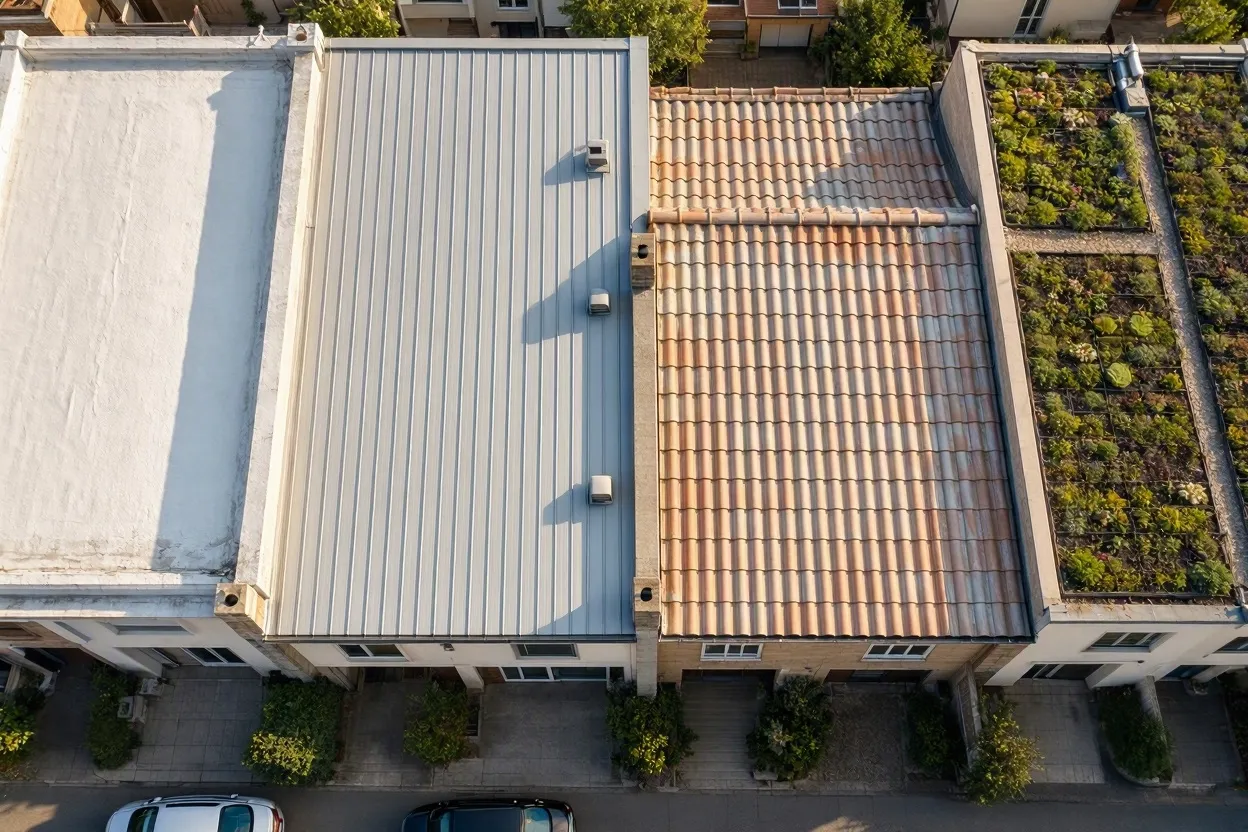
Every major roofing category now has a cool-rated version. The right choice depends on roof slope, budget, climate, and whether the building is residential or commercial. (Cost figures below reflect 2026 national material-cost averages and vary by region and contractor; confirm current pricing with a local supplier.)
Cool Metal Roofing. Reflective paint finishes or bare metal surfaces reach solar reflectance values between 0.30 and 0.70, depending on color and coating: unpainted corrugated metal starts around 0.30–0.50, white-painted panels climb to 0.60–0.70, and cool-pigment colored metal lands between 0.40 and 0.70. Metal roofing runs roughly $2–$4 per square foot in material cost and carries a 20–50+ year lifespan, making it one of the longest-lasting cool roofing materials on the market.
Cool Asphalt Shingles. Specialized granules push solar reflectance to 0.25–0.30, versus 0.05–0.15 for standard dark shingles. Installed cost runs about $15–$30 per square foot, keeping shingles the most budget-friendly steep-slope option. The reflectance gain is smaller than metal or membrane roofing, but for homeowners replacing an existing asphalt roof on a tight budget, cool-rated shingles still cut measurable heat gain without changing the roof’s appearance or installation method.
Clay and Concrete Tile. Cool-pigment colors reach 0.40–0.70 solar reflectance, and white or light terracotta finishes reach up to 0.70. Material cost runs $2–$6 per square foot with a 50+ year lifespan, the longest of any common roofing category. Tile also has inherent thermal mass: the material itself slows heat transfer through the roof deck even before reflectance is factored in. That matters most in hot, dry climates like the Southwest, where daytime heat and overnight cooling swing widely.
Single-Ply Membranes (TPO, PVC, EPDM). These reach the highest solar reflectance of any cool roofing material: white thermoplastic polyolefin (TPO) and polyvinyl chloride (PVC) membranes rate between 0.70 and 0.85. Ethylene propylene diene monomer (EPDM), the black rubber membrane still common on commercial flat roofs, sits near 0.05 reflectance unless topped with a white coating. Membrane roofing costs roughly $10–$20 per square foot and typically lasts 20–30 years. Because most commercial and industrial buildings use low-slope roofs, single-ply membranes dominate the cool roofing materials market in that segment.
Reflective Roof Coatings. Applied directly over an existing roof surface, these achieve solar reflectance values of 0.60–0.90 depending on coating chemistry and number of coats. At around $10 per square foot, coatings are the least expensive way to convert an existing dark roof into a cool roof without full replacement. Elastomeric acrylic and silicone coatings are the two most common types sold in the U.S., and both extend roof life by shielding the underlying membrane or metal from ultraviolet degradation.
Green (Vegetative) Roofs. These use a vegetation layer over a waterproof membrane to reduce heat transfer through evapotranspiration rather than reflectance alone. They aren’t rated on the SRI scale because the cooling mechanism is biological, not optical, but the EPA documents surface temperature reductions comparable to high-reflectance membranes. Installation costs run higher than any other category here, often $15–$25 per square foot before structural reinforcement, which limits green roofs mostly to commercial buildings, municipal projects, and dense urban sites where stormwater management and heat mitigation get budgeted together.
Cost Comparison
| Material | Solar Reflectance (Cool Version) | Material Cost per Sq Ft* | Lifespan |
| Asphalt shingle | 0.20–0.30 | $15–$30 | 15–30 years |
| Metal roofing | 0.40–0.70 | $2–$4 | 20–50+ years |
| Clay/concrete tile | 0.40–0.70 | $2–$6 | 50+ years |
| Single-ply membrane (TPO/PVC) | 0.70–0.85 | $10–$20 | 20–30 years |
| Liquid-applied coating | 0.60–0.90 | ~$10 | Extends existing roof |
| Green/vegetative roof | Not SRI-rated | $15–$25+ | 30–50 years (membrane) |
*2026 national averages; confirm current regional pricing before budgeting.
Two patterns stand out. Reflectance and price don’t move together in a straight line: metal roofing delivers strong reflectance at a lower material cost than membranes do. Lifespan tells a similar story. Tile and metal beat shingles and coatings by a wide margin there, which changes the total cost of ownership even when the upfront price looks higher.
Benefits of Cool Roofing Materials
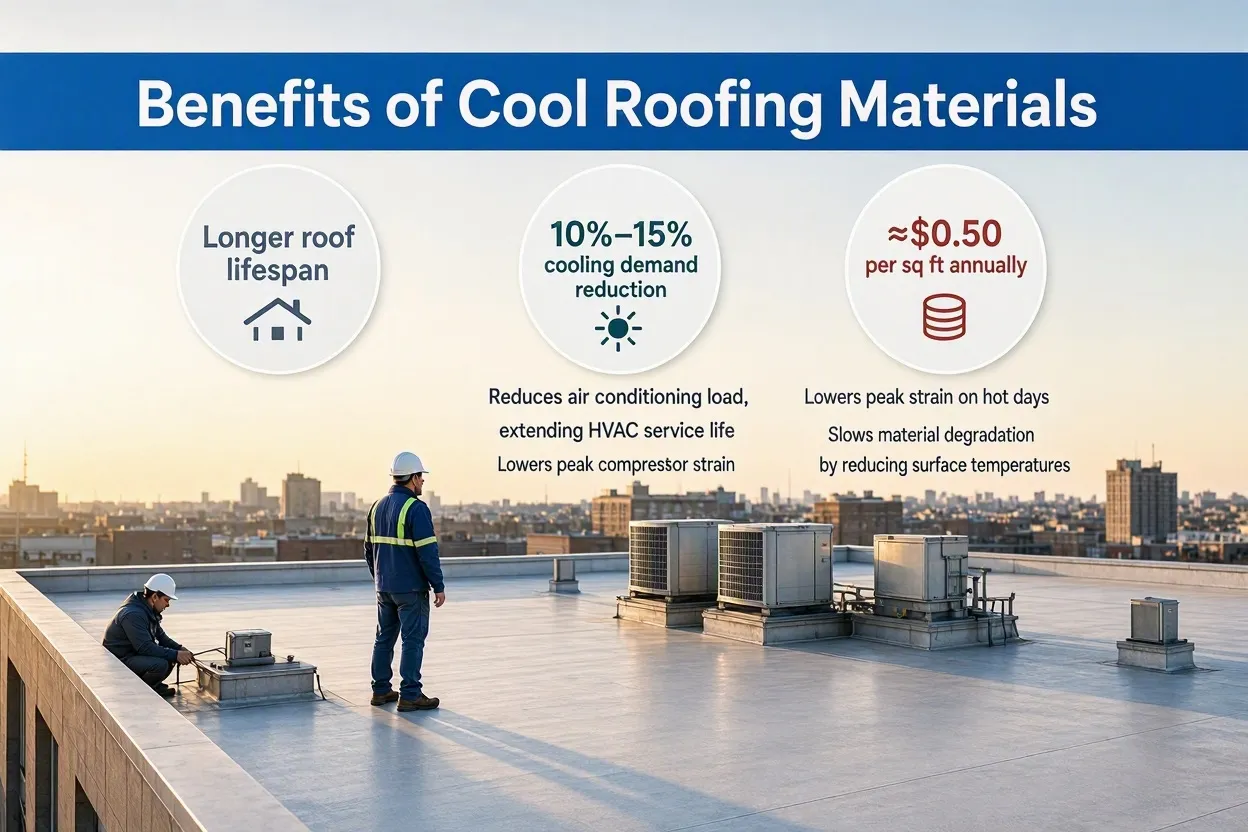
Cool roofing materials cut building cooling demand by 10% to 15%, according to ENERGY STAR, and save building owners an average of nearly 50 cents per square foot annually, according to the California Energy Commission. Beyond the utility bill:
- Reduced air conditioning load, extending the service life of existing HVAC equipment by lowering how hard compressors work on peak days
- Extended roof lifespan, since lower surface temperatures slow the thermal degradation that shortens membrane and shingle life
- Lower urban air temperatures. The EPA reports urban surfaces can run 2°F to 10°F hotter than surrounding rural areas, a gap cool roofs help narrow at scale
- Improved indoor comfort in buildings without air conditioning, which the EPA links to reduced risk of heat-related illness during extreme heat events
Here’s what that looks like in practice: switching a low-slope commercial roof from black EPDM (0.05 reflectance) to white TPO (0.80 reflectance) can drop roof surface temperature by 40–50°F or more on a 90–95°F day. That kind of gap typically shows up as a measurable dip in peak-season utility bills within the first cooling season.
Cool Roof Codes, Standards, and Incentives in the U.S.
Cool roofing requirements exist in U.S. building codes, most notably through the International Energy Conservation Code (IECC) and California’s Title 24 energy standards, both of which set minimum solar reflectance and thermal emittance thresholds for certain roof types by climate zone. California mandates cool roofs on most new commercial construction and many residential re-roofing projects in its warmer zones, and states that adopt the IECC increasingly reference similar reflectance minimums for low-slope commercial roofs. (Verify current Title 24 and IECC thresholds with a local building department, since code cycles update periodically.)
ENERGY STAR certification adds a separate benchmark: an initial solar reflectance of at least 0.65 and an aged three-year reflectance of at least 0.50 for low-slope products, versus 0.25 and 0.15 for steep-slope products. Commercial property owners may also be able to pursue the IRS Section 179 deduction for qualifying roof improvements, though eligibility rules and deduction limits change from year to year, so confirm current-year rules with a tax professional or irs.gov before assuming a project qualifies. Utility rebate availability also varies by state and provider, so checking with a local building department before purchasing remains the safest step.
How to Choose Cool Roofing Materials by Climate Zone
Cool roofing materials deliver the largest energy savings in hot climate zones with high annual cooling loads, corresponding roughly to Department of Energy (DOE) climate zones 1 through 3: most of the Southern United States, the Southwest, and coastal California. In these regions, a high-reflectance membrane or cool-color metal roof can offset a meaningful share of summer cooling costs within a few years of installation.
Colder climate zones (DOE zones 6 through 8: the Upper Midwest, the Mountain West, and the Northeast) see smaller net savings, since reduced winter solar heat gain can partially offset summer benefits. The DOE calls this the “winter penalty” and describes it as generally small. Still, it’s worth weighing against local heating costs before putting an aggressively reflective roof somewhere heating season runs longer than cooling season.
Building type matters as much as geography: a warehouse or big-box retail store with a low-slope roof and minimal insulation benefits enormously from a white membrane, regardless of climate zone, because the roof surface represents a larger share of total heat gain in a single-story structure than it does in a multi-story building.
Common Mistakes When Selecting Cool Roofing Materials
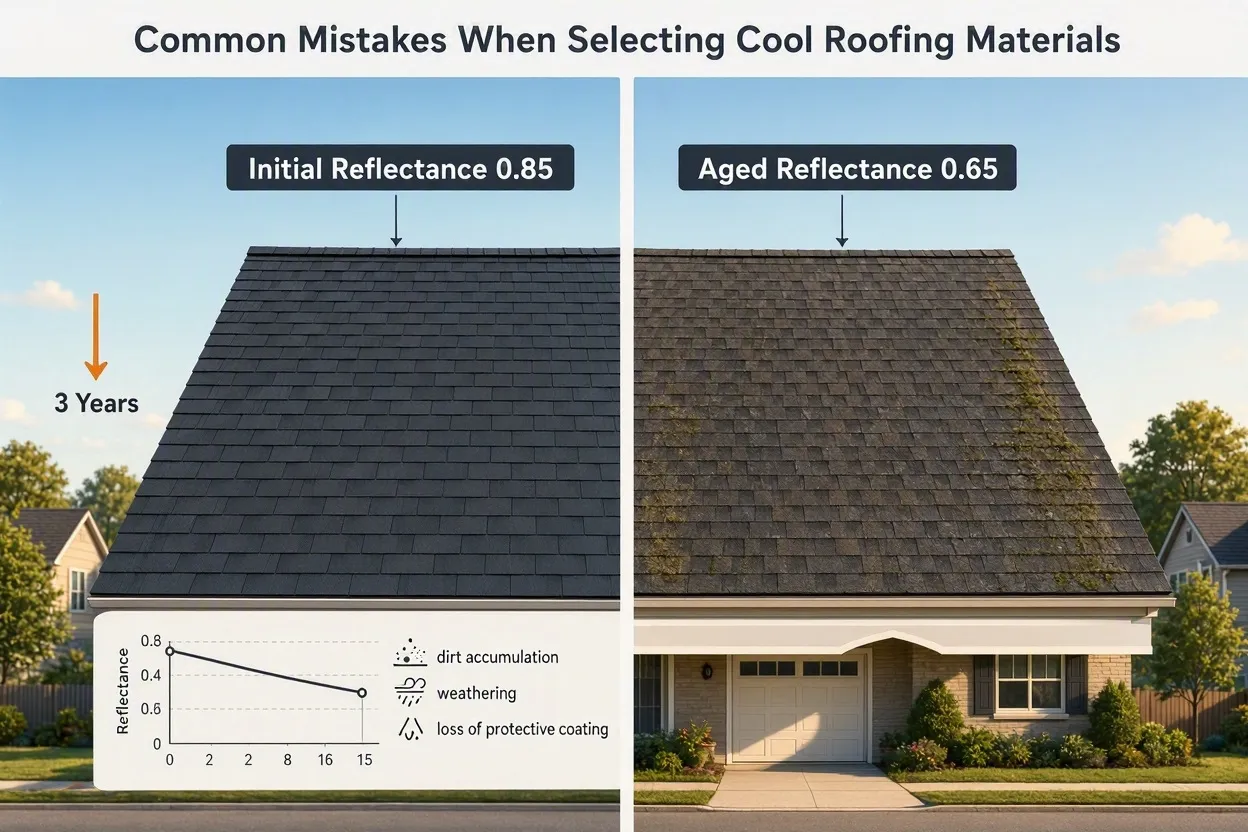
The most common mistake buyers make is choosing a material based on solar reflectance alone without checking the aged reflectance rating. Products can lose meaningful reflectance points within a few years of installation due to dirt accumulation and weathering. A roof rated at 0.85 reflectance out of the box might settle noticeably lower after three years of exposure, and that drop should factor into any energy-savings projection.
Three other mistakes come up often:
- Assuming every light-colored material is a certified cool roof, when only CRRC-rated or ENERGY STAR-certified products carry verified reflectance and emittance data
- Ignoring local code requirements before ordering materials, which can force a costly re-order if the selected product doesn’t meet a jurisdiction’s minimum SRI threshold
- Overlooking maintenance needs, since reflective coatings and membranes require periodic cleaning to maintain rated performance, unlike standard dark roofing that shows dirt less visibly
Conclusion
The right cool roofing choice comes down to three numbers: solar reflectance, thermal emittance, and aged performance after a few years of weathering. Checking a product against the CRRC directory before purchase confirms its certified reflectance data, and reviewing local code minimums beforehand avoids ordering a roof that doesn’t meet the jurisdiction’s requirements on the first try.
FAQs

Rachel Park
Rachel Park leads ConstructionSpedia’s sustainability, roofing, and building materials content. She holds a Master of Science in Sustainable Building Systems from the University of California, Berkeley and is a LEED Accredited Professional (LEED AP BD+C).
With over 10 years of experience in commercial and residential construction, Rachel specializes in roofing systems, sustainable building practices, energy-efficient materials, waterproofing, insulation, and building performance. At ConstructionSpedia, she researches, reviews, and publishes expert content on roofing, construction, home improvement, and green building to help homeowners and industry professionals make informed decision
Related Posts